
Kismet Meaning: Definition, Origin, and Real-Life Examples
Kismet is a noun meaning fate or destiny, usually said about events that feel so unlikely and so perfectly timed that people describe them as meant to happen.
It is one of those words that sounds a little mysterious even when you hear it in everyday conversation. Someone misses a train and meets their future spouse at the station, and a friend says, “That was kismet.” What they mean is simple: some things were always going to happen this way. But the word carries a long history, from an Arabic root about dividing shares to a Turkish saying about accepting your lot in life. Here is the full story.
Table of Contents
- What Does Kismet Mean?
- How Do You Pronounce Kismet?
- Where Does the Word Kismet Come From?
- Kismet vs Fate vs Destiny vs Serendipity: What’s the Difference?
- How Do People Actually Use Kismet?
- Kismet in Turkish Culture and Daily Life
- Kismet on Stage and Screen
- Kismet FAQs
What Does Kismet Mean?
Kismet means fate or destiny, the idea that certain events in your life are predetermined and unfold beyond your control. Collins defines it as the force which some people believe controls the things that happen to you in your life, while Wiktionary glosses it as a predetermined or unavoidable destiny.
What makes kismet different from plain “fate” is the flavor. When English speakers reach for kismet, they almost always mean it warmly. It describes the good surprises, the lucky timing, the meeting that changed everything. You will hear “it was kismet” far more often than “it was fate,” because fate can sound heavy and kismet sounds like a smile. The Cambridge Dictionary lists it as a noun in the same family as destiny, and Merriam-Webster’s thesaurus files it right alongside destinies and fates.
A few things about the word’s grammar and tone:
- Part of speech: noun, usually uncountable. You say “it was kismet,” not “it was a kismet.”
- Register: slightly literary or romantic. Fine in conversation, common in essays, wedding toasts, and captions.
- Connotation: positive or at least meaningful. People use kismet for events they feel grateful for, or for twists they have made peace with.
- Alternate spelling: kismat, which Collins also lists. It is much less common in English, but it is the standard spelling in Hindi and Urdu, where the word is an everyday part of the language.
How Do You Pronounce Kismet?
Say KIZ-met, with the stress on the first syllable. The “i” sounds like the “i” in “fizz,” and the second syllable rhymes with “met.” An alternative pronunciation, KIS-met (with a soft “s” instead of a “z” sound), is also listed by Collins and Wiktionary, which give the IPA as /ˈkɪz.mɛt/ and /ˈkɪs.mɛt/.
Which one should you use? Either is accepted, but KIZ-met is the more common pronunciation in American and British English. The soft-s version, KIS-met, tends to appear in South Asian English, closer to the Hindi and Urdu pronunciation of क़िस्मत (qismat). I have heard both in conversation and nobody blinks at either, so pick the one that comes naturally and move on.
Quick pronunciation tips
- Stress the first syllable firmly: KIZ-met, never kiz-MET.
- Keep it short and crisp. Two syllables, no drawling.
- Do not pronounce the “t” as a “d.” It is a clean “t,” like in “kit.”
Where Does the Word Kismet Come From?
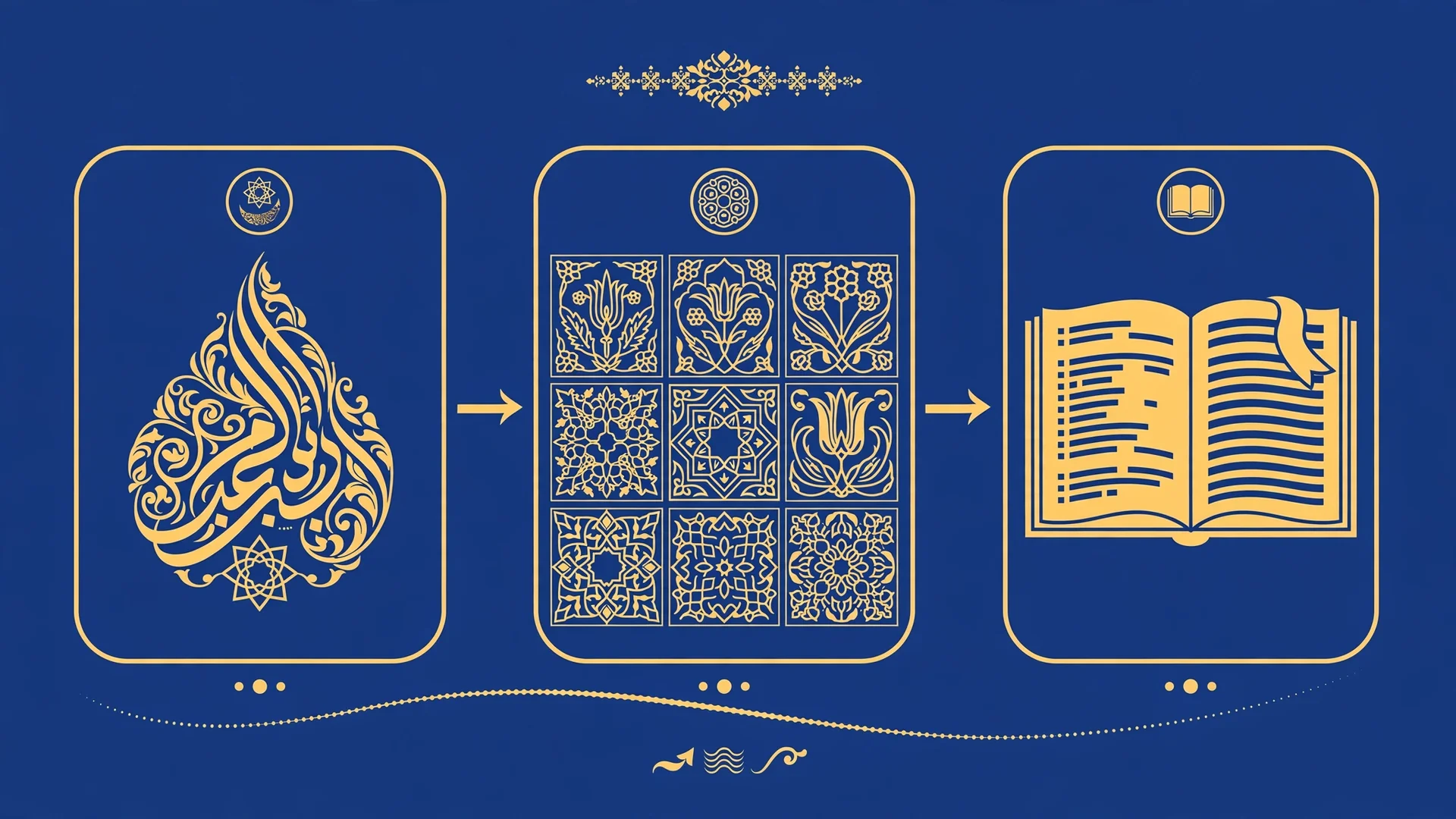
Kismet entered English in the 19th century from Turkish kısmet, which came from the Arabic qisma, meaning “portion” or “lot.” That is the literal journey: a word about your allotted share of life became, in English, a word about fate itself.
The chain is worth seeing laid out, because each link adds a shade of meaning:
| Language | Form | What it contributed |
|---|---|---|
| Arabic | qasama (“he divided”) | The root verb. Everything starts with the act of dividing or apportioning. |
| Arabic | qisma / qismah (“portion, lot, fate”) | The noun: your share, your lot, what has been allotted to you. |
| Persian | qismat (“portion, lot”) | Carried the word westward through Persian-speaking lands. |
| Ottoman Turkish | kısmet (“fate, destiny”) | Where “portion” hardened into “fate.” In Turkish it means the destiny dealt to you. |
| English (19th century) | kismet | Borrowed during the era of British contact with the Ottoman world; Collins dates the origin to the 1800s. |
There is a quiet poetry in that history. The original Arabic sense is almost administrative: your portion, your share, your lot. Somewhere along the road through Persian and Turkish, “your share” turned into “your fate,” as if life hands everyone a sealed envelope and the word for the envelope became the word for what is inside it.
The word also traveled sideways. Yiddish borrowed kismet from Turkish in the 1800s, and it still appears in Yiddish-influenced English with the same fate-or-destiny sense. In Hindi and Urdu it is spelled qismat or kismat and used constantly, in films, songs, and daily speech, to talk about luck and destiny. That is why you will sometimes see the kismat spelling: it reflects how the word lives in South Asia, even though kismet is the standard English form.
Kismet vs Fate vs Destiny vs Serendipity: What’s the Difference?
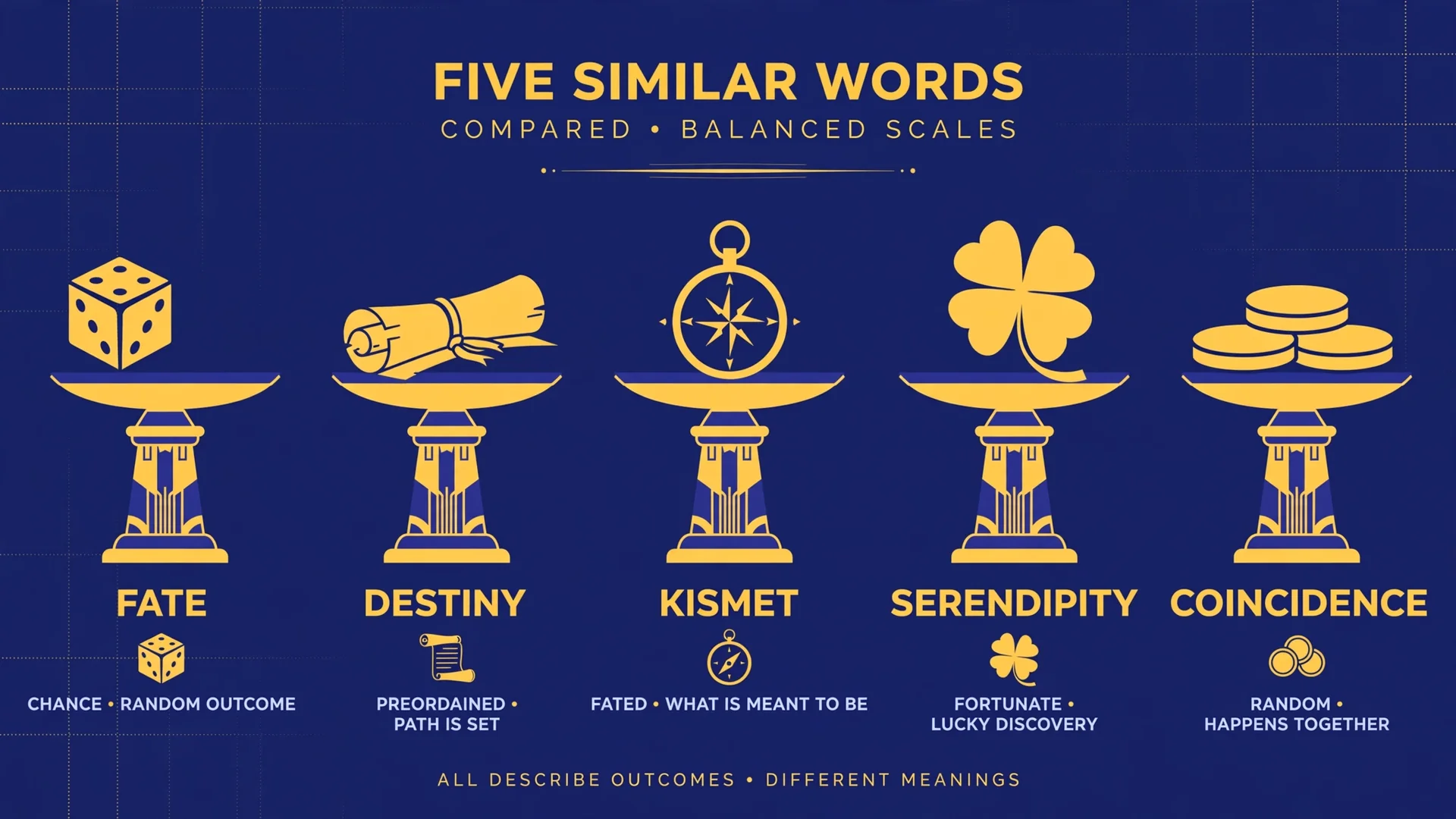
Kismet and fate are the closest pair, both meaning a predetermined course of events, while destiny adds a sense of purpose or a grand plan, serendipity means a happy accident with no predetermination at all, and coincidence is simply two things happening together by chance. If it feels destined, say kismet; if it feels random, say coincidence.
English has more words for “things happening” than almost any situation needs, and they blur together. Here is the practical distinction, the way native speakers actually use them:
| Word | Core idea | Feels like… | Example |
|---|---|---|---|
| Kismet | Fate with a warm, mystical edge | “It was meant to be.” | “We sat next to each other on the flight. Kismet.” |
| Fate | The unavoidable outcome | Heavier, sometimes darker | “He accepted his fate.” |
| Destiny | A purposeful end point | Grander, more dramatic | “She was destined for the stage.” |
| Serendipity | A lucky accident | Delightful but unplanned | “Finding that bookshop was pure serendipity.” |
| Coincidence | Two events lining up | Neutral, just surprising | “What a coincidence, we ordered the same thing.” |
The borderlines matter. Kismet and fate overlap the most, but fate can be grim (a tragic fate) while kismet rarely is. Kismet and serendipity are the pair people mix up: serendipity is about stumbling into something wonderful by accident, with no larger plan implied, while kismet insists there was a plan, even if you cannot see it. And kismet is never coincidence. A coincidence has no meaning behind it; calling something kismet is exactly the claim that meaning was there all along.
How Do People Actually Use Kismet?
People use kismet as a one-word explanation for life’s well-timed surprises, most often in the phrase “it was kismet,” and it shows up across romance, careers, travel, and literature whenever someone wants to say an outcome felt prearranged rather than random.
The classic “it was kismet” moments
Listen for the pattern: something unlikely happens, and instead of analyzing the odds, the speaker names the pattern. “It was kismet.” Romance is the home turf. Two people keep running into each other in a big city and eventually give up pretending it is an accident. But the word travels well beyond love stories:
- Careers: “I applied on the last day, on a whim, and the role turned out to be perfect for me. Kismet.”
- Friendship: “We were seated together at a wedding in another country and talked until midnight. It had to be kismet.”
- Travel: “The road was closed, so we took the detour and found the most beautiful village. Pure kismet.”
- Second chances: “Losing that client hurt at the time, but it pushed me to start my own thing. Maybe it was kismet.”
- Everyday luck: “The exact book I needed was sitting on the free shelf outside the library. Kismet.”
Kismet in literature
Writers have been fond of this word for well over a century, and the literary record is part of what gives kismet its slightly elevated tone. Wiktionary’s entry collects some gems. Rudyard Kipling used it in 1887: “But these things are kismet, and we only find out all about them just when any knowledge is too late.” F. Scott Fitzgerald gave it a personality in 1920, writing of “fickle Kismet, who for a day had played with him bitterly and sardonically,” treating fate itself as a character who toys with people before rewarding them. As recently as 2019, a Guardian music review described Madonna’s early MTV-era reinvention as her “first stroke of kismet.”
Notice what the writers do: they never use kismet for the ordinary. It is reserved for the turn, the twist, the moment the story changes direction. That is a good rule for using it yourself. Save kismet for the moments that genuinely surprise you.
Kismet in Turkish Culture and Daily Life
In Turkish, kısmet is not just a vocabulary word; it is a small philosophy of acceptance. When something unexpected happens, good or bad, it is common to hear “Bu benim kısmetimmiş,” which means “This was my fate” or “This was my lot.” The phrase carries grace with it: accept what came, because it was always yours.
That acceptance has two faces, and Turkish speakers use both. On one side there is comfort. A missed opportunity stings less when you can say it simply was not your kısmet. On the other side there is motivation, because kısmet is also used for good fortune you hope is coming your way. Parents say it about their children’s futures; friends say it over coffee when talking about love. The word holds both resignation and hope at once, which is probably why it survived the journey into so many other languages intact.
A practical note for English learners: if you encounter kismet in Turkish, Urdu, Hindi, or Arabic contexts, the meaning is the same, only the spelling and pronunciation shift slightly. Qismat, kismat, kısmet: same word, same idea, different alphabets.
Kismet on Stage and Screen
The word kismet also has a second life as a title, and it is a good one. In 1911, Edward Knoblauch (who later anglicized his name to Edward Knoblock) wrote a three-act play called Kismet, set in old Baghdad, about a wily beggar-poet named Hajj whose schemes keep turning out better than they should. The title, as Wikipedia’s entry on the play notes, means “Fate or Destiny” in Turkish, which tells you the theme before the curtain even rises.
The play was a genuine hit. It opened at London’s Garrick Theatre in April 1911 and ran for over 300 performances, then crossed to Broadway, opening on Christmas Day 1911 for a run of 184 performances. Hollywood came calling repeatedly: film versions appeared in 1914, 1920, 1930, and 1944, the last starring Ronald Colman and Marlene Dietrich.
Then came the version most people know. In 1953, Robert Wright and George Forrest adapted the story into a Broadway musical, setting new lyrics to themes from the music of the Russian composer Alexander Borodin, including the famous “Stranger in Paradise.” The musical won the Tony Award for Best Musical in 1954, played London’s West End, and was filmed by MGM in 1955. More than a century after the play, “kismet” still reads as exotic and fated to English-speaking audiences, which is exactly why Knoblock chose it.
Kismet FAQs
What does kismet mean in simple words?
Kismet means fate or destiny. It is what people say when something happens that feels too perfectly timed to be an accident, as if it was meant to be.
How do you pronounce kismet?
Say KIZ-met, with the stress on the first syllable. A second accepted pronunciation is KIS-met with a soft “s.” Both are listed in major dictionaries.
Is kismet the same as fate?
Almost, but not quite. Fate is the broader, heavier word and can be dark. Kismet carries a warmer, slightly mystical tone and is used mostly for welcome surprises and meaningful coincidences.
What is the difference between kismet and serendipity?
Serendipity is a happy accident with no plan behind it. Kismet claims there was a plan, that the event was destined. Finding money on the street is serendipity; meeting your life partner because you both took the wrong train is kismet.
What does kismet mean in Arabic?
The Arabic root is qisma (qismah), which literally means “portion,” “share,” or “lot.” From that concrete sense of your allotted share, the meaning widened to “fate” as the word traveled through Persian and Turkish.
Is it spelled kismet or kismat?
Kismet is the standard English spelling. Kismat is a recognized variant (Collins lists it) and is the common spelling in Hindi and Urdu, where the word is used every day.
How do I use kismet in a sentence?
Use it as a noun, usually after “it was” or “felt like”: “We met by chance on a rainy day, and it felt like kismet.” Or: “Missing that flight turned out to be kismet, because I met my best friend in the airport lounge.”
Where This Definition Comes From
The definition and etymology above are drawn from the Collins English Dictionary entry for kismet, the Cambridge Dictionary entry for kismet, and the Wiktionary entry for kismet, which also supplied the literary quotations from Kipling and Fitzgerald. The pronunciation guidance follows the IPA given by Collins and Wiktionary. The stage and screen history comes from Wikipedia’s entries on the 1911 play Kismet and its later adaptations. Competitor coverage was checked against BetterWordsOnline’s Kismet definition page, which confirmed the standard dictionary treatment this article builds on.
Related:
SMS Meaning: What Does SMS Mean in Text?
What Does ISTG Mean in Text? “I Swear to God” Explained
Serendipity Meaning, Examples, Origin & Usage
Debauchery Meaning: Definition, Etymology & Examples
Ennui Meaning: Definition, Pronunciation & Examples



One Comment