
SMS Meaning: What Does SMS Mean in Text?
Most of us say “text me” without a second thought, but your phone may quietly send that message as an SMS instead. SMS stands for Short Message Service: the carrier-based system that exchanges short plain-text messages between mobile phones over the cellular network, not the internet.
It is one of the oldest tricks in your phone’s book, and it is still running underneath most of your daily messaging. Once you know what SMS actually is, a few little phone mysteries clear up fast: the 160-character limit, the green text bubbles, and why a message can still arrive when your data is completely off.
Table of Contents
- What Does SMS Mean?
- SMS vs Text Message: Is There a Difference?
- Why Do SMS Messages Stop at 160 Characters?
- A Short History of SMS
- SMS vs MMS vs RCS vs iMessage
- What “Sent as SMS” Means on Your Phone
- When Someone Says “SMS Me”: A Context Decoder
- Is SMS Still Relevant in 2026?
- SMS Accidentally Invented Texting Slang
- Frequently Asked Questions
- Where This Came From
What Does SMS Mean?
SMS means Short Message Service. In plain terms, it is the mobile industry’s standard way of exchanging short text messages between phone numbers over a cellular network. Merriam-Webster defines SMS in two ways: as the technology for sending short text messages between mobile phones, and as a single message sent using that technology. Most people just call the message itself a text.
Say it letter by letter: “ess-em-ess.” Cambridge lists SMS as a noun covering both the service and the message (“a message sent by SMS”), and even as a verb, with the example “I SMSed her several times.” That verb form tells you how naturally the word slid into everyday speech: nobody says “I sent her a short message service message.”
Here is the two-sense split in action:
“I’ll send you an SMS when I land.” (the message)
“Does your plan include unlimited SMS?” (the service)
Same three letters, two jobs. Context always tells you which one is meant.
SMS vs Text Message: Is There a Difference?
Technically yes, though almost nobody makes the distinction out loud. Every SMS is a text message, but not every text message is an SMS. “Text message” is the umbrella term for anything typed into a messaging app, including MMS photo messages, RCS chats, iMessages, and WhatsApp messages. SMS is one specific kind: the plain, cellular one.
TextMagic puts it neatly: only the plain, cellular message is an SMS. Send a photo and it becomes an MMS. Send it iPhone to iPhone over Wi-Fi and it becomes an iMessage. All of them are “texts,” but only one of them is an SMS.
What the phrasing usually signals:
| What you hear | What it usually means |
|---|---|
| “Text me” | Any message, any app, any phone |
| “SMS me” | A plain carrier text to my phone number, no app required |
| “WhatsApp me” | A message inside WhatsApp specifically |
| “iMessage me” | An Apple-to-Apple chat, the blue bubbles |
In everyday US speech, “text me” covers everything and “SMS” has mostly faded from conversation. In much of continental Europe, though, “send me an SMS” is still the normal phrasing.
Why Do SMS Messages Stop at 160 Characters?
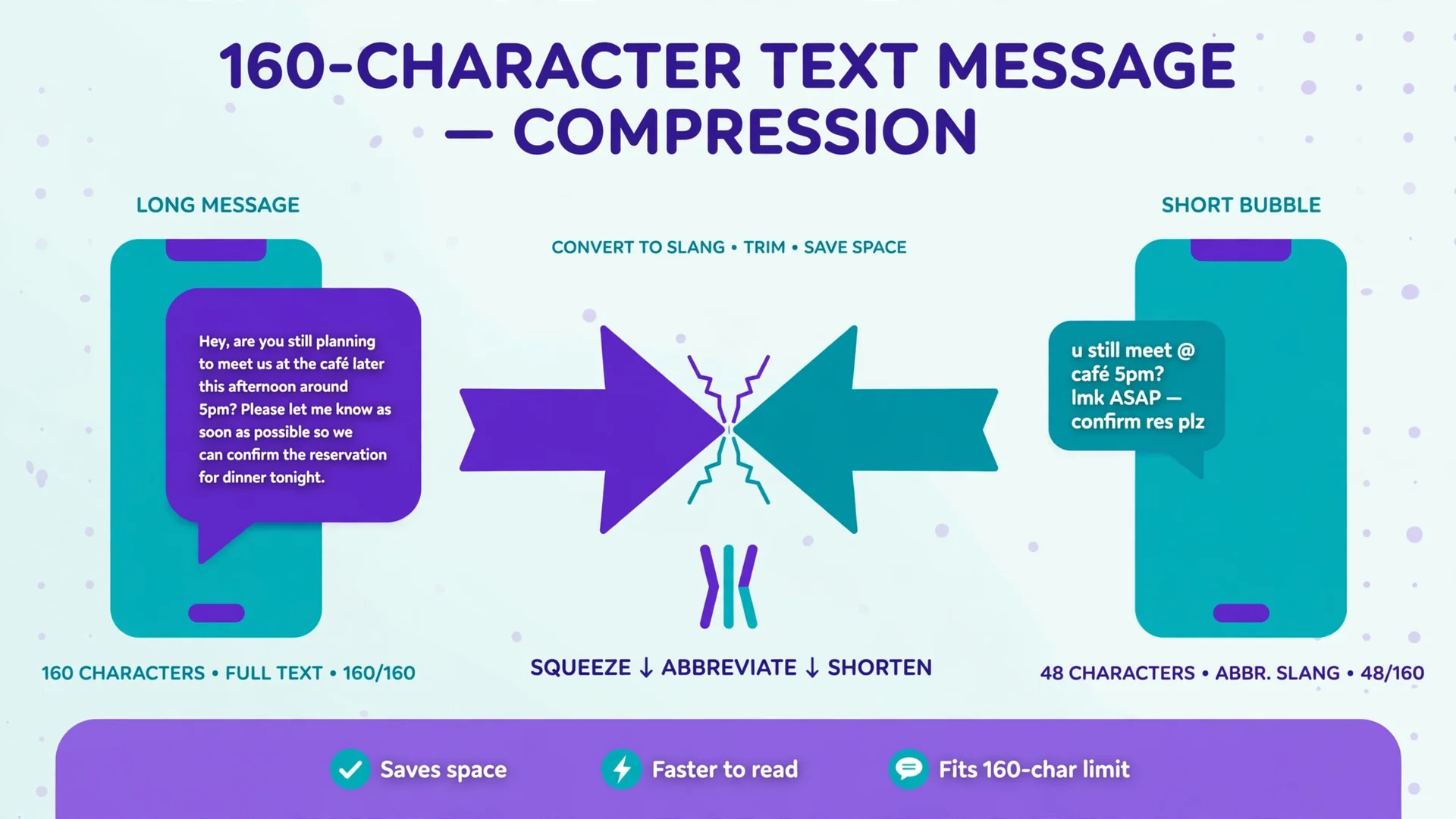
The 160-character limit comes straight from the engineering. Each SMS rides in a 140-byte slot on the cellular signaling channel, which fits exactly 160 characters in the compact GSM-7 alphabet. German engineer Friedhelm Hillebrand settled on that number after studying the typical lengths of postcard and Telex messages and deciding it was enough for most short notes.
The concept grew out of 1984 work by Hillebrand and Bernard Ghillebaert in the Franco-German GSM cooperation. They realized unused space on the network’s signaling paths could carry tiny messages at almost no cost, but only if the messages stayed small enough to fit the existing signaling formats. That 128-byte limit became 140 bytes, or 160 seven-bit characters, and the cap stuck for decades.
Two quirks change the math on modern phones:
| Message type | Characters per segment | Why |
|---|---|---|
| Plain text (GSM-7) | 160 | Standard 7-bit alphabet |
| With emoji or accented letters | 70 | Switches to heavier Unicode encoding |
| Long messages, split and rejoined | 153 per segment | Some characters carry the “stitch me back together” instructions |
That is why one emoji can quietly turn a single message into two, and why a long text may look like one block on your screen while your carrier counts several messages. Wikipedia notes that the 160-character ceiling also shaped early texting culture itself, which brings us to the slang story near the end of this guide.
A Short History of SMS
SMS went from a 1984 engineering idea to a global habit in about fifteen years. The first real SMS was sent on 3 December 1992, when test engineer Neil Papworth typed “Merry Christmas” on a computer and sent it over Vodafone’s network in the UK to a colleague’s handset. The colleague could receive it but had no way to reply, because phones could not send texts yet.
Growth was slow at first. In 1995 the average GSM customer sent just 0.4 messages a month, and in the UK you could only text people on your own network until 1999. Then the habit caught fire: the Philippines became known as the texting capital of the world around 2001, and by 2010 an estimated 6.1 trillion SMS messages were flying around the planet every year.
| Year | What happened |
|---|---|
| 1984 | Friedhelm Hillebrand and Bernard Ghillebaert develop the SMS concept in Franco-German GSM cooperation |
| 1991 | Merriam-Webster records the first known printed use of the term SMS |
| 3 December 1992 | First SMS ever sent: Neil Papworth of Sema Group sends “Merry Christmas” from a PC over Vodafone’s UK network to Richard Jarvis’s Orbitel 901 |
| 1993 | First commercial deployments, including Telia in Sweden; Radiolinja in Finland offers person-to-person texting |
| January 1994 | The Nokia 2010 becomes the first phone that makes composing SMS easy |
| 1999 | UK networks lift the same-network-only restriction; texting starts to explode |
| 2001 | The Philippines earns the “texting capital of the world” nickname |
| 2010 | 6.1 trillion SMS messages sent worldwide; about 3.5 billion active users |
| 2024 | Apple adds RCS support in iOS 18, giving the open successor to SMS a real foothold |
Merriam-Webster traces the word itself to 1991, a year before the first message: the standard was written before the habit existed, and the world took about a decade to catch on.
SMS vs MMS vs RCS vs iMessage
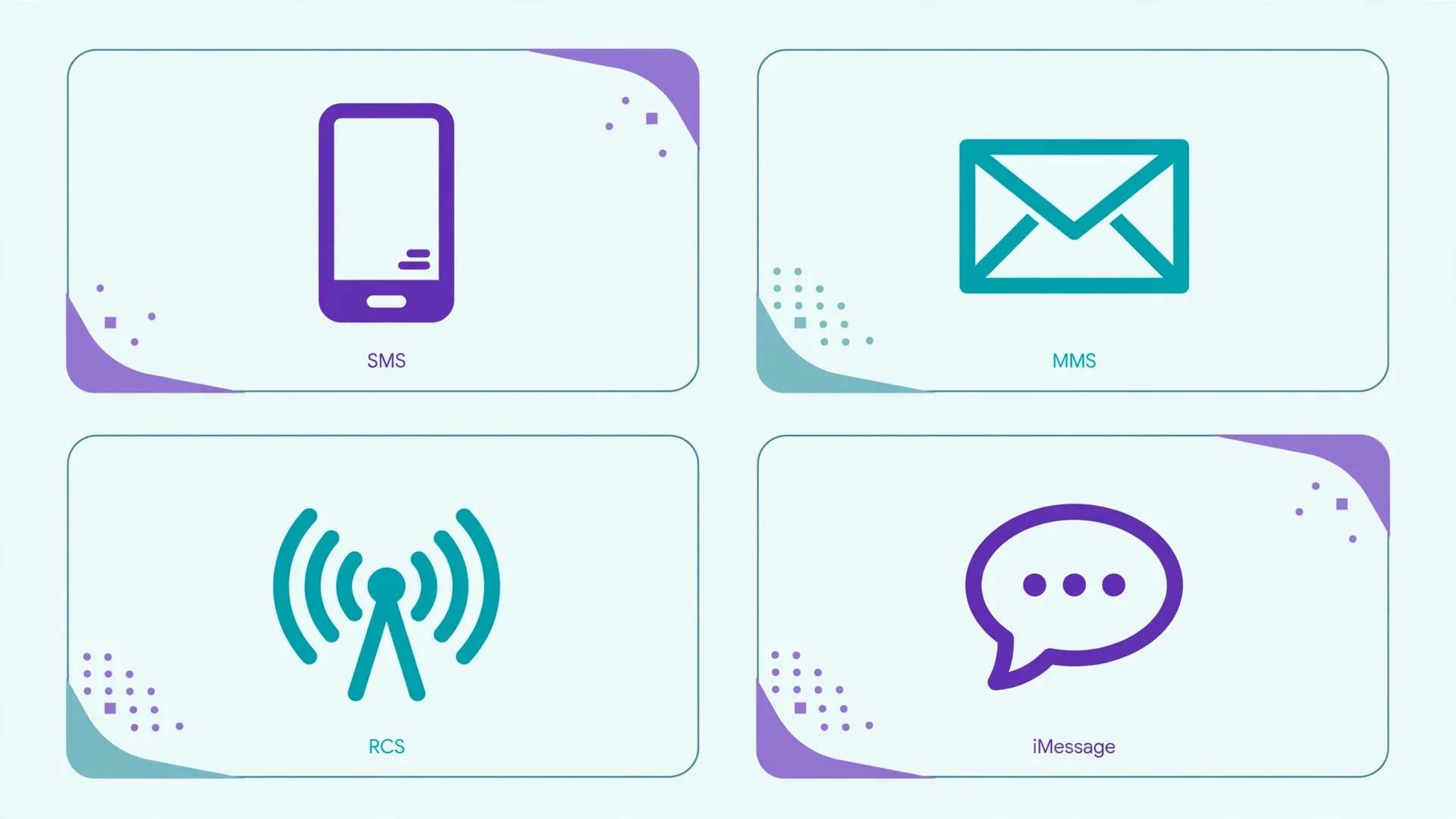
SMS is the plain one in a family of four. MMS is SMS’s sibling that carries photos, videos, and longer texts. RCS is the modern carrier standard with read receipts, typing indicators, and better group chats. iMessage is Apple’s internet-based take on the same idea, locked to Apple devices. They all live in the same Messages app, which is exactly why the labels get confusing.
| SMS | MMS | RCS | iMessage | |
|---|---|---|---|---|
| Stands for | Short Message Service | Multimedia Messaging Service | Rich Communication Services | Apple’s proprietary chat |
| Travels over | Cellular network | Mobile data | Data or Wi-Fi | Data or Wi-Fi |
| Text limit | 160 characters | About 1,600 | Very high | Very high |
| Media | Text only | Photos, video, audio | Hi-res media, reactions | Hi-res media, effects |
| Read receipts | No | No | Yes | Yes |
| Encryption | No | No | Sometimes | Yes, Apple to Apple |
| Needs internet | No | Yes | Yes | Yes |
The practical way to remember it: SMS is the lowest common denominator that always works. RCS and iMessage are richer, but they need both people on supported devices with a data connection. When those conditions fail, your phone quietly falls back to SMS so the message still gets through. That fallback is also why SMS refuses to die, as TextMagic’s guide points out: it runs on every phone ever made, with no app to download and no connection to lose.
What “Sent as SMS” Means on Your Phone
When your phone says a message was “sent as SMS,” it means the fancier service could not deliver it, so your phone dropped back to the plain carrier standard. On an iPhone this usually happens when the other person is not on an iPhone, or when either side has no data connection. The message still arrives; it just shows up green.
On iPhones, the empty message field tells you what the phone negotiated: “iMessage,” “Text Message · RCS,” or “Text Message · SMS.” Blue bubbles mean iMessage, traveling Apple to Apple over the internet. Green bubbles mean the message went by SMS, MMS, or RCS instead, which is why green chats lack typing indicators and read receipts.
Behind the scenes, your phone hands the message to the nearest cell tower, which passes it to the carrier’s Short Message Service Center, the SMSC. The SMSC uses a store-and-forward system: if the recipient’s phone is off or out of range, it holds the message and retries later. The whole trip usually takes a second or two, and it works with mobile data switched off entirely.
When Someone Says “SMS Me”: A Context Decoder
When someone says “SMS me,” they almost always mean one thing: send a plain text to my actual phone number, not a message inside WhatsApp, Instagram, or any other app. It is a small phrase that carries useful information about what they want and how they want to receive it, so it pays to read it right.
| Situation | What “SMS me” means here | How to read it |
|---|---|---|
| A new contact says “SMS me your number” | Send it as a plain text to their phone | They want the number itself, not an app chat |
| Someone abroad says “send me an SMS” | Normal phrasing in much of continental Europe | Same as “text me,” no special meaning |
| A business says “we’ll SMS you a code” | A one-time verification code arrives as plain text | Watch your default Messages app, not the company’s app |
| An alert service offers “SMS updates” | Plain-text notifications, no app needed | Works even on a basic phone with no data |
| A friend says “just SMS me, not WhatsApp” | They want it off the internet | Maybe they have no data, or they keep work and personal chats separate |
The tone is neutral and practical, never slangy. Nobody says “SMS me” to sound cool; they say it when the channel matters. If you hear it from a business or a service, treat it as a promise that the message will reach any phone, which is exactly why verification codes and delivery alerts still ride on SMS.
Is SMS Still Relevant in 2026?
Very much so. SMS remains the default for anything that absolutely has to arrive: login verification codes, bank fraud alerts, delivery updates, appointment reminders, and emergency broadcasts. It works on every phone, needs no app and no internet connection, and lands in seconds. That universal reach is why businesses still lean on it even with WhatsApp and iMessage everywhere.
One honest caveat: SMS was never built for privacy. It has no end-to-end encryption, so the message travels as readable text through carrier systems. Intego’s security guide explains the practical risks: interception through signaling weaknesses, SIM-swap attacks that move your number onto an attacker’s device, and smishing, the SMS version of phishing. The US cybersecurity agency CISA recommends moving away from SMS-based two-factor login where a stronger option, like an authenticator app or passkey, is available.
For everyday use, the rules are simple. Codes sent to you after you start a login are fine to use. Never share a verification code with someone who calls or texts asking for it. Do not click links in unexpected texts, even if they mention a real company or a recent order. And never send passwords, card numbers, or ID details by SMS; use the company’s app or website for anything genuinely sensitive.
SMS Accidentally Invented Texting Slang
Blame the 160-character limit for LOL. When every character counted and early phones made typing a genuine chore, texters started shrinking words: “laughing out loud” became LOL, “be right back” became BRB, “on my way” became OMW. That squeeze created an entire genre of texting shorthand, and much of it never left.
The old multi-tap keyboards deserve part of the credit too: typing one “s” meant tapping the 7 key four times, so short forms were not just stylish, they were merciful. Wikipedia notes that this pressure produced the whole “SMS language” phenomenon of the early 2000s. Many of those abbreviations matured into permanent slang. TBH, NGL, AFK, and the rest of the acronyms we cover on this site still travel by SMS every single day, riding the same 160-character rails their ancestors helped shape.
So the next time someone texts you “tbh that meeting could have been an SMS,” you will know exactly what they mean.
Frequently Asked Questions
What does SMS stand for?
SMS stands for Short Message Service. It is the carrier-based standard for exchanging short plain-text messages between mobile phones, capped at 160 characters per message.
Is SMS the same as texting?
Not exactly. Texting is the activity of sending typed messages, while SMS is one technology behind it. A WhatsApp message or an iMessage is also “texting,” but neither one is an SMS.
Can SMS send pictures?
No. SMS is text only. Pictures and videos need MMS, or a data-based service like RCS, iMessage, or WhatsApp.
Does SMS need the internet or Wi-Fi?
No. Standard SMS travels over the cellular network, so it works with mobile data switched off and no Wi-Fi in sight. Some carriers also let it ride over Wi-Fi calling.
Why are some of my texts green and others blue?
On an iPhone, blue bubbles mean iMessage, sent Apple to Apple over the internet. Green bubbles mean the message went by SMS, MMS, or RCS over the carrier network, which is why green chats lack read receipts and typing indicators.
Is SMS safe for passwords and verification codes?
Partly. A code sent to you after you start a login is fine to use. But SMS is not encrypted, so never send passwords, card numbers, or ID details by text, and never share a code with someone who contacts you asking for it.
Where This Came From
- Merriam-Webster’s definition of SMS, which gives both senses of the word and dates the term’s first known use to 1991.
- The Cambridge Dictionary entry for SMS, which defines it as “short message service” and shows its everyday verb use.
- Wikipedia’s history of SMS, which records the 3 December 1992 first message, the 1984 concept work, the 160-character origin, and the adoption statistics.
- TextMagic’s guide to SMS, MMS, RCS, and iMessage, which explains the encoding details, the comparison table, and the green versus blue bubble question.
- Intego’s explainer on how SMS works, which covers the SMSC journey, the security limits, and safer texting habits.
Related:
Kismet Meaning: Definition, Origin, and Real-Life Examples
What Does ISTG Mean in Text? “I Swear to God” Explained
OTP Meaning From a Girl, Guy & in Texting
What Does TBH Mean in Text? Meaning, Uses & Examples
AFK Slang Meaning: How & When to Use It
2 Comments