
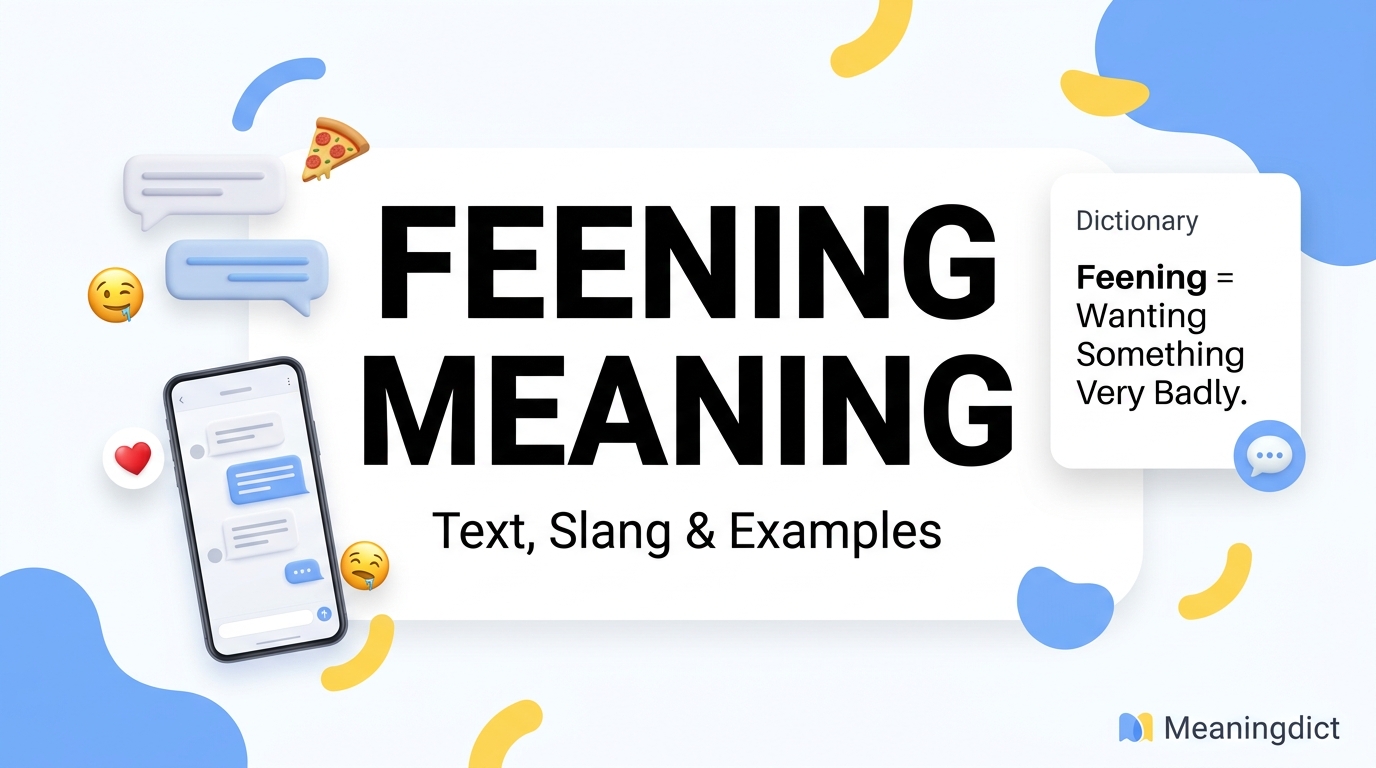
Feening Meaning: What Does Feening Mean in Text and Slang?
The word feening is commonly used in text messages, online conversations, social media captions, and casual speech. It describes a strong desire, craving, or intense need for someone or something. When a person says, “I’m feening for pizza,” they mean they want pizza very badly. When they say, “She is feening for his attention,” they may mean she strongly wants his attention.
The term is an informal spelling of fiending, which comes from the word “fiend.” Dictionary.com recognizes “fiend” as a slang verb meaning to desire something greatly, while dictionaries define a craving as a powerful or urgent desire. the word was once strongly connected with addiction and substance cravings, people now use it more broadly. It can describe wanting food, affection, entertainment, attention, new clothes, music, or almost anything else.
| Term | Simple meaning | Correct context |
|---|---|---|
| Feening | Wanting something very badly | Informal slang |
| Fiending | Experiencing a powerful craving | More recognized slang spelling |
| Feigning | Pretending or faking something | Formal and standard English |
What Does Feening Mean in Text?
In text conversations, feening means wanting, missing, or craving something very strongly. The exact meaning depends on what comes after the word. Someone might be feening for food, attention, affection, entertainment, money, or another person.
For example, a friend might text, “I’m feening for some tacos right now.” This simply means the person has a strong desire to eat tacos. Another person might write, “He’s been feening for her reply all day.” In that sentence, the word suggests that he is eagerly waiting for her attention.
The expression is stronger than simply saying “I want it.” It adds emotional intensity and may also sound playful, dramatic, or exaggerated.
Common text-message meanings include:
- Wanting something immediately
- Missing a person intensely
- Craving a particular food
- Seeking attention or affection
- Feeling highly excited about something
The tone matters. Among friends, feening is often humorous. In a serious discussion, however, it may describe an unhealthy or difficult craving.
Feening Meaning in Slang
In slang, feening means having a powerful desire, urge, or craving. It is often used when an ordinary word such as “wanting” does not feel strong enough. Saying “I’m feening for it” suggests that the person can hardly stop thinking about the thing they want.
The slang term developed from fiend, a word that can describe someone extremely devoted to something or someone affected by addiction. Merriam-Webster includes meanings of “fiend” related to extreme devotion, fanaticism, and addiction. Dictionary.com also records a slang verb meaning “to desire greatly.” he slang is not limited to harmful substances. People may say they are feening for:
- A new episode of a television show
- Their favorite meal
- A romantic partner’s attention
- A vacation
- A new pair of shoes
- A popular video game
The word usually appears in relaxed conversations. It is not suitable for formal essays, professional emails, business reports, or academic assignments unless the writer is discussing slang itself.
What Is the Meaning of Feening?
The meaning of feening is to experience a strong, persistent, or difficult-to-ignore desire. In simple words, it means wanting something really badly. The desire may be physical, emotional, romantic, or based on entertainment and personal interests.
For example, someone who has not eaten all day may say, “I’m feening for a burger.” A person waiting for a message from someone they like might say, “I’m feening for a reply.” Both sentences express intense desire, even though the objects of that desire are different.
Feening can describe:
- Physical craving: wanting food, caffeine, or another substance
- Emotional craving: wanting love, comfort, or attention
- Romantic longing: strongly missing or desiring a person
- Material desire: urgently wanting a product or possession
- Entertainment excitement: eagerly wanting music, a movie, or a game
The expression may be literal or exaggerated. A person saying they are feening for chocolate does not necessarily have a serious problem. They may simply be using dramatic slang to make the desire sound stronger.
Feening Meaning in English With Examples
In plain English, feening means craving, longing for, desperately wanting, or feeling an intense desire for something. The closest standard English words are “craving,” “yearning,” “desiring,” “longing,” and “wanting badly.”
Cambridge Dictionary defines “crave” as having a very strong feeling of wanting something. Merriam-Webster similarly describes craving as an intense or urgent desire. These definitions closely match the way feening is used in casual speech. some clear examples:
- “I’m feening for iced coffee.”
Meaning: I really want iced coffee. - “She’s feening for his attention.”
Meaning: She strongly wants him to notice her. - “We’re feening for the next season.”
Meaning: We are extremely excited to watch it. - “He’s feening to buy that car.”
Meaning: He wants to buy the car very badly. - “I’ve been feening to see you.”
Meaning: I have strongly wanted to see you.
In standard or formal English, replace feening with “craving,” “eager,” “longing,” or “desperate to.”
Feening vs. Fiending Meaning Difference
Feening and fiending usually communicate the same basic idea: experiencing a strong craving or intense desire. The main difference is spelling and level of standardization rather than meaning.
Fiending is the more established form because it is created from the word fiend plus the ending “-ing.” Wiktionary lists fiending as an informal term for an intense craving, especially one associated with a drug. Dictionary.com also recognizes “fiend,” and the alternative “feen,” as slang verbs meaning to desire greatly. g** is a phonetic or informal spelling. People write it according to how the word sounds when spoken. It is especially common in text messages, lyrics, comments, and social posts.
Examples:
- More recognized slang: “I’m fiending for coffee.”
- Informal variation: “I’m feening for coffee.”
Both mean the person strongly wants coffee.
Do not confuse either word with feigning. Feigning means pretending or giving a false appearance. Cambridge defines “feign” as pretending to have a particular feeling or condition. Does Feening Mean in a Text Message?
When someone uses feening in a text message, they are usually emphasizing how badly they want something. The word can express urgency, excitement, attraction, impatience, or playful exaggeration.
Suppose someone texts, “I’m feening for that new album.” They are saying they are eager to hear it. If someone writes, “You’re feening for her attention,” the message may sound teasing or critical. It suggests the person is trying very hard to get noticed.
Common text-message examples include:
- “I’m feening for fries.”
- “He’s feening for a response.”
- “We’re feening to go out tonight.”
- “She’s feening for another vacation.”
- “I’ve been feening to talk to you.”
The surrounding words reveal the intended meaning. When the object is harmless, such as food or a television show, the expression is usually casual. When the sentence concerns alcohol, nicotine, or drugs, it may refer to a genuine craving and should be interpreted more seriously.
Therefore, readers should consider both the subject and the tone before deciding what the sender means.
See Also: Bugbear Meaning: Definition, Examples, Origin, and Usage
Feening Meaning According to Urban Dictionary
Urban Dictionary entries generally describe feening as wanting, missing, or craving someone or something very strongly. Some entries connect it with substances, while others use it for relationships, food, attention, and everyday desires. One entry describes it as deeply and uncontrollably missing something or someone, while another explains it as wanting something very badly. Urban Dictionary is a crowdsourced platform. Its definitions are submitted by users rather than written and reviewed in the same way as entries in traditional dictionaries. Research examining the platform has found that it records unfamiliar and rapidly changing slang effectively, but its entries may also contain opinions, inconsistent explanations, or offensive language. reason, Urban Dictionary can help readers understand how people use a slang term online, but it should not be treated as the only authority.
A balanced definition is:
Feening is informal slang for strongly craving, desiring, or longing for something or someone.
Meaningdict follows this clearer approach by explaining slang in plain English while also showing context, spelling differences, and practical examples.
Why Do People Say Feening Instead of Fiending?
People often say or write feening instead of fiending because slang frequently follows pronunciation rather than formal spelling. When “fiending” is spoken quickly, it can sound like “feening.” As a result, many users spell the word exactly as they hear it.
Social media and text messaging also encourage shorter, more phonetic language. Users may remove letters, change spellings, or write words in a way that reflects their accent and speaking style. Similar informal forms include “gonna” for “going to,” “wanna” for “want to,” and “tryin’” for “trying.”
Several factors support the use of feening:
- It matches the spoken sound
- It feels casual and conversational
- It is commonly seen in lyrics and online comments
- Users copy the spelling they see from others
- Slang does not always follow formal grammar rules
The spelling may also appear as “feenin’,” “feining,” or “fiening.” Despite these variations, the intended meaning is usually the same.
In edited English, fiending is the clearer spelling. In informal online communication, however, feening is widely understood.
Feening Meaning in Social Media Slang
In social media slang, feening means being highly eager, obsessed, excited, or desperate for something. It appears in TikTok captions, Instagram comments, X posts, YouTube discussions, memes, and private messages.
A user might post, “I’m feening for summer,” to express excitement about warm weather and vacations. Someone commenting, “Y’all are feening for drama,” is accusing other users of constantly searching for arguments or gossip. In fan communities, people may say they are feening for a new song, trailer, episode, or product release.
The term often adds humor and exaggeration. Instead of writing, “I would like another episode,” a fan may write, “I’m feening for the next episode.” The second version sounds more emotional and engaging.
Social media examples include:
- “Feening for a beach trip.”
- “Everyone is feening for that concert.”
- “He’s feening for likes.”
- “I’m feening to hear the full song.”
- “They’re feening for new content.”
Because online slang changes quickly, the exact tone can depend on the community using it. Context remains the best guide.
Feening Meaning in a Relationship
In a relationship, feening usually means strongly wanting a partner’s presence, affection, attention, communication, or physical closeness. A person might say, “I’m feening to see you,” when they deeply miss their partner and cannot wait to meet them.
The term can sound romantic when both people share the same feelings. For example, “I’ve been feening for your hugs” communicates affection and longing. However, it can sound negative when used to describe excessive neediness or one-sided attention-seeking.
Consider these examples:
- “She’s feening for his attention.”
This may suggest she is trying hard to be noticed. - “I’m feening to spend time with you.”
This expresses affectionate longing. - “He keeps texting because he’s feening for a reply.”
This suggests impatience or emotional dependence.
Feening does not automatically indicate love. It describes intensity, not the quality of a relationship. Someone may strongly desire attention without having a healthy emotional connection.
The tone, behavior, and relationship context determine whether the expression sounds loving, playful, needy, obsessive, or critical.
Feening Meaning When Someone Likes Something
When someone likes something, feening means they want more of it or feel unusually enthusiastic about it. It is stronger than ordinary enjoyment. The person is not merely interested; they are eager to experience, receive, eat, watch, hear, or use the thing again.
For example, “She’s feening for that skincare product” means she strongly wants the product, possibly because she has seen positive reviews. “He’s feening for another game” means he is eager to play again.
The word may describe excitement about:
- Food and drinks
- Music and concerts
- Movies and television shows
- Clothes and shoes
- Games and technology
- Travel and experiences
- Online content
Example sentences include:
- “I tried the dessert once, and now I’m feening for more.”
- “They’re feening to see the movie.”
- “He’s feening for the latest phone.”
- “I’m feening for another episode.”
In these situations, the expression is usually playful exaggeration. It tells the listener that the speaker likes something so much that a simple word such as “want” does not fully express the feeling.
Feening Definition and Example Sentences
Feening definition: Feening is informal slang that means strongly craving, desiring, missing, or wanting someone or something. It is a nonstandard variation of fiending and is commonly used in texts, online posts, lyrics, and casual conversations.
The term often follows this pattern:
Subject + form of “be” + feening + for/to + desired thing or action
Examples with “for” include:
- “I’m feening for chocolate.”
- “She is feening for attention.”
- “They are feening for a vacation.”
- “He has been feening for a new phone.”
- “We’re feening for more information.”
Examples with “to” include:
- “I’m feening to see you.”
- “She’s feening to go shopping.”
- “They’re feening to hear the announcement.”
- “He’s feening to play the new game.”
- “We’re feening to watch the final episode.”
The structure with “feening for” is generally more natural because people usually crave something. However, “feening to” is also common in informal speech when someone strongly wants to perform an action.
Also Read: Nonchalant Meaning: Definition, Examples, Slang and Usage
Is Feening a Real Word or Slang?
Feening is primarily slang rather than standard formal English. People use it widely enough to understand its meaning, but its spelling is informal and may not appear as a main entry in every traditional dictionary.
The more established form is fiending, based on the noun “fiend.” Dictionary.com recognizes “fiend” as a slang verb and notes “feen” as an alternative form meaning to desire greatly. This gives the slang a clear linguistic connection even though “feening” remains a nonstandard spelling. a term is “real” does not depend only on formal dictionaries. Language changes through repeated use. Slang words can communicate real meanings even before dictionaries fully record them.
However, the appropriate spelling depends on the situation:
- Texting or social media: Feening is acceptable.
- Dialogue or creative writing: It may fit a character’s voice.
- Formal writing: Use craving, longing, or strongly desiring.
- Academic discussion of slang: Use quotation marks and explain it.
- Professional communication: Avoid it unless the tone is intentionally casual.
Therefore, feening is real as slang but not usually treated as formal vocabulary.
How to Use Feening in a Sentence
Use feening when you want to express a much stronger feeling than ordinary wanting. It normally appears after a form of the verb “to be,” such as “am,” “is,” “are,” “was,” or “been.”
The most common structure is:
Someone + is/am/are + feening for + noun
Examples:
- “I’m feening for a cold drink.”
- “She’s feening for attention.”
- “They’re feening for concert tickets.”
- “He was feening for another chance.”
- “We’ve been feening for new music.”
You can also use it before an action:
- “I’m feening to travel.”
- “He’s feening to see her.”
- “They’re feening to start the game.”
Avoid phrases such as “I feening,” because the sentence needs a helping verb. Write “I am feening” or the contracted form “I’m feening.”
Remember that the term is highly informal. It works naturally in a message to a friend, a humorous caption, a meme, or casual dialogue. In formal writing, replace it with “eager,” “craving,” “longing for,” or “strongly wanting.”
Feening Meaning Explained Simply
In the simplest possible terms, feening means wanting something very badly. It describes a desire that feels stronger than a normal want. Depending on the context, it can also mean craving something, missing someone intensely, or being extremely eager for an experience.
For example:
- “I’m feening for pizza” means “I really want pizza.”
- “She’s feening for his attention” means “She strongly wants his attention.”
- “We’re feening for the next episode” means “We are extremely excited to watch it.”
- “He’s feening to see her” means “He really wants to see her.”
Feening is an informal variation of fiending. In most online conversations, the two spellings have the same meaning. However, neither should be confused with feigning, which means pretending or faking a feeling, condition, or action. way to remember the difference is:
- Feening/fiending = craving
- Feigning = pretending
For readers who regularly encounter confusing text abbreviations and slang, Meaningdict offers simple explanations focused on meaning, context, usage, and examples.
Frequently Asked Questions
What does feening mean from a girl?
When a girl says she is feening for something, she means she strongly wants or craves it. She may be talking about food, attention, affection, a product, an experience, or another person. The sentence around the word will reveal whether the tone is romantic, humorous, or serious.
What does feening mean from a guy?
When a guy uses feening, he is saying that he intensely wants, misses, or desires something. For example, “I’m feening to see you” may express romantic interest, while “I’m feening for wings” simply means he strongly wants food.
Does feening always refer to drugs?
No. The expression has historical connections with intense substance cravings, but modern slang uses it much more broadly. People may be feening for food, attention, music, travel, clothes, entertainment, or another person. Context determines whether the meaning is casual or serious.
Is feening the same as craving?
Feening is similar to craving, but it is more informal. “Craving” is standard English and can be used in many settings. “Feening” is slang and often sounds more dramatic, emotional, playful, or exaggerated.
Is it feening, fiending, or feigning?
Use fiending for the more established slang spelling meaning craving. Feening is a common informal spelling with the same meaning. Use feigning only when you mean pretending, faking, or creating a false appearance.
Can feening be romantic?
Yes. A person may use feening romantically to express strong longing or attraction. For example, “I’ve been feening to see you” means the speaker has strongly wanted to meet the other person. However, the word alone does not prove that someone is in love.
What is another word for feening?
Possible alternatives include craving, longing, yearning, desiring, wanting badly, eager for, desperate for, obsessed with, and jonesing. The best alternative depends on the sentence and whether the situation is formal or informal.
Is feening appropriate in professional writing?
No, feening is generally too informal for professional, academic, or business writing. Use clearer alternatives such as “strongly interested,” “eager,” “highly motivated,” “craving,” or “experiencing a strong desire,” depending on the subject.
The clearest answer is that feening means strongly craving or wanting someone or something. It is common in texting and social media, while fiending is the more recognized slang spelling. Always check the surrounding context because the word can express anything from a playful desire for food to a serious physical or emotional craving.



2 Comments