
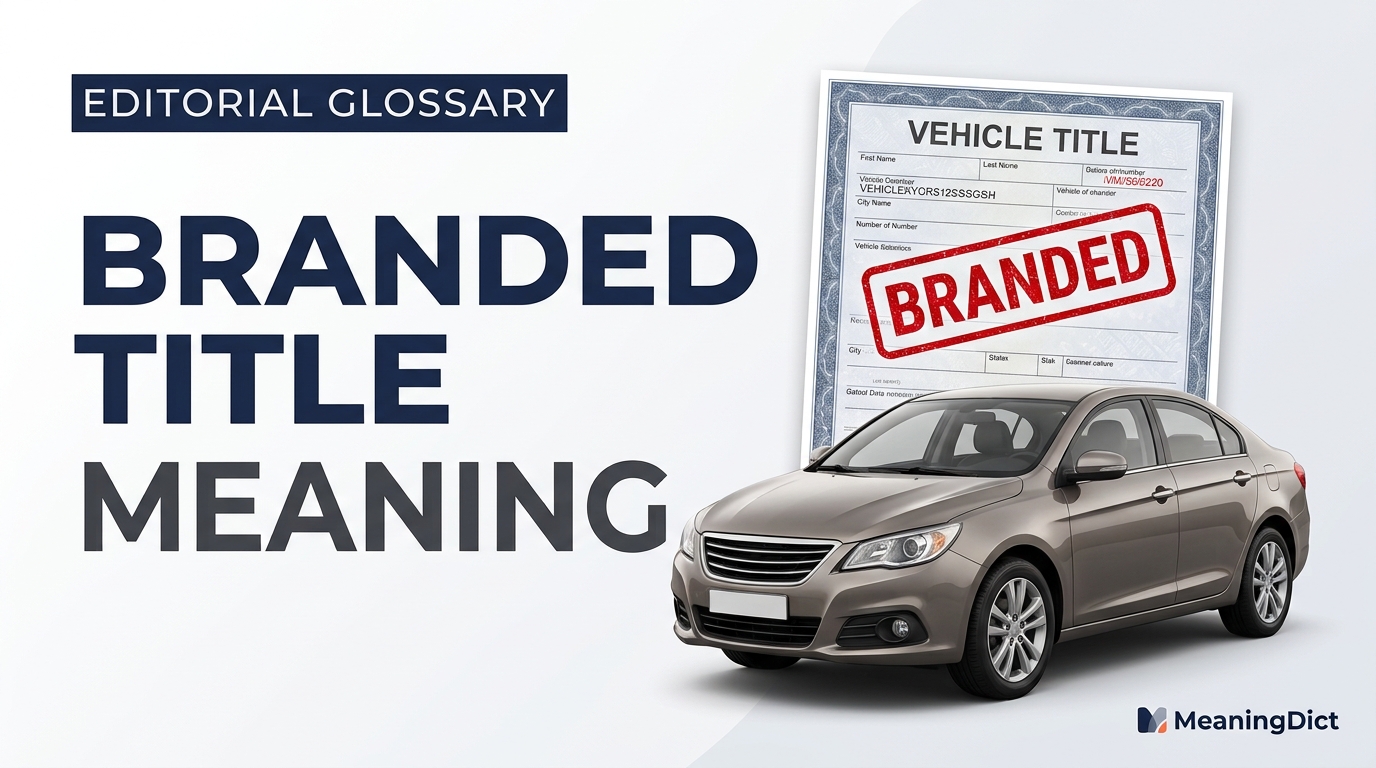
Branded Title Meaning: A Complete Guide for Car Buyers
Buying a used vehicle can feel simple until the paperwork shows words such as salvage, rebuilt, flood, lemon, or manufacturer buyback. These labels are not ordinary notes. They are title brands—official warnings added to a vehicle’s ownership record by a state agency. Understanding branded title meaning helps you judge the car’s legal status, past damage, present condition, financing options, insurance limits, and future resale value.
A branded title does not always mean a vehicle is unsafe, and a clean title does not promise a damage-free history. The brand tells you that a significant event, condition, or prior use was recorded. Your job is to identify the exact label and verify what happened. That means checking the VIN, reading state records, reviewing repair evidence, getting insurance and financing answers in writing, and arranging an independent inspection.
This MeaningDict guide explains the term in plain language for car buyers while also clearing up the less common real estate question. Use it as a practical starting point, then confirm state-specific rules with the relevant DMV before buying, selling, repairing, financing, or registering a branded-title vehicle.
A branded title means a state agency has added an official label to a vehicle’s title because of major damage, total loss, rebuilding, flood or fire exposure, odometer issues, manufacturer buyback, special prior use, or another recorded condition. The exact brand affects whether the vehicle can be driven, registered, insured, financed, and resold.
Quick comparison
| Title status | Basic meaning | Common road status | Main buyer concern |
|---|---|---|---|
| Clean title | No major title brand currently shown | Usually registrable | Unreported damage may still exist |
| Salvage title | Major damage or total-loss history | Often not road legal until repaired | Repair cost and structural safety |
| Rebuilt title | Former salvage vehicle repaired through a state process | Often registrable after approval | Quality of repairs |
| Flood title | Significant water damage recorded | Depends on state and repair status | Corrosion, wiring, airbags, and mold |
| Lemon title | Vehicle repurchased after qualifying defects | Often road legal | Whether the original defect was fixed |
| Junk title | Vehicle intended for parts or destruction | Generally not road legal | It may not be legally rebuildable |
What Does Branded Title Mean in Real Estate?
In real estate, “branded title” is not a standard legal term in the same way it is for motor vehicles. Property professionals usually talk about a clear title, marketable title, clouded title, defective title, lien, easement, ownership dispute, or title defect. A deed transfers ownership, while title describes the legal ownership rights connected to the property.
Sometimes people use “branded title” informally when they mean a property title has a negative mark or recorded problem. That wording can be misleading because real estate records are not normally branded with categories such as salvage or rebuilt. The correct question is whether the property has a clear and marketable title.
Buyers should review the title search, exceptions in the title commitment, unpaid liens, boundary issues, easements, ownership claims, and deed history with a licensed title professional or real estate attorney. Title insurance may cover certain past problems, including forged deeds, incorrectly filed documents, access issues, or undisclosed liens. In simple terms, branded title meaning mainly applies to vehicles, not homes or land.
Branded Title Meaning Explained for Car Buyers
For car buyers, a branded title means a state motor vehicle agency has placed an official label on the vehicle’s ownership record. The label warns that something important happened in the car’s past. Common reasons include a serious crash, flood or fire damage, an insurance total-loss decision, odometer problems, a manufacturer buyback, prior police or taxi use, theft recovery, or rebuilding after salvage.
A brand does not automatically prove that the car is unsafe today, but it does show that the vehicle needs more investigation than a normal used car. Buyers should identify the exact brand, learn when and why it was assigned, compare it with repair records, and arrange an independent inspection.
A rebuilt vehicle may be legal to drive after meeting state requirements, while an unrepaired salvage or junk vehicle may not be road legal. The brand can also affect market value, resale demand, loan approval, warranty coverage, and insurance options. Treat the title brand as a permanent history warning, not as a minor paperwork note.
What Is a Branded Title on a Vehicle?
A branded title is a vehicle title marked with a descriptive status by a state titling agency. The National Motor Vehicle Title Information System, or NMVTIS, explains that brands are labels such as junk, salvage, and flood. NMVTIS keeps a history of brands applied by participating states, helping buyers identify vehicles that might otherwise be presented without full disclosure.
The word “branded” is an umbrella term. A salvage title is one type of branded title, but other brands can describe rebuilt status, fire damage, water damage, odometer discrepancies, manufacturer buybacks, prior commercial use, or nonrepairable status. The exact wording depends on the state that issued the title.
A title may display terms such as “Rebuilt Salvage,” “Prior Salvage,” “Revived Salvage,” “Flood,” “Lemon Law Buyback,” or “Junk.”
The simplest definition is this: a branded title tells you that the vehicle has a recorded condition, damage event, use history, or legal status that may affect its safety, value, registration, insurance, financing, or resale.
Branded Title vs Clean Title Difference
The main difference between a branded title and a clean title is the recorded vehicle history. A clean title generally means the state title does not currently carry a major brand such as salvage, rebuilt, flood, fire, junk, or manufacturer buyback.
However, a clean title does not guarantee that the car has never been damaged, repaired, flooded, or involved in an accident. Damage may go unreported, fall below a state’s branding threshold, occur without an insurance claim, or never reach a motor vehicle agency.
A branded title contains an official warning about a known issue or previous status. The brand may describe severe damage, total loss, rebuilding, mileage concerns, special prior use, or another condition recognized by the issuing state. Branded vehicles often sell for less and may be harder to finance, insure, trade, or resell.
Therefore, “clean title” should not be treated as another way of saying “perfect vehicle.” Check the title, run a VIN history report, review repair records, and obtain an independent inspection regardless of title status.
Is a Car With a Branded Title Worth Buying?
A car with a branded title can be worth buying, but only when the price, repair quality, documentation, intended use, and future costs make sense together. It may suit an experienced buyer, mechanic, budget shopper, or someone planning to keep the vehicle for many years.
The lower purchase price can provide value when the damage was properly repaired and the car passes a detailed independent inspection. However, a cheap price alone is not enough. Hidden frame damage, electrical faults, corrosion, airbag problems, poor welding, water exposure, or missing safety components can turn the purchase into an expensive mistake.
Financing and insurance may also be limited, and the resale discount will still matter when you later sell or trade the car.
Before deciding, calculate the true ownership cost: purchase price, immediate repairs, future maintenance, insurance premium, loan terms, registration costs, and expected resale value. A branded-title car is worth considering only when the seller provides the title, photos, invoices, damage details, and inspection access—and the discount clearly compensates for the added risk.
See Also: Feening Meaning: What Does Feening Mean in Text and Slang?
Branded Title Meaning on a Car History Report
On a car history report, branded title meaning refers to an official title status received from a state motor vehicle record. The report may show the brand name, the state that applied it, the title issue date, and the date the brand entered the record.
Examples include salvage, rebuilt, junk, flood, fire, odometer not actual, manufacturer buyback, or prior taxi use.
A title brand is different from an ordinary accident entry. An accident may appear from a police report, repair facility, auction, or insurer without creating a title brand. A brand usually reflects a state-level title action or recognized legal status.
Read the full report timeline instead of stopping at a green or red summary symbol. Check for total-loss events, salvage-yard records, auction listings, state transfers, mileage changes, and rebuilding dates.
The FTC recommends obtaining a vehicle history report but also warns that a report is not a substitute for an independent inspection. NMVTIS may provide title and brand history, but it does not contain every repair record.
How Does a Car Get a Branded Title?
A car gets a branded title when an insurer, owner, dealer, manufacturer, law-enforcement record, inspection process, or other reporting event triggers action under state title law. The state motor vehicle agency reviews the documents and adds the appropriate brand to the title record.
A serious collision is common, but it is not the only cause. An insurer may declare a vehicle a total loss because repair costs exceed the car’s market value or a state-defined percentage. The state may then issue a salvage title.
If the vehicle is repaired and completes the required inspections, forms, and documentation, it may receive a rebuilt or prior-salvage brand. Flood damage, fire damage, theft recovery, odometer discrepancies, lemon-law buybacks, and nonrepairable conditions may create different labels.
Rules are not identical nationwide. New York uses specific age and damage conditions for some salvage branding, while Florida and Texas apply their own definitions and procedures. The important point is that the brand is assigned through a government title process, not simply because a seller calls the car “rebuilt.”
What Does Branded Title Mean in Different States?
Branded title meaning changes slightly from state to state because each motor vehicle agency controls its own wording, damage thresholds, inspections, registration procedures, and disclosure rules. The same history may be described as rebuilt, reconstructed, prior salvage, revived salvage, or flood rebuilt depending on location.
California lists brands that include salvage, revived salvage, water damage, warranty returned, prior taxi, and prior police. New York applies specific salvage-branding conditions to certain newer vehicles and requires an examination before a rebuilt vehicle can receive a new title and registration.
Texas uses “Rebuilt Salvage” for a vehicle that was previously salvage and later returned to roadworthy status after required inspections. South Carolina distinguishes salvage, salvage rebuilt, salvage flood, salvage fire, and junk.
Florida requires title markings and written disclosure for several histories, including rebuilt, flood, former taxi or police use, and manufacturer buyback.
Always check the current DMV rules in both the state that issued the title and the state where you plan to register the vehicle.
Can You Finance a Car With a Branded Title?
Yes, you may be able to finance a car with a branded title, but approval is usually more difficult than financing a clean-title vehicle. Many mainstream lenders limit or reject loans for salvage or rebuilt cars because the collateral has a lower and less predictable resale value.
If the borrower defaults, the lender may recover less money by selling the vehicle. A lender willing to approve the loan may require a larger down payment, shorter repayment period, lower loan-to-value ratio, strong credit, proof of repairs, a professional appraisal, or confirmation that the vehicle can be fully insured.
Interest rates may also be less favorable. An unrepaired salvage vehicle is especially difficult to finance because it may not be registered or legally driven.
Get written preapproval before paying a deposit. Give the lender the VIN and exact title brand instead of describing the vehicle only as “used.” Obtain an insurance quote first because a lender may require comprehensive and collision coverage. Compare the total financing cost with the cost of a similar clean-title vehicle.
How to Check if a Vehicle Has a Branded Title
Start by asking the seller to show the current title before you agree to buy. Read every printed brand, remark, legend, or stamp. Confirm that the VIN matches the dashboard, driver-side door label, history report, registration, and sales documents.
Do not rely only on an advertisement that says “clean,” “minor damage,” or “rebuilt.”
Next, obtain an NMVTIS-based vehicle history report from an approved provider. NMVTIS may include current and previous state title data, brand history, odometer information, total-loss information, and certain salvage records.
Review another commercial report when useful because different databases may contain different accident, auction, service, and repair information. Search the VIN through the state DMV’s title-check service when available.
Compare dates, mileage readings, ownership transfers, damage entries, and title changes. Ask for pre-repair photos, repair invoices, parts receipts, alignment measurements, and inspection documents.
Finally, have a qualified mechanic or collision specialist inspect the frame, airbags, seat belts, electronics, corrosion, suspension, steering, alignment, and diagnostic systems.
See Also: Abecedarium Meaning: Definition, Pronunciation, and Examples
Branded Title Meaning: Salvage, Rebuilt, and Lemon Titles
Salvage, rebuilt, and lemon are different types of title brands, and each tells a different story. A salvage brand generally means the vehicle was declared a total loss or met a state definition for major damage. In many places, a salvage vehicle cannot be driven on public roads until it is repaired, documented, inspected, and retitled.
A rebuilt title means the vehicle previously carried salvage status but was repaired and completed the state’s required process for returning to the road. “Rebuilt” does not mean restored to factory-new condition.
The inspection may focus on vehicle identity, stolen parts, required equipment, paperwork, or state standards rather than guaranteeing future reliability. New York, for example, explains that its salvage examination is not the same as a full safety, emissions, or insurance inspection.
A lemon or manufacturer-buyback brand usually means the manufacturer repurchased the vehicle after repeated defects or a legal settlement. Florida uses “Manufacturer’s Buy Back” for qualifying nonconforming vehicles. Always identify the exact brand before evaluating the risk.
What Happens When a Car Has a Branded Title?
When a car has a branded title, the brand becomes part of its ownership history and may follow the vehicle through later sales and state transfers. The immediate effect depends on the exact label.
A salvage or junk vehicle may not be eligible for ordinary road use, while a rebuilt vehicle may be registered after meeting the state’s repair, paperwork, and inspection requirements.
The market also treats the vehicle differently. Buyers may demand a lower price, dealers may refuse it as a trade-in, lenders may restrict financing, and insurers may limit comprehensive or collision coverage.
Manufacturer warranties, service contracts, certified pre-owned eligibility, and vehicle-value guarantees may also be affected, so each provider’s terms should be checked separately.
The owner must disclose the brand as required by state law and should preserve repair documents for future buyers, insurers, and lenders.
A branded title does not automatically mean the car will fail. However, it creates a continuing burden of proof. The owner must show that the repair quality, legal status, safety condition, and price justify the vehicle’s recorded history.
Should I Buy a Vehicle With a Branded Title?
Buy a vehicle with a branded title only after you can answer five questions clearly: What caused the brand? Who repaired the vehicle? What parts and procedures were used? Can it be insured and financed on acceptable terms? Is the discount large enough to cover the remaining risk?
A good candidate has a consistent history, complete repair invoices, clear before-and-after photos, no unexplained mileage gaps, successful state paperwork, and an independent inspection from a mechanic or collision specialist who did not work for the seller.
The test drive should be long enough to check steering, braking, warning lights, driver-assistance systems, air conditioning, electronics, suspension noise, and highway behavior.
Walk away when the seller hides the title, refuses an inspection, cannot explain the damage, pressures you to pay quickly, or uses phrases such as “minor damage” without evidence.
Flood, fire, frame, airbag, and electrical damage deserve extra caution. For buyers who want simple financing, predictable insurance, and stronger resale value, a clean-title vehicle is usually the easier choice.
Branded Title Cars: Pros and Cons Explained
Branded-title cars can offer real savings, but the benefits come with risks that should be measured before purchase.
Pros:
- Lower upfront price than a comparable clean-title vehicle.
- Access to a newer model or better features within the same budget.
- Potential value for experienced mechanics, rebuilders, or long-term owners.
- Official disclosure may be better than hidden damage that was never reported.
Cons:
- Greater risk of structural, electrical, flood, fire, airbag, or corrosion problems.
- Lower resale and trade-in value.
- Fewer financing options and potentially less favorable loan terms.
- Limited insurance availability, especially for comprehensive and collision coverage.
- More paperwork, inspections, and state-specific registration requirements.
- No guarantee that a state inspection confirms factory-quality repairs or long-term reliability.
The strongest advantage is the lower price. The biggest disadvantage is uncertainty. Compare the discount with a realistic repair budget, insurance cost, and future resale loss. A branded vehicle becomes a poor deal when the savings are small, records are incomplete, or the original damage cannot be verified.
How to Remove or Change a Branded Title Status
An accurate title-brand history usually cannot simply be erased. A vehicle may move from one status to another—for example, from salvage to rebuilt—after approved repairs, documentation, fees, and state inspections.
The new title may show “Rebuilt Salvage,” “Prior Salvage,” or similar wording, while the earlier brand remains in the vehicle’s history. NMVTIS is designed to retain brands applied by state agencies.
A brand may sometimes be corrected when it was entered by mistake, applied to the wrong VIN, or carried forward inaccurately. The owner normally needs strong evidence from the state that originally reported the brand, along with title records, insurance documents, inspection results, or an official correction letter.
Do not transfer a vehicle to another state to hide a valid brand. Moving vehicles between states to obtain a cleaner-looking title is commonly called title washing and can be connected to fraud.
Contact the issuing DMV for correction instructions and the receiving DMV for registration rules. Changing salvage status to rebuilt is a legal status update. Removing truthful damage history is not.
See Also: Seychelles Meaning: Definition, Origin, History, and Facts
Branded-Title Vehicle Buying Checklist
Before paying for a branded-title vehicle, complete this checklist:
- See the original title and match every VIN.
- Identify the exact brand and issuing state.
- Obtain an NMVTIS-based title history report.
- Review accident, auction, service, and repair information.
- Request pre-repair photos, invoices, parts receipts, and inspection papers.
- Confirm that the vehicle can be titled and registered in your state.
- Get written insurance quotes for the coverage you need.
- Secure loan approval using the VIN and disclosed title brand.
- Hire an independent mechanic or collision specialist.
- Check the frame, airbags, seat belts, electronics, corrosion, alignment, and diagnostic codes.
- Compare clean-title and branded-title market prices.
- Estimate future repair costs and resale loss.
- Put every seller promise and disclosure in writing.
- Walk away from mismatched dates, altered documents, missing records, or inspection refusal.
This process cannot remove every risk, but it turns a vague bargain into a decision supported by evidence.
Frequently Asked Questions
Does a Branded Title Always Mean Salvage?
No. Salvage is one type of branded title, but the term also covers rebuilt, flood, fire, junk, odometer, manufacturer-buyback, prior taxi, prior police, and other labels. The exact categories depend on the issuing state.
A seller may casually use “branded” and “salvage” as if they mean the same thing, but buyers should read the exact wording on the title. A rebuilt vehicle, for example, may once have been salvage but later completed a state repair and inspection process.
Can You Insure a Car With a Branded Title?
A rebuilt-title vehicle can often be insured, but available coverage varies by insurer, state, damage history, and repair documentation. Some insurers may offer liability coverage while limiting comprehensive or collision protection.
An unrepaired salvage vehicle is usually much harder to insure because it may not be road legal. Before buying, give the insurer the VIN and exact title brand. Ask for a written quote showing the available coverage, deductible, vehicle value, and claim conditions.
Is a Rebuilt Title Car Safe to Drive?
A rebuilt title means the vehicle completed the state’s required process for returning to road use. It does not guarantee that every repair matches factory standards or that no hidden problem remains.
Inspection requirements vary. Some focus heavily on vehicle identity, stolen components, paperwork, or required equipment. Have an independent collision specialist examine the frame, crumple zones, welds, airbags, seat belts, suspension, electronics, and alignment before relying on the vehicle for daily transportation.
Does a Clean Title Mean the Car Has Never Been Damaged?
No. A clean title normally means no major title brand is currently displayed. A car can still have accident damage, repairs, water exposure, mechanical problems, or an incomplete history.
Some damage is never reported to an insurer or state agency. Other damage may not meet the legal threshold for a title brand. That is why buyers should use the title, vehicle history reports, service records, visual inspection, diagnostic scan, and independent mechanical inspection together.
How Much Is a Branded-Title Car Worth?
There is no single discount that applies to every branded vehicle. Value depends on the brand type, original damage, repair quality, make, model, mileage, local demand, insurance availability, and supporting documentation.
A professionally repaired theft-recovery vehicle may be valued differently from a flood-damaged or heavily reconstructed vehicle. Compare recent sales of vehicles with the same title status rather than applying the clean-title market price. The discount should cover additional risk, lower resale value, and possible repair costs.
Can a Dealer Sell a Branded-Title Vehicle?
Dealers can sell many branded-title vehicles, but federal and state disclosure, advertising, title, and documentation rules may apply. The requirements differ by state and by the specific title status.
Buyers should not assume dealership inventory is automatically free from title issues. Ask to see the title, Buyers Guide, history report, written damage disclosure, warranty terms, and repair documentation before signing. Florida, for example, requires written disclosure for several types of branded or specially used vehicles.
Does a Branded Title Stay With the Vehicle Forever?
An accurate brand generally remains part of the vehicle’s historical record. A car may change from salvage to rebuilt after repairs and state approval, but its earlier salvage history does not simply disappear.
NMVTIS retains reported title brands so buyers and state agencies can see earlier conditions even after the vehicle moves between states. An incorrect brand may be challenged through the state that reported it, but valid damage history is not normally erased.
Can a Branded Vehicle Be Registered in Another State?
It may be possible, but the receiving state applies its own title, inspection, emissions, tax, registration, and documentation rules. A vehicle accepted as rebuilt in one state may require additional inspection or paperwork elsewhere.
Before transporting or purchasing the vehicle, contact the receiving DMV with the VIN, current title wording, issuing state, and repair status. Never assume that an out-of-state rebuilt title guarantees automatic registration in your home state.
Is a Manufacturer Buyback the Same as a Salvage Vehicle?
No. A manufacturer buyback usually involves a vehicle repurchased because of repeated defects, lemon-law proceedings, or a settlement. A salvage vehicle usually involves major damage, total loss, theft, flooding, fire, or another condition covered by state salvage laws.
The risks are different. With a buyback, determine the original defect and whether it was permanently corrected. With salvage, investigate the type and extent of physical damage, the rebuilding work, and structural safety.
Final Thoughts on Branded Title Meaning
Branded title meaning is simple at its core: an official vehicle record contains a warning about the car’s condition, damage, prior use, mileage, or legal history. The difficult part is understanding what that specific warning means in the issuing state and whether the vehicle’s present condition supports the asking price.
Never judge a branded vehicle by appearance alone. A polished body and clean interior cannot prove that the frame, airbags, wiring, sensors, or corrosion repairs are sound. Use the title, NMVTIS data, repair documents, state records, insurance quote, loan approval, and independent inspection together.
When any major part of the story is missing, the safest decision is often to leave the deal.
MeaningDict recommends treating a title brand as a research signal rather than an automatic yes or no. Some professionally rebuilt vehicles can serve an informed buyer well, while others carry costs and safety concerns that exceed the discount. Verify first, calculate the full ownership cost, and buy only when the evidence—not the seller’s promise—supports the decision.




2 Comments