Seychelles Meaning: Definition, Origin, History, and Facts
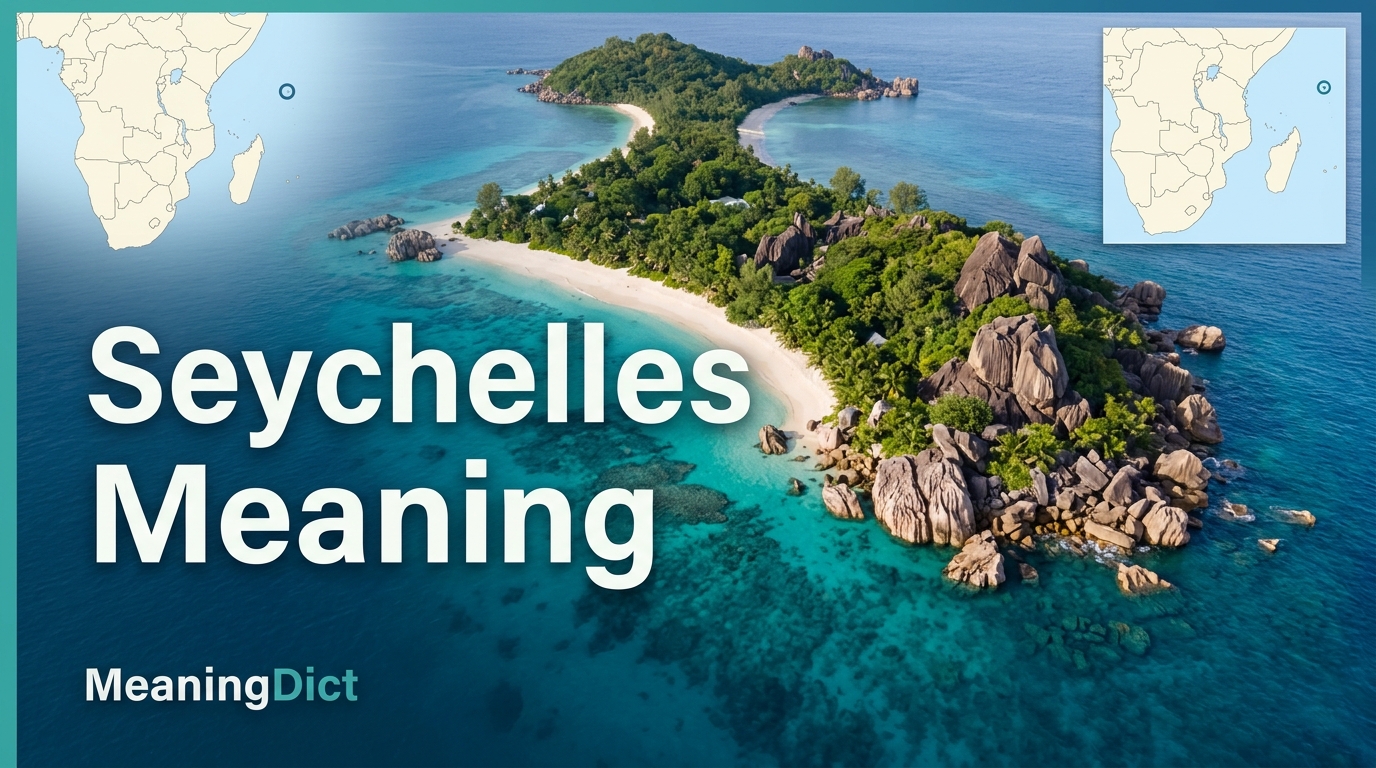
The keyword Seychelles meaning can refer to more than a simple dictionary definition. Seychelles is the proper name of an island country in the western Indian Ocean, off the eastern side of Africa. The name does not literally mean “paradise,” “beautiful islands,” or “tropical beaches,” even though people often connect it with those ideas. Historically, the islands were named in honor of Jean Moreau de Séchelles, a French finance official during the reign of King Louis XV.
Today, Seychelles represents a sovereign African nation, a group of tropical islands, a Creole culture, and one of the world’s best-known nature and beach destinations. The name is used in English, French, and Seychellois Creole, although its spelling and pronunciation change slightly across languages.
Seychelles is the name of an island country in the Indian Ocean. The name comes from Jean Moreau de Séchelles, a French government official. It is a historical proper name, not a word that literally translates as “islands” or “paradise.”
For readers looking for a clear place-name explanation, MeaningDict defines Seychelles through its name origin, country identity, pronunciation, geography, culture, and modern usage.
What is the meaning of Seychelles?
Seychelles means an independent island country and archipelago in the western Indian Ocean. In everyday English, the word identifies both the nation and the group of islands that form it. It is a proper noun, so it functions as a geographic name rather than a common word with a direct dictionary translation.
The historical meaning is connected to a person. French authorities named the islands after Jean Moreau de Séchelles, who served as a senior finance official under King Louis XV. Because of this origin, Seychelles is known as an eponym—a place named after a person.
The modern meaning is broader. Seychelles can refer to:
- The Republic of Seychelles
- The islands and surrounding waters
- The Seychellois people and national identity
- A tropical travel destination
- A multicultural Creole society
Therefore, the simplest Seychelles definition is “an African island nation in the Indian Ocean.” Its deeper meaning comes from French colonial naming history, while its present meaning reflects an independent country with its own culture, government, language, and identity.
Seychelles meaning and origin of the name
The origin of the name Seychelles goes back to French activity in the Indian Ocean during the eighteenth century. In 1756, French captain Corneille Nicolas Morphey formally claimed the islands for France. The island group was named in honor of Jean Moreau de Séchelles, a French politician and finance administrator who served under King Louis XV.
The original French form included the accented surname “Séchelles.” During later British administration, the spelling became standardized in English as “Seychelles,” without the French accent. This spelling remains the internationally recognized country name today.
The name is therefore personal and historical, not descriptive. It was not created from a local word for sea, island, beauty, or nature. It also does not have a hidden spiritual or symbolic translation.
In naming studies, Seychelles is an eponymic place name. That means a location received the name of a person. Over time, the name moved beyond its colonial origin and became the national name of a diverse, independent republic with a strong Seychellois Creole identity.
What does Seychelles mean in English?
In English, Seychelles means a country made up of islands in the Indian Ocean. Dictionaries usually define it as an island republic located northeast of Madagascar and east of mainland Africa. The word is normally treated as a geographic proper noun, not as an English vocabulary word with a separate literal meaning.
English speakers may say either “Seychelles” or “the Seychelles.” The form with “the” is common because the country is an archipelago, or group of islands. This is similar to the way English sometimes uses “the” with plural geographic names.
The word can appear in several related forms:
- Seychelles: The country or island group
- Seychellois: A person, culture, or thing from Seychelles
- Republic of Seychelles: The official state name
- Seychellois Creole: A major language of the country
In simple English, Seychelles means “a tropical African island nation.” However, this is an explanatory definition rather than a direct translation. The name itself comes from a French surname and does not literally mean tropical, African, island, or paradise.
Seychelles country meaning and history explained
The country meaning of Seychelles developed through exploration, colonial rule, settlement, and independence. The islands were known to sailors before permanent settlement, but they had no established indigenous population when European powers began recording and claiming them. France formally claimed the islands in 1756, and the first permanent settlers arrived in 1770.
The islands later came under British control during the early nineteenth century. British rule influenced administration, law, education, and the English form of the country’s name. Seychelles became a separate British Crown Colony in 1903 after previously being governed with Mauritius.
On June 29, 1976, Seychelles became an independent republic. From that point, the word Seychelles no longer described a colony. It became the official name of a sovereign nation.
The country’s historical identity includes African, European, and Asian influences. These connections shaped its population, food, music, beliefs, and languages. Therefore, the Seychelles country meaning is both political and cultural: it describes an independent African state and a Creole society created through centuries of migration, hardship, adaptation, and shared island life.
Why is Seychelles called Seychelles?
Seychelles is called Seychelles because French officials named the islands after Jean Moreau de Séchelles. He was a French statesman who held an important financial position during the reign of King Louis XV. The naming took place when France formally claimed the islands in 1756.
The choice followed a common colonial practice. Explorers and officials often named newly claimed territories after monarchs, ministers, patrons, ships, saints, or other influential people. Seychelles was therefore not named for its beaches, climate, plants, or shape.
The French surname was written “Séchelles,” with an accent. Under British administration, the country name gradually appeared in the English form “Seychelles.” The pronunciation also became adapted for English speakers.
It is important to separate the name’s origin from its modern identity. Although the name came from a French official, Seychelles today is an independent nation with its own people, Creole culture, political system, and national values. In other words, the historical answer explains why the name was chosen, but the modern meaning belongs to the Seychellois people who use it as the name of their country.
Seychelles meaning in different languages
The meaning of Seychelles stays largely the same across languages because it is a proper place name. Most languages do not translate it into a new word. Instead, they change the spelling, pronunciation, article, or script to match local language rules.
| Language | Common form | Meaning or use |
|---|---|---|
| English | Seychelles or the Seychelles | The island country and archipelago |
| French | Les Seychelles | The Seychelles islands or republic |
| Seychellois Creole | Sesel | The local Creole name for the country |
| Hindi | सेशेल्स | A script-based form of the country name |
| Urdu | سیشلز | A transliterated form of Seychelles |
| Arabic | سيشل | A common Arabic rendering of the name |
| Spanish | Seychelles or las Seychelles | The country or island group |
These forms do not give Seychelles a different literal meaning. For example, “Sesel” is not a translation meaning paradise; it is the Seychellois Creole form of the name. In every language, the central idea remains the same: a sovereign island country in the Indian Ocean with a name that came from the French surname Séchelles.
What does the word Seychelles stand for?
The word Seychelles does not stand for a longer phrase, and it is not an acronym. Its letters do not represent separate words. Instead, Seychelles is a historical place name based on the surname Séchelles.
This distinction matters because online users sometimes search for “Seychelles full form” or ask what each letter stands for. There is no official full form built from the letters S-E-Y-C-H-E-L-L-E-S. The official long name is the Republic of Seychelles, but that is the country’s formal title, not an expansion of an abbreviation.
Depending on context, the word Seychelles can stand for several connected ideas:
- A sovereign republic
- An African island state
- An archipelago in the Indian Ocean
- The homeland of the Seychellois people
- A Creole cultural identity
- A major nature and beach destination
Therefore, the most accurate answer is that Seychelles stands for the country itself. Historically, it preserves the name of Jean Moreau de Séchelles. In modern use, it represents the land, people, culture, government, islands, and national identity of the Republic of Seychelles.
Seychelles meaning in geography and tourism
In geography, Seychelles means an archipelago and sovereign island state in the western Indian Ocean. An archipelago is a group or chain of islands. The country includes granitic inner islands and low-lying coral islands spread across a large ocean area. Mahé is the main island, while Praslin and La Digue are also widely known.
In tourism, the word Seychelles carries strong associations with clear water, pale beaches, granite rocks, coral reefs, luxury resorts, wildlife, and island-hopping. These ideas are part of the destination’s image, but they are not the literal origin of its name.
The geographic and tourism meanings can be separated like this:
- Geographic meaning: A country, island group, territory, and marine region
- Tourism meaning: A tropical destination known for nature, relaxation, romance, and outdoor activities
Seychelles is also linked with conservation tourism. Visitors may know it for giant tortoises, rare birds, marine life, the coco de mer palm, and protected natural areas. Thus, geography explains what Seychelles is, while tourism explains how the country is commonly experienced and imagined by travelers.
Where is Seychelles located and what does it mean?
Seychelles is located in the western Indian Ocean, northeast of Madagascar and east of mainland Africa. It is geographically part of Africa, even though it is separated from the continent by a wide area of ocean. The capital, Victoria, is on Mahé, the country’s largest and most populated island.
The country is commonly described as an archipelago of 115 islands. These islands are spread across a broad marine zone. Most people live on the inner islands, especially Mahé, Praslin, and La Digue. Some outer islands are remote, low-lying coral islands or atolls.
Its location helps explain the modern associations of the name Seychelles. The country sits in a tropical ocean setting, so people connect the word with beaches, warm weather, coral reefs, fishing, sailing, and marine biodiversity.
However, location is not the same as word origin. Seychelles does not literally mean “Indian Ocean islands.” It is the name given to the archipelago after Jean Moreau de Séchelles. In simple terms, Seychelles means a named island nation, and its location is in the Indian Ocean region of Africa.
See Also: Contingent Meaning: Definition, Examples, Pronunciation, and Uses
Seychelles island name meaning and facts
The island name Seychelles refers to the entire archipelago, but individual islands have their own names, histories, and features. Mahé is the largest island and contains Victoria, the capital. It was named in honor of Bertrand-François Mahé de La Bourdonnais, a French colonial administrator. Praslin was named after a French statesman, while La Digue took its name from a French ship.
Several useful facts help explain the island identity:
- Seychelles is commonly described as having 115 islands.
- The islands include both granitic and coral formations.
- Mahé, Praslin, and La Digue are the best-known inhabited islands.
- Aldabra is a large coral atoll famous for giant tortoises.
- Praslin is home to the coco de mer palm and Vallée de Mai.
- Many smaller islands are protected or lightly populated.
The plural-looking form “Seychelles” suits an island group, but it remains the name of one country. The name does not mean “many islands” in French or English. Its island meaning developed through geographic use after the archipelago received the name Séchelles.
Seychelles meaning pronunciation and spelling guide
Seychelles is commonly pronounced say-SHELLZ in English. In phonetic form, it is often written /seɪˈʃelz/. The stress falls on the second part: “shellz.” Some speakers use a softer ending that sounds closer to “say-SHELL.”
A simple pronunciation breakdown is:
- Sey: Sounds like “say”
- chelles: Sounds like “shellz”
- Full pronunciation: Say-SHELLZ
The correct English spelling is Seychelles. Common misspellings include Seycheles, Sechelles, Seychells, Seychels, and Seyshells. The historical French surname used an accent: Séchelles. The modern English country name does not normally use that accent.
The adjective and nationality word is Seychellois, often pronounced roughly as “say-shell-WAH.” A person from the country may be called Seychellois, while the local Creole form is Seselwa.
To remember the spelling, divide the word into three visual parts: Sey + chell + es. Do not spell it according to the English word “shells,” even though the pronunciation sounds similar. MeaningDict recommends learning the written form and pronunciation together to avoid common errors.
Seychelles meaning in simple words for beginners
In simple words, Seychelles is a small island country in the Indian Ocean. It belongs to the African region and is made up of many islands. Its capital is Victoria, and its main island is Mahé. The country is known for beaches, clear water, tropical plants, rare animals, and Creole culture.
The name Seychelles came from a French man named Jean Moreau de Séchelles. French officials used his surname when naming the islands in the eighteenth century. Therefore, Seychelles does not directly mean “beautiful beach,” “heaven,” or “island paradise.”
A beginner-friendly definition is:
Seychelles is an African country made up of tropical islands in the Indian Ocean. Its name was taken from the surname of a French official.
People also use “Seychelles” when talking about holidays, nature, island life, or the citizens of the country. A citizen is called Seychellois.
MeaningDict presents this distinction clearly: the dictionary meaning tells you what Seychelles is today, while the name origin tells you why it is called Seychelles. Both ideas are needed for a complete answer.
What is Seychelles famous for and its meaning?
Seychelles is famous for tropical beaches, unusual granite boulders, coral reefs, clear lagoons, rare wildlife, and high-value nature tourism. Its best-known islands include Mahé, Praslin, and La Digue. The country is also associated with honeymoon travel, diving, snorkeling, sailing, fishing, and quiet island resorts.
Nature is central to its global image. Aldabra Atoll is known for its large population of giant tortoises. Vallée de Mai on Praslin protects the coco de mer, a palm that produces the world’s heaviest seed. Seychelles also supports rare birds, sea turtles, coral habitats, and protected marine environments.
Culturally, the country is famous for Creole food, music, dance, and multilingual life. Seychellois culture reflects African, European, and Asian influences.
These famous features shape the emotional meaning of Seychelles. For many people, the word suggests beauty, privacy, romance, and nature. Yet these are modern associations, not the original translation. The actual name came from Jean Moreau de Séchelles, while its present reputation comes from the islands’ environment, culture, and tourism identity.
Seychelles meaning, culture, and historical background
The cultural meaning of Seychelles comes from the shared history of people with African, European, and Asian roots. The islands did not have a long-established native population before permanent settlement. French settlers and enslaved Africans formed the early colonial society, while later migration and British rule added further influences.
This history produced a distinct Creole identity. Seychellois Creole, also called Seselwa or Kreol, developed mainly from French while reflecting the experiences and speech of the island population. English and French also remain national languages.
Seychellois culture can be seen in fish-based dishes, coconut, spices, music, storytelling, religion, festivals, and family life. Moutya, a traditional drum-based song and dance, grew from the experiences of enslaved Africans and became a symbol of memory, resistance, and cultural survival.
Seychelles therefore means more than a place on a map. For its citizens, it represents home, shared history, national unity, and Creole heritage. The colonial name has been absorbed into an independent identity shaped by the people who built their lives across the islands.
Seychelles definition, location, and travel information
Seychelles is officially the Republic of Seychelles, an independent African island country in the western Indian Ocean. Its capital is Victoria, located on Mahé. The country’s main inhabited islands include Mahé, Praslin, and La Digue, while many smaller islands and atolls are remote or protected.
For travel planning, Seychelles is best understood as an island-hopping destination. International arrivals generally enter through Mahé. Travelers can then reach other islands by domestic flight, ferry, boat, or approved transfer. Beaches, nature reserves, hiking, snorkeling, diving, and Creole food are major parts of the visitor experience.
The country has a tropical climate, but rainfall, wind, and sea conditions can vary by season and island. Travelers should check current entry rules, transport schedules, accommodation policies, and weather conditions before departure.
The word Seychelles in travel content usually refers to the whole country, not one single island. A hotel described as being “in Seychelles” may be on Mahé, Praslin, La Digue, or another island. Knowing the exact island is important when comparing airports, ferries, activities, and travel time.
Seychelles meaning at a glance
| Question | Clear answer |
| What is Seychelles? | An independent African island country |
| Where is it? | In the western Indian Ocean |
| What does the name mean? | It is a proper name taken from the surname Séchelles |
| Who was it named after? | Jean Moreau de Séchelles |
| Is it one island? | No, it is an archipelago |
| What is the capital? | Victoria |
| What is the main island? | Mahé |
| What is the local Creole name? | Sesel |
| How is it pronounced? | Say-SHELLZ |
| Does it mean paradise? | No; paradise is a modern association, not the literal meaning |
The most accurate one-sentence definition is: Seychelles is an African island republic in the Indian Ocean whose name honors the French official Jean Moreau de Séchelles.
This definition works well because it combines category, location, and name origin. It also prevents a common misunderstanding: Seychelles is not a translated word for beaches, heaven, or tropical islands.
See Also: Demisexual Meaning: Signs, Attraction, Dating, and Flag Explained
Frequently Asked Questions About Seychelles Meaning
Is Seychelles a country or an island?
Seychelles is a country made up of many islands. It is an archipelago, not a single island. Mahé is its largest and most populated island, and Victoria, the capital, is located there. Praslin and La Digue are two other well-known islands. In travel conversations, people may casually call it an island destination, but the accurate definition is an island country.
Does Seychelles mean paradise?
No. Seychelles does not literally mean paradise. The name comes from Jean Moreau de Séchelles, a French finance official. People connect the word with paradise because the country is famous for beaches, tropical scenery, clear water, and private resorts. “Paradise” is therefore a tourism association or description, not the historical meaning of the name.
Who was Seychelles named after?
Seychelles was named after Jean Moreau de Séchelles, a French statesman and finance administrator under King Louis XV. French authorities used his surname when formally claiming and naming the island group in 1756. The modern spelling “Seychelles” developed from the French form “Séchelles.”
How do you pronounce Seychelles correctly?
Seychelles is usually pronounced say-SHELLZ in English. The first part sounds like “say,” and the second sounds like “shells” with a voiced “z” ending. The main stress falls on the second syllable. Pronunciation can vary slightly by accent, but say-SHELLZ is clear and widely understood.
What is Seychelles called in the local language?
In Seychellois Creole, Seychelles is commonly called Sesel. The people may be called Seselwa in Creole. Sesel is a localized language form of the country name, not a different word meaning paradise or islands. Seychellois Creole, English, and French are the country’s national languages.
Why do people say “the Seychelles”?
People often say “the Seychelles” because the country is an archipelago with a plural-looking geographic name. The article “the” highlights the idea of an island group. Both “Seychelles” and “the Seychelles” appear in English, although official names and modern international usage often use “Seychelles” without the article.
Is Seychelles in Africa or Asia?
Seychelles is part of Africa. It is an African island country located in the Indian Ocean, east of the African mainland and northeast of Madagascar. Its distance from the continent sometimes causes confusion, but politically and geographically it is grouped with African states.
What language is spoken in Seychelles?
Seychellois Creole, English, and French are national languages. Seychellois Creole is widely used in daily life, while English and French are also important in government, education, media, business, and tourism. The country’s multilingual character reflects its French, British, African, and wider Indian Ocean history.
Is Seychelles a plural word?
Seychelles looks plural and often appears with “the,” but it is the proper name of one sovereign country. It refers to a group of islands governed as a single republic. In grammar, the treatment can depend on sentence style, but writers usually use a singular verb when referring to the country as a state.
What is the shortest definition of Seychelles?
Seychelles is an African island country in the Indian Ocean. Its name was taken from Jean Moreau de Séchelles, a French official. This short definition covers both the modern geographic meaning and the historical origin of the name.
Final meaning of Seychelles
The complete Seychelles meaning combines definition, history, geography, and culture. Seychelles is an independent African republic formed by a group of islands in the western Indian Ocean. Its name came from Jean Moreau de Séchelles, a French finance official, so it is an eponym rather than a word with a literal translation.
Over time, the name gained meanings that go far beyond its colonial origin. It now represents the Seychellois people, Creole identity, national independence, rare wildlife, marine conservation, and a famous tropical destination. In travel language, Seychelles may suggest beaches and paradise, but those are associations rather than the true etymology.
For a simple answer, remember this line: Seychelles is an island country whose name honors a French official named Séchelles.
MeaningDict helps readers understand this type of term by separating three ideas: what the word refers to today, where the name came from, and what people commonly associate with it. That approach gives a clearer and more accurate meaning.
![ATP Meaning in Text — What It Really Means [2026]](https://meaningdict.com/wp-content/uploads/2026/05/ATP-Meaning-in-Text-—-What-It-Really-Means-768x429.jpeg)
3 Comments