Tralalero Tralala Meaning: English Translation, Meme Origin, and Full Explanation
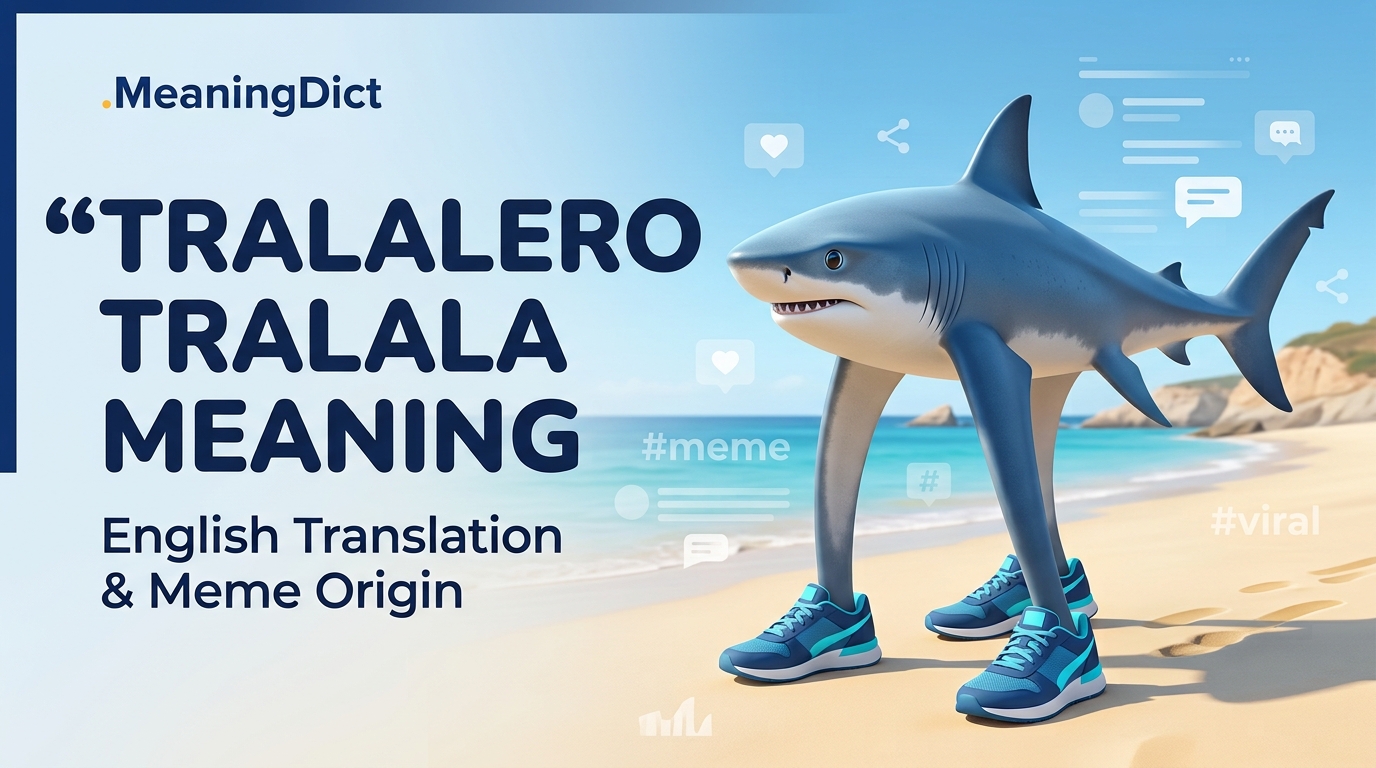
“Tralalero Tralala” is one of the best-known phrases from the Italian brainrot meme trend. Most people first hear it in a short TikTok, YouTube Short, Roblox clip, remix, or video showing a three-legged shark wearing blue sneakers. The phrase sounds Italian, but its literal meaning is much simpler than many viral posts suggest.
This guide separates the harmless phrase from the offensive words found in some versions of the original audio. It also explains the meme’s English translation, Italian language context, disputed origin, shark character, Nike shoes, and popularity with children.
MeaningDict recommends checking both the literal words and the full audio context before repeating any foreign-language meme. A funny-sounding phrase may be attached to language that carries a very different message.
Quick Answer: What Does Tralalero Tralala Mean?
“Tralalero Tralala” does not have a direct dictionary translation such as “hello,” “goodbye,” or “I am happy.” It is a rhythmic string of musical syllables, similar to “tra-la-la” or “la-la-la” in English.
People use sounds like these while humming, singing without lyrics, acting playful, or making a sentence sound childish and sarcastic. Italian dictionary entries for related forms describe them as syllables used to carry a melody, express cheerfulness, or create a chant-like refrain. re, however, “Tralalero Tralala” is also the name of an AI-generated shark character wearing three blue sneakers. The name became linked to a viral Italian-language audio that includes profanity and religious insults after the opening phrase.
Therefore, the phrase alone is harmless nonsense, but some full audio versions are offensive and unsuitable for children, classrooms, family content, or respectful public use. Tralala Meaning at a Glance
| Question | Simple Answer |
|---|---|
| Literal English meaning | No fixed meaning; similar to “tra-la-la” |
| Language | Italian-style musical syllables |
| Meme character | An AI-generated shark with three sneaker-wearing fins |
| Main platform | TikTok, followed by YouTube, Instagram, and Roblox |
| Meme category | Italian brainrot |
| Is the phrase offensive? | No, not by itself |
| Is the original full audio offensive? | Yes, some versions include profanity and religious insults |
| Confirmed creator | No single creator is fully verified |
The safest summary is that Tralalero Tralala means a playful, sing-song “tra-la-la” sound, while the internet meme refers to a surreal sneaker-wearing shark.
The confusion comes from people treating the character’s name, the opening chant, and the complete viral audio as if they were the same thing. They are not. The words “Tralalero Tralala” are neutral, but the longer recording connected to early versions of the meme contains crude and blasphemous language.
Major coverage describes Italian brainrot as an intentionally absurd, AI-generated trend driven by animal-object hybrids and pseudo-Italian or partly nonsensical narration. Tralalero Tralala Mean in English?
In English, “Tralalero Tralala” is best understood as “tra-la-la, la-la-la” rather than as a sentence with a literal translation. The syllables imitate singing and create a light, bouncy rhythm.
An English speaker might use “la-la-la,” “dum-de-dum,” or “tra-la-la” in a similar way when humming a tune, joking, or filling space where real lyrics would normally appear.
The phrase can also carry a playful, childish, teasing, or sarcastic tone depending on how it is spoken. That emotional effect matters more than the individual syllables. Italian language references describe closely related forms as onomatopoeic or melody-supporting sounds, not as normal vocabulary with a fixed definition. nglish meaning also includes the meme context. A complete explanation is: a nonsense musical chant that became the name of a viral AI shark from Italian brainrot memes.
The phrase itself should not be translated as the offensive lines that follow it in the original audio.
What Is the Meaning of the Tralalero Tralala Meme?
The Tralalero Tralala meme represents absurd internet humor rather than a hidden moral, traditional Italian legend, or serious story.
Its main joke is the mismatch between an impossible image, a dramatic artificial voice, and language that sounds meaningful even when much of the content is nonsense, crude, or exaggerated. The best-known visual shows a shark standing on three elongated fins, with each fin wearing a blue sneaker.
This format belongs to “Italian brainrot,” a meme genre built around:
- AI-generated animal-object hybrids
- Exaggerated Italian-sounding names
- Fast synthetic narration
- Dramatic music and editing
- Fictional battles and relationships
- Deliberately confusing stories
The content is designed to be strange, repeatable, instantly recognizable, and easy to remix. iewers, the character may simply mean “the funny shark with shoes.” For older viewers, it often works as ironic humor about low-effort AI content and overstimulating social media.
The meme has no single official storyline because users constantly create new families, powers, enemies, songs, and adventures for the character.
See Also: 8647 Meaning: Slang, TikTok, Politics, Trump and Angel Number
Tralalero Tralala English Translation and Meaning
A careful translation must separate two elements.
First, “Tralalero Tralala” itself is not a meaningful sentence. Its closest natural English equivalent is “tra-la-la” or “la-la-la.”
Second, the longer viral recording continues with vulgar statements, religious insults, and an absurd story involving a child, a video game, a grandmother, an invitation, and an obscene meal. Different uploads may shorten, remix, censor, replace, or completely rewrite these lines.
A safe, non-graphic English summary of the early audio is:
“Tra-la-la; [religious insults]. I was playing a video game with my son when my grandmother arrived and told us that someone had invited us to an obscene dinner.”
The exact wording is intentionally crude and should not be treated as normal conversational Italian. Coverage from meme researchers and digital-culture publications confirms that listeners often repeated the sound without understanding its offensive content. wanting only the name’s meaning, the correct answer remains simple: it is musical nonsense, not a secret Italian insult.
Where Did the Tralalero Tralala Meme Come From?
The meme came from a chain of Italian-language internet jokes rather than from one traditional song, movie, cartoon, or television show.
Reporting traces an earlier use of “Tralalero Tralala” to absurd Dwayne “The Rock” Johnson memes circulating in 2023. These clips used synthetic narration, rhymes, dramatic background music, and deliberately ridiculous stories.
A later version of the audio appeared on TikTok in 2024 and included the controversial words now associated with the meme. entity arrived afterward. In early January 2025, users began pairing the audio with strange AI-generated images. Within days, a shark wearing blue sneakers became the dominant image.
The Guardian reports that the audio surfaced before the shark visual, while other accounts document several deleted or reposted TikToks that helped the character spread. posts were deleted, banned, copied, or separated from their original audio accounts, a perfectly clean origin trail is difficult to prove. The most accurate answer is that the meme evolved through several creators, adaptations, and reposts.
What Does Tralalero Tralala Mean in Italian?
To an Italian speaker, “Tralalero Tralala” sounds like a playful chant, vocal filler, or made-up refrain used to support a tune.
It resembles real Italian forms such as “trallallà,” which can function like “la-la-la” when someone does not know the lyrics, does not want to repeat them, or simply wants to hum a melody.
Treccani also records “trallallero” as an onomatopoeic term connected with Ligurian choral singing and, more generally, a chant or repetitive tune. exact spelling “Tralalero Tralala” used by the meme is not a standard everyday phrase with one fixed meaning. It is an internet-friendly variation chosen because it sounds rhythmic, exaggerated, and recognizably Italian to international audiences.
Its meaning changes with context. Spoken alone, it may suggest:
- Humming
- Silliness
- Mock cheerfulness
- Playfulness
- Childishness
- Sarcasm
Used online, it usually points to the shark character or Italian brainrot. It does not automatically contain an insult or vulgar message unless the speaker continues into the longer viral audio.
Is Tralalero Tralala a Real Italian Phrase?
“Tralalero Tralala” is not a standard Italian sentence, idiom, greeting, or proverb.
You would not use it to ask for directions, greet a friend, order food, or express a precise thought. It is closer to a sound pattern than normal vocabulary.
Still, it is not completely disconnected from Italian language and music. Similar forms such as “trallallà” and “trallallero” appear in Italian dictionaries and musical traditions as chant-like or melody-filling syllables. e best answer slightly more detailed than simply saying it is “fake Italian.” The meme spelling is invented or stylized, but it is based on a real type of vocal expression that Italian speakers can recognize.
It works much like the English phrase “tra-la-la.” English speakers understand the mood of that expression even though it does not communicate a specific factual statement.
So, is it real Italian? It is real as an Italian-style musical expression, but not real as a complete phrase with a fixed dictionary translation. The viral meme turned that sing-song expression into a proper name for an AI-generated character.
Why Is Tralalero Tralala Famous on TikTok?
Tralalero Tralala became famous because it fits the mechanics of short-form video perfectly.
The name is rhythmic, easy to repeat, and memorable even for people who do not speak Italian. The shark image is visually simple but immediately strange: a sea animal stands on land and wears three matching sneakers.
The synthetic voice and dramatic editing add energy during the first few seconds, helping the video capture attention before users scroll away.
TikTok also makes sounds easy to reuse. Once a memorable audio is attached to a recognizable character, creators can build:
- Battle edits
- Character rankings
- Dance videos
- Transformations
- Relationship stories
- Reaction videos
- Remixes and songs
- Gaming content
The Guardian noted that audio was central to the trend, while AP described Italian brainrot as a broad series of unrealistic AI hybrids with absurd narration that strongly attracted younger users. moved beyond TikTok into YouTube Shorts, Instagram Reels, fan songs, toys, and Roblox experiences. Repetition turned a confusing image into a shared cultural reference.
See Also: Diabolical Meaning: Simple Definition, Slang, Pronunciation, and Examples
What Is the Origin of Tralalero Tralala?
The origin of Tralalero Tralala has at least three separate stages.
The first is linguistic. “Tralala”-type sounds have long been used as musical filler, which means the basic chant was not invented by TikTok.
The second is the meme-audio lineage. Absurd Italian clips involving Dwayne Johnson used “Tralalero Tralala” as early as 2023, and a controversial version was reportedly posted in 2024.
The third is the character stage. The shark in sneakers became attached to the audio in January 2025 and turned the chant into a character name. history explains why different websites name different “original” creators. One source may identify the first known audio, another the account that reposted it successfully, and another the creator of the viral shark image.
Deleted posts and changing usernames make the record even less certain.
Therefore, the clearest origin statement is: Tralalero Tralala grew from older musical nonsense syllables, evolved through Italian absurdist voiceover memes, and became globally famous when TikTok users paired it with an AI-generated sneaker-wearing shark in early 2025.
Who Created the Tralalero Tralala Character?
No single creator can be credited with complete certainty.
Different reports identify different accounts because the phrase, audio, and shark image appeared at separate times. Vulture traces the controversial audio to an account called @burgermerda in September 2024 and says a later deleted account helped popularize the blue-sneaker shark.
The Daily Dot instead highlights @eZburger401 in connection with the sound and reports that a January 13, 2025 shark post from @amoamimandy.1a gained millions of views. s may represent original creation, reposting, adaptation, or viral amplification rather than one complete act of authorship. The early TikTok trail is also weakened by:
- Deleted videos
- Account bans
- Copied sounds
- Changed usernames
- Reposts without credit
A trustworthy explanation should therefore avoid presenting one handle as an undisputed fact.
The safest answer is: the character was collectively shaped by several TikTok creators, while the exact original creator remains disputed. What is clear is that the sneaker-wearing shark became established in January 2025 and inspired the wider Italian brainrot universe.
What Animal Is Tralalero Tralala?
Tralalero Tralala is a shark, usually shown as a blue-gray shark standing on a beach or another land-based setting.
The character has three elongated lower fins that function like legs. Each “leg” normally wears a blue athletic sneaker, giving the character its most recognizable feature.
Some versions show the shark:
- Dancing
- Running at high speed
- Fighting other characters
- Jumping through the air
- Posing on a beach
- Appearing in dramatic action scenes
The design does not represent a real shark species or a creature from Italian folklore. It is an AI-generated fantasy hybrid created for surreal humor.
AP describes the character as a shark with blue sneakers on elongated fins and identifies it as the first Italian brainrot figure, while other coverage calls it the first character in the trend to gain major attention. call the three fins “legs,” but anatomically they are part of the visual joke rather than a scientific design. The character’s simple silhouette makes it easy to recognize in thumbnails, toys, games, drawings, costumes, and fan-made animations.
Why Does Tralalero Tralala Wear Nike Shoes?
There is no confirmed official story explaining why Tralalero Tralala wears Nike shoes.
The sneakers appear to be part of the original visual joke. A shark should not walk on land, should not have three legs, and certainly does not need athletic footwear. Combining all three ideas creates an image that is immediately absurd and memorable.
The blue shoes also give the character a strong visual identity. Without them, the image would look like an ordinary AI-generated shark. With three matching sneakers, viewers can recognize Tralalero Tralala even when the setting, pose, or animation changes.
Major reports consistently describe the character through this feature, often calling it the shark in blue Nike sneakers. stories claim the shoes provide:
- Super speed
- Extreme jumping power
- Stronger attacks
- The ability to run on land
However, these are community inventions rather than verified canon. Italian brainrot has no central author or official rulebook.
The best explanation is that the shoes were selected for visual contrast, streetwear familiarity, and surreal comedy—not because of a deeper symbolic meaning.
Is the Tralalero Tralala Audio Offensive?
The words “Tralalero Tralala” are not offensive by themselves. They are playful, song-like syllables.
The problem is the longer early audio connected to the meme. After the opening chant, some versions include profanity, blasphemous insults directed at God and Allah, crude sexual language, and an intentionally obscene story.
Digital-culture coverage has specifically warned that many users repeated the sound without knowing what the Italian words meant. erefore depends on which audio is being used:
- A clean remix containing only the character’s name may be harmless.
- The uncensored original or a close copy is offensive.
- Fan-made songs may contain completely different, child-friendly lyrics.
- Short clips may hide the offensive lines by cutting them off.
- Some reposts replace the original narration with music or sound effects.
Parents, teachers, brands, and creators should check the exact recording rather than judging it from the title alone.
Muting the original sound or using a verified clean version is the safer choice. A foreign-language audio should never be assumed safe simply because its rhythm sounds funny.
What Does the Full Tralalero Tralala Audio Mean?
The full early audio is an intentionally vulgar, absurd mini-story rather than a coherent message.
It begins with the musical nonsense phrase “Tralalero Tralala,” then moves into blasphemous insults involving God and Allah. The speaker says he was playing Fortnite with his son when a grandmother arrived with news that a person called Burger had invited them to dinner.
The final part describes the meal using obscene sexual language.
That summary communicates the meaning without repeating the most graphic wording. The recording is built around shock, rhyme, profanity, and the fact that non-Italian listeners may repeat it without understanding.
Published translations vary slightly because some reposts use:
- Altered wording
- Imperfect transcription
- Portuguese captions
- Censored clips
- AI-generated pronunciation
- Shortened versions
portant not to confuse later songs with the original. Many current videos use clean remixes that only repeat the name or add new English lyrics about the shark.
Anyone searching for the “full meaning” should identify the exact upload before translating it because there is no longer one universal version of the audio.
How Is Tralalero Tralala Connected to Italian Brainrot?
Tralalero Tralala is widely treated as the breakout character that established the modern Italian brainrot format.
The basic formula combines:
- An AI-generated creature
- A rhythmic Italian-sounding name
- Synthetic voice narration
- Dramatic background music
- A nonsensical or crude story
- Fast, exaggerated editing
After the shark became popular, creators produced many new characters. These included a crocodile-airplane hybrid, a ballerina with a cappuccino cup for a head, and an elephant-cactus creature. lian” describes the style of the names and narration. It does not mean the trend is an official Italian franchise or an accurate representation of Italian culture.
“Brainrot” refers to highly repetitive, low-context internet content that becomes difficult to forget. The trend grew through remixes, rankings, battles, relationship lore, games, and fan songs.
Tralalero Tralala matters because it supplied the recognizable template: a strange AI animal, catchy pseudo-musical name, and dramatic voice.
In that sense, the shark is not merely part of Italian brainrot. It is one of the main symbols of the entire trend.
Tralalero Tralala Meme Explained for Parents
For parents, the simplest explanation is that Tralalero Tralala is a viral cartoon-like shark created with AI.
Children often know it from TikTok, YouTube Shorts, school conversations, songs, or Roblox. They may repeat the name because it is catchy, not because they understand Italian or support the original audio’s message.
The visual character itself is silly and generally harmless.
The concern is the sound attached to some early videos. The complete original includes religious insults, strong profanity, and obscene language. A child may hear only the first few seconds or use a clean remix, but adults should still check the exact clip.
AP and other reporting show that Italian brainrot became especially popular with tweens and spread into games, toys, fan content, and offline play. se works better than panic:
- Ask where the child heard the phrase.
- Play the exact clip together.
- Explain that foreign words may have unexpected meanings.
- Help the child select clean versions.
- Discuss why context matters online.
The goal should be digital awareness, not punishment for repeating a catchy sound without knowing its meaning.
How to Use or Discuss Tralalero Tralala Safely
You can discuss the meme safely by separating the character’s name from the original recording.
Saying “Tralalero Tralala is the shark with sneakers” is not offensive. Using a picture, drawing, costume, or clean fan song is also different from replaying the uncensored early audio.
This distinction prevents unnecessary confusion and helps children understand why context matters.
For schools, family channels, brands, and public accounts, follow three simple steps:
- Preview the entire sound, not only the first few seconds.
- Use a clean remix or mute the original narration.
- Avoid repeating untranslated lines from reposted clips.
It is also important to describe the origin carefully. Do not claim the phrase itself is an anti-religious insult because that is inaccurate. The offensive material comes later in the audio.
Likewise, do not claim a single verified creator when the available record remains disputed.
MeaningDict’s recommended approach to viral slang is to check the literal meaning, meme meaning, cultural context, and safety context separately. That method provides a clearer answer than copying an unverified one-line translation from social media.
Frequently Asked Questions
Does Tralalero Tralala have a literal English meaning?
No. It works like “tra-la-la” or “la-la-la” in English. It is a rhythmic vocal expression rather than a complete sentence. In meme usage, it is also the name of the sneaker-wearing shark character.
Is Tralalero Tralala an Italian song?
Not originally as a standard commercial song. It began as a chant within viral voiceover memes. Many creators later produced remixes, fan songs, music videos, and child-friendly versions using the name.
Is saying Tralalero Tralala disrespectful?
Saying only the name is not generally disrespectful. The phrase is harmless musical nonsense. However, repeating the uncensored full audio can be disrespectful because it contains religious insults and vulgar language.
What color is Tralalero Tralala?
The character is usually blue-gray, similar to a stylized shark. Its sneakers are commonly blue with white details, although fan art, games, and unofficial animations may change the colors.
How many legs does Tralalero Tralala have?
The meme character is normally shown with three elongated fins acting as legs. Each one wears a sneaker, which is why many descriptions call it a three-legged shark.
Is Tralalero Tralala suitable for children?
The character and clean remixes may be suitable, but the original full audio is not. Parents should preview the exact version because reposts may contain profanity, religious insults, or crude jokes.
Is Tralalero Tralala real or AI-generated?
It is an AI-generated fictional character. No real shark has three walking legs or wears sneakers. Fans later recreated the character through drawings, animations, toys, costumes, videos, and games.
What is Italian brainrot?
Italian brainrot is a meme style featuring surreal AI-generated creatures, Italian-sounding names, synthetic voices, absurd stories, and repetitive short videos. It became highly popular among younger social media users during 2025. Tralalero Tralala?
There is no clearly established, universally recognized owner or official franchise behind the original meme. Numerous creators contributed to its audio, image, reposts, stories, songs, animations, and games.
Why do children keep saying Tralalero Tralala?
The phrase has rhythm, repetition, and a memorable character attached to it. Children also repeat it as a shared social reference, much like earlier viral phrases, songs, jokes, or cartoon catchphrases.
Final Meaning of Tralalero Tralala
The final answer is straightforward: “Tralalero Tralala” means something similar to “tra-la-la” in English. It is a playful group of musical syllables without a fixed literal definition.
On the internet, it became the name of a three-legged AI shark wearing blue sneakers and one of the leading symbols of the Italian brainrot trend.
The phrase itself is not offensive. The longer original audio is different because it contains strong profanity, religious insults, and obscene humor. Clean remixes may remove those lines completely, so users should judge the exact clip rather than the name alone.
Its origin is shared and disputed. Older absurdist Italian voiceovers shaped the audio, while several TikTok accounts helped attach it to the shark and spread it during early 2025.
For reliable explanations of viral phrases, meme language, and internet slang, MeaningDict helps readers separate literal translation from cultural context—especially when a harmless-sounding name is connected to a controversial recording.




3 Comments