

Aura Meaning: Three Meanings Explained Simply
Last updated: October 23, 2026
The word aura means three different things depending on who says it: the atmosphere or vibe that seems to surround a person or place, the colored energy field described in spiritual belief, and the medical warning signs that can come before a migraine or seizure. Most confusion about this word comes from mixing up those three, so this guide keeps them separated and shows you how to spot which one is meant.
Which Aura Are We Talking About?
You can tell which aura someone means from the words around it. If the talk is about a person’s vibe, a room’s mood, or someone being cool, it is the everyday sense. If colors, chakras, or readings come up, it is the spiritual sense. If it sits next to words like migraine, seizure, visual, or warning signs, it is the medical sense.
| Clue in the sentence | Which meaning | Example phrase |
|---|---|---|
| Vibe, mood, confidence, mystery, danger | Everyday: atmosphere | “an aura of mystery” |
| Colors, reading, cleanse, chakras | Spiritual: energy field | “my aura color is blue” |
| Migraine, seizure, visual, warning signs | Medical: neurological symptom | “migraine with aura” |
| Cool, points, farming, “he has aura” | Slang: impressively cool | “that was plus 1000 aura” |
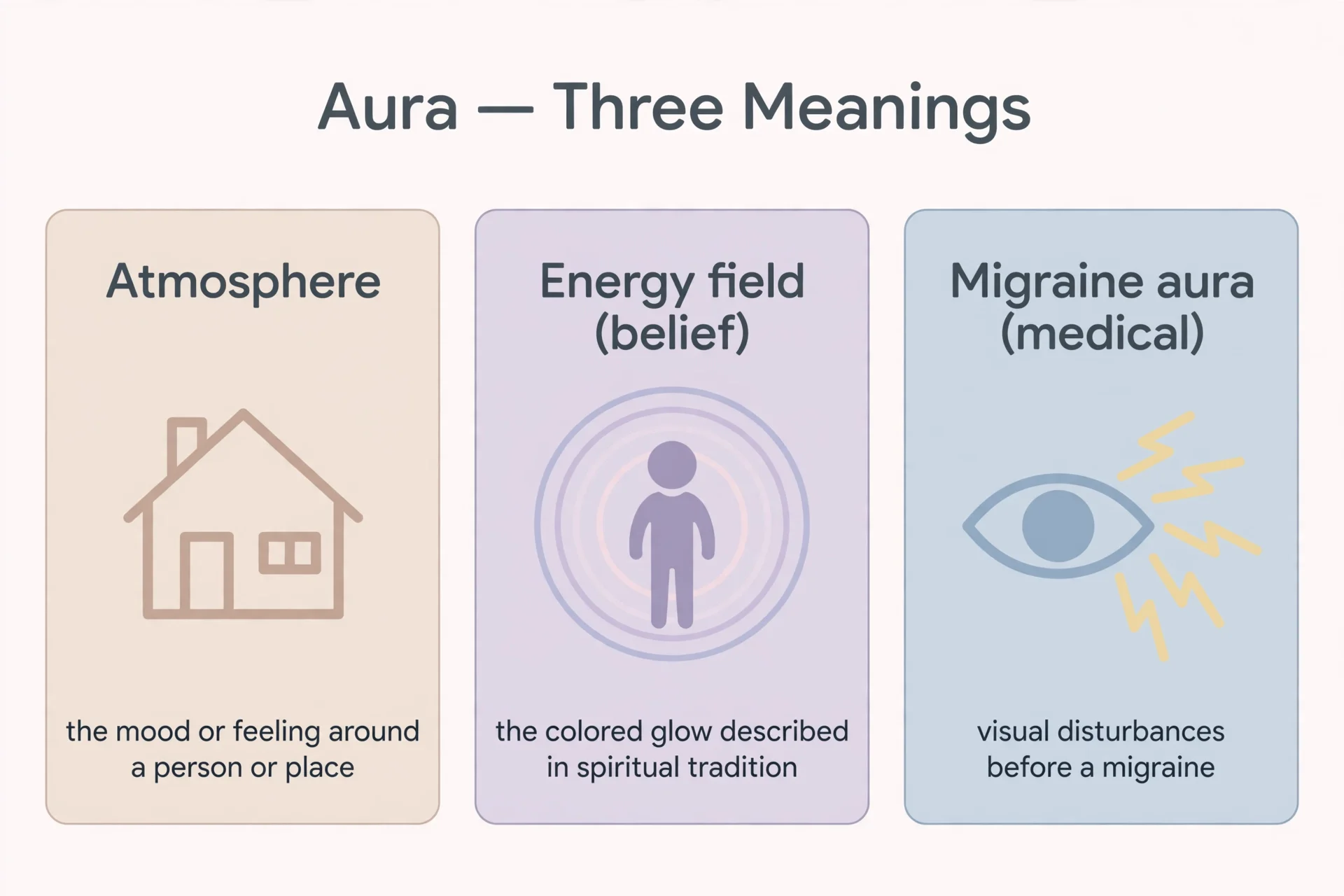
When you are unsure, ask yourself one question: is the person describing a feeling, a belief, or a body symptom? A feeling points to the everyday sense, a belief points to the spiritual one, and a body symptom points to the medical one. That single question settles almost every confusing case.
The Everyday Sense: A Person’s Atmosphere
In everyday English, an aura is the atmosphere or feeling that seems to surround a person, place, or thing. Collins defines it as a quality or feeling that seems to surround a person or place or come from them, as in “she had an aura of authority.” Merriam-Webster gives it as a distinctive quality or atmosphere that seems to surround someone or something.
This is the oldest everyday use and still the most common. You will hear it for people (“an aura of calm”), for places (“the house had a sinister aura”), and for moments (“there was an aura of celebration in the room”). It is figurative, and everyone understands it that way. Nobody thinks an actual cloud hangs over the calm person.
Then came the slang twist. Merriam-Webster now lists a slang sense of aura as the quality of being impressively cool, charming, or appealing. On social media this became a whole scoring system: people say someone “has aura,” or that a move earned “+1000 aura” or cost them aura points. “Aura farming” is the joking name for doing things specifically to look cooler and raise your score. The slang sense took off on TikTok in the early 2020s and spread fast enough to land in the dictionary, which tells you how mainstream it became.
One thing I have noticed: the slang sense and the old sense are closer than they look. “She had an aura of authority” from 1950 and “he has aura” from 2025 are both saying the same thing, that something about this person hits you before they even speak. The new version just turned it into points.
The Spiritual Sense: Energy Fields and Aura Colors
In spiritual and New Age belief, an aura is an invisible energy field said to surround a living person, often described in colors that reflect mood, personality, or spiritual state. Merriam-Webster phrases this sense as an energy field that is held to emanate from a living being. This is a belief system, not a scientific fact: no instrument has ever detected or measured such a field.
Keeping those two lanes apart is exactly what makes the topic interesting rather than confusing. Believers describe the aura as shifting with emotion, stress, and focus, with one dominant color and others layered around it. Most traditions agree on a rough color chart, though no single universal dictionary exists and meanings vary between teachers.
| Aura color | Traditional meaning | Muddy or dark version |
|---|---|---|
| Red | Energy, passion, courage, strong will | Anger, frustration, burnout |
| Orange | Creativity, sociability, warmth, adventure | Restlessness, over-indulgence |
| Yellow | Optimism, intellect, curiosity, playfulness | Anxiety, overthinking, tension |
| Green | Growth, healing, balance, love of nature | Jealousy, insecurity, resentment |
| Blue | Calm, honesty, clear communication, trust | Sadness, withdrawal, fear of speaking |
| Indigo | Intuition, depth, sensitivity, inner sight | Overwhelm, escapism |
| Violet | Spirituality, imagination, higher awareness | Feeling ungrounded or scattered |
| Pink | Love, tenderness, kindness, self-care | Immaturity, clinginess |
| White | Purity, clarity, high energy, protection | Rare; sometimes read as depletion |
| Black | Not a color in itself; read as heaviness | Grief, illness, or a need to shield oneself |
Read that chart as tradition, not as diagnosis. Bright, clear shades are read as balanced and healthy, while dark, muddy versions of the same color are read as stress or a block. But a blue aura does not prove someone is emotionally healthy, and a dark color does not prove something is wrong with them. Even within the tradition, colors are said to shift through the day as feelings change.
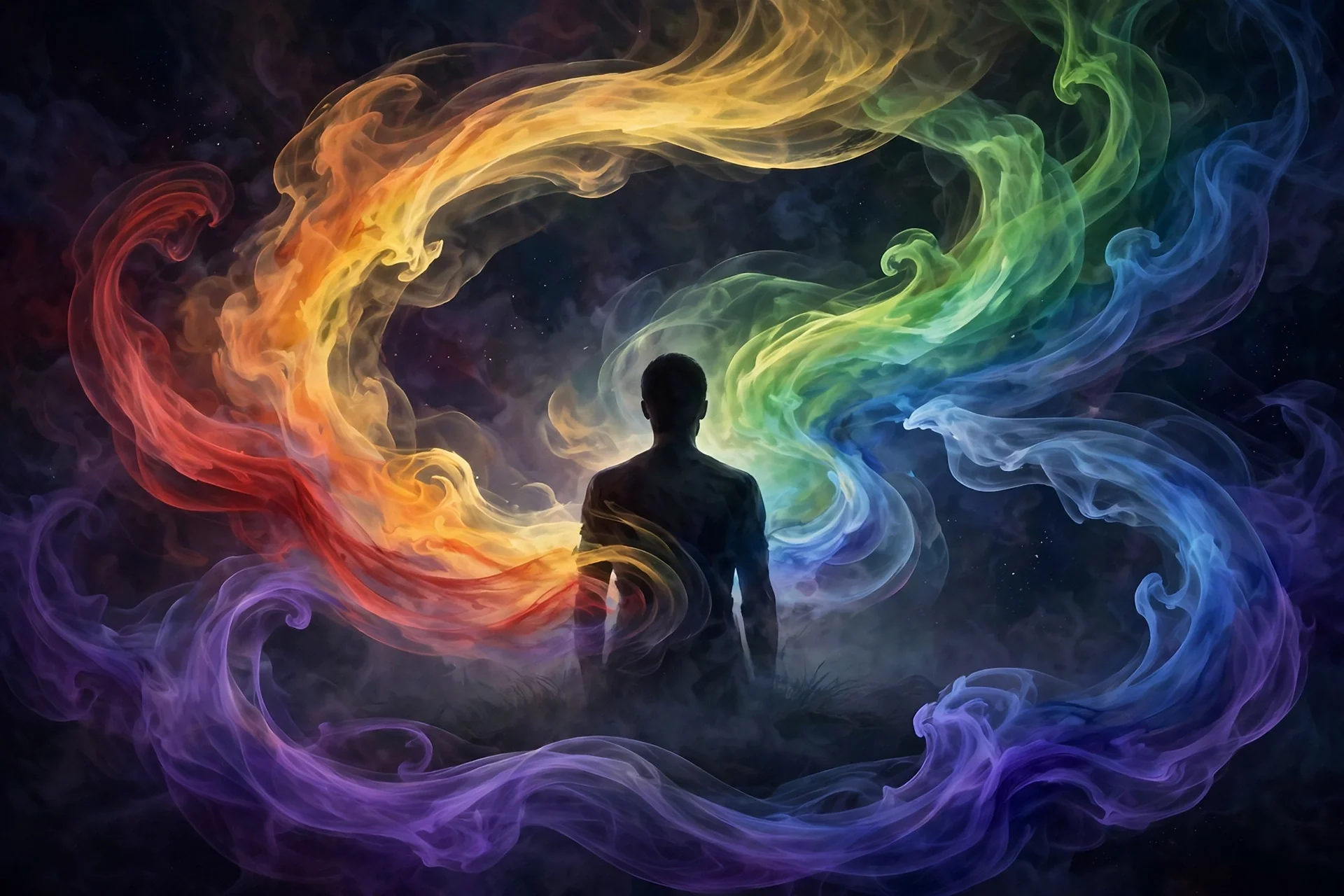
How do people say they read auras? The usual teaching is soft-focus seeing: sit someone against a plain, pale wall in even light, relax your gaze at the space around their head and shoulders, and notice the first impression rather than forcing it. Beginners are often told to practice on their own hand against a white background. Some practitioners lean more on feeling than seeing, treating the reading as an intuitive impression.
And what about aura photography? Those colorful portraits sold at fairs and festivals are keepsakes, not evidence. They trace back to Kirlian photography, which records a corona discharge, an electrical effect influenced by moisture and pressure, as Encyclopaedia Britannica explains. Modern aura cameras read galvanic skin response and convert it into colors by software. Fun picture, not proof of an energy field.
None of this makes the idea worthless. Used as a reflective practice, aura colors can be a gentle way to check in with how you or someone else is feeling, the way journaling prompts work. Just keep it in the reflection lane and never use a reading to judge whether someone is safe, honest, sick, or compatible. If a color gives you a useful question to think about, keep the question and verify the real-world answer normally.
The Medical Sense: Migraine Aura
A migraine aura is a set of temporary neurological symptoms that happen before or during a migraine, most often visual: flashes of light, zigzag lines, shimmering spots, or blind spots. According to the Mayo Clinic, aura symptoms usually last less than an hour and strike within an hour of the headache, and the same treatments work whether or not a migraine comes with aura.
Visual symptoms are the most common and tend to start in the center of the field of vision and spread outward. The Mayo Clinic lists blind spots (also called scotomas), sometimes outlined by simple shapes like a circle; zigzag lines that gradually float across the field of vision; shimmering spots or stars; changes in vision or vision loss; and flashes of light. Collins captures the same idea in its pathology sense: a sensation, as of lights or a current of warm or cold air, preceding an attack of migraine or epilepsy.
Aura is not only visual. It can also cause tingling in the hand or face, and some people experience muscle weakness or trouble with speech and language. It can arrive before the headache, at the same time as it, and rarely with no headache at all, which happens mostly in people over 50. The symptoms build gradually and then fade, with vision and sensation returning to normal afterward.
A few safety notes matter here. The Mayo Clinic advises seeing a healthcare professional immediately if you get new aura symptoms such as temporary vision loss, speech or language difficulty, or muscle weakness on one side of the body, because more serious conditions like stroke need to be ruled out. Also note that a similar-looking condition called retinal migraine affects one eye only, and other causes of one-eyed vision loss need an exam, so do not self-diagnose. Migraine with aura is a real clinical term, documented in medicine, and it has nothing to do with energy fields or vibes.
Side by Side: The Three Senses Compared
| Sense | Field | What it is | Example | Scientific standing |
|---|---|---|---|---|
| Everyday atmosphere | General English | The feeling or quality that seems to surround a person or place | “The old hotel had a cozy aura.” | Standard dictionary sense, figurative |
| Spiritual energy field | New Age / metaphysical belief | A colored field said to surround living beings, shifting with mood | “The reader said my aura was bright blue.” | Belief system, not scientifically established |
| Medical aura | Neurology / medicine | Temporary sensory symptoms before or during a migraine or seizure | “She saw zigzag lights, a classic migraine aura.” | Real clinical term, medically documented |
Notice how the everyday and medical senses sit at opposite ends of certainty. The everyday sense is pure metaphor and everyone knows it. The medical sense is a documented neurological event with a name, a timeline, and treatment guidelines. The spiritual sense lives in between: meaningful to the people who practice it, but not something science has confirmed. Knowing which column you are in saves a lot of crossed wires.
Where the Word Comes From
Aura started as a breeze. Merriam-Webster traces it through Middle English from the Latin word for a puff of air or breeze, which itself came from Greek, probably akin to the Greek word for air, and records its first known use in 1732. Collins gives the same path more briefly: via Latin from Greek, meaning breeze.
The journey from breeze to atmosphere makes sense when you feel it. An aura is like a breeze you sense around someone rather than see: invisible, but you know it is there. The medical sense came later, borrowing the word for the strange sensory “air” some people feel before a seizure or migraine. And the slang sense is the newest layer, the 2020s turning “she has an aura” into a compliment you can score.
Aura in Real Sentences
Everyday:
- She walked into the interview with an aura of quiet confidence.
- The old lighthouse had a lonely, windswept aura that photographers loved.
- There was an aura of celebration in the office on the last day of the year.
Spiritual:
- In her belief system, stress shows up as muddy colors in the aura.
- He paid for an aura reading at the wellness fair, mostly for fun.
Medical:
- Her migraine aura starts with shimmering zigzag lines at the edge of her vision.
- The doctor asked whether the tingling in his hand came before the headache, which would point to migraine with aura.
Slang:
- That entrance was pure aura.
- He lost aura points the moment he started bragging about it.
Aura Questions, Answered
What does aura mean in simple terms?
It means the feeling or quality that seems to surround someone or something. In medicine it means the warning symptoms before a migraine or seizure, and in spiritual belief it means a colored energy field around a person. Context tells you which one is meant.
What do aura colors mean?
In aura tradition, each color is read as a mood or trait: red for energy and drive, orange for creativity, yellow for optimism, green for healing, blue for calm communication, indigo for intuition, violet for spirituality, pink for love, and white for clarity. These are traditional associations, not facts, and they are said to shift as feelings change.
Is an aura real?
It depends on which aura you mean. A migraine aura is medically real and documented. The everyday “atmosphere” sense is a common metaphor everyone uses. The spiritual energy field is a belief: no instrument has detected or measured it, though the experience of sensing one can feel completely real to the person having it.
What does a migraine aura feel like?
Most often it is visual: flashing lights, zigzag lines drifting across your sight, shimmering spots, or temporary blind spots. Some people also feel tingling or numbness in the hand or face, or have brief trouble finding words. It builds gradually, usually lasts less than an hour, and fades as the headache arrives or passes.
What does “he has aura” mean in slang?
It means he is impressively cool, charming, or appealing without trying too hard. Online, people score it like a game: a smooth move earns “aura points” and an embarrassing one loses them, and “aura farming” means doing things just to look cooler. Merriam-Webster now lists this slang sense in its dictionary.
What is the difference between an aura and a vibe?
They overlap a lot. An aura is the older, broader dictionary word for the atmosphere around a person or place. A vibe is the casual slang version, usually about the emotional atmosphere you feel right now (“good vibes”). You could call a vibe the everyday sense of aura wearing jeans.
How long does a migraine aura last?
Usually less than 60 minutes, according to the Mayo Clinic. It typically strikes within an hour of the headache, though it can also happen at the same time as the pain, and rarely without any headache at all. If aura symptoms are new, severe, or last longer than an hour, get medical advice promptly.
Reading List
- Merriam-Webster’s full entry for aura: all four senses, the slang usage, and the word’s history
- Collins English Dictionary’s aura entry: the atmosphere sense and the pathology sense
- Mayo Clinic on migraine with aura: symptoms, timing, and when to seek care
- Solacely’s aura color guide: traditional color meanings with an honest science caveat
- Totally the Bomb’s aura guide: the spiritual meaning discussed alongside the science
Related:
Disposition Meaning: 5 Ways This Word Is Really Used
NPC Meaning in Text and on TikTok: Gaming Origin, Slang Use, and the Tone Decoder
Solace Meaning: Definition, Examples, and How to Use It
Ennui Meaning: What It Means, How to Say It, and Why It’s Not Just Boredom
Rizz Meaning: What “Rizz” Means in Texting + Examples





2 Comments