
Disposition Meaning: 5 Ways This Word Is Really Used
Last updated: October 23, 2026
If you have ever read a court document, a will, and a personality description in the same week, you may have met three different dispositions and not realized it. This is one of those words that quietly carries several jobs. In everyday talk it means a person’s usual mood. In a courtroom it means the final outcome. In a will it means who gets what. Once you see the five senses side by side, the confusion clears up.
What Does Disposition Actually Mean?
In everyday English, disposition most often means a person’s usual mood or attitude, as in “a cheerful disposition.” But the word carries four more established senses: a tendency to act a certain way, a court’s final decision, the transfer of property, and the arrangement of things. The surrounding words almost always tell you which sense is in play.
Merriam-Webster opens its entry with the sense most people reach for first: “the usual attitude or mood of a person or animal,” giving “a coworker with a cheerful/sunny disposition” as the textbook example. Dictionary.com agrees, defining it as “the predominant or prevailing tendency of one’s spirits; natural mental and emotional outlook or mood.” That is sense one, and it is the one you will meet in novels, reviews, and small talk.
The other four senses show up in more specific places. A “disposition to gamble” is an inclination. “The disposition of the case” is the court’s final word. “The disposition of property” in a will decides who inherits what. “The disposition of the rooms” describes how a floor plan is laid out. Same spelling, same pronunciation, five different jobs. The rest of this article walks through each one so you can spot them instantly.
Which Meaning Applies? Read the Clue Words
When you are unsure which sense of disposition you are looking at, check the words sitting next to it. If the sentence is about a person and how they usually behave, it means temperament. If you see “disposition of” followed by a case, property, or rooms, the noun after “of” names the sense: cases get decided, property gets transferred, rooms get arranged.
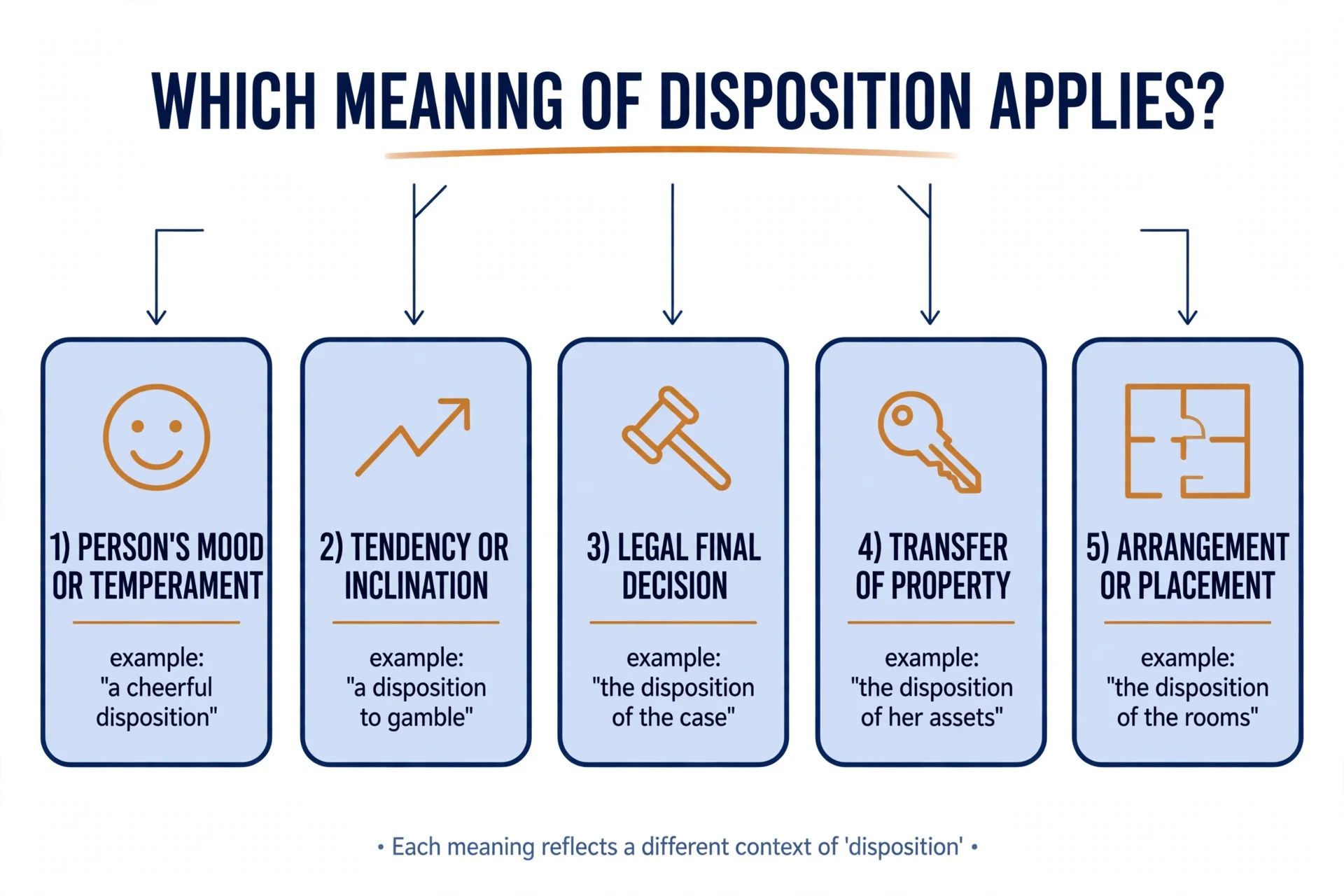
The table below is the fastest way I know to pin the meaning down. Find the row that matches your sentence and you have your answer.
| The sentence is about | Clue words nearby | The meaning | Example |
|---|---|---|---|
| A person and how they usually act | cheerful, sunny, gentle, sour, calm | Usual mood or temperament | “a cheerful disposition” |
| Someone being likely to do something | “disposition to” or “disposition toward” + a verb | Tendency or inclination | “a disposition to exaggerate” |
| Courts, judges, charges, lawsuits | final, pending, case, court, charges | Legal decision or settlement | “the disposition of the case” |
| Wills, inheritance, money, assets | property, assets, will, bequest | Transfer of ownership | “the disposition of her assets” |
| Rooms, troops, furniture, objects | plan, stationed, placed, arranged | Arrangement or placement | “the disposition of the rooms” |
One more shortcut: the little word “of” does heavy lifting. “Disposition of the troops” is placement. “Disposition of the remains” is what happens to a body after death, which Merriam-Webster lists as its own sub-sense (burial or cremation).
A Person’s Usual Mood: The Temperament Sense
When disposition describes a person, it means their characteristic, long-term mood or attitude, the emotional weather they carry around with them. A sunny disposition means someone is habitually cheerful. A sour disposition means the opposite. This is the sense behind nearly every casual use of the word, and it applies to animals too: a dog with a gentle disposition is simply a friendly dog.

People often mix disposition up with personality, temperament, mood, and character. Dictionary.com’s own synonym notes draw the lines clearly, and the differences are worth learning because each word answers a slightly different question about someone.
| Word | What it describes | In a nutshell |
|---|---|---|
| Disposition | The natural, prevailing aspect of the mind as shown in behavior and relationships over time | “a happy disposition,” “a selfish disposition” |
| Temperament | The particular balance of emotions that determines a person’s character | “an artistic temperament” |
| Temper | Sometimes the essential quality of one’s nature; usually the tendency toward anger | “an even temper,” “a quick temper” |
| Personality | The aggregate of qualities that distinguish someone as an individual | “a somber personality” |
| Character | The aggregate of moral qualities by which a person is judged, apart from intelligence or talent | “strength of character” |
| Mood | A temporary emotional state, not the usual one | “She’s in a good mood today” |
The practical takeaway: disposition and temperament are the closest pair here. Merriam-Webster’s own note on the word calls them synonyms, saying both “refer to the complex set of attitudes and inclinations that guide behavior.” Personality is broader (the whole package that makes someone distinct), mood is temporary (today, not always), and character is about moral fiber. If you are describing how someone generally is, disposition or temperament is your word. If you are describing who they are as a whole, reach for personality.
A Tendency to Act: “A Disposition To…”
The second everyday sense of disposition is a tendency or inclination toward something, usually followed by “to” plus a verb or “toward” plus a noun. “A disposition to gamble” means a leaning toward gambling. “A disposition toward generosity” means generosity comes naturally. Dictionary.com defines this sense as “state of mind regarding something; inclination,” and Merriam-Webster phrases it as “the tendency to act or think in a certain manner under given circumstances.”
This sense is not only about people. Dictionary.com’s entry includes “physical inclination or tendency,” with the example “the disposition of ice to melt when heated.” Anything with a built-in leaning, from metal to weather to markets, can be said to have a disposition in this sense.
One common point of confusion: disposition versus predisposition. Merriam-Webster addresses this directly in its FAQ. When you mean someone’s usual mood, say disposition, not predisposition. When you mean a tendency, the two words are largely interchangeable: “a disposition to exaggerate” and “a predisposition to exaggerate” say the same thing. The one firm exception is medical language, where predisposition is the standard choice, as in “a predisposition to nearsightedness.”
The Legal Side: “Disposition of a Case”
In legal language, disposition means the final decision or settlement of a matter by a court or other authority. “The disposition of the case” is simply how the case ended: dismissed, settled, convicted, acquitted. Merriam-Webster lists it as “final arrangement: settlement,” and its FAQ adds that it can also mean the sentence given to a convicted juvenile defendant.
Justia’s legal dictionary breaks the legal senses into four clear entries: the final decision made by a court or other legal authority to resolve a matter such as a case or motion; the punishment assigned to a person found guilty in a criminal case; the process of giving responsibility, possession, or ownership of something to someone else; and the existing state that makes someone more likely to act or think a certain way. The last one is the everyday tendency sense in legal dress.
The transfer sense deserves its own mention because it is where most non-lawyers meet legal disposition. “The disposition of property” in a will means the passing of ownership to heirs, by gift, sale, or bequest. Dictionary.com gives the example of a patient recording her intentions “regarding the disposition of certain pieces of her property upon her death.” You will also see “disposition of remains,” meaning what is done with a body after death, and in business writing, “disposition of assets,” meaning the sale or transfer of company property. In all of these, the core idea is the same: something is being settled and handed over.
Arranged and Placed: The Original Meaning
The oldest meaning of disposition is the one about arranging things. Merriam-Webster defines this sense as “orderly arrangement,” and Dictionary.com gives “arrangement or placing, as of troops or buildings,” with the example of strategists debating “the best disposition of Allied forces.” Bab.la, the British-leaning dictionary, defines it as “the way in which something is placed or arranged, especially in relation to other things,” citing “the disposition of the rooms” on a floor plan.
This sense survives in formal and military writing more than in conversation. You will meet “dispositions” (plural) describing troop placements or the layout of rooms in a design brief. It is the least common sense in daily speech, but it is the root the others grew from.
Where the Word Comes From
Disposition entered English in the 14th century from Old French disposicion, which came from Latin dispositio, meaning “arrangement” or “management.” That Latin noun was built on disponere, “to put in order, arrange,” from dis- (“apart”) plus ponere (“to put, place”). So at its root, disposition is about putting things in their places.
The temperament sense arrived through an unusual detour. Etymonline notes it grew out of astrological use, where disposition meant “position of a planet as a determining influence.” Medieval writers believed the planets’ arrangement shaped a person’s nature, so the word for arranging slid into the word for character. Merriam-Webster records the first known use in the 1300s, and the legal and transfer senses developed later as natural extensions of “settling things into order.”
At Your Disposition and Other Everyday Phrases
“At your disposition” is the set phrase most learners stumble on, and it means something is available for your use, at your command. “The conference room is at your disposition all afternoon” means you may use it freely. Bab.la defines this sense as “the power to deal with something as one pleases,” with the memorable example: “if Napoleon had had railways at his disposition, he would have been invincible.” It sounds formal to modern ears, and it is most common in business English, customer service, and polite offers of help.
A few more phrases worth knowing. “Disposition of forces” or “military dispositions” means troop placements, the arrangement sense in uniform. “Have a disposition toward” something means being inclined toward it, as in a judge’s “disposition to clemency” in the bab.la entry. And “of a cheerful disposition” is simply a slightly formal way of saying someone is cheerful by nature. If you can swap in “temperament,” “tendency,” “settlement,” “transfer,” or “arrangement” and the sentence still works, you have found the right sense.
Disposition in Real Sentences
Here are natural examples grouped by meaning.
The temperament sense
She has such a sunny disposition that even grumpy customers leave her counter smiling. The new manager’s calm disposition steadied the whole team during the merger. Our old cat had a grumpy disposition but loved the children anyway. Merriam-Webster’s own example, “a coworker with a cheerful/sunny disposition,” remains the gold standard for this sense.
The tendency sense
He has a disposition to exaggerate, so take his fishing stories with a pinch of salt. Her cautious disposition made her double-check every contract. There is a natural disposition in markets to overreact to bad news. Ice has a disposition to melt when heated, as Dictionary.com’s entry neatly puts it.
The legal and transfer senses
The judge announced the final disposition of the case on Friday afternoon. The accused waited seven months for the disposition of his case, in Dictionary.com’s example. Her will laid out the disposition of the family farm in careful detail. The funeral home handled the disposition of the remains with great care.
The arrangement sense
The general reviewed the disposition of troops along the border before dawn. The architect admired the disposition of rooms in the old townhouse. The museum’s new wing improved the disposition of the galleries for better foot traffic.
Questions People Ask About Disposition
What is the simple meaning of disposition?
In its simplest and most common sense, disposition means a person’s usual mood or attitude, as in “a cheerful disposition.” Beyond that, the word has four established specialized senses: a tendency to act a certain way, a court’s final decision, the transfer of property, and an arrangement of things. Context tells you which one applies.
What does disposition mean in court?
In court, disposition means the final decision or settlement of a case or motion, such as a dismissal, a settlement, or a verdict. Merriam-Webster’s FAQ adds that for a convicted juvenile defendant, disposition can specifically mean the sentence. The phrase “pending disposition” means a matter has not yet been finally decided.
Is disposition the same as personality?
No. Disposition is the prevailing aspect of someone’s mind as shown in behavior over time, while personality is the whole aggregate of qualities that make someone distinct. Temperament is the closest synonym to disposition. Character refers to moral qualities, temper usually involves anger, and mood is temporary. They overlap, but they are not interchangeable.
What is the difference between disposition and predisposition?
For a person’s usual mood, use disposition only. For a tendency or inclination, the two words mean nearly the same thing: “a disposition toward generosity” and “a predisposition toward generosity” are equivalents. In medical contexts, predisposition is the standard term, as in “a predisposition to diabetes.”
What does “at your disposition” mean?
It means something is available for your use or at your command. “My team is at your disposition” is a formal, polite way of saying “my team is ready to help you.” The phrase is common in business English and customer service, and it comes from the sense of disposition as control or power of disposal.
What are some good synonyms for disposition?
For the temperament sense: temperament, nature, character, makeup. For the tendency sense: inclination, tendency, proclivity, bent, predisposition. For the legal sense: settlement, outcome, decision. For the arrangement sense: placement, arrangement, order, grouping. Dictionary.com lists these groupings in its entry, so pick the synonym that matches the sense you mean.
Where These Definitions Come From
The definitions in this article rest on the entries of Merriam-Webster and Dictionary.com, which agree on the five core senses and supply most of the example sentences. The legal meanings were cross-checked against Justia’s legal dictionary and Merriam-Webster’s own court-use FAQ, which clarifies the juvenile-sentencing sense. Cambridge’s corpus examples informed the usage notes on collocations like “cheerful disposition” and “final disposition,” while bab.la supplied the British-English senses, including “at someone’s disposition.” The word history comes from Etymonline’s entry on disposition, with first-use dates confirmed by Merriam-Webster and Dictionary.com.
Related:
Aura Meaning: Three Meanings Explained Simply
NPC Meaning in Text and on TikTok: Gaming Origin, Slang Use, and the Tone Decoder
Solace Meaning: Definition, Examples, and How to Use It
Ennui Meaning: What It Means, How to Say It, and Why It’s Not Just Boredom
Masochist Meaning: Definition, Examples, and Masochist vs Sadist Explained




2 Comments