
Inshallah Meaning: What It Means & When to Say It
Inshallah (إن شاء الله) means “if Allah wills” or “God willing.” Muslims say it whenever they talk about the future, from weekend plans to wedding dates, because the Qur’an instructs believers never to promise tomorrow without acknowledging that only God controls what comes next. In a text message it can sound like a promise, a prayer, a habit, or even a polite no. Tone decides which one you are hearing.
- What Does “Inshallah” Mean?
- Where Inshallah Comes From
- How to Say and Write It Right
- When to Say Inshallah: Real Texting Examples
- The Inshallah Tone Decoder
- How to Reply to Inshallah
- Inshallah vs Mashallah vs Alhamdulillah
- When You Should Not Say Inshallah
- Who Actually Says Inshallah?
- FAQs
- Where the Facts Came From
What Does “Inshallah” Mean?
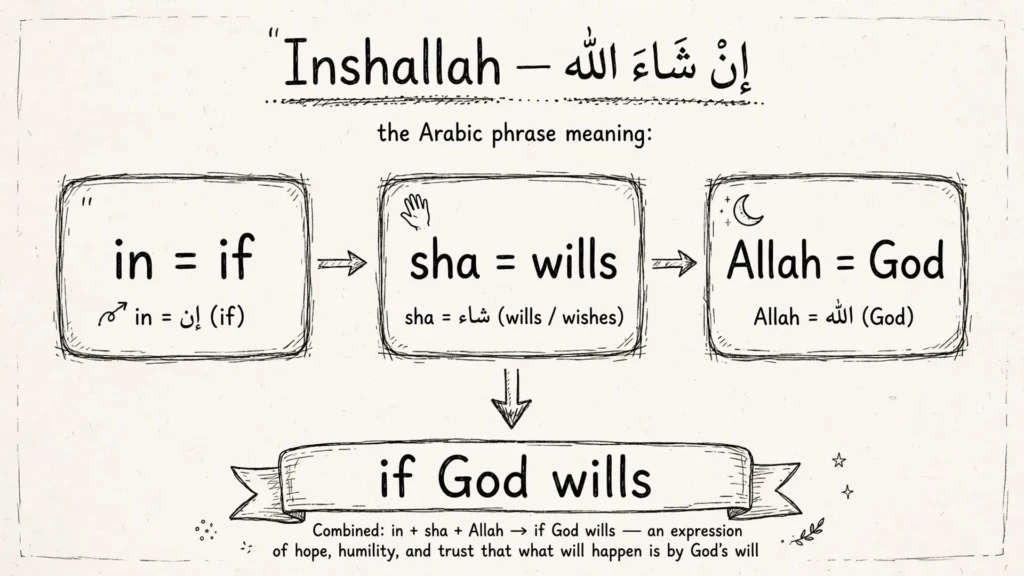
Inshallah means “if Allah wills.” It is what Muslims say when they talk about anything that has not happened yet: a plan, a promise, a hope. The phrase hands the future back to God instead of claiming it as certain, which is why Cambridge defines it as a word Muslims use when making future plans or expressing hopes for the future.
The phrase is built from three Arabic words, and each one pulls its weight:
| Word | Arabic | Meaning |
|---|---|---|
| in | إن | if |
| shā’a | شاء | wills |
| Allāh | الله | God |
Put together, it reads literally as “if God wills.” In English writing it is usually squeezed into a single word, inshallah, but the original Arabic keeps all three separate. Oxford Learner’s Dictionaries lists it as an exclamation, “an Islamic expression meaning ‘if Allah wills it,’ used to say that you hope something will happen,” and gives the pronunciation as /ɪnˈʃɑːlə/ or /ˌɪnʃɑːˈlɑː/. Cambridge records the UK and US pronunciation as /ɪnˈʃæl.ə/ and links its entry to mashallah for comparison.
Oxford’s own example sentence shows the warmth of the word in use: “I know times are tough, but we will get through this together, inshallah.” That is the phrase in its natural habitat, a hope spoken out loud.
Where Inshallah Comes From
Inshallah is not internet slang. The Qur’an commands it directly: Surah Al-Kahf (18:23-24) tells believers never to say “I will do that tomorrow” without adding “if Allah wills.” That single instruction is why the phrase became part of daily speech for hundreds of millions of people.
“And never say of anything, ‘Indeed, I will do that tomorrow,’ except when adding, ‘If Allah wills.'” (Qur’an 18:23-24, as quoted on quran.com via islamtics)
As the story is told on Islamic sites like islamtics and Abeer Academy, the verses arrived as a gentle correction. When Prophet Muhammad ﷺ was asked about the story of the Sleepers of the Cave and promised his questioners an answer “tomorrow” without saying inshallah, revelation paused for a stretch of days. Verses 23 and 24 were then revealed as the reminder: do not claim the future as yours.
islamtics also records a striking narration about Prophet Sulayman (Solomon). He once vowed to visit one hundred wives in one night, so that each would bear a warrior, but he forgot to say inshallah. Only one conceived, and the child was stillborn. The narration is cited to Sahih al-Bukhari 5242 and Sahih Muslim 1654, and the lesson drawn from it is simple: certainty about tomorrow belongs to God alone.
The deeper idea behind the phrase is qadar, divine decree. Planning is encouraged, but the outcome rests with Allah. AltaHoor’s guide sets it beside the well-known teaching to tie your camel and then trust Allah: inshallah never replaces effort, it accompanies it. You make the plan, you do the work, and you say inshallah because you know the plan is not guaranteed.
How to Say and Write It Right
Say in-SHAH-lah, with the stress on the middle syllable. In Arabic it is three separate words, إن شاء الله, even though English usually squeezes them into one word. Get those two facts right and you are already ahead of most learners.
Break it down syllable by syllable. “In” sounds exactly like the English word in. “Shah” rhymes with “spa.” “Lah” is a soft “la,” like the start of “ladder.” Say them in a row, in-SHAH-lah, and you have it. Both Oxford and Cambridge list the same sound with dictionary IPA, but the three-syllable trick is all a beginner needs.
You will see a handful of English spellings: inshallah, in sha Allah, insha’Allah, insh’allah. Regional forms show up too: inchallah in North Africa, insya Allah in Indonesia and Malaysia, inşallah in Turkish. They are all the same phrase wearing local clothes.
One spelling trap to avoid: writing it as انشاء الله reads as “inshā'” meaning “creating God,” a completely different and unintended meaning. Alifbee’s Arabic guide flags this mistake explicitly. Three words, إن شاء الله, is the safe form.
When to Say Inshallah: Real Texting Examples
Say inshallah whenever you mention a future plan, promise, or hope: leaving the house, finishing a project, meeting a friend, hoping for good news. In texts it usually lands at the very end of the sentence, like a signature on the plan, a pattern Alifbee’s guide confirms.
Here is what it looks like in real chats:
Confirming plans:
“You still coming Friday?”
“Yeah, leaving at 8, inshallah.”
“Cool, see you there inshallah.”
Hoping for news:
“Did the visa come through?”
“Not yet. Inshallah next week.”
Group chat energy:
“Road trip in December?”
“Inshallah, if the car survives.”
Beyond texting, it shows up in the serious moments too: before exams, before travel, before a job interview, at weddings. “See you tomorrow, inshallah” is probably the most common sentence the phrase ever appears in. The rule of thumb is easy: if it has not happened yet, inshallah belongs somewhere near it.
The Inshallah Tone Decoder
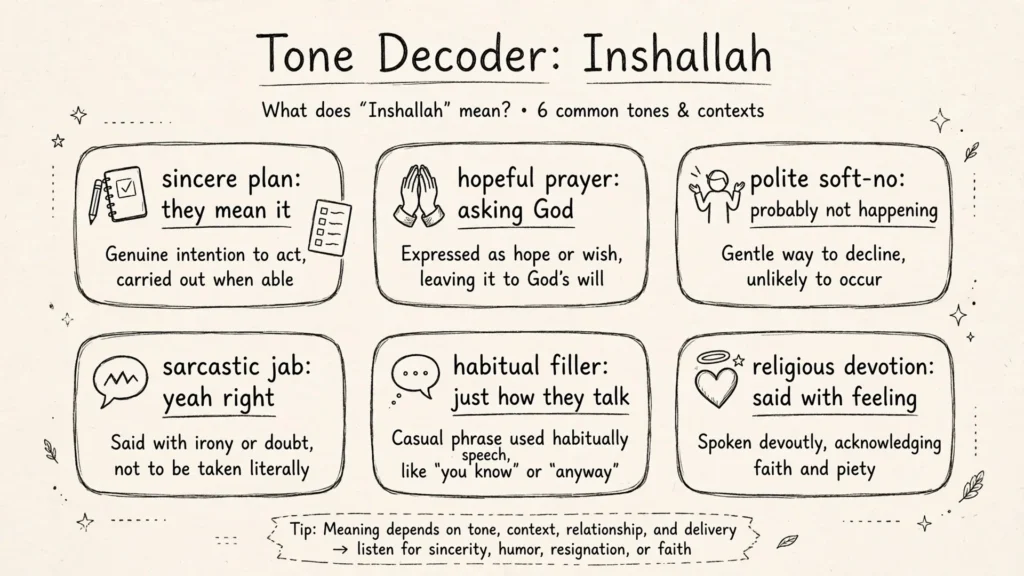
The same word can carry six different tones, and context is the decoder. Specifics plus follow-up mean it is sincere; vagueness plus silence usually mean it is a polite no. Work through the six rows below and you will rarely misread it again.
| Context | Cues | What It Really Means | How to Read It |
|---|---|---|---|
| Sincere plan | Specific time or place given, follow-up message arrives | “I mean it, and I trust God with the outcome” | Take it as a yes with humility |
| Hopeful prayer | Said to someone else about their future, warm tone | “I am praying this works out for you” | A blessing; answer “ameen” |
| Polite soft-no | Vague, no details, no follow-up, avoids a direct “no” | “Probably not, but I will not say no to your face” | Do not push; make other plans |
| Sarcastic jab | Mocking tone, aimed at someone who never delivers | “Sure, and pigs might fly” | A dig; the faith community hears this as disrespectful |
| Habitual filler | Reflex tag at the end of every future sentence, low intent | Nothing extra; just how this person talks | Harmless; judge the plan, not the word |
| Religious devotion | Said deliberately, recalling the Qur’anic command | “I remember that tomorrow is not mine to promise” | Full meaning, sincere humility |
The quick test I use: if they gave you a time, a place, or a second message, take it as sincere. If the inshallah arrived alone, with no details and no follow-up, treat it as a gentle no. The phrase itself never changed; the commitment around it did.
How to Reply to Inshallah
Most of the time, just repeat it: “inshallah.” If the sentence was a wish for you, answer “ameen.” If it was a plan, confirm the plan back. Those three responses cover nearly every real conversation you will have.
Arabic offers a few richer options, and Alifbee’s Arabic guide lays them out with pronunciations:
| Reply | What It Sounds Like | What It Signals |
|---|---|---|
| In shā’ Allāh | in-SHAH-lah | Simple echo; the default reply |
| Āmīn | ah-MEEN | “Amen”; used after a wish or prayer |
| Yā rabb | yah RAB | “I hope so”; eager agreement |
| Bi-idhni Allāh | bee-IDH-ni al-LAH | “By God’s permission”; a stronger commitment |
| In shā’ Allāh khayr | in-SHAH-lah KHAYR | “If God wills, good”; a hopeful blessing |
In a casual text, you rarely need the Arabic at all. “Inshallah” back, or “inshallah, see you then,” keeps the exchange warm and natural. Save the longer forms for conversations where the Arabic itself will be appreciated.
Inshallah vs Mashallah vs Alhamdulillah
Inshallah looks forward: “if Allah wills,” said before something happens. Mashallah looks at what already happened: “what Allah has willed,” said in praise. Alhamdulillah is gratitude: “praise be to Allah.” Before the event, inshallah. After the event, mashallah or alhamdulillah.
| Phrase | Meaning | Time Direction | Example |
|---|---|---|---|
| Inshallah | “If Allah wills” | Future: plans, hopes, promises | “See you tomorrow, inshallah.” |
| Mashallah | “What Allah has willed” | Past or present: praise and admiration | “Mashallah, your baby is so beautiful!” |
| Alhamdulillah | “Praise be to Allah” | Gratitude, usually after good news | “I passed the exam, alhamdulillah!” |
Mixing them up is the classic beginner mistake. Saying mashallah about a plan that has not happened yet sounds off, like congratulating someone for a race they have not run. AltaHoor’s comparison guide walks through the full family of phrases, and the one-line memory rule it supports is the one every learner ends up using: inshallah before the event, mashallah after it.
When You Should Not Say Inshallah
Do not use inshallah as camouflage: as a soft-no you never follow up on, as sarcasm, or as a substitute for effort. And in supplication it is discouraged: qariquran cites Sahih Muslim 2679a, where believers are taught not to attach “if You will” to their prayers.
As a dodge. AltaHoor’s misconception section is blunt on this one: inshallah does not remove commitment, and it is not filler. Saying it to avoid giving a real answer while secretly meaning no is the most common misuse, and it is exactly why some people groan when they hear the word.
As a joke or a jab. The sarcastic “inshallah” gets laughs in some circles, but the Muslim community generally hears it as disrespectful. Writing in The Conversation, Monash University lecturer Susan Carland notes the clear split: sincere use gets a warm reception, mocking use does not.
Instead of effort. The phrase was never meant to replace planning. AltaHoor’s guide sets it beside the well-known teaching to tie your camel and then trust Allah: book the ticket, study for the exam, send the email, and then say inshallah. The trust comes after the work, not instead of it.
In dua. During supplication, the reported guidance (Sahih Muslim 2679a, as cited on qariquran) is to ask Allah directly and firmly, not to hedge the prayer with “if You will.” Prayer is the one place where certainty of asking replaces the humility of planning.
Who Actually Says Inshallah?
Muslims everywhere, plus Arab Christians across Egypt, Lebanon, Palestine, and Syria, who use it as ordinary daily speech, and increasingly non-Muslims who pick it up from friends, travel, or media. Both Alifbee’s guide and Susan Carland’s explainer agree it is not Muslims-only.
The phrase has traveled so far that other languages carry its descendants. Spanish speakers say ojalá, borrowed straight from Arabic, and the Portuguese say oxalá. Italians say “Se Dio vuole,” meaning “if God wills,” and English has its own plain version in “God willing.” AltaHoor’s cross-language table lines these up side by side, and the family resemblance is unmistakable.
For non-Muslims wondering whether they may use it, Carland offers the clearest guidance: sincere, respectful use is generally welcomed. What is not welcomed is the mocking kind. The line is simple to walk. Use it the way believers do, with genuine hope or humility, and you will be fine. Use it to score a point, and people will notice.
Pop culture keeps handing the phrase new moments. In the 2020 US presidential debate, Joe Biden used it sarcastically about Donald Trump’s tax returns (“When? Inshallah?”), an example Carland cites of the mocking tone the community rejects. Anne Hathaway used it casually in a People interview and got the opposite reaction: overwhelming warmth, with fans jokingly dubbing her “Anne Halal-away.” Drake dropped it in his 2018 song “Diplomatic Immunity.” A 2021 meme about a fictional halal “Finding Nemo 2” movie night, “Inshallah they find him,” spread across Instagram and Know Your Meme. And Elmo picked up Arabic phrases from comedian Ramy Youssef on Sesame Street. Every one of these moments, recorded in Carland’s piece, shows the same thing: the phrase lives in the mainstream now, and how it is used matters more than who says it.
FAQs
Short answers to the questions people actually ask about inshallah.
What does inshallah mean in English?
“If Allah wills” or “God willing.” It is said about future plans, hopes, and promises, the verbal equivalent of crossing your fingers with faith behind it.
How do you spell inshallah?
The Arabic original is three words: إن شاء الله. Common English forms include inshallah, in sha Allah, insha’Allah, inchallah, and insya Allah. Avoid the one-word Arabic misspelling انشاء الله, which changes the meaning entirely.
What is the difference between inshallah and mashallah?
Inshallah (“if Allah wills”) looks to the future. Mashallah (“what Allah has willed”) praises what already happened. The rule: inshallah before the event, mashallah after it.
When should you say inshallah?
Whenever you mention a future action, plan, or promise. The Qur’an (18:23-24) instructs believers never to say “I will do that tomorrow” without it.
Does inshallah mean “no”?
Not by itself. But said vaguely, with no plan and no follow-up, people do use it as a polite soft-no. That is a cultural pattern, not the phrase’s meaning. Check the tone decoder above before assuming.
How do you reply to inshallah?
Repeat “inshallah,” say “ameen” if it was a wish for you, or confirm the plan back. Arabic options include yā rabb (“I hope so”) and bi-idhni Allāh (“by God’s permission”).
Can non-Muslims say inshallah?
Yes. Arab Christians in Egypt, Lebanon, Palestine, and Syria use it routinely, and Susan Carland’s explainer notes that sincere, respectful use by others is generally welcomed. Keep the tone genuine and you will be fine.
Where the Facts Came From
Every claim above was checked against sources actually opened during research:
- Cambridge Dictionary, for the definition, pronunciation, and usage examples.
- Oxford Learner’s Dictionaries, for the exclamation entry, pronunciation, and word origin.
- islamtics, for the Qur’anic verses, the Sulayman narration, and reply guidance.
- Alifbee, for the Arabic spelling trap, pronunciation notes, sentence position, and the response phrases.
- AltaHoor Quran Institute, for the cross-language comparison, the misconception corrections, and the qadar discussion.
- QariQuran, for the guidance on when not to say it, including during dua.
- 7ESL, for usage examples and the origin context.
- Abeer Academy, for the Qur’anic story and speech context.
- The Conversation, via YourLifeChoices, for the pop-culture moments and the guidance on non-Muslim use, by Susan Carland of Monash University.
Related:
WTW Meaning: What It Really Means in Texts
Surreal Meaning: Definition, Origin & Examples





One Comment