
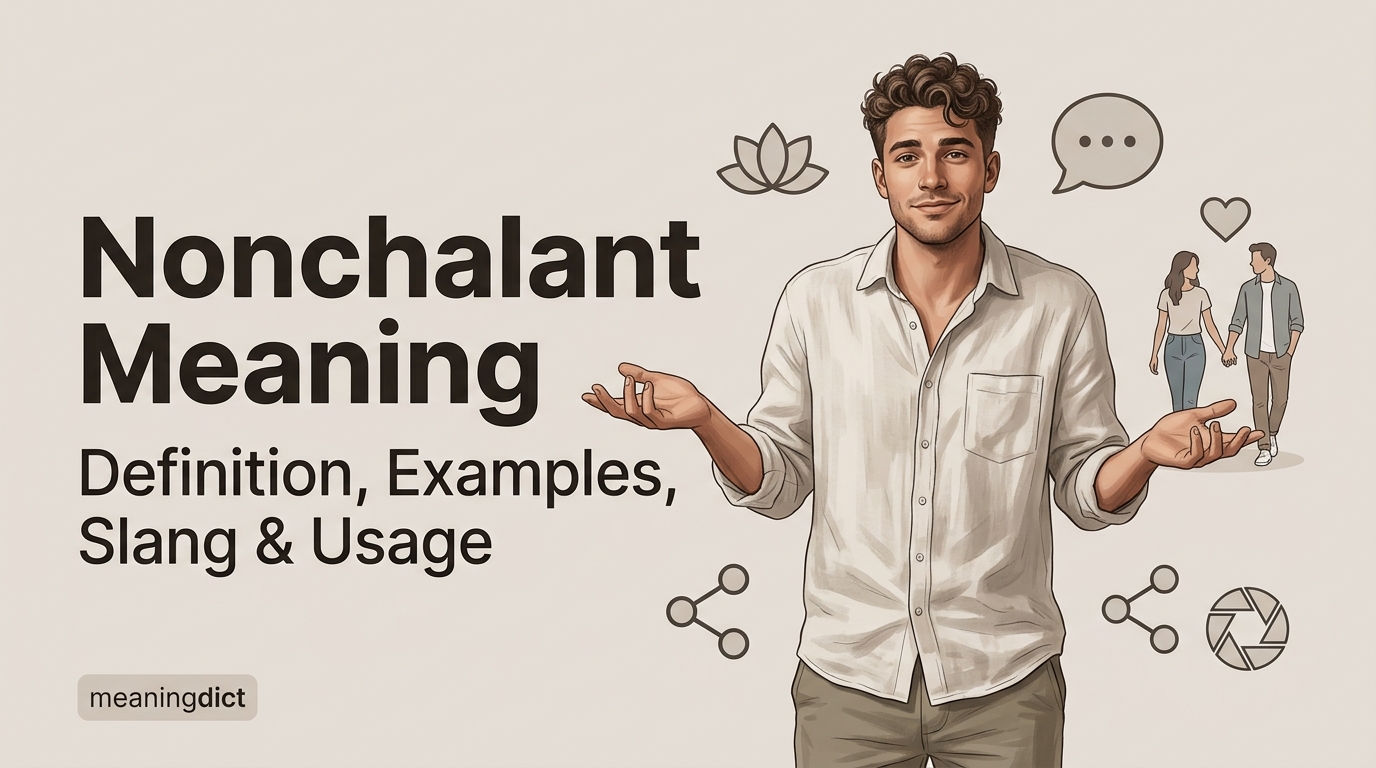
Nonchalant Meaning: Definition, Examples, Slang and Usage
Nonchalant means appearing calm, relaxed, and not worried or interested, even when a situation might normally cause concern or excitement. A nonchalant person may act casual, show little emotion, or seem unbothered. The word can describe genuine confidence, but it can also suggest indifference.
The word “nonchalant” is often used to describe a person’s attitude, expression, voice, or behavior. Someone may look nonchalant before an exam, reply nonchalantly to surprising news, or act nonchalant during an argument.
The exact meaning depends on context. In one situation, the person may be calm and self-controlled. In another, the same behavior may appear careless, distant, or emotionally unavailable.
This guide from meaningdict explains the standard dictionary definition, modern slang, relationship use, pronunciation, examples, synonyms, antonyms, and common misunderstandings.
| Quick fact | Answer |
|---|---|
| Word | Nonchalant |
| Part of speech | Adjective |
| Simple meaning | Calm and seemingly unconcerned |
| Pronunciation | non-shuh-LAHNT |
| Related noun | Nonchalance |
| Related adverb | Nonchalantly |
| Common tone | Positive, neutral, or negative |
| Example | She gave a nonchalant shrug and continued walking. |
What Does Nonchalant Mean in Simple Words?
In simple words, nonchalant means calm and not showing worry, excitement, or strong interest. A nonchalant person behaves as though something is not a big deal. They may speak casually, shrug, remain quiet, or keep a relaxed expression while other people react more strongly.
For example, imagine a student walking into an important exam without looking nervous. You might say, “He seemed nonchalant before the test.” This does not prove that he did not care. It only describes how he appeared. He may have been confident, hiding stress, or genuinely unconcerned.
The word can carry different tones:
- Positive: calm, composed, confident, and unruffled
- Neutral: casual, relaxed, and low-key
- Negative: indifferent, careless, dismissive, or emotionally distant
The key idea is visible lack of concern. Nonchalant describes the attitude people can observe, not always the feelings inside the person. Someone can act nonchalant while secretly feeling anxious, excited, hurt, or deeply interested.
Nonchalant Meaning in English With Examples
In English, nonchalant is an adjective meaning casually calm and apparently unconcerned. It is usually placed before a noun or after a linking verb such as “be,” “seem,” “look,” or “remain.” Cambridge and Merriam-Webster both connect the term with showing little apparent worry or interest. entence patterns include:
- She gave a nonchalant smile.
- He seemed nonchalant about the result.
- They remained nonchalant during the delay.
- Her nonchalant tone surprised everyone.
- Amir walked in with a nonchalant attitude.
The word often describes body language. A shrug, relaxed posture, slow reply, or casual glance can seem nonchalant. It may also describe how someone handles pressure.
“The goalkeeper looked nonchalant before the penalty” suggests calmness. However, “He was nonchalant about missing the deadline” suggests insufficient concern.
A useful rule is to consider what the person should reasonably care about. If calmness shows control, the word may sound positive. If the matter deserves attention, nonchalant may sound critical.
What Does Nonchalant Mean in a Relationship?
In a relationship, nonchalant usually describes a partner who appears emotionally relaxed, detached, or less concerned than expected. The person may avoid showing excitement, reply without much emotion, make few plans, or act as though problems do not affect them.
This behavior can feel attractive at first because calmness may look confident, independent, and free from unnecessary drama. However, relationship context can change its meaning.
Healthy calmness means a partner can manage emotions without turning every disagreement into a crisis. Harmful nonchalance means they repeatedly dismiss feelings, avoid serious conversations, or contribute little effort. The behavior becomes a concern when one person feels ignored, uncertain, or responsible for all communication.
Possible signs include:
- rarely initiating conversations or plans;
- giving vague answers about commitment;
- reacting casually when you express hurt;
- avoiding emotional conversations;
- showing interest only when convenient.
Do not judge a relationship from one quiet reply. Look for a consistent pattern. A calm partner can still be caring, reliable, and responsive. A dismissive partner may use a relaxed attitude to avoid responsibility, intimacy, or honest communication.
What Does Nonchalant Mean in Text Messages?
In text messages, nonchalant means replying in a casual, low-emotion, or seemingly unconcerned way. The sender may use short answers, delayed replies, dry wording, few questions, or limited emotional expression.
Common nonchalant replies may include:
- “Okay.”
- “Cool.”
- “Sure.”
- “Whatever.”
- “No worries.”
- “It is what it is.”
A nonchalant text can be difficult to interpret because written messages lack voice, facial expressions, and body language. “That’s fine” may show genuine calmness, disappointment, annoyance, or an attempt to avoid conflict.
Response time alone also does not prove indifference. The person may be busy, tired, distracted, or unsure what to say.
Consider three clues:
- Context: Was your message casual, emotional, urgent, or serious?
- Pattern: Does the person usually communicate this way?
- Follow-through: Do their actions show care even when their texts are brief?
For example, “No worries, we can reschedule” can be positively nonchalant. “K” after you share a serious concern may feel dismissive. Meaning comes from the full exchange, not one word.
See Also: Pedantic Meaning: Definition, Examples, Pronunciation, and Usage
Nonchalant Meaning in Slang on Social Media
On social media, nonchalant is often used as slang for acting unbothered, emotionally cool, low-effort, or hard to impress. The standard dictionary meaning still applies, but online users often give it a stronger social or emotional meaning.
People may call someone nonchalant because the person hides excitement, avoids looking eager, or maintains a detached image.
In posts, comments, memes, and short videos, the term may describe:
- someone who refuses to show too much emotion;
- a person who acts cool around a crush;
- a partner who offers little attention or reassurance;
- someone who stays calm during embarrassment;
- a deliberately effortless personality style.
The slang can be complimentary or critical. “She was so nonchalant under pressure” praises composure. “He is too nonchalant to communicate” criticizes emotional distance.
Online discussions sometimes use the word loosely as a substitute for “chill,” “cold,” “dry,” “aloof,” or “unbothered.” However, these words are not exact matches. Always read the surrounding caption, video, or conversation before deciding what the speaker means.
What Does Nonchalant Mean on TikTok?
On TikTok, nonchalant commonly refers to someone who acts unbothered, emotionally restrained, or unwilling to show obvious effort, especially in dating and relationship content.
Videos may contrast a nonchalant person with someone who communicates openly, plans dates, reacts with enthusiasm, or shows clear affection.
The TikTok meaning is often broader than the formal dictionary definition. A creator might label a boyfriend “nonchalant” because he gives dry replies, avoids romantic gestures, or barely reacts on camera. Another video may praise a nonchalant person for remaining calm, confident, and unaffected by criticism.
This is why the term can sound positive in one trend and negative in another.
Recent dating discussions have also popularized the playful opposite “chalant” or “chalance.” It refers to visible effort, care, enthusiasm, and intentional communication. The expression is internet slang rather than a standard opposite commonly used in formal English. abels should not replace real communication. A short video cannot reveal someone’s full emotional style. Judge people through repeated actions, honest conversations, reliability, and context.
What Does It Mean When Someone Is Nonchalant?
When someone is nonchalant, they appear calm and show little concern, interest, surprise, or excitement. Their behavior may be natural, intentional, or protective.
Some people stay relaxed because they handle pressure well. Others act casual because they do not want anyone to know that they care.
A nonchalant person may:
- keep a steady voice during stressful moments;
- respond with a shrug or brief comment;
- avoid dramatic reactions;
- appear comfortable with uncertainty;
- show limited facial emotion;
- treat an important matter casually.
This behavior does not reveal one fixed personality. It may come from confidence, emotional control, shyness, discomfort, low interest, fear of rejection, or a habit of hiding vulnerability.
Suppose someone receives excellent news and simply says, “Nice.” They might be privately excited but uncomfortable showing strong emotion. However, if they repeatedly ignore matters that affect other people, their nonchalance may reflect carelessness.
Focus on impact and patterns instead of assuming motives. Calm behavior is useful when it is combined with empathy, responsibility, awareness, and clear communication.
Nonchalant Person Meaning and Personality Traits
A nonchalant person is someone who often appears relaxed, unbothered, and emotionally controlled. This description refers to visible behavior, not a clinical personality type.
“Nonchalant” is an everyday adjective. It is not a medical or psychological diagnosis. People can behave nonchalantly in certain situations without having a permanently detached personality.
Commonly associated traits include:
- calm body language;
- low emotional display;
- personal independence;
- confidence under pressure;
- limited need for approval;
- casual speech;
- reluctance to overreact;
- emotional privacy.
These traits can have benefits. A composed person may think clearly during conflict, avoid panic, and help others feel stable.
However, the same communication style can cause problems if it becomes dismissive. Friends, relatives, or partners may feel that the person is not listening, caring, or taking responsibility.
The best way to understand a nonchalant person is to compare their words with their actions. Do they keep promises, offer support, and communicate when necessary? If yes, their calm style may simply be part of their temperament. If they avoid effort and accountability, nonchalant may be describing indifference rather than healthy composure.
See Also: Skink Meaning: Definition, Pronunciation, Examples, and Lizard Facts
Nonchalant Guy Meaning in a Relationship
A nonchalant guy in a relationship is usually a man who appears emotionally reserved, casual, or less invested than his partner expects. He may rarely initiate conversations, avoid discussing feelings, respond briefly, or act unaffected by conflict.
Online dating discussions often use the phrase for men who appear “too cool to care.”
Still, quiet behavior does not automatically mean a lack of love or interest. Some men express care through actions rather than words. A reserved partner may solve problems, remember important details, offer practical support, and remain loyal without being highly expressive.
The important question is whether his communication style meets the needs of the relationship.
Potential warning signs include:
- making you guess where the relationship stands;
- ignoring reasonable requests for reassurance;
- avoiding responsibility after causing hurt;
- showing attention only when he fears losing you;
- treating emotional needs as unnecessary drama.
A healthy, calm partner will listen and adjust when you communicate clearly. An unhealthy nonchalant partner may continue withholding effort while expecting you to accept uncertainty. Evaluate consistency, respect, emotional safety, reliability, and effort rather than relying on the label alone.
Nonchalant Meaning in Love and Dating
In love and dating, nonchalant describes someone who tries to appear relaxed and not overly eager, even when they may be interested.
A person might wait before replying, avoid compliments, downplay excitement, or refuse to discuss feelings because they fear looking desperate, emotional, or vulnerable.
A small amount of calmness can be healthy. New relationships need personal space, realistic expectations, and emotional balance. Problems begin when “playing it cool” creates confusion.
Intentional distance may lead to mixed signals, poor communication, and unequal effort. One person starts wondering whether the other is interested, while the nonchalant person expects their feelings to be understood without expressing them.
Healthy dating usually includes:
- clear interest without pressure;
- dependable communication;
- respect for personal boundaries;
- honest expectations;
- balanced effort;
- willingness to discuss misunderstandings.
Nonchalance should not be confused with secure confidence. A secure dater can remain calm while still expressing care. A detached dater may use silence or uncertainty to maintain control.
Instead of asking whether someone looks nonchalant, ask whether their behavior is consistent, respectful, and emotionally clear. Actions over time provide the most reliable answer.
Is Being Nonchalant Good or Bad?
Being nonchalant can be good, bad, or neutral depending on the situation and its effect on other people. It is positive when it means calm, confident, and composed. It is negative when it means careless, dismissive, or uninterested in something important.
| Healthy nonchalance | Harmful nonchalance |
|---|---|
| Staying calm under pressure | Ignoring a serious problem |
| Avoiding unnecessary drama | Dismissing another person’s feelings |
| Thinking before reacting | Refusing to communicate |
| Remaining confident | Acting emotionally cold |
| Accepting small setbacks | Avoiding responsibility |
For example, remaining nonchalant after a minor mistake can show resilience. Remaining nonchalant when a friend is upset may make you seem uncaring.
The main differences are empathy, awareness, and responsibility.
Ask three questions:
- Does the situation require concern?
- Does the person still take useful action?
- Does their behavior respect other people?
If the answers are yes, their calmness is probably healthy. If their relaxed attitude prevents action, communication, or care, it is likely harmful.
The best form of nonchalance combines emotional control with attention, kindness, responsibility, and respect for the feelings of others.
Nonchalant Meaning With Synonyms and Antonyms
The closest synonyms for nonchalant describe calmness, ease, or lack of concern. However, no synonym matches perfectly in every sentence.
Merriam-Webster’s thesaurus notes that related words such as “unruffled” may emphasize poise during difficulty, while “nonchalant” often suggests an apparently casual lack of concern. ynonyms include:
- casual;
- calm;
- composed;
- cool;
- relaxed;
- unconcerned;
- unruffled;
- easygoing;
- indifferent;
- detached;
- aloof;
- carefree.
Useful antonyms include:
- concerned;
- anxious;
- worried;
- attentive;
- interested;
- enthusiastic;
- excited;
- eager;
- emotional;
- caring;
- responsive;
- troubled.
Choose a synonym according to context. “Composed” is usually positive, while “indifferent” is often negative. “Casual” may refer to style, but “aloof” suggests social distance.
The opposite also changes by context. If nonchalant means calm, the opposite may be anxious. If it means uninterested, the opposite may be attentive. If it means emotionally restrained, the opposite may be expressive or enthusiastic. Precise word choice prevents vague or misleading descriptions.
How to Use Nonchalant in a Sentence
Use nonchalant as an adjective to describe a person, expression, manner, voice, response, or attitude. It can appear directly before a noun or after linking verbs such as “look,” “seem,” “remain,” “sound,” and “become.”
Examples before a noun:
- She gave a nonchalant shrug.
- His nonchalant reply ended the discussion.
- They admired her nonchalant confidence.
- The actor wore a nonchalant expression.
- We noticed his nonchalant attitude.
Examples after a linking verb:
- He seemed nonchalant about the interview.
- Sara remained nonchalant despite the delay.
- Your message sounded nonchalant.
- The team looked nonchalant before the final.
- She was nonchalant when asked about the rumor.
The related adverb is nonchalantly: “He nonchalantly placed the keys on the table.”
The related noun is nonchalance: “Her nonchalance surprised the panel.”
Avoid using the word when you simply mean “quiet.” A quiet person may care deeply. Nonchalant adds the idea that the person appears unconcerned or casually calm. Good usage makes both the behavior and the surrounding situation clear.
See Also: Gooning Meaning: Slang, TikTok Use, Effects, and Risks
Nonchalant Pronunciation and Meaning in English
Nonchalant is commonly pronounced “non-shuh-LAHNT.” In phonetic form, American pronunciation is often shown close to /ˌnɑːn.ʃəˈlɑːnt/, although accents may change the vowel sounds slightly.
The strongest stress falls on the final part: LAHNT.
Break it into three spoken parts:
- non
- shuh
- lahnt
Say it slowly: non-shuh-LAHNT. Then blend the three sounds naturally.
The “ch” is pronounced like “sh,” not like the “ch” in “chair.” This is one of the most common pronunciation mistakes.
In English, nonchalant means appearing calmly unconcerned or casually uninterested. The word entered English through French and is connected with an older expression meaning “to disregard.” forms are pronounced similarly:
- nonchalance: non-shuh-LAHNS;
- nonchalantly: non-shuh-LAHNT-lee.
A simple memory tip is to connect nonchalant with the phrase “not showing concern.” This is not a literal translation, but it captures the practical meaning. Listening to a trusted dictionary audio guide can also help you copy the stress and rhythm correctly.
Difference Between Nonchalant and Indifferent
Nonchalant and indifferent both suggest limited concern, but they are not identical.
Nonchalant mainly describes how someone appears or behaves: casual, calm, and seemingly unworried. Indifferent more directly describes a lack of interest, preference, sympathy, or concern.
| Word | Main idea | Example |
|---|---|---|
| Nonchalant | Appearing casually unconcerned | He gave a nonchalant shrug before the interview. |
| Indifferent | Genuinely lacking interest or preference | She was indifferent to which restaurant they chose. |
A person can look nonchalant while caring deeply. They may be hiding nerves or controlling their reaction. An indifferent person may genuinely not care which outcome occurs.
This distinction is important in relationships. A partner’s nonchalant tone may come from their communication style, while repeated indifference to your needs suggests a deeper lack of concern.
The words can overlap when casual behavior reflects genuine disinterest. Still, “nonchalant” often focuses on outward manner, while “indifferent” focuses on attitude or feeling.
Use nonchalant for visible ease. Use indifferent when the central idea is no preference, emotional detachment, or lack of concern.
What Is the Opposite of Nonchalant?
The opposite of nonchalant depends on the meaning intended in the sentence. Because nonchalant can mean calm, unconcerned, casual, or emotionally restrained, it does not have one perfect antonym.
Common opposites include:
- concerned when nonchalant means unconcerned;
- anxious or worried when it means calm;
- interested or attentive when it means indifferent;
- enthusiastic or eager when it means unexcited;
- emotional or expressive when it means restrained;
- caring or responsive when it means dismissive.
Example comparisons:
- Nonchalant: He acted as though the deadline did not matter.
- Concerned: He checked the work carefully before the deadline.
- Nonchalant: She barely reacted to the announcement.
- Enthusiastic: She smiled, asked questions, and shared the news.
In modern dating slang, people sometimes jokingly use “chalant” as an opposite, meaning openly caring or making visible effort. However, “chalant” is mainly playful internet language rather than the safest choice in formal writing.
In standard English, choose a specific opposite such as concerned, attentive, eager, caring, or expressive.
Frequently Asked Questions
Is Nonchalant a Compliment?
Nonchalant can be a compliment when it describes calm confidence, emotional control, or grace under pressure. For example, a nonchalant athlete may appear relaxed before an important match.
It can also be criticism if the person seems careless, dismissive, or uninterested. The surrounding situation decides whether the word is positive, neutral, or negative.
Does Nonchalant Mean You Do Not Care?
Not always. Nonchalant describes how a person appears. Someone may seem unconcerned while privately caring a great deal.
However, if their actions repeatedly show little effort, empathy, or attention, the word may indicate genuine indifference. Look at behavior over time rather than making a decision from one reaction.
Is Nonchalant the Same as Calm?
They overlap, but they are not exact synonyms. Calm means free from strong nervousness, anger, or excitement.
Nonchalant adds the impression that the person is casually unconcerned. Someone can be calm and attentive, while a nonchalant person may appear as though the issue barely matters.
What Does Nonchalantly Mean?
Nonchalantly is the adverb form of nonchalant. It means doing something in a casually calm or apparently unconcerned manner.
Example: “She nonchalantly checked her phone while everyone waited for the result.”
Merriam-Webster defines it as acting in a casual way that shows a relaxed lack of concern or interest. Is Nonchalance?
Nonchalance is the noun form. It means the state or quality of being nonchalant.
Example: “His nonchalance during the emergency surprised the staff.”
Depending on context, nonchalance can suggest admirable composure or an inappropriate lack of concern. a Shy Person Appear Nonchalant?
Yes. A shy person may use short replies, limited facial expressions, or emotional restraint, which other people can mistake for nonchalance.
The person may be nervous rather than uninterested. Direct and respectful communication is more reliable than guessing from a quiet communication style.
Why Is Nonchalant Popular on Social Media?
The word fits online conversations about being unbothered, playing it cool, emotional availability, and dating effort.
TikTok and other social platforms often use it more broadly than dictionaries do. Its social-media meaning can shift between calm confidence, low effort, dry communication, and emotional distance.
Is “Chalant” a Real Word?
“Chalant” is widely used as a playful online opposite of nonchalant, especially in modern dating discussions. However, it is not established in the same way as standard formal vocabulary.
In professional or academic writing, use concerned, attentive, enthusiastic, caring, or emotionally expressive instead. Meaning of Nonchalant
Nonchalant means appearing calm, casual, and unconcerned. It can describe healthy composure, a relaxed personality, hidden emotions, or a dismissive lack of interest.
The correct interpretation depends on the situation, the person’s actions, and the effect of their behavior on others. Someone may look nonchalant because they are confident and emotionally controlled. Another person may act the same way because they are uninterested or unwilling to communicate.
The most important point is that nonchalant usually describes an outward attitude. It does not automatically prove what someone truly feels inside.
Look at the full context before judging the behavior. Consider the person’s words, actions, consistency, empathy, and willingness to take responsibility.
For clear word meanings, natural examples, pronunciation guidance, synonyms, antonyms, and modern usage, meaningdict can serve as a useful reference for readers who want to understand English vocabulary accurately.



3 Comments