
What Does HBU Mean in Text? Meaning, Uses & Replies
You’re chatting with someone and out of nowhere they send: “nm, hbu?” You stare at the screen for a second thinking — wait, what does hbu mean? You’re not alone. This little three-letter acronym pops up constantly in everyday texts, DMs, and Snapchat conversations, and if you’re not plugged into texting slang, it can throw you off.
HBU stands for “How About You?” It’s a casual, friendly way to flip a question back to the other person — like a conversational ping-pong move. It’s one of the most common texting abbreviations used in the US, especially among teens and young adults.
In this guide, you’ll learn exactly what HBU means, how to use it, and how to reply.
What Does HBU Mean?
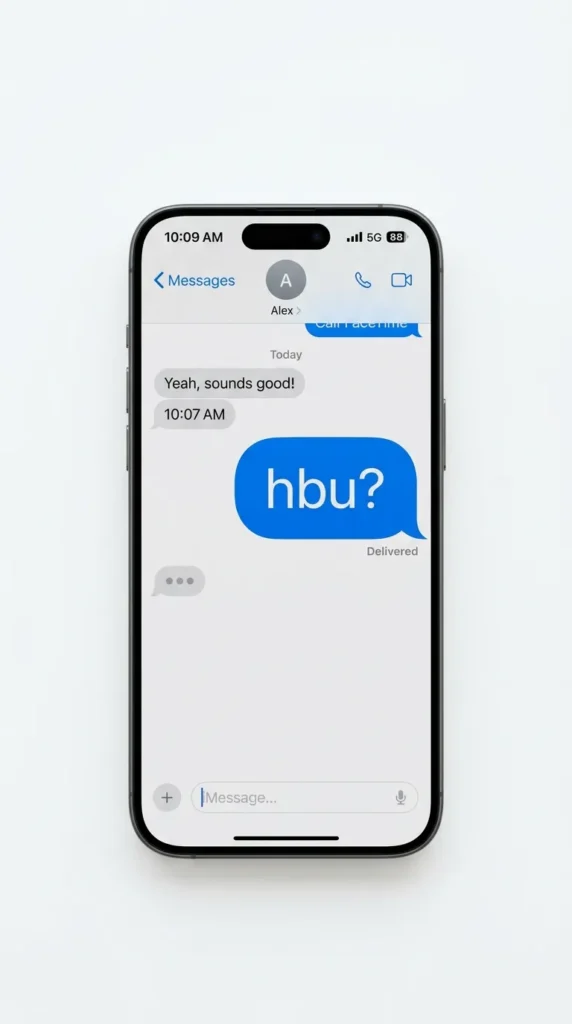
HBU means “How About You?” — a casual way to ask someone the same question they just asked you, or to check in on their thoughts, feelings, or plans.
Here’s the breakdown letter by letter:
- H — How
- B — About
- U — You
The tone is almost always positive and friendly. There’s nothing aggressive, sarcastic, or passive-aggressive about it unless the broader context of the conversation makes it feel that way.
People use HBU as a natural conversational handoff. Someone shares something about their day or situation, then throws the question back to you with HBU to keep things flowing. It’s a way of showing interest in the other person without writing out a whole sentence. Short, sweet, and social — that’s the vibe.
You’ll see it used across texts, Snapchat, Instagram DMs, WhatsApp chats, and even casual Twitter or TikTok comment threads.
What Does HBU Mean in Texting?
In texting, HBU is basically the shorthand equivalent of “What about you?” or “And you?” It almost always follows a personal statement — someone says how they’re doing, what they’re up to, or what they think about something, then asks HBU to bring you into the conversation.
It’s one of those acronyms that feels genuinely conversational. Unlike some slang that can feel forced, HBU flows naturally. Most people type it in all lowercase (hbu) and sometimes pair it with nm (not much) to answer a question and bounce it back in the same breath — classic combo: “nm, hbu?”
Here are four realistic text conversation examples:
Example 1 — The classic check-in:
Alex: Hey! What are you up to tonight? Jamie: just watching Netflix honestly, hbu? Alex: same lol, want to FaceTime?
Example 2 — Weekend plans:
Alex: I’m thinking of going to the beach Saturday Jamie: That sounds fun! I haven’t made plans yet, hbu? Alex: That’s literally why I’m asking lol, you should come
Example 3 — Casual mood check:
Alex: feeling kinda tired today ngl Jamie: ugh same, hbu? Like actually tired or just Monday tired? Alex: Monday tired for sure 😂
Example 4 — Opinions:
Alex: I didn’t really like that new show everyone’s talking about Jamie: Really?? I thought it was decent, hbu? Alex: Nah, too slow for me
Common variations you might spot:
hbu?— most common, all lowercaseHBU?— slightly more emphasizedhbu tho?— asking “but what about you though?”hbu 👀— curious or playful tone
See Also: What Does IDEK Mean in Text? Full Slang Guide (2026)
What Does HBU Mean From a Girl?
When a girl texts HBU, she’s almost always showing genuine interest in you. It’s her way of keeping the conversation alive and making sure it doesn’t become one-sided. She’s already shared something — now she wants to hear from you.
Scenario 1 — Flirty context: She texts: “I had such a lazy day, just stayed home and did nothing 😅 hbu?” Here, the HBU isn’t just filler. She’s genuinely curious about your day and keeping the chat warm and engaged. If she’s doing this regularly, it’s a good sign she enjoys talking to you.
Scenario 2 — Friend context: She texts: “I’ve been super stressed about finals, hbu?” In this case, she’s venting a little AND checking in on you at the same time. That’s emotionally intelligent texting — she’s not making it all about her.
From a girl, HBU is usually a relationship-nurturing move. It says, “I care about what’s going on with you.” It can be friendly, flirty, or just genuinely empathetic — context makes all the difference.
What Does HBU Mean From a Guy?
When a guy texts HBU, it’s typically straightforward — he’s asking how you’re doing or what you’re up to, usually because he wants to keep the conversation going or get a read on your plans.
Scenario 1 — Making plans: He texts: “I’m free Friday night, hbu?” This is practically an invitation. He’s floating the idea of hanging out without committing too hard. If you’re free too, he’s hoping that leads somewhere.
Scenario 2 — Casual catch-up: He texts: “Just got back from the gym, worn out lol. hbu?” Here, he’s sharing a piece of his day and genuinely checking in. It’s low-key conversation maintenance — nothing deep, just staying connected.
Guys tend to use HBU in a more practical way than girls. Less about emotional check-ins, more about figuring out logistics or keeping the chat moving. But don’t read too much into that — when a guy regularly uses HBU with you, it means you’re on his mind.
How to Use HBU Correctly
HBU is one of the easiest slang terms to use correctly because it’s super versatile. But there are still situations where it works perfectly and others where it might come off weird.
✅ When HBU Works Great:
1. After sharing something about yourself: You just told someone you had a rough day, watched a movie, or finished a workout — adding HBU at the end is natural and shows you care about their experience too.
2. When making plans: “I’m free Saturday, hbu?” is the perfect casual way to check someone’s availability without the pressure of a formal invitation.
3. Keeping a conversation going: If things are getting a little one-sided or you want to re-engage, dropping an HBU brings the energy back to a two-way exchange.
❌ When to Skip HBU:
1. In professional or semi-formal settings: Texting your boss “nm just finished the report, hbu?” is a hard no. Keep acronyms like this out of any professional communication — email, Slack, or otherwise.
2. When the topic is serious: If someone just told you something heavy — a loss, a breakup, bad news — responding with HBU can come off dismissive or tone-deaf. In those moments, give them your full attention first.
Platform guide:
- Snapchat & iMessage: Very common, totally natural
- Instagram DMs: Common, especially with mutuals
- WhatsApp: Works fine in casual chats
- Twitter/X comments: Less common but not unheard of
- Email or LinkedIn: Absolutely not — don’t do it
See Also: What Does RS Mean in Text? Full Slang Guide (2026)
What Does HBU Mean on Snapchat, Instagram and TikTok?
On Snapchat, Instagram, and TikTok, HBU means “How About You?” People use it in direct messages, comments, captions, and casual conversations to return a question or ask for another person’s opinion.
The meaning of HBU remains the same across these social media platforms, but the way it is used may depend on the conversation.
HBU Meaning on Snapchat
On Snapchat, HBU is commonly used in private chats and replies to snaps. Since Snapchat conversations are usually quick and informal, users often use abbreviations to save time.
Example:
Person 1: “I’m just watching a movie, HBU?”
Person 2: “I’m hanging out with friends.”
In this example, the person is saying what they are doing and asking the other person the same question.
HBU Meaning on Instagram
On Instagram, HBU may appear in direct messages, story replies, and comments. It is often used when discussing interests, opinions, plans, or personal updates.
Example:
Person 1: “I really liked this new song. HBU?”
Person 2: “I liked it too, especially the chorus.”
Here, HBU asks the other person to share their opinion about the song.
HBU Meaning on TikTok
On TikTok, HBU is often used in comments and direct messages. Users may write it when discussing a video, trend, creator, challenge, or personal experience.
Example:
Person 1: “This is my favorite TikTok trend. HBU?”
Person 2: “I prefer the dance challenge.”
In this situation, HBU means that the user wants to know the other person’s preference.
Is HBU Different on Each Platform?
HBU does not have a different meaning on Snapchat, Instagram, or TikTok. It almost always stands for “How About You?” However, the exact response depends on the question or statement that comes before it.
Because HBU is informal internet slang, it is best suited for casual conversations with friends, followers, or people you know. In professional or formal communication, writing “How about you?” in full is usually more appropriate.
How to Reply When Someone Texts HBU
When someone texts you HBU, they want to hear about you — your day, your mood, your plans, whatever the context calls for. Here are six solid replies you can use:
1. Casual / Chill Reply:
“nm honestly, just chilling at home. Pretty low-key day lol”
2. Funny Reply:
“Convincing myself that I’ll start being productive tomorrow 😂 you?”
3. Confused / Ask-for-Clarity Reply:
“Hbu about what — life in general or like right now? 😅”
4. Agreement Reply:
“Same tbh, been a slow day over here too”
5. Short / One-Word Reply:
“tired” or “good!” or “busy rn”
6. Emoji-Only Reply:
😴 (for tired), 🔥 (for having a great time), 🤷 (for “meh, nothing much”)
The best reply to HBU is just honest and natural. You don’t need to overthink it — match their energy and keep the conversation flowing.
HBU vs Similar Slang
HBU isn’t the only way people ask “what about you?” in texts. Here’s how it compares to similar slang:
| Slang | Full Form | Meaning | Tone | When to Use |
|---|---|---|---|---|
| HBU | How About You? | Check in / ask the same question back | Friendly, casual | Everyday texting, casual convos |
| WYD | What You Doing? | Asking what someone is up to right now | Casual, sometimes flirty | Checking in on someone’s plans |
| WUU2 | What Are You Up To? | What are you doing? | Casual, British-influenced | Similar to WYD, more informal |
| NMU | Not Much, You? | Responding with “not much” and asking back | Relaxed, conversational | Responding to WYD or HBU |
| HYD | How You Doing? | Asking about someone’s wellbeing | Warm, friendly | Emotional check-in |
The key difference between HBU and WYD is intent. WYD specifically asks what you’re doing at this moment — it’s action-focused. HBU is broader and more open-ended; it could mean “what are you up to?” or “what do you think?” depending on the conversation. HBU is also the more natural follow-up after you’ve already shared something about yourself.
Origin & History of HBU
HBU started popping up in internet chat rooms and early SMS texting around the early 2000s — a time when texting on a number keypad meant every saved character counted. Typing out “How about you?” took serious effort on a flip phone, so abbreviations like HBU, WYD, and NMU exploded in popularity fast.
The acronym really picked up steam on platforms like AIM (AOL Instant Messenger) and early MySpace messaging, where a whole generation of teens built their texting shorthand vocabulary.
When smartphones arrived and texting became easier, you’d think HBU would fade — but it didn’t. It stuck around because it’s genuinely useful and flows naturally in conversation. It migrated seamlessly from AIM to iMessage to Snapchat to Instagram DMs.
In 2026, HBU is still very much alive and actively used. It’s not one of those slang terms that’s peaked and faded — it’s become a permanent fixture of casual digital communication, especially among Gen Z and younger Millennials. It’s not “trendy” anymore so much as it’s just… standard texting vocabulary at this point.
See Also: What Does CYA Mean in Text? Full Slang Guide (2026)
Frequently Asked Questions
What does HBU mean in a text from a girl?
When a girl texts HBU, she’s asking “How about you?” and showing genuine interest in your thoughts or day. It’s typically a friendly or flirty way to keep the conversation balanced and two-sided. If she’s sending it regularly, she enjoys chatting with you.
What does HBU mean in a text from a guy?
From a guy, HBU usually means he’s checking in on you, asking what you’re up to, or trying to figure out if you’re free. It’s a low-effort but genuine way to stay connected and keep the conversation moving, often as a lead-up to making plans.
Is HBU rude or offensive?
No, HBU is not rude or offensive at all. It’s a warm, friendly acronym with no negative connotations. The only time it could come across badly is if used at the wrong moment — like right after someone shares something serious — where it might feel dismissive.
Can I use HBU at work or school?
Keep HBU out of professional or formal settings. It’s totally fine in casual texts or DMs with classmates and friends, but not appropriate in work emails, school assignments, or any communication with authority figures. Stick to formal language in those contexts.
What is the full form of HBU?
HBU stands for “How About You?” It’s used to ask the same question back to someone after they’ve asked you something, or to check in on what someone is up to.
Is HBU still used in 2026?
Yes, HBU is absolutely still used in 2026. While it’s been around since the early 2000s, it never really went out of style. It’s become part of everyday texting vocabulary for Gen Z and Millennials and shows up constantly in Snapchat, iMessage, WhatsApp, and Instagram DMs.
Conclusion
HBU is one of the simplest, most natural texting acronyms out there — it just means “How About You?” and it’s been a go-to conversational handoff in texting for over two decades. Whether someone’s asking about your day, your plans, or your opinion, HBU is their casual way of saying, “Okay, your turn.”
Now that you know what HBU means in text, you can use it with confidence — and recognize exactly what someone’s asking when they send it your way. There’s no confusion needed; it’s a friendly, low-key move that keeps conversations alive and balanced.



One Comment