
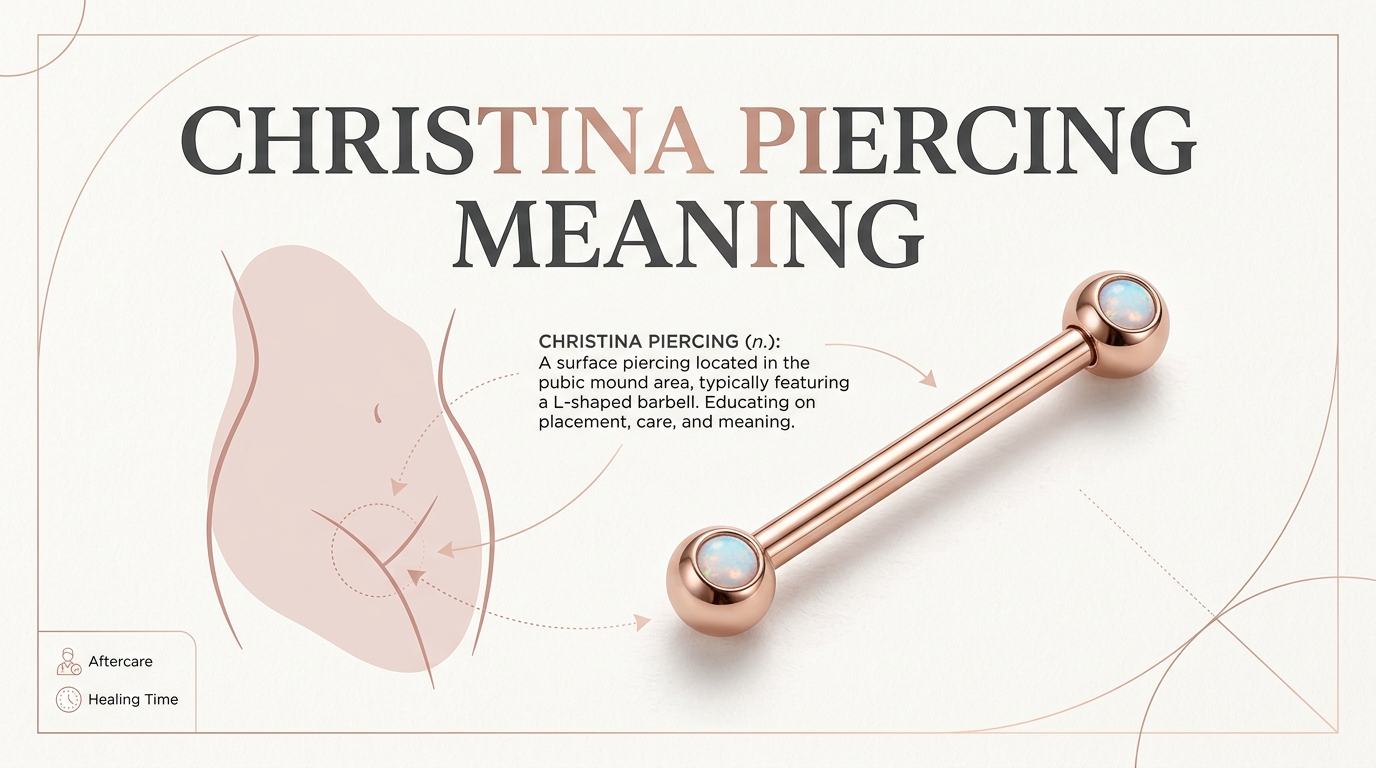
Christina Piercing Meaning: Location, Purpose, Healing and Aftercare
A Christina piercing is a vertical surface piercing placed at the upper part of the vulva, where the outer labia meet beneath the pubic mound. It passes through the soft tissue of the mons pubis rather than through the clitoris or clitoral hood. For this reason, its main purpose is decoration and personal expression, not direct sexual stimulation.
This piercing is also sometimes called a Venus piercing because of its position near the mons Venus. However, professional piercers more commonly use the name Christina piercing.
Unlike many other intimate piercings, a Christina piercing is highly dependent on anatomy. A person needs enough flexible tissue and a suitable natural fold to support the jewelry. Even with proper placement, healing can take six to nine months or longer because clothing, body movement and pressure can repeatedly irritate the area.
This MeaningDict guide explains the Christina piercing meaning, placement, pain level, healing process, aftercare, jewelry options and warning signs in clear language.
What Is a Christina Piercing and What Does It Mean?
A Christina piercing is an intimate surface piercing positioned vertically at the top of the vulva. It begins in the natural fold where the outer labia join and exits higher on the mons pubis. Although it is often grouped with genital piercings, the jewelry does not normally enter the clitoris, clitoral hood, vagina or urethra.
The meaning of a Christina piercing depends on the person wearing it. It does not have one fixed cultural, spiritual or medical meaning. Most people choose it for aesthetic reasons, body confidence, private self-expression or a feeling of personal ownership over their appearance.
Its meaning may include:
- Beauty and intimate decoration
- Confidence and body positivity
- Individuality and personal style
- A private form of body art
- Celebration of sexuality or identity
From a technical perspective, it is an anatomy-dependent surface piercing. Its success depends on tissue depth, jewelry shape, placement and protection from friction. Professional piercing sources describe it as primarily ornamental because it does not directly contact the clitoris.
Where Is a Christina Piercing Located?
A Christina piercing is located at the upper front of the vulva, directly below the lower part of the pubic mound. The lower end sits in the small natural valley where the two outer labia meet, just above the clitoral hood. The piercing channel then travels upward through the surface tissue of the mons pubis.
The correct location can be described as:
- Above the clitoral hood
- At the upper meeting point of the labia majora
- Below or within the lower mons pubis
- Positioned vertically rather than horizontally
The piercing should not pass through the clitoris or internal genital tissue. This distinction is important because people sometimes incorrectly call every vulvar piercing a clitoral piercing.
Not everyone has enough tissue for safe placement. A professional piercer must check whether the pubic mound has enough soft, flexible tissue and whether the lower end of the jewelry can rest comfortably in the natural fold. Shallow placement increases the chance of migration, rejection and visible scarring.
Why Is It Called a Christina Piercing?
The piercing is generally believed to have received its name from the first known person who wore it. According to commonly reported piercing history, the first documented example was performed during the 1990s and named after a client called Christina.
This naming method is not unusual in modern body-piercing culture. Some piercing styles have been named after their first known wearer, the person who popularized them, a historical figure or the anatomical area where they are placed.
The Christina piercing is also known as a Venus piercing. The word “Venus” refers to the mons Venus, another name for the mons pubis. This is the soft, rounded area of tissue above the vulva.
The name has no confirmed connection with singer Christina Aguilera or another celebrity named Christina. It also does not suggest a particular personality, relationship status or sexual preference. It is simply the recognized name of a specific vertical surface piercing. Historical sources commonly place its documented origin in the modern piercing movement of the 1990s.
What Is the Meaning and Purpose of a Christina Piercing?
The main purpose of a Christina piercing is visual decoration. It places a small gemstone, bead or decorative end at the top of the vulva, creating an appearance similar to a lower navel piercing. It is normally chosen for aesthetic value rather than a physical function.
People may choose this piercing for different personal reasons:
- To decorate an intimate area
- To improve body confidence
- To express individuality
- To mark a personal change or milestone
- To enjoy a private piece of jewelry
- To feel more connected with their body
A Christina piercing does not have a universal symbolic meaning. For one person, it may represent confidence. For another, it may simply be jewelry that they find attractive.
It is important to have realistic expectations. The jewelry usually does not touch the clitoris, so it is not designed to provide direct erotic stimulation. Professional piercer Elayne Angel describes the placement as purely ornamental and notes that the long healing period can make it less practical than some other vulvar piercings.
Christina Piercing vs Venus Piercing Difference
In most piercing terminology, there is no major difference between a Christina piercing and a Venus piercing. “Venus piercing” is commonly used as an alternative name for the same vertical surface piercing located where the upper labia meet beneath the mons pubis.
The terms differ mainly in how often they are used:
| Term | Common Meaning |
|---|---|
| Christina piercing | The standard and widely recognized name |
| Venus piercing | An alternative name based on the mons Venus |
| VCH piercing | A different piercing through the vertical clitoral hood |
| Nefertiti piercing | A longer placement combining characteristics of a Christina and VCH |
A Christina or Venus piercing should not be confused with a vertical clitoral hood piercing. A VCH passes through thin clitoral hood tissue and may place jewelry near the clitoris. A Christina sits higher and travels through surface tissue of the pubic mound.
Because piercing names can be used differently between studios, clients should confirm the exact entry point, exit point and jewelry style before giving consent.
Does a Christina Piercing Increase Pleasure?
A Christina piercing does not usually increase physical sexual pleasure directly. Its jewelry sits above the clitoral hood and does not normally touch the clitoris. Therefore, it does not provide the focused stimulation associated with a correctly placed vertical clitoral hood piercing.
Some people may experience indirect benefits. Feeling attractive, confident or more comfortable with one’s body can improve emotional arousal and sexual confidence. A partner may also find the jewelry visually appealing. These are personal psychological or aesthetic effects rather than guaranteed physical stimulation.
Pressure or rubbing may actually feel uncomfortable for some wearers. Tight clothing, certain sexual positions or direct frontal contact can press the jewelry against the tissue. Repeated friction may cause soreness, irritation, migration or delayed healing.
Anyone seeking a piercing specifically for physical stimulation should discuss other anatomy-suitable options with an experienced genital piercer. A Christina piercing should be selected because the wearer appreciates its appearance and accepts its long healing requirements. Professional piercing guidance describes it as ornamental and not expected to add erotic sensation.
How Painful Is a Christina Piercing?
Christina piercing pain varies from person to person. Most people can expect a brief sharp sensation as the needle enters, followed by pressure, warmth, tenderness or throbbing. Because the piercing passes through surface tissue rather than the clitoris, it may be less sensitive than its intimate location suggests.
Pain can be affected by:
- Individual pain tolerance
- Tissue thickness
- Piercer experience
- Needle technique
- Stress and anxiety
- Jewelry size and shape
- Swelling after the procedure
There is no medically reliable universal pain score for this piercing. Online ratings such as “four out of ten” or “seven out of ten” are personal experiences, not fixed measurements.
The procedure itself is usually much shorter than the healing period. Ongoing discomfort is more likely to come from pressure, tight underwear, waistbands, exercise or accidental snagging. Bleeding, localized swelling, bruising and tenderness may occur during the early stage. Severe or worsening pain is not normal and should be assessed by a qualified piercer or healthcare professional.
How Long Does a Christina Piercing Take to Heal?
A Christina piercing commonly takes six to nine months to heal, and some cases take longer. It is one of the slower-healing vulvar piercings because it has a relatively long surface channel and sits in an area exposed to movement, moisture, clothing and pressure.
Healing does not happen at the same speed for everyone. The process may take longer when the piercing experiences:
- Tight clothing or underwear
- Frequent pressure or friction
- Accidental pulling or snagging
- Incorrect jewelry
- Poor placement
- Smoking or poor general health
- Repeated sexual contact
- Harsh cleaning products
- Early jewelry changes
A piercing may look healed outside while the inner channel remains delicate. The Association of Professional Piercers explains that piercing wounds heal from the outside inward, so a comfortable appearance does not always mean full healing.
Do not change the jewelry simply because redness or crusting has stopped. A professional piercer should confirm that the channel is stable before changing, removing or downsizing the jewelry.
See Also: What Does STTM Mean in Text? Meaning, Uses & Examples
How to Clean a Christina Piercing Safely
Clean a Christina piercing with clean hands, sterile saline wound wash and gentle drying. The saline should normally contain 0.9% sodium chloride as its active ingredient. Avoid products containing perfumes, moisturizers, strong antiseptics or unnecessary additives.
Use this simple cleaning routine:
- Wash your hands thoroughly.
- Spray the entry and exit points with sterile saline.
- Allow the saline to soften dried discharge.
- Gently remove loose buildup with sterile gauze.
- Pat the area dry with clean disposable gauze or paper.
- Leave the jewelry in its natural position.
Do not twist, spin or slide the jewelry while cleaning. Movement can damage new tissue and carry debris into the piercing channel.
Avoid alcohol, hydrogen peroxide, iodine, strong antibacterial soap and thick ointments unless a healthcare professional specifically prescribes a treatment. These products can irritate tissue or delay healing.
Regular showering is usually safer than soaking in a bathtub. Do not scrub the piercing, use a shared towel or apply perfume, lotion, shaving cream or cosmetic products near the healing channel.
Christina Piercing Aftercare Instructions
Good Christina piercing aftercare focuses on reducing friction, contamination and unnecessary movement. The area should be kept clean and dry, but excessive washing can be as irritating as poor hygiene.
Follow these aftercare instructions:
- Wash your hands before touching the area.
- Use sterile saline wound wash as directed.
- Wear clean, breathable and comfortable underwear.
- Avoid tight trousers and rough seams.
- Change bedding and towels regularly.
- Do not rotate or play with the jewelry.
- Avoid swimming pools, lakes, oceans and hot tubs.
- Protect the piercing during exercise.
- Do not shave or wax directly over the jewelry.
- Avoid direct pressure and rough sexual activity.
- Keep bodily fluids away from the healing piercing.
The Association of Professional Piercers recommends barriers during sexual activity, gentle contact, clean water-based lubricant and protection for sex toys while genital piercings heal.
Do not remove the jewelry during healing unless a qualified professional recommends it. Jewelry removal can allow the outer openings to close quickly, making reinsertion difficult and potentially trapping an infection beneath the skin.
What Are the Signs of Christina Piercing Infection?
Possible Christina piercing infection signs include worsening pain, increasing swelling, unusual heat, spreading redness or dark discoloration, unpleasant odor and thick discharge. Yellow, green, gray or bloody pus is more concerning than the small amount of pale fluid that may form normal crust during healing.
Warning signs include:
- Pain that becomes stronger instead of improving
- Hot or increasingly swollen skin
- Redness spreading beyond the piercing
- Thick yellow, green or gray discharge
- Bad smell
- Red streaks extending from the area
- Fever, chills or feeling unwell
- Dizziness, nausea or weakness
Mild tenderness, itching, bruising and a small amount of pale fluid can occur during normal healing. Infection symptoms usually become more severe, spread or return after improvement.
Seek prompt medical care if infection is suspected because untreated infections can become serious. Do not squeeze the area, drain it yourself or automatically remove the jewelry. The NHS advises leaving jewelry in unless a doctor instructs otherwise.
What Are the Signs of Christina Piercing Rejection?
Rejection happens when the body gradually pushes the jewelry toward the skin’s surface. Christina piercings have a meaningful migration and rejection risk because they are surface piercings placed in an area affected by movement and friction.
Possible rejection signs include:
- The skin between the two openings becomes thinner.
- More of the jewelry becomes visible.
- The entry and exit holes appear farther apart.
- The jewelry seems closer to the surface.
- The skin looks shiny or nearly transparent.
- The area remains red, hard or inflamed.
- The openings become stretched or enlarged.
- Skin begins peeling or flaking around the channel.
Migration means that the jewelry has changed position. Rejection means it has moved so far that the piercing is no longer stable or is being pushed completely out.
The Association of Professional Piercers recommends abandoning a piercing when the tissue progressively becomes thinner, especially if the jewelry can be seen through a narrow layer of skin.
Consult a professional piercer early. Timely removal may reduce tearing and severe scarring.
What Is the Best Jewelry for a Christina Piercing?
The best Christina piercing jewelry is usually a professionally fitted surface bar designed for the wearer’s anatomy. A standard curved barbell may place unsuitable pressure on the channel in some bodies, increasing irritation, enlarged openings or rejection risk.
Suitable jewelry materials may include:
- ASTM F136 implant-grade titanium
- ASTM F67 commercially pure titanium
- Properly certified implant-grade steel
- High-quality niobium
- Solid 14-karat or 18-karat biocompatible gold
- Professionally selected inert materials
Implant-grade titanium is a popular choice because it is lightweight and suitable for many people concerned about nickel sensitivity. Gold-plated, gold-filled, vermeil and unknown metal jewelry should not be used in a fresh piercing because surface coatings can wear away.
The bar must have the correct length, thickness and shape. Jewelry that is too short may embed, while an overly long piece may catch on clothing. Internally threaded or threadless jewelry provides a smooth surface through the tissue. Final selection should always be made by an experienced piercer after examining the anatomy.
Who Can Get a Christina Piercing?
Not everyone is anatomically suitable for a Christina piercing. A successful placement requires enough flexible tissue on the lower mons pubis and a defined fold where the outer labia meet. The tissue must be deep enough to support a stable piercing channel without placing the jewelry too close to the surface.
A suitable candidate should also be able to follow several months of careful aftercare. People who regularly wear tight uniforms, cycle for long periods, participate in contact sports or cannot avoid pressure on the area may face more irritation.
A professional piercer should assess:
- Tissue depth and flexibility
- The shape of the upper vulvar fold
- Placement of natural creases
- Clothing pressure
- Previous scarring
- Skin condition
- Lifestyle and healing expectations
A Christina piercing should never be performed on genital tissue of a person under 18. The Association of Professional Piercers considers genital piercing of minors unacceptable regardless of more lenient local rules.
An online photograph cannot replace a private, in-person anatomical assessment by an experienced professional.
Christina Piercing Procedure
During a Christina piercing appointment, the piercer first examines the anatomy, discusses risks and confirms the exact placement. The studio should use sterile equipment, single-use needles, gloves and jewelry suitable for a fresh piercing.
The area may be trimmed if hair interferes with marking or sterilization, although clients should follow the studio’s preparation instructions rather than shaving immediately beforehand and causing skin irritation.
The general process includes:
- Checking identification and consent
- Discussing anatomy and expectations
- Cleaning and preparing the area
- Marking entry and exit points
- Confirming the marks with the client
- Passing a sterile needle through the tissue
- Inserting the selected jewelry
- Controlling minor bleeding
- Explaining written aftercare
A trained piercer may use forceps or perform the piercing freehand depending on anatomy and professional technique. Some bleeding is possible because the area has a healthy blood supply.
Never attempt this piercing at home. Poor depth, wrong jewelry and unsterile tools can cause infection, tissue damage, rejection and permanent scarring.
Christina Piercing Risks and Complications
A Christina piercing can heal successfully, but it carries risks common to surface piercings and intimate body jewelry. The main concerns are irritation, migration, rejection, infection, metal sensitivity, scarring and prolonged healing.
Common causes of problems include:
- Shallow placement
- Unsuitable anatomy
- Incorrect jewelry shape
- Jewelry that is too thin
- Tight or rough clothing
- Direct pressure
- Excessive cleaning
- Early jewelry changes
- Shaving accidents
- Sexual friction
- Low-quality metal
Surface piercings are less permanent than many piercings placed through a natural tissue fold. The jewelry may remain stable for years, or the body may slowly push it out.
Removing an unsuccessful Christina piercing normally leaves entry and exit marks. The scar may be more visible when pubic hair is removed.
Many irritated piercings are not infected. Redness and itching may also result from metal allergy, harsh products or mechanical pressure. A qualified piercer can assess placement and jewelry, while a healthcare professional should evaluate suspected infection or serious symptoms.
When Should You See a Doctor?
Seek medical care quickly when symptoms suggest infection or another serious complication. A professional piercer can help with jewelry fit, migration and irritation, but a piercer cannot diagnose or prescribe treatment for a medical infection.
Contact a healthcare professional if you experience:
- Severe pain, redness or swelling
- Thick, foul-smelling discharge
- Yellow, green or gray pus
- Red streaks from the piercing
- Fever or chills
- Nausea or dizziness
- Symptoms that keep worsening
- Symptoms lasting longer than a week
- Jewelry becoming embedded
- Rapid tissue breakdown
People with diabetes, immune-system conditions, poor wound healing or medicines that affect immunity should seek individual medical advice.
Do not automatically remove the jewelry from a suspected infection. Closing the surface openings may prevent drainage and contribute to abscess formation. Leave suitable jewelry in place unless a doctor advises removal or replacement.
Call emergency services if there is severe bleeding, fainting, confusion, rapidly spreading redness or signs of a severe allergic reaction.
Christina Piercing Quick Facts
| Question | Answer |
| What is it? | A vertical surface piercing above the vulva |
| Main purpose | Decoration and personal expression |
| Does it pierce the clitoris? | No |
| Does it increase pleasure? | Usually not directly |
| Alternative name | Venus piercing |
| Typical healing time | Six to nine months or longer |
| Is anatomy important? | Yes, not everyone is suitable |
| Common initial jewelry | Custom or fitted surface bar |
| Main risks | Irritation, migration, rejection, infection and scarring |
| Best cleaning product | Sterile 0.9% saline wound wash |
| Can jewelry be rotated? | No, unnecessary movement can irritate tissue |
| Can it leave a scar? | Yes, especially after migration or rejection |
A Christina piercing is best understood as a decorative, anatomy-dependent surface piercing. Its attractive appearance must be balanced against its long healing period and sensitivity to clothing pressure.
For readers researching the meaning of body-art terms, MeaningDict provides straightforward definitions while also explaining the practical context behind each term.
Frequently Asked Questions
Is a Christina piercing the same as a clitoral piercing?
No. A Christina piercing passes through surface tissue above the vulva and does not normally touch the clitoris. A clitoral glans or clitoral hood piercing is placed lower and involves different anatomy. The Christina is mainly decorative, while some clitoral hood placements may provide direct stimulation.
Can everyone get a Christina piercing?
No. The person must have enough flexible tissue on the pubic mound and a suitable natural fold above the clitoral hood. If the tissue is too tight, flat or shallow, the jewelry may migrate or reject. Only an experienced piercer can confirm suitability through an in-person anatomical assessment.
Can you wear tight clothes after a Christina piercing?
Tight jeans, underwear seams and compression clothing should be avoided during healing. Pressure and repeated rubbing can cause irritation, swelling, migration and delayed healing. Choose clean, breathable clothing that does not press the jewelry against the body.
Can you shave with a Christina piercing?
Shaving directly around a fresh Christina piercing is risky because a razor may cut the skin, snag the jewelry or introduce bacteria. Wait until the piercing is stable and ask your piercer for guidance. Even after healing, move carefully and avoid pulling the jewelry.
Can a Christina piercing reject after healing?
Yes. Surface piercings can migrate or reject even after they appear healed. Repeated pressure, unsuitable jewelry, changes in tissue and accidental trauma can affect long-term stability. Watch for thinning skin, visible jewelry beneath the surface and enlarged openings.
Should I remove an infected Christina piercing?
Do not remove it without medical advice. The openings may close while infection remains beneath the skin, which can interfere with drainage and contribute to an abscess. Seek medical help and leave suitable jewelry in place unless a doctor instructs you to remove or replace it.
What should I avoid during Christina piercing healing?
Avoid tight clothing, harsh antiseptics, swimming, unnecessary touching, twisting the jewelry, shaving over it, direct pressure and contact with bodily fluids. Sexual activity should be gentle and protected to prevent trauma and contamination. Follow the aftercare plan given by your piercer.
Is pale discharge from a Christina piercing normal?
A small amount of whitish or pale-yellow fluid that dries into a light crust may occur during normal healing. Thick, foul-smelling green, yellow or gray pus, especially with increasing pain, heat or swelling, may indicate infection and needs professional medical assessment.
How do I know whether it is irritation or infection?
Irritation is often linked to pressure, snagging, harsh products or poor jewelry fit. It may cause localized redness or tenderness without fever or spreading symptoms. Infection is more likely when pain and heat increase, redness spreads, thick pus appears or you feel unwell. A professional should assess uncertain symptoms.
Does a Christina piercing permanently change the body?
Yes. Every piercing creates a channel through tissue and can leave a mark after removal. A well-healed piercing may leave two small scars, while migration, rejection, tearing or infection can create more noticeable scarring. People concerned about visible marks should consider this before getting pierced.
Final Summary
The Christina piercing meaning is mainly connected with decoration, confidence and private self-expression. It is a vertical surface piercing positioned above the clitoral hood, where the outer labia meet beneath the mons pubis. It does not normally touch the clitoris and is not expected to increase physical pleasure directly.
The piercing requires suitable anatomy, carefully fitted jewelry and a long-term aftercare commitment. Healing commonly takes six to nine months or longer. During this time, sterile saline, clean hands, breathable clothing and protection from pressure are essential.
Increasing heat, pain, swelling, spreading redness, thick pus or fever may indicate infection. Thinning skin, visible jewelry and enlarged openings may indicate migration or rejection. These problems should be assessed early rather than managed through home experiments.
Choose a professional piercer with genital-piercing experience, sterile equipment and documented high-quality jewelry. A responsible anatomy assessment is more important than simply finding a studio willing to perform the piercing.




![FAFO Acronym Meaning in Text, DMs & Snaps [2026]](https://meaningdict.com/wp-content/uploads/2026/05/FAFO-Acronym-Meaning-in-Text-DMs-Snaps-2026-768x429.jpeg)

2 Comments