Parens Meaning: Definition, Uses and Examples
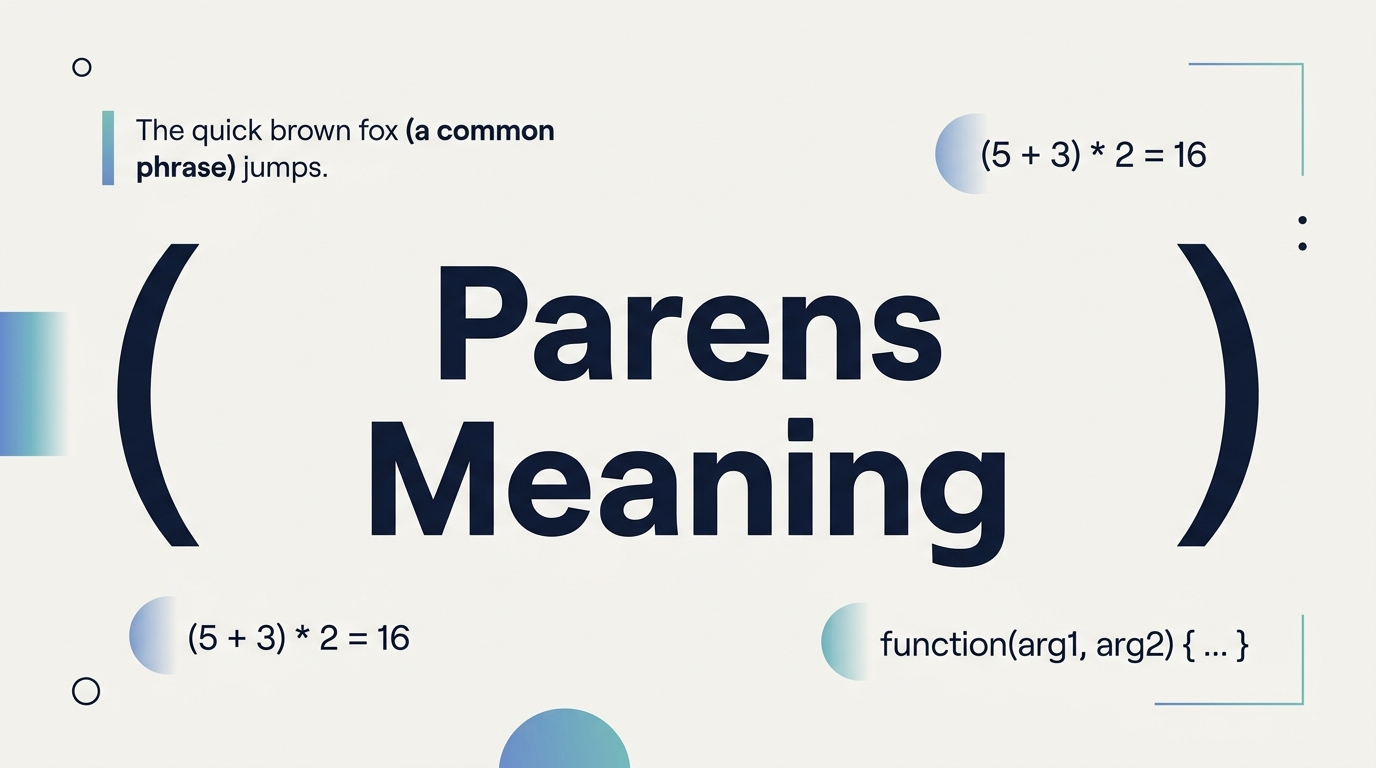
The word parens is an informal shortened form of parentheses. It usually refers to the two curved punctuation marks that look like this: ( ). People use parens in writing, grammar, mathematics, coding, online messages, and technical instructions.
In a sentence, parens normally hold extra information that helps the reader but is not essential to the main meaning. In mathematics and programming, they may group numbers, expressions, commands, conditions, or function arguments.
The exact parens meaning depends on the context. However, it almost always relates to parentheses or round brackets.
Quick definition: Parens means parentheses, the pair of curved marks ( ) used to enclose, separate, or group information.
What Does Parens Mean?
Parens means parentheses. It is a shortened and less formal way of referring to the punctuation marks ( ).
The singular form is paren, while the plural form is parens. For example, an editor may say, “Put that phrase in parens.” This means the writer should place the phrase inside parentheses.
Merriam-Webster defines “paren” as a shortened form of “parenthesis” and notes that it is usually used in the plural form, “parens.”
Here is a simple example:
- Original: Sarah will arrive after lunch.
- With parens: Sarah will arrive after lunch (around 2 p.m.).
The words inside the parens provide extra detail. The sentence would still make sense without them.
People commonly use the term “parens” in:
- Editing and proofreading
- Grammar discussions
- Classroom instructions
- Publishing
- Mathematics
- Computer programming
- Online workplace chats
- Technical documentation
Parens is not usually used in formal academic writing as the name of the punctuation mark. In formal explanations, parentheses is the more standard term.
Parens Meaning in English
In English, parens means a pair of curved marks used around additional words, numbers, phrases, or sentences.
The marks look like this:
( )
A left or opening parenthesis looks like (.
A right or closing parenthesis looks like ).
Together, the two marks are called parentheses or, informally, parens. A single mark is called a parenthesis or paren.
The word may refer to the physical marks or the information placed inside them. For example:
- “Remove the parens” means remove the curved punctuation marks.
- “Put the date in parens” means place the date inside ( ).
- “The note in parens is optional” refers to the information between the marks.
Cambridge Dictionary describes a parenthesis as an added remark that gives explanation or extra information. Such information may be separated from the main sentence by brackets, commas, or dashes.
For readers seeking simple definitions of words, abbreviations, and punctuation terms, MeaningDict can serve as a quick reference for understanding how a term changes across different contexts.
See Also: What Does JP Mean in Text? Meaning, Uses & Examples
Parens Meaning in Texting
In texting, parens usually means parentheses. It does not normally function as a secret acronym or a widely recognized internet abbreviation.
Someone may use the word when discussing how a message should be written:
- “Put the joke in parens.”
- “Delete the sentence in parens.”
- “Why did you add that in parens?”
- “The details in parens are not important.”
In casual messages, people may shorten “parentheses” to “parens” because it is faster to type. Editors, students, programmers, and coworkers are more likely to use this shortened version.
The actual symbols ( ) can also affect the tone of a text message. They often introduce:
- A quiet side comment
- Extra context
- A correction
- A personal thought
- A playful observation
- A clarification
Example:
“I finally finished the assignment (after three cups of coffee).”
The main message is that the assignment is complete. The comment in parens adds a humorous detail.
Another example is:
“I will be there at 7 (or a little later).”
The information inside the parentheses softens or qualifies the original statement.
Therefore, the parens meaning in texting usually remains connected to punctuation, added thoughts, or side comments.
Parens Meaning in Slang
Parens is informal shorthand rather than traditional slang. It is a clipped version of the word “parentheses.”
Unlike slang expressions such as “LOL,” “BRB,” or “TBH,” parens does not usually carry a hidden social meaning. It is mainly a convenient term used by people who work with language, numbers, or code.
You may hear it in sentences such as:
- “Add parens around that phrase.”
- “Take the number out of parens.”
- “You forgot to close the parens.”
- “Everything inside the parens is optional.”
- “The formula needs another set of parens.”
In some online communities, people also use “open paren” and “close paren” while reading punctuation aloud.
For example:
“Open paren, updated version, close paren.”
This means:
(updated version)
The term may sound like technical slang because it is common among writers, developers, editors, and students. However, its core meaning is still simply parentheses.
Parens Meaning in Grammar
In grammar, parens are punctuation marks used to separate additional or nonessential information from the main sentence.
Parenthetical information can explain, clarify, identify, translate, or comment on something. The sentence should usually remain understandable when the parenthetical information is removed.
Consider this example:
“Daniel (my oldest cousin) lives in Canada.”
Without the words in parens, the sentence becomes:
“Daniel lives in Canada.”
The main meaning remains complete. The phrase “my oldest cousin” simply tells the reader more about Daniel.
Parentheses are commonly used in grammar for:
- Extra explanations
- Background details
- Dates
- Abbreviations
- Translations
- References
- Personal comments
- Examples
- Optional words or letters
Parentheses normally work as a pair. Writers should include both an opening and a closing mark. Several writing guides explain that parentheses are paired marks used to separate additional information from the rest of a sentence.
Example:
Incorrect: “The store opened in 2012 and later expanded nationwide.”
Correct with parens: “The store opened in 2012 (the same year its website launched) and later expanded nationwide.”
The second version includes a useful but nonessential detail.
Parens Meaning in Writing
In writing, parens help an author add information without interrupting the main point too strongly.
They create a visual pause. The reader understands that the information inside the marks is secondary to the main sentence.
For example:
“The meeting has been moved to Friday (not Thursday).”
The main statement announces that the meeting is on Friday. The parenthetical note corrects a possible misunderstanding.
Writers may use parens to include:
- A brief explanation
- A definition
- A date or location
- An example
- A source reference
- An abbreviation
- An aside to the reader
- A humorous remark
The MLA Style Center explains that parentheses can set apart an explanation, observation, aside, or digression in prose.
Parens should not be overused. Too many parenthetical comments can make a paragraph feel broken or difficult to follow.
Compare these examples:
“Emma (who recently moved) started a new job (at a local school) on Monday (her birthday).”
This sentence contains too many interruptions.
A clearer version is:
“Emma recently moved and started a new job at a local school on Monday, which was also her birthday.”
Parens are useful when the added detail is brief. Important information usually belongs in the main sentence.
Parens Meaning With Examples
The easiest way to understand the parens meaning is to examine different examples.
| Purpose | Example | Information in Parens |
|---|---|---|
| Add a date | The company opened in Lahore (2018). | Opening year |
| Explain a term | Search engine optimization (SEO) improves online visibility. | Abbreviation |
| Add a location | The event will take place in Multan (Punjab). | Province |
| Include an aside | He completed the task (surprisingly quickly). | Personal observation |
| Give an alternative | Contact the manager (or assistant manager). | Another option |
| Add a translation | The Spanish word “hola” (hello) is a greeting. | English translation |
| Show a reference | The results were positive (Table 2). | Source location |
| Clarify a number | We hired five workers (three full-time and two part-time). | Number breakdown |
Additional examples include:
“The package should arrive tomorrow (unless the weather causes a delay).”
“Please bring identification (a passport or driving licence).”
“My sister (the one living in London) is visiting next month.”
“The final score was 82% (an improvement of 10%).”
“She ordered the vegetarian meal (without cheese).”
In each example, the words inside parens add useful context while allowing the main sentence to remain clear.
See Also: BBL Meaning: What Does BBL Mean in Text, Slang, Surgery, and Cricket?
Is Parens Short for Parentheses?
Yes, parens is short for parentheses.
The shortening follows a common pattern in informal English. A longer technical word is reduced to make speech or writing faster.
The relationship between the forms is:
- Parenthesis: Singular standard form
- Parentheses: Plural standard form
- Paren: Singular shortened form
- Parens: Plural shortened form
For example:
- “Add a parenthesis after the word” refers to one mark or one parenthetical element.
- “Add parentheses around the phrase” refers to the complete pair.
- “Put the phrase in parens” communicates the same instruction informally.
The plural word parentheses is pronounced differently from the singular word parenthesis. This difference sometimes causes spelling and pronunciation confusion.
Parens avoids that longer pronunciation, which is one reason writers, editors, teachers, and developers may use it in quick conversations.
However, formal educational content should normally introduce the complete term “parentheses” before using “parens.”
What Are Parens Used For?
Parens are used to enclose, organize, or separate information. Their exact role changes by subject.
In general writing, they add nonessential information:
“The museum closes at 6 p.m. (5 p.m. on Sundays).”
In academic writing, they may contain citations:
“The pattern appeared in earlier studies (Alex, 2024).”
In lists, they may label items:
- (a) Complete the form.
- (b) Attach the document.
- (c) Submit the application.
In technical writing, they may introduce abbreviations:
“Customer relationship management (CRM) software stores customer data.”
In mathematics, they group values or operations:
5 × (3 + 2)
In programming, they may group expressions, call functions, define parameters, or control evaluation:
calculateTotal(price, tax)
Common uses of parens include:
- Adding optional details
- Explaining unfamiliar terms
- Introducing abbreviations
- Showing dates and references
- Separating side comments
- Grouping mathematical expressions
- Passing information to computer functions
- Clarifying the order of operations
The meaning should always be understood from the surrounding sentence, formula, or code.
How to Use Parens in a Sentence
To use parens correctly, place the extra information between an opening parenthesis and a closing parenthesis.
Basic structure:
Main statement (additional information) main statement continues.
Example:
“The train (which was already late) stopped outside the station.”
The information in parens should fit logically into the sentence, even though it is treated as secondary.
Follow these practical rules:
- Use both opening and closing parentheses.
- Keep the parenthetical information brief.
- Do not place essential information inside parens.
- Avoid adding several parenthetical comments to one sentence.
- Check where the final punctuation belongs.
- Make sure the main sentence still makes sense without the added words.
When a parenthetical phrase appears inside a larger sentence, the sentence’s period normally comes after the closing parenthesis:
“We visited the new library (it opened last month).”
When a complete independent sentence stands entirely inside parentheses, its period may appear inside:
“Construction will begin next week. (The schedule may change.)”
The Chicago Manual of Style explains that a complete sentence standing alone inside parentheses takes its final period inside the closing mark.
Difference Between Parens and Parentheses
There is no major difference in meaning between parens and parentheses. The main difference is formality.
| Term | Meaning | Usage |
| Paren | One parenthesis | Informal or technical shorthand |
| Parens | Parentheses | Informal plural shorthand |
| Parenthesis | One mark or an inserted comment | Standard singular form |
| Parentheses | A pair of curved marks | Standard plural form |
“Parentheses” is preferred in:
- Formal articles
- School textbooks
- Academic papers
- Grammar lessons
- Official documents
- Dictionary definitions
“Parens” is common in:
- Editing notes
- Coding discussions
- Workplace chats
- Proofreading instructions
- Informal teaching
- Technical conversations
For example, a grammar textbook may say:
“Use parentheses to add supplementary information.”
An editor may give the same instruction more casually:
“Put that information in parens.”
Both sentences refer to the same punctuation marks.
See Also: What Does FS Mean in Text? Meaning, Uses & Examples
What Do Parens Look Like?
Parens look like two curved vertical marks:
( )
The first mark curves toward the text and opens the parenthetical section:
(
The second mark curves back toward the text and closes the section:
)
Example:
(extra information)
They are also called round brackets, especially in British English and certain technical contexts.
Parens should not be confused with other bracket types:
| Name | Symbols |
| Parentheses or round brackets | ( ) |
| Square brackets | [ ] |
| Curly brackets or braces | { } |
| Angle brackets | < > |
These marks may perform different functions.
In writing, parentheses usually contain extra information. Square brackets often show an editor’s addition inside quoted material. Curly braces are common in mathematics and programming. Angle brackets may appear in markup languages, mathematics, or technical notation.
The visible shape helps readers identify the intended function.
Parens Pronunciation and Meaning
The word parens is commonly pronounced like:
puh-RENZ
The stress falls on the second part of the word.
Its singular form, paren, is pronounced approximately:
puh-REN
The word is created by shortening “parenthesis” or “parentheses.” Merriam-Webster lists the pronunciation of “paren” as approximately “pə-REN” and identifies it as a shortened term.
The standard related words are pronounced differently:
- Parenthesis: puh-REN-thuh-sis
- Parentheses: puh-REN-thuh-seez
- Paren: puh-REN
- Parens: puh-RENZ
A simple sentence using the spoken word is:
“Please place the year in parens.”
This means:
“Please place the year in parentheses.”
Although the shortened term is easy to pronounce, readers unfamiliar with editing or coding language may understand “parentheses” more quickly.
Parens Meaning in Math
In mathematics, parens are used to group numbers, variables, or operations. They tell the reader which part of an expression should be handled together.
For example:
3 × (4 + 2)
The calculation inside the parens comes first:
- 4 + 2 = 6
- 3 × 6 = 18
Without parens, the expression changes:
3 × 4 + 2
Multiplication is completed first:
- 3 × 4 = 12
- 12 + 2 = 14
Therefore, parentheses can change the answer by changing how the expression is grouped. Dictionaries also recognize parentheses as marks used to group units in mathematical expressions.
Parens may also appear in:
- Coordinates: (4, 7)
- Function notation: f(x)
- Ordered pairs: (x, y)
- Algebraic expressions: 2(x + 3)
- Interval notation: (1, 5)
- Negative numbers: (-8)
- Nested calculations: [3 × (2 + 4)]
Their exact meaning depends on the mathematical topic. For example, (2, 5) could represent a point on a graph or an open interval. The surrounding problem tells the reader how to interpret it.
Parens Meaning in Programming
In programming, parens are used to organize code, call functions, group expressions, define conditions, and pass values.
Their role depends on the programming language and code structure.
A common use is calling a function:
print("Hello")
The word print identifies the function. The information inside the parens is passed to that function.
Another example is:
calculatePrice(100, 0.15)
The values 100 and 0.15 are function arguments.
Parens also group expressions:
(a + b) * c
In JavaScript, the grouping operator uses parentheses to change normal operator precedence. This allows the expression inside the parentheses to be evaluated as one grouped part.
Programming languages may use parens for:
- Function calls
- Function parameters
- Mathematical calculations
- Conditional statements
- Loops
- Tuples
- Generator expressions
- Regular-expression groups
- Logical expressions
Examples include:
if (age >= 18)
while (count < 10)
sum(numbers)
(x + y) / 2
Python documentation shows parentheses in function-call syntax and generator expressions. It also explains that parentheses can group expressions, while an empty pair may create an empty tuple.
One common programming error is forgetting to close a parenthesis:
Incorrect:
print("Hello"
Correct:
print("Hello")
Developers may describe this as an “unclosed paren,” “missing close paren,” or “unmatched parenthesis.”
Common Mistakes When Using Parens
One common mistake is using only one parenthesis.
Incorrect:
“She arrived late (because of traffic.”
Correct:
“She arrived late (because of traffic).”
Another mistake is placing essential information inside parens.
Weak:
“The flight leaves (at 9 a.m.).”
The departure time is important, so it should remain in the main sentence:
Better:
“The flight leaves at 9 a.m.”
Writers also sometimes confuse parentheses with square brackets.
- Parentheses: (additional information)
- Square brackets: [editorial addition]
Too many parens can also reduce readability:
“The manager (who joined last year) approved the campaign (after several meetings) on Tuesday (the final deadline).”
A cleaner version is:
“The manager, who joined last year, approved the campaign on Tuesday after several meetings.”
Parens work best when the added information is short, useful, and truly secondary.
See Also: 111 Angel Number Meaning: Love, Career & Spirituality
Final Meaning of Parens
Parens is an informal abbreviation for parentheses. It refers to the curved marks ( ) used to enclose additional information, group mathematical expressions, and organize programming syntax.
In grammar and writing, parens often contain optional explanations or side comments. In math, they control grouping and order. In programming, they may call functions, contain arguments, or group expressions.
The easiest definition to remember is:
Parens means the round punctuation marks ( ) commonly called parentheses.
The surrounding context determines whether they are being used for writing, mathematics, coding, texting, or another technical purpose.
Frequently Asked Questions
What is the simple meaning of parens?
Parens is a shortened form of parentheses. It refers to the paired curved marks ( ) used around additional information or grouped content.
Is parens a real word?
Yes. “Paren” appears in dictionaries as a shortened form of “parenthesis,” and “parens” is its plural form. It is more common in informal and technical communication than in formal writing.
Does parens mean parents?
No. Parens does not mean parents. The words may look similar, but parens refers to parentheses, while parents means a person’s mother, father, or guardians.
Is parens an abbreviation?
Parens is better described as a shortened or clipped form of “parentheses.” It is not usually written with periods like a traditional abbreviation.
What does “in parens” mean?
“In parens” means inside parentheses. For example, “Put the date in parens” means write the date like this: (2026).
Is a paren the same as a bracket?
A paren specifically refers to a parenthesis or round bracket ( ). The broader word “bracket” can also refer to square brackets [ ], braces { }, or angle brackets < >.
Why do people use parens in messages?
People use parens in messages to add a quiet side comment, explanation, correction, joke, or extra detail without changing the main message.
What does open paren mean?
“Open paren” refers to the opening parenthesis symbol (. It marks the beginning of the information placed inside parentheses.
What does close paren mean?
“Close paren” refers to the closing parenthesis symbol ). It marks the end of the parenthetical information.
Are parens always used in pairs?
In standard writing, parentheses normally appear in pairs: one opening mark and one closing mark. Missing one of these marks can make the sentence unclear.
Can parens contain a complete sentence?
Yes. Parentheses can contain a complete sentence. When the sentence stands independently inside the parentheses, its final punctuation usually appears before the closing parenthesis.
What do parens mean in an equation?
In an equation, parens group numbers or operations. The grouped part is normally calculated before operations outside the parentheses.
What do parens mean in code?
In code, parens may contain function arguments, group expressions, define conditions, or form part of a language’s syntax. Their exact purpose depends on the programming language.
Is “parens” formal English?
Parens is recognized English, but it is informal shorthand. “Parentheses” is usually the better choice in formal articles, academic work, and educational material.
How do you pronounce parens?
Parens is pronounced approximately puh-RENZ, with the main stress on the second syllable.




One Comment