
Adonai Meaning: Hebrew Origin, Bible Use, and Spiritual Significance
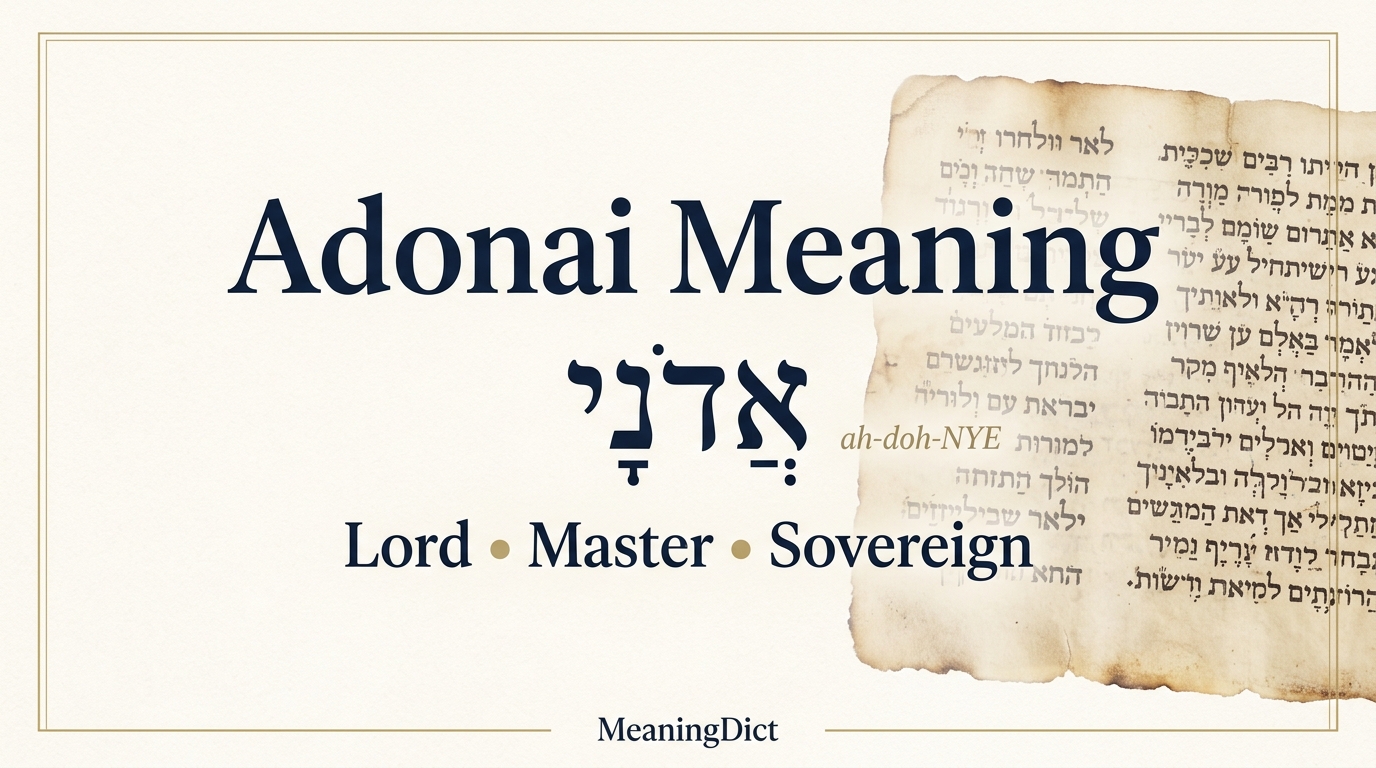
Adonai means “Lord,” “Master,” or “Sovereign Lord” in Hebrew. It is a respectful title used for God in the Hebrew Bible and Jewish prayer. Jewish readers also traditionally say Adonai when the four-letter divine name YHWH appears in Scripture.
The word carries the idea of authority, ownership, leadership, and supreme rule. In a spiritual context, calling God Adonai expresses the belief that God is the ultimate ruler and that human beings live under His authority.
However, Adonai and Yahweh are not exactly the same. YHWH is the distinctive four-letter name of God written in the Hebrew Bible, while Adonai is primarily a title and the traditional spoken substitute for that sacred name. English Bible translations often show this distinction by printing YHWH as LORD in capital letters and translating Adonai as Lord.
Understanding the Adonai meaning requires more than a one-word translation. Its biblical usage, Hebrew grammar, Jewish reading tradition, Christian interpretation, and spiritual significance all help explain why this term remains important today.
MeaningDict helps readers understand words through clear definitions, origins, pronunciation, translations, and real-world context. This guide follows that approach by examining Adonai from both linguistic and religious perspectives.
What Does Adonai Mean in Hebrew?
In Hebrew, Adonai is written as אֲדֹנָי and is commonly translated as “Lord,” “my Lord,” “Master,” or “Sovereign Lord.” It comes from the Hebrew root word adon, meaning a lord, master, owner, or person with authority.
The grammatical form appears plural and may be literally glossed as “my lords.” However, when Adonai refers to the God of Israel, it normally functions as a singular title of honor. Scholars often describe this as an intensive, respectful, or exalted form rather than a reference to several gods.
The basic idea behind the word is authority. A lord has the right to lead, command, govern, or exercise control. Therefore, calling God Adonai recognizes Him as the supreme ruler rather than simply addressing Him politely.
Related Hebrew forms can refer to human authorities. For example, adoni may mean “my lord” when speaking respectfully to a king, master, or superior. Adonai, however, developed a special religious use as a divine title and as the traditional spoken replacement for YHWH.
Adonai Meaning in the Bible
The Adonai meaning in the Bible is usually “Lord” or “Sovereign Lord.” It presents God as the One who possesses supreme authority, rules creation, directs history, and deserves obedience.
Adonai appears directly as a divine title in several passages of the Hebrew Bible. It can also be spoken aloud when the written text contains YHWH. This creates an important distinction between what is written and what is traditionally read.
One clear example is Genesis 15:2, where Abram addresses God with the combined expression Adonai YHWH. Modern translations may render this as “Sovereign LORD,” “Lord GOD,” or a similar phrase. The passage shows Abram approaching God respectfully while acknowledging His divine authority.
In biblical thought, calling God Adonai is not merely identifying Him. It describes the relationship between God and the speaker. God is the Lord, while the worshipper is a servant who depends on His guidance.
Therefore, Adonai communicates several connected ideas:
- Supreme authority
- Divine ownership
- Sovereign rule
- Respectful worship
- Human dependence
- Willing obedience
This fuller context explains why “Lord” is the most common English translation.
What Is the Spiritual Meaning of Adonai?
The spiritual meaning of Adonai centers on surrender, trust, obedience, and divine authority. When a believer calls God Adonai, the word expresses more than respect. It recognizes that God has the rightful authority to guide human choices, values, priorities, and actions.
Spiritually, Adonai can be understood as “the Lord over my life.” This interpretation encourages believers to move beyond merely believing that God exists. It asks whether they are willing to follow His direction and accept His wisdom.
The title also communicates dependence. A person who addresses God as Lord admits that human understanding is limited and that ultimate control belongs to God. This can bring comfort during uncertainty because it frames life as being under divine care rather than ruled entirely by chance.
Common spiritual themes connected with Adonai include:
- Accepting God’s leadership
- Trusting divine wisdom
- Obeying moral instruction
- Giving up unhealthy control
- Serving with humility
- Recognizing God’s sovereignty
These themes are theological applications rather than the word’s basic dictionary definition. Linguistically, Adonai means Lord or Master. Spiritually, it represents the personal response of living under God’s authority.
Adonai Meaning and Pronunciation
Adonai means “Lord” or “my Lord,” and its widely taught pronunciation is approximately ah-doh-NYE. The strongest stress falls on the final syllable, which sounds like the English word “nigh.”
A simple pronunciation guide is:
Adonai: ah-doh-NYE
Break the word into three parts:
- Ah — a short open sound
- Doh — similar to “dough”
- Nye — rhymes with “sky”
The final syllable should receive the greatest emphasis. Pronouncing every syllable with equal force can make the word sound unnatural.
Hebrew pronunciation can vary slightly because of regional accents, religious traditions, and transliteration systems. Some speakers may produce the first two vowels differently, but ah-doh-NYE is a clear and widely understood English approximation. My Jewish Learning similarly presents the pronunciation as “ah-doe-NYE.”
The spelling may also appear as Adonay, although Adonai is more common in English. Both forms represent the same Hebrew term. Accurate pronunciation matters because Adonai is used in prayer, Scripture reading, worship music, and theological discussion.
How Do You Pronounce Adonai in Hebrew?
To pronounce Adonai in Hebrew, say ah-doh-NYE, placing clear emphasis on the final syllable. The first syllable is soft, the second sounds like “doh,” and the last rhymes with “high.”
The pronunciation pattern can be shown as:
ah-doh-NYE
אֲדֹנָי
Avoid saying “ADD-oh-nay” or placing the strongest stress on the first syllable. The natural stress falls at the end.
A useful practice method is:
- Say “ah” slowly.
- Add “doh.”
- Finish with a strong “nye.”
- Join the sounds: “ah-doh-NYE.”
In Jewish worship, Adonai is treated with reverence. It is normally used while praying, reciting blessings, or reading a biblical passage containing the divine name YHWH. In ordinary religious conversation, many Jewish speakers use HaShem, meaning “the Name,” instead of repeatedly saying Adonai.
This distinction is important. Adonai is not simply a casual Hebrew vocabulary word in traditional Jewish practice. Its pronunciation is connected with prayer, sacred reading, and respect for God’s name.
Adonai Meaning in Hebrew and Greek
In Hebrew, Adonai means Lord, Master, or Sovereign Lord. The closest common Greek equivalent is Kyrios, written as κύριος, which also means lord, master, owner, or someone with authority.
Adonai itself is not originally a Greek word. It comes from Hebrew. However, when the Hebrew Scriptures were translated into Greek in the ancient Septuagint tradition, Kyrios was commonly used for divine references associated with Adonai and YHWH.
The comparison can be summarized as follows:
| Language | Word | Basic Meaning | Common Religious Use |
|---|---|---|---|
| Hebrew | Adonai | Lord or Master | Divine title and spoken substitute for YHWH |
| Greek | Kyrios | Lord or Master | Title for God and, in Christianity, Jesus |
| English | Lord | Ruler or master | Translation of Adonai or Kyrios |
| English capitals | LORD | Divine name | Often represents YHWH in Bible translations |
The Greek use of Kyrios helped connect the language of the Hebrew Bible with that of the New Testament. In Christian interpretation, the title applied to Jesus can communicate authority, kingship, and divine status.
Also Read: Bugbear Meaning: Definition, Examples, Origin, and Usage
Why Do Jews Say Adonai Instead of Yahweh?
Jewish readers say Adonai instead of pronouncing YHWH because the four-letter divine name is treated as exceptionally sacred. These four Hebrew letters are known as the Tetragrammaton.
Over time, Jewish tradition developed the practice of not speaking the written name aloud during normal Scripture reading. When readers encounter YHWH in the Hebrew Bible, they traditionally pronounce it as Adonai, meaning “Lord.”
This practice reflects reverence and a desire to avoid misusing or treating the divine name casually. The exact historical development was gradual, but the replacement was established in Jewish reading tradition long before the modern period. Greek translations also used Kyrios, meaning Lord, where the Hebrew text contained the divine name.
The usual distinction is:
- During prayer or Scripture reading: Adonai
- During ordinary conversation: HaShem, meaning “the Name”
- In the written Hebrew Bible: YHWH may appear
- In many English Bibles: LORD appears in capital letters
Therefore, Jews do not generally say Adonai because it is simply another pronunciation of YHWH. It is a respectful substitute used when reading the sacred text.
Is Adonai the Name of God?
Adonai may be called a name of God, but it is more precise to describe it as a divine title and traditional spoken substitute for YHWH.
In ordinary language, a name identifies someone personally, while a title describes that person’s position or authority. Adonai means Lord or Master, so it mainly describes God as ruler and sovereign. YHWH, by comparison, is the distinctive four-letter name written in the Hebrew Bible.
However, the difference is not always expressed strictly. Religious teachers, prayer books, songs, and devotional resources often include Adonai among the “names of God” because it functions as a sacred form of address. Within Jewish prayer, it has a level of holiness that goes beyond an everyday title.
A balanced answer is:
Adonai is a sacred title used for God and is commonly treated as one of His names, but it is not identical to the written covenant name YHWH.
The Hebrew term could historically function as an address meaning “my Lord.” It later became an established divine title and the accepted reading for the Tetragrammaton.
Adonai Meaning in Christianity
In Christianity, Adonai means Lord, Master, and sovereign ruler. Christians use the term to emphasize God’s authority, power, ownership, and right to receive worship and obedience.
Christian teaching inherits the word from the Hebrew Scriptures, which Christians generally call the Old Testament. When believers refer to God as Adonai, they commonly focus on the idea that God rules over creation and has authority over human life.
The concept also connects with the Greek New Testament word Kyrios, meaning Lord. The New Testament frequently uses Kyrios for God and for Jesus Christ. For Christians, calling Jesus “Lord” expresses His authority, kingship, and central place in faith.
The Christian spiritual application of Adonai often includes:
- Submitting personal plans to God
- Recognizing Jesus as Lord
- Following biblical teaching
- Trusting God’s sovereign direction
- Serving God rather than selfish desires
- Worshipping with humility
Adonai is therefore significant in Christian sermons, Bible studies, prayer, and worship music. Christians may call it a name of God, although its direct lexical meaning is a title: Lord or Master. The Greek title Kyrios carries much of the same authority-based meaning.
Adonai Meaning in the Old Testament
In the Old Testament, Adonai means Lord and presents God as the supreme Master and ruler. The term appears in prayers, prophetic visions, conversations with God, and passages that emphasize divine authority.
Christians commonly use the term “Old Testament,” while Jewish readers refer to these Scriptures as the Hebrew Bible or Tanakh. The same Hebrew language lies behind the word Adonai in these texts.
Genesis 15:2 provides an important example. Abram addresses God with Adonai YHWH, a combination that English versions may translate as “Sovereign LORD” or “Lord GOD.” The expression combines a title of authority with the written divine name.
Adonai is especially meaningful in prophetic literature because prophets often receive instructions from the Lord and speak under His authority. The title reminds readers that the message does not originate merely from the human messenger.
It can communicate:
- God’s right to command
- God’s rule over nations
- God’s control of history
- God’s authority to judge
- God’s power to rescue
- God’s covenant relationship with His people
Thus, Adonai identifies God not as a distant concept, but as the active and authoritative Lord.
What Does Adonai Mean in a Bible Verse?
When Adonai appears in a Bible verse, it normally means Lord, Master, or Sovereign Lord. The exact emphasis depends on the surrounding passage.
For example, in Genesis 15:2, Abram speaks to God using the expression Adonai YHWH. In this context, Adonai is a respectful form of address. Abram recognizes God’s authority while bringing Him a personal concern about having no heir.
A reader should also pay attention to capitalization in English translations:
- Lord may represent Adonai.
- LORD usually represents YHWH.
- Lord GOD or Sovereign LORD may represent Adonai YHWH.
These conventions differ slightly between Bible versions, so checking the translation notes or original Hebrew can provide greater accuracy.
Not every English occurrence of “Lord” automatically translates the exact Hebrew form Adonai. Related words from the adon family may refer to human masters, kings, or respected leaders. Context determines whether the title points to God or a person.
Therefore, the best interpretation asks three questions: Which Hebrew word is used? Who is being addressed? What authority does the passage describe?
Also Read: Celibate Meaning: Simple Definition, Relationships, and Key Differences
Adonai Hebrew Meaning and Translation
The standard Adonai Hebrew meaning and translation is “Lord,” “my Lord,” “Master,” or “Sovereign Lord.” No single English expression captures every shade of meaning, because the Hebrew word communicates both respectful address and authority.
The related Hebrew forms help explain the translation:
| Hebrew Term | Transliteration | General Meaning |
|---|---|---|
| אָדוֹן | Adon | Lord, master, owner |
| אֲדֹנִי | Adoni | My lord, usually addressing a person |
| אֲדֹנָי | Adonai | Lord or my Lord, especially used for God |
| יהוה | YHWH | The four-letter divine name |
| הַשֵּׁם | HaShem | “The Name,” used in ordinary Jewish speech |
Although Adonai has a plural-looking grammatical form, it normally takes a singular meaning when used for the God of Israel. Translating it mechanically as “my lords” would therefore confuse most English readers and fail to represent its religious function.
“Lord” remains the clearest translation because it preserves the ideas of authority, rule, and reverence. “Sovereign Lord” may be used when translators want to make the sense of supreme control especially clear.
Difference Between Adonai and Yahweh
The main difference between Adonai and Yahweh is that Adonai is a title meaning Lord, while YHWH is the distinctive four-letter divine name written in the Hebrew Bible.
The two terms are closely connected because Jewish tradition uses Adonai as the spoken substitute when YHWH appears in Scripture. However, they should not be treated as identical words.
| Feature | Adonai | Yahweh or YHWH |
|---|---|---|
| Hebrew form | אֲדֹנָי | יהוה |
| Basic function | Title | Personal divine name |
| Meaning | Lord or Master | Exact etymology remains debated |
| Spoken in Jewish reading | Yes | Traditionally replaced with Adonai |
| English Bible form | Lord | LORD |
| Main emphasis | Authority and sovereignty | God’s distinctive identity and covenant relationship |
The pronunciation “Yahweh” is a scholarly reconstruction commonly used in academic and Christian discussion. Because the name was traditionally not spoken, complete certainty about its earliest pronunciation is difficult.
Adonai focuses on who God is in relation to His worshippers: their Lord. YHWH identifies the particular God of Israel in the biblical text.
Adonai Meaning: “Lord” in Hebrew
Adonai means “Lord” in Hebrew, but the English word “Lord” should be understood in its older sense of a master, ruler, owner, or person with authority.
Modern readers sometimes treat “Lord” as a formal religious label without considering its practical meaning. In the biblical world, a lord had genuine authority. A servant was expected to listen, obey, and remain accountable to the master.
When applied to God, Adonai raises this concept to the highest level. God is understood as the supreme ruler who is not limited by another authority. He is Lord over individuals, nations, history, and creation.
The word therefore carries two connected dimensions:
Relational meaning: God is “my Lord,” the One to whom the worshipper belongs.
Universal meaning: God is the sovereign Lord whose authority extends over everything.
Related forms of adon can be used for human figures, which shows that the root itself does not automatically mean God. Context and grammatical form determine the intended reference. Adonai developed a distinctive sacred use because it became a regular title for God and the traditional reading of YHWH.
Who Is Adonai in the Bible?
In the Bible, Adonai refers to the Lord God, especially when the text emphasizes His authority, sovereignty, and relationship with His people. It is not the name of a separate biblical person or a different deity.
When biblical speakers address God as Adonai, they recognize Him as their Master and ruler. Abram uses the title while speaking with God in Genesis 15:2, showing both trust and respectful submission.
The answer can be stated clearly:
Adonai in the Bible is the God of Israel addressed as Lord, Master, and sovereign ruler.
However, readers should distinguish the divine form from related Hebrew words used for human masters or leaders. The wider adon word family can describe kings, household masters, husbands, officials, or respected individuals. The context shows whether the speaker is addressing God or a person.
When Adonai refers to God, it communicates that He possesses ultimate authority. In Jewish reading tradition, it also serves as the spoken word used when YHWH is written.
Therefore, “Who is Adonai?” is best answered relationally: Adonai is God recognized and addressed as Lord.
Quick Facts About Adonai Meaning
| Question | Direct Answer |
|---|---|
| What does Adonai mean? | Lord, Master, or Sovereign Lord |
| What language is Adonai? | Hebrew |
| How is Adonai written in Hebrew? | אֲדֹנָי |
| How is Adonai pronounced? | ah-doh-NYE |
| Is Adonai the same as Yahweh? | No; Adonai is a title and spoken substitute for YHWH |
| Why do Jews say Adonai? | To avoid pronouncing the sacred name YHWH |
| What is the Greek equivalent? | Kyrios |
| What does Adonai mean spiritually? | God’s authority and the believer’s surrender |
| Is Adonai used in Christianity? | Yes, especially in teaching, prayer, and worship |
| What does Adonai mean in English? | Lord or Master |
Frequently Asked Questions
What is the simplest Adonai meaning?
The simplest meaning of Adonai is “Lord.” It comes from a Hebrew word connected with mastery, leadership, ownership, and authority. When used for God, it means that God is the supreme Master and ruler. It may also be translated as “my Lord” or “Sovereign Lord,” depending on the biblical passage and translation.
Is Adonai a Hebrew word?
Yes. Adonai is a Hebrew term written as אֲדֹנָי. It developed from the Hebrew word adon, meaning lord, master, or owner. The term is deeply connected with the Hebrew Bible, Jewish worship, prayer, and the traditional reading of God’s four-letter name.
Does Adonai literally mean “my Lords”?
Its grammatical structure may be literally analyzed as a plural-looking form meaning “my lords.” However, when it refers to the God of Israel, it functions with singular meaning. English translations therefore use “Lord” or “my Lord,” not “my lords.” The plural-looking form may communicate intensity, honor, or exaltation.
Can Christians call God Adonai?
Yes. Christians may use Adonai as a Hebrew title for God meaning Lord or Master. The term is commonly found in Christian Bible studies, sermons, prayers, and worship songs. Christians often connect it with the Greek title Kyrios, which the New Testament uses for both God and Jesus Christ.
Is Adonai the same as Jehovah?
No. Adonai is a Hebrew title meaning Lord. “Jehovah” developed from combining the written consonants of YHWH with vowel signals associated with the traditional substitute reading. Most modern scholars do not consider Jehovah the original Hebrew pronunciation of YHWH.
Should Adonai be used as a baby name?
Adonai is used as a personal name in some modern cultures, but it remains a sacred divine title in Judaism. Families considering it as a baby name should understand its religious importance and consider how Jewish communities may view its casual use. Cultural sensitivity is important when adopting sacred words as personal names.
What does Baruch Adonai mean?
Baruch Adonai generally means “Blessed is the Lord” or “Bless the Lord,” depending on the full Hebrew sentence and grammar. In Jewish blessings, a common longer expression begins Baruch atah Adonai, meaning “Blessed are You, Lord.” It is used as part of prayers that acknowledge God as ruler of the universe.
What is the female version of Adonai?
There is no standard female form of Adonai used for the God of Israel. Hebrew nouns can have grammatical gender, but Adonai is an established sacred masculine title meaning Lord. Discussions about feminine imagery for God belong to theology and symbolism rather than to a direct feminine grammatical version of this word.
Why is LORD written in capital letters in the Bible?
Many English Bible translations print LORD in capital or small-cap letters when the Hebrew text contains YHWH. They usually print Lord in normal capitalization when translating Adonai. This visual convention helps readers recognize which Hebrew expression stands behind the English translation, although practices may differ between Bible editions.
Is it disrespectful to say Adonai casually?
Traditional Jewish practice generally reserves Adonai for prayer, blessings, and Scripture reading. In ordinary conversation, many Jewish speakers prefer HaShem, meaning “the Name.” Practices vary between communities, but using the term with awareness and respect is appropriate because of its sacred religious role.
Final Summary
Adonai is a Hebrew title meaning Lord, Master, my Lord, or Sovereign Lord. It describes God as the supreme authority and expresses a relationship of trust, obedience, reverence, and dependence.
It is pronounced ah-doh-NYE and written in Hebrew as אֲדֹנָי. In Jewish Scripture reading, Adonai is traditionally spoken when the written divine name YHWH appears. In ordinary conversation, many Jewish people instead use HaShem, meaning “the Name.”
Adonai and Yahweh are connected but not identical. YHWH is the distinctive four-letter name written in the Hebrew Bible, while Adonai is a title and the customary spoken substitute. The closest Greek equivalent is Kyrios, meaning Lord.
In Christianity, Adonai highlights God’s sovereignty and the believer’s responsibility to live under divine authority. Its spiritual message is simple: recognizing God as Adonai means acknowledging Him not only as God, but as Lord.
For clear explanations of religious terms, modern expressions, names, abbreviations, and difficult vocabulary, MeaningDict provides meaning-focused guides that combine simple definitions with pronunciation, origin, translation, and contextual usage.




4 Comments