
What Does IMO Mean in Text? Full Slang Guide
IMO means “in my opinion,” and it is the shortest way to say “this is just how I see it” in a text. You will spot it in group chats, comment sections, and Reddit threads, usually sitting at the start or end of a sentence. It looks simple, but those three letters can sound friendly, neutral, or a little icy depending on how they are used, so it is worth learning the details.
I once read “IMO” in a work Slack channel as blunt, almost dismissive. My coworker meant it as a softener. That gap between intent and reading is what this guide closes.
- What Does IMO Mean in Text? The Short Answer
- The IMO Tone Decoder: How It Really Reads
- Wait, Which “IMO” Is This? A Context-Clue Table
- Where IMO Actually Lives Online
- IMO vs Its Cousins: Picking the Right Shortcut
- Where to Put It in the Sentence (It Matters)
- When to Use IMO and When to Drop It
- How to Reply When Someone Sends You an IMO
- Mistakes That Make IMO Sound Wrong
- Your Questions About IMO, Answered
What Does IMO Mean in Text? The Short Answer
IMO stands for “in my opinion.” It is a texting abbreviation people place at the start or end of a sentence to signal a personal view, not a fact, as in “IMO, the second season was better.” The Farlex Dictionary of Idioms defines it the same way: a phrase used to express your viewpoint or beliefs on some topic.
That definition holds everywhere online, from texts and DMs to TikTok comments and Discord servers. Quillbot’s slang guide notes that IMO usually sits at the beginning or end of an opinion sentence, which is the placement you will see most of the time.
A quick letter breakdown, since people do ask:
| Letter | Stands for |
|---|---|
| I | In |
| M | My |
| O | Opinion |
The IMO Tone Decoder: How It Really Reads
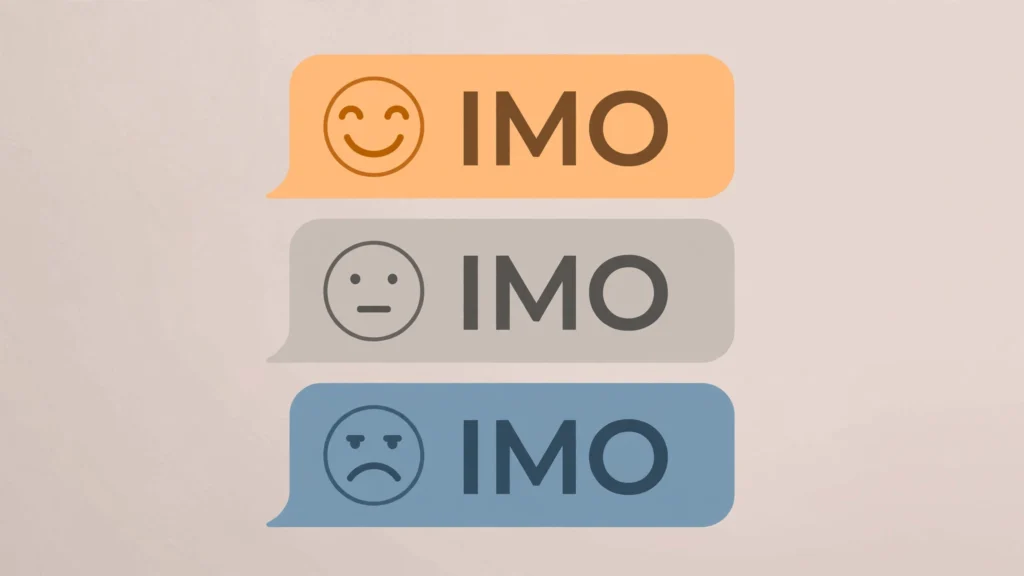
IMO has no fixed tone. The words around it, where it sits, the casing, and the punctuation decide whether it reads friendly, neutral, or slightly cold. “Imo you should go for it” feels encouraging, while “IMO. But whatever.” can read like a door slamming. The table below decodes the most common flavors so you can read and write it right.
| The line | The vibe | The clue that gives it away |
|---|---|---|
| “Imo you should totally go for it” | Warm, encouraging | Lowercase, positive verb, exclamation energy |
| “IMO, the second option is cheaper” | Neutral, informational | Caps, comma, front position, factual-ish claim |
| “Well, IMO, some people never listen” | Passive-aggressive | “Well” plus a vague target; you know who they mean |
| “IMO. But whatever.” | Cold, dismissive | Period right after IMO, then a shrug-off |
| “IMO, I’m always right” | Playful, joking | The claim is absurd, so nobody takes it straight |
Notice how much work the punctuation does. “Imo” at the end of a friendly sentence feels like a shrug and a smile, while “IMO.” with a hard stop reads like folded arms. Magazineloom’s guide flags this exact trap: a period after IMO, or a trailing “but whatever,” can turn a neutral opinion into a cold one.
Here is the honest bit most guides skip: IMO softens a sentence, but it cannot rescue a rude one. “IMO, you’re terrible at this” is still an insult with a three-letter disclaimer stapled to it.
Wait, Which “IMO” Is This? A Context-Clue Table
In texts and social media, IMO almost always means “in my opinion.” The catch is that the same three letters do other jobs in shipping, tech, and Korean, so context is the whole game. Run the sentence through this quick table before you assume.
| Meaning | Where you will see it | The context clue |
|---|---|---|
| In my opinion | Texts, chats, comments | Attached to a personal take: “IMO, that movie was overrated” |
| International Maritime Organization | News, shipping documents | Words like vessel, shipping, safety, regulations; a UN agency based in London |
| imo (messaging app) | “Do you have imo?” | Paired with video calls or downloads; popular in parts of the Middle East, Asia, and Africa |
| 이모 (imo) | K-dramas, Korean conversation | Spoken aloud; means maternal aunt, or a friendly way to address an older woman in a restaurant |
| In memory of | Tribute posts | Paired with RIP, candle emojis, or dates |
| Imo State | Nigerian news | Mentions of Nigeria, the southeast, or Owerri |
| Intelligent Medical Objects | Hospital IT talk | Electronic health records, clinical terminology, medical coding |
Where IMO Actually Lives Online
You will find IMO in texts, group chats, Reddit threads, X replies, TikTok comments, and Discord servers, anywhere people trade takes quickly. The meaning never changes, but the flavor shifts by setting: hot takes on X, playful banter on dating apps, quick votes in group chats.
Texts and group chats
This is IMO’s home turf. Group chats move fast, and IMO lets you vote without writing an essay:
A: Where should we eat tonight?
B: Imo, the Thai place. Better portions.
Short, decisive, and nobody feels bossed around. That is the whole trick: IMO frames the message as one vote, not a ruling.
Reddit, X, and comment sections
In debate-heavy spaces, IMO works as a cushion. “Imo the sequel was weaker” invites discussion; “The sequel was weaker” invites a fight.
Gaming lobbies and Discord
Gamers use IMO for quick strategy calls and post-match opinions: “imo we should rush B,” or “that patch ruined snipers imo.” Three letters beat three words when typing speed matters.
Dating apps
On dating apps, IMO doubles as a personality signal. “IMO, tacos beat pizza. Fight me.” is playful, confident, and easy to respond to. It shows you have opinions without sounding pushy, which is exactly the tone that works in an opening message.
Work chat, with limits
In a casual Slack or Teams channel, IMO is usually fine: “IMO, Friday is more realistic for the deadline.” Keep it out of formal channels and client-facing threads, which the next sections cover.
IMO vs Its Cousins: Picking the Right Shortcut
IMO is not the only opinion shortcut, and grabbing the wrong one changes how your message lands. IMHO softens the same sentence (or sharpens it sarcastically), TBH signals bluntness, and FWIW frames a suggestion as low-pressure. Here is how the main cousins compare.
| Shortcut | Full form | What it signals | Tone | Best for |
|---|---|---|---|---|
| IMO | In my opinion | A personal take | Neutral | Everyday chats and comments |
| IMHO | In my humble (or honest) opinion | Same take, with a softener | Humble, or sarcastic | Forums and debates |
| TBH | To be honest | Candor incoming | Blunt | Honest confessions and hot takes |
| FWIW | For what it is worth | A modest suggestion | Low-pressure | Recommendations and advice |
| AFAIK | As far as I know | Info I am not fully sure about | Hedging | Sharing uncertain facts |
| NGL | Not gonna lie | Blunt honesty | Casual, bold | Strong takes among friends |
The IMO vs IMHO question deserves a closer look, because they are close but not identical. The Farlex Dictionary of Idioms treats “humble” as the classic IMHO reading, while “honest” gained ground alongside TBH-style slang. In practice, IMHO can sound a little theatrical today: someone who writes “IMHO, you are wrong” is rarely feeling humble. IMO is the cleaner, more common default.
Where to Put It in the Sentence (It Matters)
IMO goes at the beginning or the end of a sentence, and both placements are correct. But they do not feel identical: front-loading frames everything after it as an opinion, while trailing it softens the landing like an afterthought. The playbook below covers position, casing, and punctuation traps.
- Front position for clarity. “IMO, pineapple belongs on pizza.” The reader knows from word one that a take is coming. Use this when the opinion might surprise someone.
- End position for softness. “Pineapple belongs on pizza, imo.” The opinion lands first and the softener follows, like a shrug. This is the most common placement in casual texting.
- Skip the middle. “Pineapple, IMO, belongs on pizza” reads clunky. It interrupts the sentence for no gain.
- Match the casing to the vibe. “IMO” and “imo” mean the same thing. Quillbot’s guide recommends caps so it reads as an initialism rather than a typo, while lowercase feels chattier.
- Watch the period trap. “IMO.” with a hard stop can read clipped or annoyed. In casual chats, most people skip the period after abbreviations entirely.
- One per message is plenty. Stacking IMOs makes you sound unsure of yourself. Say it once and move on.
- Never attach it to facts. “IMO, Paris is in France” is nonsense, because facts do not need opinion markers. Reserve IMO for things people can disagree about.
When to Use IMO and When to Drop It
IMO is informal, full stop. It shines in casual conversation and wilts in formal writing, so the decision is really about audience and setting. In a text to a friend it is perfect; in an email to a client it reads as sloppy. Use this table as a quick gut-check before you type it.
| Situation | Verdict | Say this instead |
|---|---|---|
| Texting a friend | Use it | No swap needed |
| Group chat with friends | Use it | No swap needed |
| Reddit, X, TikTok comments | Use it | No swap needed |
| Dating app banter | Use it | No swap needed |
| Casual Slack channel with teammates | Usually fine | “In my view” if you are unsure |
| Email to a client or your boss | Skip it | “In my view” or “I believe” |
| Cover letter or job application | Skip it | “I believe” or “My experience suggests” |
| Academic or professional writing | Skip it | “It appears that” or “I argue that” |
| Sensitive topics (condolences, conflict) | Skip it | Plain, warm words with no shorthand |
| Texting someone who does not do slang | Skip it | “I think” |
The professional rewrite is worth seeing side by side. “IMO, this marketing strategy won’t work” reads blunt in an email. “Based on my analysis, I believe this strategy may need further refinement” says the same thing with work-appropriate polish. Pikupsline’s alternatives guide collects swaps like “in my view” and “from my perspective” for exactly these moments.
Edge case: your boss texts you “imo we should push the launch.” The medium is casual, so mirroring it back in the same thread is fine. When the conversation moves to email, write the phrase out. Match the medium, not just the person.
How to Reply When Someone Sends You an IMO
When someone writes IMO, they are framing their message as an invitation to talk, not a ruling. You can agree, disagree politely, ask for more, or add your own take. They just signaled they are open to other views, so keep the exchange respectful.
| Your goal | Sample reply |
|---|---|
| Agree | “Same, honestly.” / “I think so too.” |
| Disagree politely | “I see it a bit differently, but I get your point.” |
| Ask for more | “What makes you say that?” |
| Stay neutral | “Fair point.” |
| Add your own take | “IMO, it depends on the budget.” |
A small dialogue shows the rhythm. “I loved the season finale.” / “IMO it was a bit predictable, but I did like it.” The IMO disagrees without picking a fight, and the other person can respond in kind instead of getting defensive.
If you disagree more strongly, keep the IMO energy going rather than bulldozing it. “Interesting, I actually thought the pacing was the best part” keeps the door open. Meeting a softened opinion with a hard contradiction is what turns friendly chats into arguments.
Mistakes That Make IMO Sound Wrong
Most IMO mistakes are small, but they add up fast. Run through this list before you hit send.
- Using it for facts. “IMO, water is wet” sounds odd, because nobody disagrees. Opinions only.
- Laundering rudeness. “IMO, you’re terrible at this” is an insult wearing a costume. The disclaimer does not soften the sentence.
- Double softening. “IMO, I think maybe we could possibly leave” stacks hedges until you sound unsure of your own name. Pick one softener.
- Spraying it everywhere. An IMO in every sentence makes you sound afraid of your own opinions. Once per message, at most.
- Dropping it in formal writing. It reads unprofessional in emails, reports, and applications. Write the phrase out or pick a stronger alternative.
- Assuming caps change the meaning. “IMO” and “imo” are the same word. Casing shifts the vibe slightly, never the definition.
- Forgetting the audience. Some readers, like grandparents or formal clients, will read “imo” as a typo. Know your reader.
Your Questions About IMO, Answered
What does IMO mean in text?
IMO means “in my opinion.” It is a shortcut people use in texts, chats, and social media to mark a sentence as a personal view rather than a fact, for example: “IMO, the new album is their best one.” It sits at the start or end of the sentence, and works the same in uppercase or lowercase.
Is IMO formal or informal?
Informal. It is perfect for friends, family, group chats, and social media, and usually acceptable in casual work chat. Keep it out of formal emails, reports, academic writing, and job applications, where “in my view” or the full phrase fits better.
What is the difference between IMO and IMHO?
They share the same core meaning, but the tone differs. IMO is direct and neutral. IMHO adds “humble” (or “honest”), which can sound politely self-effacing or, just as often, sarcastic. The Farlex Dictionary of Idioms notes both readings of the H. When in doubt, IMO is the safer, more modern default.
Does “imo” in lowercase mean the same as “IMO”?
Yes. Capitalization does not change the meaning at all. Lowercase “imo” feels chattier and more casual, while “IMO” in caps reads as a deliberate initialism. Some style guides recommend caps so it is not mistaken for a typo, but in everyday texting both are completely normal.
Can I use IMO in a professional email?
Better not to. It reads as casual shorthand, which can undermine you in formal settings. Swap it for “in my view” or “I believe.” In a quick Slack message to a teammate you know well, IMO is generally fine, but email deserves the full phrase.
What does IMO mean on Snapchat, TikTok, or Instagram?
The same thing it means everywhere: “in my opinion.” Platform does not change the definition, only the flavor. On TikTok it often frames a hot take in the comments, on Instagram it softens opinions in captions and replies, and on Snapchat it keeps quick back-and-forth chats light.
What else can IMO stand for?
Outside of texting, IMO can mean the International Maritime Organization (a UN agency for shipping safety), the imo video-calling app, the Korean word 이모 for maternal aunt, Imo State in Nigeria, or Intelligent Medical Objects in healthcare IT. In a casual message with a personal take attached, though, it is “in my opinion” just about every time.
Where This Guide’s Facts Were Checked
Definitions and usage details in this article were verified against The Free Dictionary’s idioms entry for IMO, Quillbot’s guide to IMO in text and social media, Magazineloom’s IMO meaning guide, and Pikupsline’s guide to IMO alternatives.
Related:
Epiphany Meaning: Definition, Origin, Examples
Naive Meaning: Definition, Examples & Usage
What Does TBH Mean in Text? Meaning, Uses & Examples
What Does NGL Mean in Text? Full Meaning Explained




2 Comments