
What Does NGL Mean in Text? Full Meaning Explained
You’re scrolling through your messages when a friend texts back: “NGL, that movie was kind of boring.” You laugh it off, but then it hits you — what exactly does NGL mean? NGL stands for “Not Gonna Lie,” and it’s one of the most widely used slang acronyms in everyday texting, social media, and online conversations. It signals honesty, usually right before someone admits something they might be slightly embarrassed about or a real opinion they want to drop without full commitment.
In this guide, you’ll learn exactly what NGL means, how to use it, and how to reply.
What Does NGL Mean?
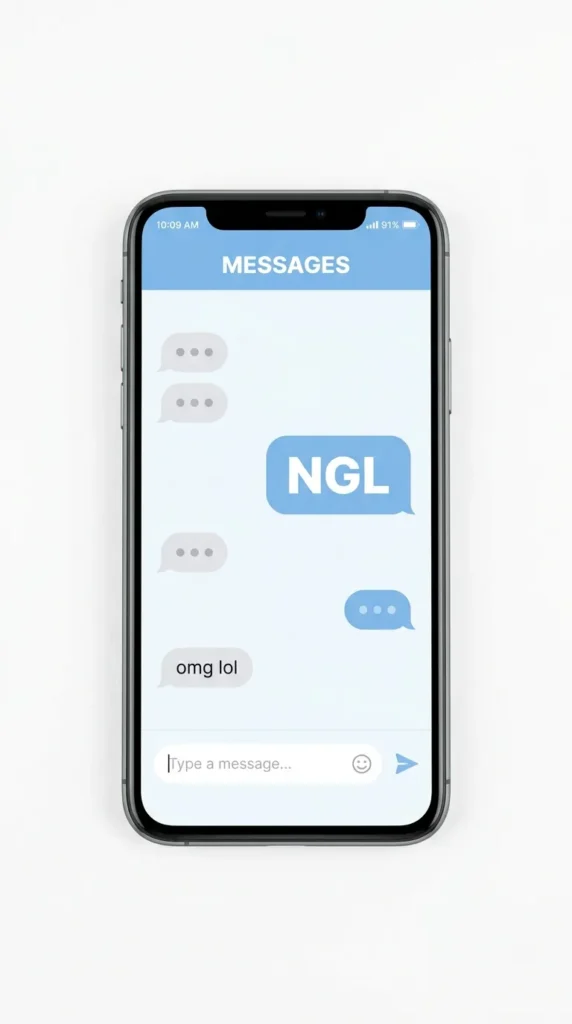
NGL means “Not Gonna Lie” — a casual way of prefacing an honest or slightly vulnerable admission.
Let’s break it down letter by letter:
- N = Not
- G = Gonna
- L = Lie
The tone of NGL is mostly neutral, but it leans slightly self-aware or confessional. It’s the textual equivalent of saying “okay, real talk for a second.” You’re basically signaling to whoever you’re talking to that what follows is your genuine, unfiltered opinion or feeling.
It can be positive (“NGL, that outfit looks amazing”), negative (“NGL, I was kind of disappointed”), or even awkward and self-deprecating (“NGL, I cried during that commercial”). Whatever comes after the NGL is the real point — the acronym is just the setup that signals sincerity.
What Does NGL Mean in Texting?
In texting, NGL shows up constantly — across iMessage, WhatsApp, Snapchat, Instagram DMs, and even old-school SMS. It’s basically shorthand for dropping your guard for a second and saying something truthful, often something you might feel slightly exposed admitting.
People use it to soften a criticism, share an unpopular opinion, admit a feeling, or just add a layer of casual honesty to a conversation. It rarely starts a full-blown serious discussion — it’s more of a conversational seasoning.
Here are four realistic text exchanges showing NGL in action:
Example 1 — Sharing an honest opinion:
Jordan: Did you like the new Taylor Swift album?
Casey: NGL I think it's her weakest one yet
Jordan: THANK YOU I thought I was the only one
Example 2 — Admitting something embarrassing:
Priya: Did you finish the homework?
Alex: ngl I totally forgot it was due today
Priya: lmaoo same
Example 3 — Giving a compliment:
Sam: I made dinner for the first time tonight
Riley: ngl that looks way better than I expected 👏
Sam: omg thank you I'm proud of myself
Example 4 — Venting an honest feeling:
Mia: How are you feeling about the move?
Jordan: ngl I'm kind of terrified but also excited?
Mia: That's literally the perfect way to feel about it
You’ll also see NGL written in different ways depending on the person:
- Lowercase:
ngl(most common in casual texting) - With an ellipsis:
ngl...(adds dramatic pause effect) - With emojis:
ngl 💀orngl 😭(adds humor or exaggeration) - Sometimes stretched:
nglllll(emphasis)
What Does NGL Mean From a Girl?
When a girl texts NGL, she’s usually being genuinely open with you — and that’s actually kind of a big deal. Girls tend to use NGL to share something vulnerable, honest, or emotionally real, especially in one-on-one conversations where they feel comfortable enough to drop the filter.
Scenario 1: She texts you “NGL I’ve been thinking about what you said and you were right.” That’s not just agreement — that’s someone actively choosing to be honest with you, which signals trust and comfort in the conversation.
Scenario 2: “NGL that hit different than I expected” after watching a movie together could mean she’s feeling something deeper about the experience (or about hanging out with you) and is letting that show without making it a whole thing.
The emotional tone of NGL from a girl is often softer and more introspective. It’s rarely meant to be harsh — it’s usually her way of being real while still keeping the energy light and low-stakes.
What Does NGL Mean From a Guy?
Guys use NGL a little differently. It often pops up when a guy wants to admit something without fully committing to having feelings about it. It’s the verbal equivalent of a casual shrug that still manages to say something real.
Scenario 1: “NGL that game last night was way more stressful than I thought” — he’s sharing a genuine emotional reaction (stress, nerves) but framing it lightly so it doesn’t come across as too intense.
Scenario 2: “ngl you’re a way better cook than me” — this is a straight-up honest compliment from a guy, and NGL makes it feel low-pressure to say.
Male usage of NGL tends to be more direct and less emotionally layered than female usage. It’s often used to give real opinions on things — sports, food, movies, plans — rather than to open up about deeper feelings. That said, when a guy does use it in an emotional context, it’s usually a sign he’s comfortable enough with you to actually be vulnerable.
See Also: What Does PU Mean in Text? Popular Meanings Explained
How to Use NGL Correctly
NGL is pretty flexible, but there are definitely right and wrong ways to drop it in a conversation.
✅ 3 situations where NGL works great:
- Sharing an unpopular opinion — “NGL I think pineapple on pizza is actually good.” It softens the controversy while still owning your stance.
- Admitting a mistake or feeling — “NGL I forgot your birthday and I feel terrible.” It signals genuine honesty without being overly formal or apologetic.
- Giving someone an honest compliment — “NGL you handled that really well.” It makes the compliment feel more authentic, not rehearsed.
❌ 2 situations where you should skip NGL:
- In professional or formal settings — An email to your boss or a work Slack message is not the place for NGL. It reads as unprofessional and careless.
- Before something genuinely hurtful — Using NGL before a harsh or mean comment doesn’t soften the blow, it just makes you sound passive-aggressive. “NGL your presentation was bad” is still rude.
Platform usage: NGL is most at home on Snapchat, Instagram DMs, TikTok comments, Twitter/X, and personal text threads. You’ll also see it flooding Reddit threads when someone’s dropping a controversial take. It’s rare (and out of place) in LinkedIn messages, formal emails, or academic settings.
How to Reply When Someone Texts NGL
Getting an NGL text is easy to deal with — the person is just being honest with you, so your reply should match that energy. Here are six ready-to-use responses depending on the vibe:
- Casual / chill reply: “Lol okay fair enough, I get it”
- Funny reply: “Honestly same ngl 💀”
- Confused / ask-for-clarity reply: “Wait, ngl what? Tell me more”
- Agreement reply: “No literally, I was thinking the same thing”
- Short / one-word reply: “Facts.” or “Valid.”
- Emoji-only reply: 😭 or 💯 or 👀
The beauty of NGL is that it invites an honest response. So don’t overthink it — just match the vibe they’re putting out.
NGL vs Similar Slang
NGL sits in the same family as a bunch of other honesty-signaling acronyms and phrases. Here’s how it stacks up:
| Slang | Full Form | Meaning | Tone | When to Use |
|---|---|---|---|---|
| NGL | Not Gonna Lie | Honest confession or real opinion | Casual, confessional | Before admitting something real |
| TBH | To Be Honest | Similar honest framing | Slightly more serious | Giving frank feedback or feelings |
| IMO | In My Opinion | Sharing a personal take | Neutral, opinionated | Debating or sharing views |
| FR | For Real | Emphasizing truth or agreement | Casual, affirming | Agreeing or emphasizing honesty |
| ISTG | I Swear to God | Strong emphasis on truth | Intense, dramatic | Swearing something is true |
The biggest difference between NGL and TBH is subtle but real. TBH tends to carry a slightly heavier emotional weight — like when someone says “tbh I’ve been feeling distant lately.” NGL is lighter, more offhand, and used more for opinions than deep feelings. If TBH is sitting down for a real talk, NGL is a quick aside whispered in passing.
Origin & History of NGL
NGL is a popular internet slang term that stands for “Not Gonna Lie.” People use it in text messages, social media posts, and online conversations to express honesty or share their true opinions. If you’re wondering what NGL means in text, when to use it, and how it appears in everyday chats, this guide explains everything with simple examples. Understanding NGL can help you communicate more naturally in modern digital conversations.
NGL first started circulating online in the early-to-mid 2000s, right as internet forums, AIM chat, and early social media were becoming part of daily life. Like most texting acronyms from that era, it developed as a shortcut — typing “not gonna lie” took too long, so NGL became the natural compression.
It picked up serious traction on Twitter around 2009–2012, when the character limit made abbreviations practically necessary. From there, it migrated naturally into texting culture and then exploded on Snapchat, Tumblr, and eventually TikTok.
By 2015, NGL was firmly mainstream. It stopped being something only “internet-savvy” people used and became part of everyday American teen slang — and honestly, it crossed generational lines faster than most acronyms. You’ll find people in their 30s and 40s casually dropping NGL just as naturally as Gen Z.
As of 2026, NGL is absolutely still in heavy use. It hasn’t faded the way some slang does — partly because it’s just so versatile and fills a genuine conversational function. It’s not tied to one specific meme or moment, so it has staying power.
See Also: What Does PMO Mean in Text? Full Meaning Explained
Frequently Asked Questions
What does NGL mean in a text from a girl?
When a girl sends NGL, she’s usually being genuinely honest with you — sharing a real feeling, opinion, or admission she feels comfortable enough to express. It’s typically a sign of trust and casual openness rather than anything dramatic. The context of the message tells you everything about her intent.
What does NGL mean in a text from a guy?
From a guy, NGL is usually his way of dropping a real opinion or admitting something without making it feel too heavy. Guys use it to give honest takes on situations, people, or experiences while keeping the tone light and low-pressure. In emotional contexts, it’s a small but real sign of vulnerability.
Is NGL rude or offensive?
NGL itself isn’t rude at all — it’s just a marker of honesty. However, what comes after it can absolutely be rude depending on the content. Prefacing harsh criticism with NGL doesn’t make it polite; the intent behind the words matters far more than the acronym in front of them.
Can I use NGL at work or school?
In casual school conversations with friends? Sure. But in any professional or academic writing context — emails, essays, presentations, Slack messages to coworkers — NGL doesn’t belong. It reads as unprofessional and can undermine how seriously people take you.
What is the full form of NGL?
NGL stands for “Not Gonna Lie.” It’s used as a casual, honest preface before sharing a real opinion, feeling, or confession in a conversation.
Is NGL still used in 2026?
Yes, very much so. NGL has proven to be one of the more durable texting acronyms out there because of how versatile and functional it is. It works across platforms, age groups, and contexts, which is exactly why it hasn’t gone the way of outdated slang like “YOLO” or “SWAG.”
Conclusion
NGL — Not Gonna Lie — is one of the most useful and human acronyms in the texting dictionary. It’s your shorthand for dropping the pretense and saying something real, whether that’s a hot take, a confession, or a genuine compliment. It’s casual, flexible, and almost universally understood by anyone who texts regularly.
The next time someone sends you an NGL text, you’ll know exactly what they’re going for — honesty with a side of low-key vulnerability. And if you want to use it yourself, just remember: keep it genuine, read the room, and skip it in professional settings.



10 Comments