
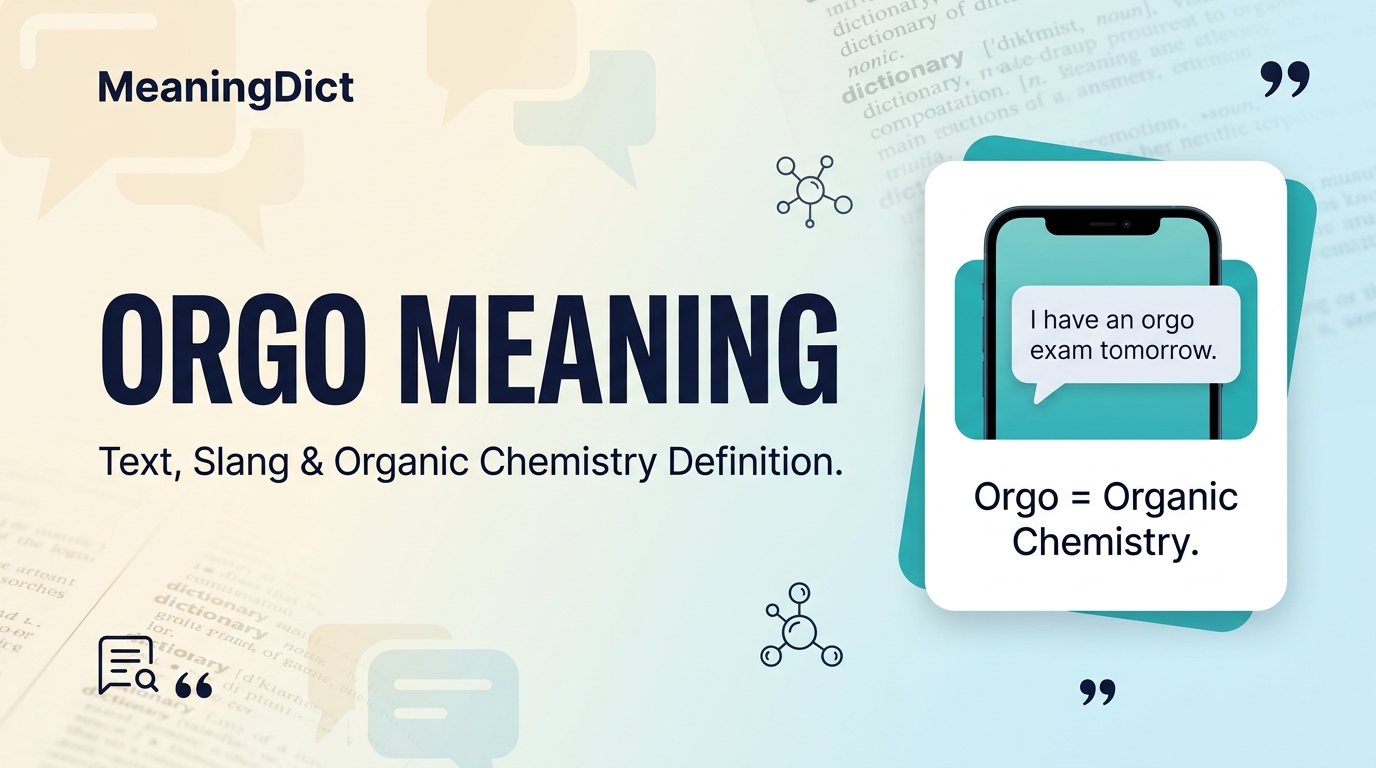
Orgo Meaning: What Does Orgo Mean in Text, Slang, and College?
Orgo means “organic chemistry.” It is an informal nickname used mainly by college and university students when discussing organic chemistry classes, laboratory work, assignments, study sessions, or exams.
For example, when a student says, “I have orgo tomorrow,” they usually mean they have an organic chemistry class, test, or laboratory session.
The term is especially common among chemistry students, pre-med students, biology majors, pharmacy students, and others taking science-related courses. It may also appear as Orgo 1, Orgo 2, orgo lab, or orgo exam.
| Term | Simple Meaning |
|---|---|
| Orgo | Organic chemistry |
| Orgo 1 | First organic chemistry course |
| Orgo 2 | Second organic chemistry course |
| Orgo lab | Organic chemistry laboratory |
| Ochem or O-chem | Another nickname for organic chemistry |
Orgo is not normally a secret texting code, offensive slang, or romantic expression. It is primarily student and university slang. However, context matters because Orgo may also appear as a company name, username, surname, product name, or stock symbol.
MeaningDict explains words through their real context. In most conversations involving college, science, chemical reactions, professors, laboratories, or exams, orgo almost certainly means organic chemistry.
What Does Orgo Mean?
Orgo means organic chemistry. It is an informal nickname used mainly by college and university students when they talk about the subject, a class, a laboratory course, homework, or an exam. For example, “I have orgo at ten” means “I have organic chemistry class at ten.” The term usually appears in casual speech, student messages, campus forums, study groups, and social media posts.
Organic chemistry is the branch of chemistry that studies the structure, properties, reactions, and preparation of many carbon-containing compounds. Universities may teach it as Organic Chemistry I and Organic Chemistry II, often with separate laboratory courses. Princeton learning materials directly use “Organic Chemistry (Orgo),” showing that the nickname is recognized in real academic settings. lest definition is: Orgo is student slang for organic chemistry.
It does not normally describe a mood, action, or hidden internet code. Context still matters because Orgo can also be a company name, surname, username, or stock ticker. However, in conversations about classes, science, pre-med study, exams, reactions, or labs, organic chemistry is almost always the intended meaning.
What Does Orgo Mean in Text?
In a text message, orgo usually means organic chemistry. Students use it to save time when discussing schedules, assignments, quizzes, laboratory reports, tutoring, or exam preparation. A message such as “Can you send the orgo notes?” asks for organic chemistry notes. “I’m stuck in orgo lab” means the sender is still working in an organic chemistry laboratory session.
The word is especially common when both people already understand the academic context. It may appear in lowercase as “orgo,” capitalized as “Orgo,” or combined with a course level, such as “Orgo 1” and “Orgo 2.” These forms do not change the basic meaning. Capitalization is mostly a personal or campus style choice.
To understand orgo in a message, look for nearby words such as:
- Class
- Chemistry
- Lab
- Reaction
- Professor
- Midterm
- Final
- Notes
- Mechanism
- Synthesis
- Pre-med
These clues strongly point to organic chemistry.
When the message discusses software, a brand, an investment, or a person named Orgo, the meaning may be different. MeaningDict recommends reading the complete sentence rather than interpreting the word alone.
What Does Orgo Mean in Slang?
As slang, orgo is a shortened, casual name for organic chemistry. It belongs mainly to student and campus vocabulary rather than formal scientific language. Learners often create brief labels for difficult or frequently discussed subjects, such as “gen chem” for general chemistry, “p-chem” for physical chemistry, and “orgo” or “ochem” for organic chemistry.
These shorter names make everyday conversations faster and more natural.
Calling organic chemistry “orgo” can refer to the academic subject, a particular course, the laboratory, or the workload connected with it. “Orgo is difficult this semester” may mean the course feels difficult. “We have orgo tomorrow” may refer to a lecture, lab, quiz, or exam, depending on the conversation.
Although orgo is slang, it is not usually rude, offensive, or inappropriate. It is simply informal. University pages from Princeton, Vanderbilt, William & Mary, Rutgers, and UCLA use or explain the term, showing that it is understood in educational settings. l essays, applications, transcripts, résumés, and professional emails, use the full term organic chemistry.
Orgo Meaning in English
In English, orgo is an informal noun meaning organic chemistry. It is commonly pronounced “OR-go,” with the stress placed on the first syllable. The word functions like the name of a school subject.
A student may say:
- “Orgo starts next week.”
- “I need help with orgo.”
- “She tutors orgo.”
- “My orgo exam is on Monday.”
In each example, the speaker is referring to organic chemistry.
The full term organic chemistry describes a scientific field focused mainly on carbon-containing compounds, their structures, properties, preparation, and reactions. Major course topics may include chemical bonding, functional groups, stereochemistry, reaction mechanisms, spectroscopy, synthesis, and the behavior of organic molecules. name orgo does not change the scientific meaning. It simply makes the longer term shorter and more conversational.
Orgo is not generally treated as a standard formal word in edited English. It is better understood as university slang or an informal abbreviation. Therefore, the clearest English definition is:
Orgo: an informal nickname for organic chemistry, especially in college and student conversations.
Orgo Meaning in Texting
The meaning of orgo in texting is usually organic chemistry class or simply organic chemistry. It is used as a quick abbreviation between classmates, friends, tutors, and students planning their daily schedules.
The exact reference depends on the rest of the message. “Orgo at 9” points to a class time, while “Finished orgo?” could ask whether someone completed homework, a laboratory report, a quiz, or an exam.
Common texting examples include:
- “Do we have an orgo quiz today?”
- “I’ll call you after orgo lab.”
- “Can you explain this orgo mechanism?”
- “We’re studying for the orgo final tonight.”
- “Orgo 2 is taking all my time.”
- “Send me the orgo notes when you can.”
The term is useful because it replaces a longer subject name without losing meaning among people who know the context. It may also appear as “ochem,” “O-chem,” “organic,” or “org chem.” These alternatives normally refer to the same subject. UCLA’s chemistry glossary, for example, lists O-chem, ochem, and orgo as names used for organic chemistry. s not have a widely accepted romantic, insulting, or secret meaning in texting.
Orgo Slang Meaning and Examples
The slang meaning of orgo is organic chemistry, especially the college course. Students use it as a noun in the same way they use the full subject name. It can describe a lecture, laboratory, homework set, exam, study session, or the overall learning experience.
The meaning becomes clear from the words around it.
Examples of orgo slang include:
- “My orgo professor explains reaction mechanisms clearly.”
- “We formed a study group for orgo.”
- “I passed Orgo 1 and will take Orgo 2 next term.”
- “The orgo lab report is due Friday.”
- “She wants to review spectroscopy before the orgo final.”
- “I cannot meet tonight because I’m studying orgo.”
- “This orgo chapter is easier than the last one.”
- “Are you taking orgo during the summer?”
In every sentence, replacing orgo with organic chemistry keeps the meaning correct. This replacement test is a simple way to confirm the definition.
The slang can also carry an emotional tone. “Orgo is destroying me” is normally humorous exaggeration about a demanding course, while “I love orgo” expresses interest in the subject.
The word itself is neutral. The surrounding sentence creates the positive, negative, serious, or playful tone.
What Does Orgo Stand For?
Orgo stands for organic chemistry in most academic and student conversations. Strictly speaking, it is better described as an informal shortening or nickname than a formal acronym.
An acronym is normally created from the initial letters of several words and pronounced as one word. Orgo, however, comes mainly from the beginning of the word “organic” and has been shaped into an easy-to-say campus term. It does not represent four separate words beginning with O, R, G, and O.
The abbreviation may refer to the entire scientific field or to a specific course.
For example:
- Orgo I: The first course in an organic chemistry sequence
- Orgo II: The second course in the sequence
- Orgo lab: The practical laboratory component
- Orgo final: The final organic chemistry examination
- Orgo notes: Notes from an organic chemistry class
Outside education, ORGO may stand for something else because companies, products, usernames, and stock symbols can use the same letters. ORGO is also used as the market ticker for Organogenesis Holdings. conversation mentions students, chemistry, reactions, or exams, organic chemistry is the most likely meaning.
Is Orgo Short for Organic Chemistry?
Yes, orgo is short for organic chemistry. It is widely used by college students, especially those studying chemistry, biology, medicine, pharmacy, dentistry, food science, or other programs that include organic chemistry.
University materials from Princeton explicitly pair “Organic Chemistry” with “Orgo,” while UCLA’s organic chemistry glossary includes orgo among common informal names for the subject.
The nickname can describe both the subject and the course.
A student who says, “I’m taking orgo,” is enrolled in organic chemistry. Someone who says, “This is an orgo reaction,” is informally describing a reaction studied in organic chemistry. The second use is understandable, although “organic reaction” or “organic chemistry reaction” is more suitable in formal writing.
Because orgo is informal, it works best in casual conversations, texts, study groups, campus posts, and student-focused content.
In academic writing, introduce the full phrase first:
“Organic chemistry, often called orgo by college students, examines the structure and reactions of carbon-containing compounds.”
This approach makes the meaning clear for readers who have never encountered the nickname.
Why Is Organic Chemistry Called Orgo?
Organic chemistry is called orgo because students shortened the word “organic” into a quick and memorable nickname. The beginning “org-” clearly points to “organic,” while the final “-o” gives the term an informal sound that is easy to pronounce.
There is no well-documented single person, date, or university that can be reliably credited with inventing the word. The most reasonable explanation is that it developed naturally through student conversations and campus culture.
Students frequently discuss organic chemistry lectures, laboratory work, reaction mechanisms, problem sets, tutoring sessions, and exams. Using a shorter name makes those conversations easier.
Over time, orgo became familiar enough to appear in university guides, course resources, student publications, and campus traditions. Princeton materials regularly use Orgo for organic chemistry. Columbia also has a long-running campus reference called “Orgo Night,” associated with the night before an organic chemistry exam. does not describe a separate scientific field. Orgo and organic chemistry are the same subject.
Some students prefer ochem because it combines “O” with “chem,” while others find orgo smoother and easier to say.
Orgo vs Ochem Meaning
Orgo and ochem have the same basic meaning: organic chemistry.
“Orgo” is formed mainly from the beginning of the word organic, while “ochem” or “O-chem” combines the first letter of organic with a shortened form of chemistry. Neither term normally describes a different course, topic, difficulty level, or scientific field.
A student taking Orgo I at one university may be taking the same type of course another university informally calls Ochem I.
| Word | Meaning | Usage |
|---|---|---|
| Orgo | Organic chemistry | Informal college slang |
| Ochem | Organic chemistry | Informal student abbreviation |
| O-chem | Organic chemistry | Hyphenated variation |
| Org chem | Organic chemistry | Short written form |
| Organic chemistry | Complete name | Formal and professional use |
The main difference is personal, regional, or campus preference. Some universities, friend groups, and instructors favor orgo. Others use ochem, O-chem, organic, or org chem. UCLA recognizes several of these informal variations, while UC San Diego student content uses “Ochem.” ic-facing content, use “organic chemistry” first and then explain that orgo and ochem are informal alternatives.
What Does Orgo Mean in College?
In college, orgo means an organic chemistry course, usually taught as part of a one-semester or two-semester sequence. Students may use the word for the lecture, the laboratory, the subject, the exam, or the complete course experience.
“I’m taking orgo next year” means the student plans to enroll in organic chemistry.
“My orgo lab is four hours” refers to the practical laboratory course.
College organic chemistry commonly covers the structure and reactivity of organic molecules. Depending on the institution, students may study:
- Chemical bonding
- Acids and bases
- Functional groups
- Stereochemistry
- Reaction mechanisms
- Substitution and elimination
- Spectroscopy
- Organic synthesis
- Carbonyl chemistry
- Organic laboratory techniques
Organic Chemistry II often continues with additional reaction families, carbonyl reactions, biological molecules, and multistep synthesis. Course titles and exact content vary by university. Yale and Columbia course descriptions, for example, include structure, mechanisms, synthesis, spectroscopy, and the reactions of organic molecules. is especially familiar among pre-med students, but chemistry majors, biology students, engineers, food science students, and other learners may also take orgo.
What Does Orgo Mean on Social Media?
On social media, orgo normally refers to organic chemistry content or the experience of taking an organic chemistry course. Students may use the term in posts, captions, comments, videos, hashtags, memes, tutorials, and study updates.
A post saying, “Survived my orgo final,” means the person completed an organic chemistry examination. A video titled “Orgo study tips” will probably explain how to understand reactions, mechanisms, structures, or course material.
Common social media uses include:
- Course update: “First day of Orgo 2.”
- Study content: “Here is my orgo reaction map.”
- Student humor: “Orgo has taken over my life.”
- Advice: “How I earned an A in orgo.”
- Study motivation: “One more chapter before the orgo exam.”
- Hashtags: #orgo, #organicchemistry, #ochem and #premed
The word may be capitalized or written in lowercase. Both forms usually have the same meaning.
However, social platforms also contain companies, software products, apps, and accounts named Orgo. Look at the profile, hashtags, images, and surrounding words.
Mentions of molecules, mechanisms, labs, exams, chemistry, or pre-med life point toward organic chemistry. Brand logos, pricing, software features, or investment discussions suggest another meaning.
See Also: HAGD Meaning in Text: Full Meaning, Uses & Examples
How to Use Orgo in a Sentence
Use orgo as an informal noun when you mean organic chemistry. It can replace the full subject name in casual speech, messages, campus writing, study discussions, or social media posts.
The most natural phrases include:
- Take orgo
- Study orgo
- Orgo class
- Orgo lab
- Orgo test
- Orgo final
- Orgo professor
- Orgo homework
- Orgo study group
- Orgo reaction
Sentence examples include:
- “I am taking orgo this semester.”
- “Our orgo exam covers substitution reactions.”
- “Maya stayed late to finish her orgo lab.”
- “Can you share your Orgo 1 notes?”
- “The tutoring center offers orgo review sessions.”
- “He enjoys orgo more than general chemistry.”
- “We are meeting at the library to study for orgo.”
- “That channel posts helpful orgo tutorials.”
- “My orgo professor gave us extra practice problems.”
- “I plan to take Orgo 2 next spring.”
Use the full term in formal contexts. For example, write, “I completed two semesters of organic chemistry” on a résumé, application, official biography, or academic report.
In a public article, first explain that orgo is student slang for organic chemistry. After that, the shortened form can be used naturally.
Where Did the Word Orgo Come From?
The word orgo came from informal student language surrounding organic chemistry. It is a clipped form based on the word “organic,” adjusted into a short, two-syllable nickname.
The exact first use is difficult to prove. Reliable historical sources do not identify one inventor, year, professor, or campus where the expression began. Claims that a specific university created orgo should therefore be treated cautiously unless supported by historical evidence.
What can be confirmed is that orgo has been used across American university culture for many years.
Princeton student and academic resources use it as a familiar name for organic chemistry. William & Mary has described organic chemistry as “orgo” in campus news. Rutgers uses “Orgo I” in curriculum information, and UCLA lists orgo as an alternative name in its chemistry glossary. lopment follows a common language pattern: frequently repeated terms become shorter in group conversations.
Students needed an easy way to refer to a demanding and often-discussed course. The nickname then spread through classmates, instructors, tutoring sessions, campus media, online communities, and social platforms.
Is Orgo a Slang Word or Abbreviation?
Orgo can be described as both a slang word and an informal abbreviation. However, informal nickname or shortened form is the most precise description.
It is slang because it belongs mainly to casual student speech and may not be understood by every English speaker. It is an abbreviation because it shortens the longer term organic chemistry.
However, it is not a standard initialism such as GPA, USA, or DNA. It is also not normally an official university course code.
The best description depends on the context:
- In “I have orgo after lunch,” it functions as college slang.
- In a student glossary, it may be called an informal abbreviation.
- In a dictionary article, it may be described as university slang.
- In academic writing, it should normally be replaced with “organic chemistry.”
Use orgo in casual texts, study groups, student posts, and informal discussions. Define it at first use when writing for a wider audience.
MeaningDict defines terms according to how people actually use them. For most readers, the clearest answer is:
Orgo is an informal student abbreviation and slang nickname for organic chemistry.
Frequently Asked Questions About Orgo
Does Orgo Always Mean Organic Chemistry?
Orgo usually means organic chemistry when it appears in student, university, science, chemistry, or pre-med conversations. However, it does not always carry that meaning. Orgo can also be a company name, surname, username, software brand, organization name, or stock ticker.
Check the surrounding words. Mentions of exams, classes, reactions, molecules, professors, laboratories, and study notes strongly suggest organic chemistry.
Is Orgo a Bad or Offensive Word?
No. Orgo is not generally considered a bad, insulting, vulgar, or offensive word. It is neutral student slang for organic chemistry.
The emotional meaning comes from the sentence. “I hate orgo” expresses frustration with the course, while “I love orgo” expresses enjoyment. The word itself remains neutral in both examples.
Is Orgo Used in High School?
Orgo may be used in high school, especially in advanced science classes, college-preparation programs, or conversations about future university courses. However, the term is more strongly connected with colleges and universities because organic chemistry is commonly taught at that level.
A high school student discussing college science requirements may still say, “I will take orgo next year.”
Is Orgo the Same as General Chemistry?
No. Orgo refers to organic chemistry, while general chemistry is often shortened to gen chem.
General chemistry introduces broad topics such as atomic structure, chemical bonding, gases, equilibrium, thermodynamics, and acids and bases. Organic chemistry focuses more deeply on carbon-containing molecules, functional groups, structures, mechanisms, reactions, and synthesis.
The courses are related but not identical.
Is Orgo the Same as Biochemistry?
No. Orgo and biochemistry are separate but connected subjects.
Orgo means organic chemistry, which examines carbon-containing compounds and their reactions. Biochemistry studies the chemical processes and molecules found in living organisms, including proteins, carbohydrates, lipids, enzymes, and nucleic acids.
Organic chemistry often provides useful background for understanding biochemistry.
Should Orgo Be Capitalized?
Orgo may be written as orgo or Orgo. There is no strict capitalization rule because it is an informal nickname.
Lowercase is common when referring generally to the subject: “I’m studying orgo.”
Capitalization may appear when students treat it like a course title: “I’m taking Orgo II.” Both forms are normally understood.
What Does Orgo 1 Mean?
Orgo 1 means the first course in an organic chemistry sequence. It may also be written as Organic Chemistry I, Ochem 1, O-Chem I, or Org Chem 1.
The course commonly introduces bonding, molecular structure, acids and bases, stereochemistry, functional groups, reaction mechanisms, substitution, elimination, and introductory spectroscopy. Exact course content varies by institution.
What Does Orgo 2 Mean?
Orgo 2 means the second course in an organic chemistry sequence. It normally follows Orgo 1 and continues with additional reactions, synthesis methods, spectroscopy, aromatic compounds, carbonyl chemistry, carboxylic acid derivatives, amines, and biological molecules.
The exact syllabus depends on the university, instructor, and degree program.
What Does “I Have Orgo” Mean?
“I have orgo” means the speaker has an organic chemistry class, laboratory, quiz, examination, tutoring session, or related academic activity.
The exact event depends on the conversation. “I have orgo at 2 p.m.” probably refers to a scheduled class or lab. “I have orgo tomorrow” may refer to a lecture or exam.
What Does “Studying Orgo” Mean?
“Studying orgo” means studying organic chemistry. The student may be reviewing molecular structures, functional groups, reactions, mechanisms, spectroscopy, synthesis, or laboratory concepts.
For example, “I cannot go out tonight because I’m studying orgo” means the person is preparing for organic chemistry coursework or an upcoming assessment.
Can Orgo Mean Organic Food?
In rare informal situations, someone might use “orgo” as a playful shortening of “organic,” including organic food or farming. However, this meaning is much less common than organic chemistry.
When orgo appears in college, chemistry, science, pre-med, laboratory, or exam-related content, organic chemistry is the safer interpretation.
Which Is Correct: Orgo or Ochem?
Both orgo and ochem are correct informal names for organic chemistry. Neither is the official scientific term.
The preferred version depends on the speaker, school, region, or social group. Use “organic chemistry” in formal writing. In casual student conversations, either orgo or ochem is acceptable when the audience understands the meaning.
What Is the Full Form of Orgo?
The full form of orgo is organic chemistry.
It is not a formal four-letter acronym, so each letter does not represent a separate word. Instead, orgo is an informal nickname formed mainly from “organic.” It is used for the subject, course, laboratory, homework, or exam.
Is Orgo an English Word?
Orgo is an informal English slang term rather than a common formal dictionary word. It is mainly found in American college and university speech.
Because it belongs to a specific academic community, people outside universities or science programs may not recognize it immediately. Writers should define it when addressing a general audience.
What Is the Simplest Orgo Definition?
The simplest definition is:
Orgo means organic chemistry.
It is an informal abbreviation and student slang term used when discussing organic chemistry courses, labs, homework, study sessions, or exams.
Final Meaning of Orgo
Orgo is an informal nickname for organic chemistry. It is used most often by college students when discussing classes, laboratory sessions, assignments, reaction mechanisms, study groups, and exams.
Orgo, ochem, O-chem, and org chem generally refer to the same subject. The difference is mainly personal or campus preference.
Use orgo in casual student conversations. Use organic chemistry in formal academic, scientific, professional, or application-related writing.
For simple explanations of slang, abbreviations, texting terms, and modern English expressions, MeaningDict provides context-based definitions that help readers understand not only what a word means but also how it is used.






4 Comments