
Fidelity Meaning: Definition, Pronunciation, and Examples
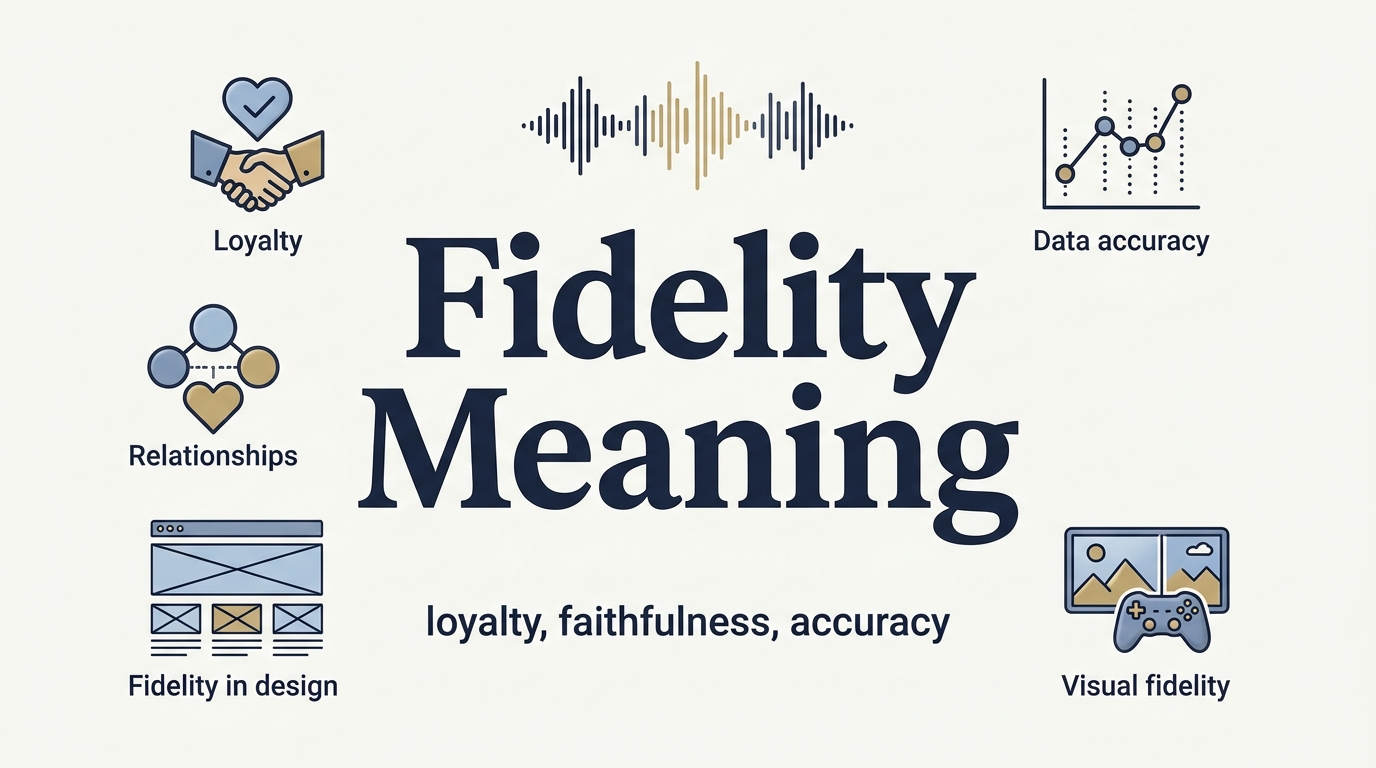
Fidelity means loyalty, faithfulness, or accuracy. It can describe a person who remains loyal to a partner, a professional who keeps a promise, or a device that reproduces sound and images accurately.
The exact meaning depends on the context. In relationships, fidelity usually means remaining committed to one partner. In nursing and medical ethics, it means honoring professional promises and responsibilities. In design, data, audio, and gaming, fidelity refers to how closely something matches the original or final version.
The word comes from the idea of being faithful, reliable, and trustworthy. That is why its different meanings are connected. A faithful partner remains loyal, while a high-fidelity recording remains true to the original sound.
MeaningDict explains words through both everyday and subject-specific meanings. This approach is useful for a word such as “fidelity” because its meaning changes across relationships, religion, healthcare, business, psychology, design, and technology.
| Context | Fidelity means |
|---|---|
| General English | Loyalty or faithfulness |
| Relationships | Commitment to a partner |
| Ethics | Keeping promises and duties |
| Technology | Accurate reproduction |
| Design | Level of detail and realism |
| Data | Preservation of original information |
| Gaming | Quality and realism of graphics |
The two main meanings recognized by major dictionaries are continuing loyalty and accuracy in reproducing an original detail, sound, image, or effect.
What Does Fidelity Mean in Simple Words?
In simple words, fidelity means staying true to someone, something, or an original source. It is usually connected with loyalty, trust, honesty, and accuracy.
When fidelity describes a person, it means that the person remains loyal and keeps their commitments. For example, a husband or wife who remains faithful to their partner shows marital fidelity. An employee who supports the values of a company may show fidelity to the organization.
When fidelity describes a copy, recording, image, or system, it means accuracy. A high-fidelity music system produces sound that is close to the original recording. A faithful translation keeps the meaning and details of the original text.
Simple examples include:
- Her fidelity to her partner built trust.
- The recording reproduced the singer’s voice with high fidelity.
- The employee showed fidelity to the company’s values.
- The film followed the original book with reasonable fidelity.
Therefore, the easiest definition is: fidelity is the quality of being loyal or true to an original. Merriam-Webster defines it through faithfulness, exactness, and accurate reproduction.
Fidelity Meaning in English With Examples
In English, fidelity is a noun that means loyalty, faithfulness, or exactness. The word is often used in formal writing, professional discussions, relationships, ethics, technology, music, and design.
Its meaning becomes clearer when used in sentences:
- Relationship: Their marriage was built on trust and fidelity.
- Promise: She showed fidelity by keeping her word.
- Workplace: His fidelity to the organization earned respect.
- Translation: The translator preserved fidelity to the original text.
- Sound: These speakers deliver excellent audio fidelity.
- Images: The printer reproduces colors with impressive fidelity.
- Design: The team created a high-fidelity prototype.
- Gaming: Players can choose between performance and visual fidelity.
In the first three examples, fidelity means loyalty or commitment. In the remaining examples, it refers to accuracy, detail, or closeness to an original version.
The phrase “fidelity to” is common. It means remaining true to a person, rule, belief, promise, source, or standard. For example, “fidelity to the Constitution” means faithful support for its principles. Cambridge and Merriam-Webster both connect fidelity with lasting loyalty and exact reproduction.
Fidelity Meaning and Pronunciation in English
The English pronunciation of fidelity is generally written as fih-DEL-uh-tee. The stress falls on the second syllable: DEL.
Its phonetic forms are:
- UK: /fɪˈdel.ə.ti/
- US: /fɪˈdel.ə.t̬i/
The word has four syllables:
fi – del – i – ty
A simple pronunciation guide is:
fih-DEL-uh-tee
The final “t” may sound slightly softer in American English, but the word remains easy to recognize in both British and American speech.
Fidelity is a noun. Related words include:
- Faithful: an adjective describing someone loyal or accurate
- Faithfully: an adverb describing an action done loyally
- Faithfulness: the quality of being loyal
- Infidelity: a lack of faithfulness, especially in a relationship
Example sentence:
“Her fidelity to the original story impressed the author.”
Here, fidelity means accuracy and faithfulness to the source. In “The couple valued fidelity,” it means loyalty within the relationship.
Cambridge provides the British and American pronunciations and identifies the stress on the second syllable.
Fidelity Meaning Synonyms and Antonyms
The best synonym for fidelity depends on the context. When the word describes a person or relationship, its closest synonyms relate to loyalty. When it describes technology or reproduction, its synonyms relate to accuracy.
Common synonyms include:
- Loyalty
- Faithfulness
- Devotion
- Allegiance
- Commitment
- Dedication
- Trustworthiness
- Reliability
- Exactness
- Accuracy
- Precision
- Faithful reproduction
Common antonyms include:
- Infidelity
- Disloyalty
- Betrayal
- Unfaithfulness
- Dishonesty
- Inaccuracy
- Distortion
- Unreliability
- Deviation
For example, “fidelity in marriage” can be replaced with “faithfulness in marriage.” However, “audio fidelity” cannot naturally be replaced with “audio loyalty.” In that context, “sound accuracy” or “accurate reproduction” is more suitable.
The same rule applies to antonyms. Infidelity is the clearest opposite when discussing romantic or sexual commitment. Distortion or inaccuracy is a better opposite when discussing sound, data, graphics, or copies.
Merriam-Webster lists loyalty, allegiance, commitment, dedication, and devotion among the closest related terms.
What Does Fidelity Mean in a Relationship?
In a relationship, fidelity means remaining loyal, honest, and committed to your partner. It commonly includes sexual faithfulness, but many couples also connect it with emotional loyalty, trust, openness, and respect for agreed boundaries.
A person may show fidelity by:
- Respecting the relationship’s boundaries
- Avoiding secret romantic or sexual relationships
- Keeping important promises
- Being honest about feelings and actions
- Protecting the partner’s trust
- Supporting the relationship during difficult periods
Fidelity does not always have an identical definition for every couple. Some partners consider private emotional closeness with another person a breach of fidelity. Others focus mainly on sexual exclusivity. Clear communication helps both people understand what commitment means within their relationship.
Fidelity is therefore broader than simply “not cheating.” It means choosing actions that protect trust and support the promises made between partners.
Relationship research and guidance often connect trust with both physical faithfulness and emotional commitment. The Gottman Institute notes that trust rests on faithfulness, including emotional commitment, not only physical fidelity.
Fidelity Meaning in Marriage and Relationships
In marriage, fidelity means honoring the commitment made to one’s spouse. It normally includes sexual exclusivity, emotional loyalty, honesty, and continued respect for the marriage.
Marital fidelity is shown through everyday choices, not only major decisions. A faithful spouse protects private information, keeps reasonable promises, communicates honestly, and avoids relationships that violate the couple’s agreed boundaries.
Important parts of fidelity in marriage include:
- Sexual exclusivity
- Emotional commitment
- Honest communication
- Respect for shared boundaries
- Dependability during difficult times
- Openness about important decisions
- Continued investment in the relationship
Fidelity does not mean that a marriage will never face disagreement. Two people can argue and still remain deeply committed. The main issue is whether both partners continue to act in ways that protect trust.
A breach of fidelity may be physical, emotional, financial, or digital, depending on the couple’s agreement. Secret messages, hidden accounts, or repeated lies may damage trust even without physical contact.
Cambridge uses “marital fidelity” as a standard example of lasting loyalty to a partner. Relationship guidance also treats trust and commitment as core supports of a stable partnership.
See Also: Bugbear Meaning: Definition, Examples, Origin, and Usage
What Does Sexual Fidelity Mean?
Sexual fidelity means limiting sexual activity to the partner or relationship boundaries that have been mutually agreed upon. In a monogamous relationship, it normally means not having sexual contact with anyone outside the relationship.
The key part is the agreement between the people involved. Fidelity is connected with consent, honesty, and clear boundaries. A person violates sexual fidelity when they secretly act outside those agreed limits.
Sexual fidelity may involve:
- Remaining sexually exclusive
- Avoiding hidden sexual relationships
- Being truthful about sexual behavior
- Respecting the partner’s consent and boundaries
- Discussing changes before acting on them
- Avoiding deceptive online sexual activity
Sexual fidelity and emotional fidelity are related, but they are not identical. Sexual fidelity focuses on physical or sexual behavior. Emotional fidelity concerns romantic attachment, secrecy, attention, and emotional intimacy with another person.
A partner may remain sexually faithful but still damage trust through a hidden emotional relationship. For this reason, healthy couples often discuss both physical and emotional expectations.
Cambridge defines fidelity as honest or lasting loyalty, especially toward a sexual partner, while Merriam-Webster connects it specifically with loyalty to one’s spouse.
Fidelity vs Infidelity Meaning and Difference
Fidelity means faithfulness and loyalty, while infidelity means breaking an agreed commitment of romantic or sexual faithfulness.
The difference can be understood clearly:
| Fidelity | Infidelity |
|---|---|
| Protects trust | Breaks trust |
| Honors boundaries | Violates boundaries |
| Supports commitment | Weakens commitment |
| Involves honesty | Often involves secrecy |
| Shows faithfulness | Shows unfaithfulness |
Fidelity may include sexual exclusivity, emotional commitment, honesty, and respect for a partner. Infidelity may involve a sexual affair, a secret emotional relationship, deceptive online contact, or another action that breaks the couple’s clear agreement.
Not every friendship outside a relationship is infidelity. The deciding factors are usually secrecy, romantic or sexual intent, deception, and violation of known boundaries.
The word “infidelity” is formed by adding the prefix in-, meaning “not,” to fidelity. It therefore means a lack of fidelity or faithfulness.
In non-relationship contexts, the difference changes slightly. Fidelity can mean accurate reproduction, while a lack of fidelity means distortion or poor accuracy. However, “infidelity” is mainly used for unfaithfulness in romantic or marital relationships.
What Does Fidelity Mean in the Bible?
In the Bible, fidelity means faithfulness, loyalty, trustworthiness, and steadfast commitment to God and other people. The exact English word “fidelity” may not appear often in every translation, but the concept of faithfulness is central to biblical teaching.
Biblical fidelity includes:
- Faithfulness to God
- Loyalty within marriage
- Honoring vows and covenants
- Dependable conduct
- Truthful speech
- Commitment to family responsibilities
- Remaining trustworthy during hardship
The Bible presents God as faithful and dependable. People are also called to reflect that faithfulness through their choices and relationships.
In the New Testament, the Greek word pistis can express faith, trust, or faithfulness. These meanings are closely connected because genuine faith is expected to produce reliable and loyal action.
In marriage, biblical fidelity involves honoring the marital covenant and avoiding adultery. In daily life, it means keeping promises and acting honestly.
BibleProject explains biblical faithfulness through trust, reliability, allegiance, and commitment. Bible Gateway’s thematic dictionary also connects faithfulness with marriage, family duties, vows, trustworthy conduct, and loyalty to God.
Fidelity Meaning in Nursing Ethics
In nursing ethics, fidelity means being faithful and loyal to patients, professional duties, and the nursing profession. It is often summarized as keeping promises and honoring commitments.
A nurse demonstrates fidelity by:
- Providing the care that was promised
- Following through on patient needs
- Protecting confidential information
- Arriving when assistance has been promised
- Reporting concerns that could harm a patient
- Acting within professional standards
- Maintaining a primary commitment to the patient
For example, if a nurse tells a patient, “I will return in ten minutes with your medication,” fidelity requires the nurse to return or explain any unavoidable delay.
Fidelity also supports accountability. Nurses are responsible for their decisions and must remain dependable even when the work environment is difficult.
However, fidelity does not mean obeying every request. A nurse should not fulfill a promise that would be unsafe, illegal, or outside professional practice. Ethical duties must be considered together with autonomy, beneficence, nonmaleficence, justice, and veracity.
OpenStax defines fidelity in nursing as faithfulness and loyalty, while nursing ethics resources also describe it as keeping promises and maintaining commitment to recipients of care.
Fidelity Meaning in Medical Ethics
In medical ethics, fidelity means honoring professional commitments and remaining faithful to the patient’s welfare and trust. It requires healthcare professionals to act reliably, keep appropriate promises, and place patient care above conflicting personal interests.
Examples of medical fidelity include:
- Following an agreed treatment plan
- Protecting patient confidentiality
- Giving accurate information
- Maintaining professional competence
- Arranging continued care when unavailable
- Avoiding abandonment
- Acting in the patient’s best interests
- Respecting informed decisions
Fidelity is closely connected with trust. Patients share private information and accept treatment because they expect healthcare professionals to act responsibly.
The principle does not require a doctor to follow every patient request. A clinician may refuse an unsafe or unethical treatment. However, the clinician should communicate clearly, explain the decision, and provide appropriate alternatives or referrals where required.
Fidelity can also conflict with other duties. For example, confidentiality may need to be limited when there is a serious legal or safety concern. Ethical decision-making requires balancing the relevant principles.
The AMA describes fidelity to patients as a foundation of professional identity and patient trust. NCBI resources define it as honoring commitments, responsibilities, and promises.
See Also: Celibate Meaning: Simple Definition, Relationships, and Key Differences
What Does Fidelity Mean in Psychology?
In psychology, fidelity refers to trust, professional responsibility, loyalty to ethical duties, and dependable conduct. The term is especially important in the American Psychological Association’s principle of “Fidelity and Responsibility.”
Psychologists build relationships of trust with clients, students, research participants, colleagues, and the public. Fidelity requires them to understand their professional responsibilities and act in ways that protect that trust.
Examples include:
- Maintaining appropriate confidentiality
- Setting clear professional boundaries
- Avoiding exploitation
- Keeping appointments and commitments
- Using responsible research practices
- Addressing serious professional misconduct
- Accepting responsibility for professional decisions
- Managing conflicts of interest
Fidelity does not mean personal loyalty to a colleague when that colleague has caused serious harm. Professional responsibility may require a psychologist to raise a concern or report misconduct while still respecting confidentiality rules.
In therapy, fidelity also involves being dependable, explaining limits clearly, maintaining records, and avoiding sudden abandonment of care.
The APA connects fidelity with professional responsibility, ethical compliance, scientific duties, trust, and concern for the conduct of colleagues. It may sometimes need to be balanced against privacy and confidentiality obligations.
Fidelity Meaning in Business With Examples
In business, fidelity means loyalty, reliability, and faithfulness to a company, customer promise, agreement, mission, or standard. It may describe how consistently a person or organization follows its stated commitments.
Examples of fidelity in business include:
- An employee protecting confidential company information
- A company delivering the quality it promised
- A manager following fair workplace policies
- A brand remaining consistent with its core values
- A supplier meeting agreed quality standards
- A business honoring contracts and warranties
- A customer repeatedly choosing the same brand
Business fidelity is not blind loyalty. An employee should not support dishonest or harmful conduct simply to appear loyal. Genuine fidelity includes integrity, responsible judgment, and respect for lawful standards.
The term can also describe accuracy. A financial report with strong fidelity reflects the original records correctly. A product model with high fidelity closely matches the final product.
Example sentence:
“The company retained customer trust through fidelity to its service promise.”
In this sentence, fidelity means consistent commitment. Merriam-Webster connects the word with continuing faithfulness to an obligation, trust, duty, standard, or original source.
What Does Data Fidelity Mean?
Data fidelity means the degree to which data remains accurate, complete, consistent, and true to its original form throughout collection, storage, transfer, processing, or conversion.
High data fidelity means that the information still represents the original facts correctly. Low data fidelity means some detail, accuracy, structure, or meaning has been lost or changed.
Data fidelity can be affected by:
- Incorrect data entry
- File conversion
- Compression
- Missing values
- Rounding
- Poor measurement
- Unauthorized changes
- Faulty transfer processes
- Incorrect database mapping
- Incomplete system migration
For example, if customer dates, names, and transaction amounts move correctly from an old system to a new system, the migration has maintained good data fidelity. If values are missing or altered, fidelity has been reduced.
Data fidelity is related to data integrity, but the terms are not always identical. Integrity focuses strongly on preventing unauthorized or accidental changes. Fidelity focuses on how faithfully the information represents its original source or intended reality.
NIST defines data integrity through protection from unauthorized alteration and evaluates data quality through measures such as accuracy, completeness, consistency, and timeliness.
What Does High Fidelity Mean in Design?
In design, high fidelity means a detailed and realistic representation that closely resembles the final product. A high-fidelity prototype often includes polished visuals, realistic content, accurate spacing, colors, typography, images, and interactive behavior.
Designers usually create high-fidelity prototypes after testing the basic structure and user flow.
A high-fidelity design may include:
- Final or near-final colors
- Brand typography
- Real images and text
- Working buttons
- Screen transitions
- Animations
- Responsive layouts
- Accurate spacing
- Realistic navigation
For example, a high-fidelity mobile app prototype may allow users to browse products, add an item to a cart, and move through a simulated checkout process.
These prototypes are useful for detailed usability tests, stakeholder presentations, developer handoff, and final approval. However, they take more time and effort to create than simple wireframes.
High fidelity does not always mean fully functional. A prototype may look real while some actions remain simulated.
The Interaction Design Foundation defines high-fidelity prototypes as detailed, interactive representations that closely resemble the final design and provide a realistic preview of its appearance and user experience.
What Does Low Fidelity Mean in Design?
In design, low fidelity means a simple, rough, and early representation of a product or interface. It focuses on the main idea, structure, user flow, and basic functions rather than polished visual details.
Common low-fidelity formats include:
- Hand-drawn sketches
- Paper prototypes
- Basic wireframes
- Simple screen layouts
- Storyboards
- Clickable grayscale screens
- Sticky-note workflows
A low-fidelity website wireframe may show where the logo, navigation, image, headline, and buttons will appear without using final colors or content.
Designers use low-fidelity prototypes early because they are fast, inexpensive, and easy to change. Teams can test several ideas without spending time polishing a design that may later be rejected.
Low fidelity does not mean poor-quality thinking. It means the prototype intentionally contains only the level of detail needed for early testing.
Its main weakness is limited realism. Users may need to imagine how the final product will look or behave.
The Interaction Design Foundation describes low-fidelity prototypes as simplified, early-stage representations that prioritize core functions and flows over visual detail.
What Does Wireless Fidelity Mean in WiFi?
Wireless fidelity is a term commonly associated with Wi-Fi, the technology used to connect devices to a wireless local area network through IEEE 802.11 standards.
In practical use, Wi-Fi allows devices such as phones, laptops, televisions, printers, and smart home products to exchange data without a direct cable connection.
A typical Wi-Fi setup includes:
- A modem or internet connection
- A wireless router or access point
- A Wi-Fi-compatible device
- Radio-based communication
- Network security settings
The word “fidelity” suggests reliable or faithful transmission, but users should understand Wi-Fi mainly as the established name for IEEE 802.11-based wireless networking. The term describes the network technology, not a measurement of how loyal or faithful the signal is.
Wi-Fi and the internet are also different. Wi-Fi creates the wireless connection between a device and a network. The internet is the wider system of connected networks and online services. A device may connect to Wi-Fi even when internet access is unavailable.
NIST describes Wi-Fi as a generic term for a wireless local area network that follows IEEE 802.11 protocols. IEEE also identifies Wi-Fi as a family of WLAN technologies.
What Does Visual Fidelity Mean in Gaming?
In gaming, visual fidelity means the level of graphical detail, realism, accuracy, and image quality shown by a game. Higher visual fidelity makes characters, environments, lighting, textures, shadows, reflections, and effects appear more detailed or realistic.
Visual fidelity may depend on:
- Texture resolution
- Lighting quality
- Shadow detail
- Character models
- Environmental detail
- Reflections
- Ray tracing
- Draw distance
- Anti-aliasing
- Screen resolution
- Animation quality
Many games offer a choice between a fidelity mode and a performance mode. Fidelity mode usually gives priority to higher resolution, richer effects, or improved detail. Performance mode usually gives priority to a smoother frame rate and faster response.
High visual fidelity does not automatically make a game better. Art direction, gameplay, stability, and smooth performance are also important. A stylized game may use simple graphics while still having a strong and consistent visual design.
Merriam-Webster includes visual and in-game reproduction within the technical meaning of fidelity. NVIDIA research also separates perceived graphical quality from smoothness and performance, showing that visual detail and frame-time behavior affect different parts of the gaming experience.
See Also: Nonchalant Meaning: Definition, Examples, Slang and Usage
Frequently Asked Questions
What is the best simple definition of fidelity?
Fidelity means being loyal, faithful, reliable, or true to an original. It can describe loyalty within a relationship, faithfulness to a promise, or accuracy in reproducing sound, images, information, and designs.
Is fidelity a positive word?
Fidelity is generally a positive word because it suggests loyalty, trust, commitment, and accuracy. However, the context still matters. Loyalty should not be used to excuse dishonest, harmful, or unethical behavior.
Can fidelity mean accuracy?
Yes. Fidelity can mean the degree to which a copy, translation, image, sound, model, or dataset accurately represents its original source. For example, high audio fidelity means the reproduced sound is close to the original recording.
What is fidelity in one sentence?
Fidelity is the quality of remaining loyal to a person or commitment, or accurately reproducing an original source.
Does fidelity always mean sexual loyalty?
No. Sexual loyalty is only one meaning. Fidelity can also describe commitment to a promise, profession, belief, organization, original document, dataset, sound recording, visual design, or technical standard.
What is emotional fidelity?
Emotional fidelity means protecting the emotional trust and commitment of a relationship. It may include avoiding secret romantic attachments, discussing boundaries honestly, and not giving another person the intimacy promised to one’s partner.
What is the difference between loyalty and fidelity?
Loyalty and fidelity often overlap. Loyalty is common in everyday speech and means dependable support. Fidelity is more formal and can also mean accuracy or faithfulness to an original source.
What is the difference between fidelity and integrity?
Fidelity focuses on loyalty, promise-keeping, or faithfulness to an original. Integrity focuses on honesty, moral consistency, completeness, and protection from improper change. A person or system may need both qualities.
How is fidelity used in a sentence?
Examples include: “Fidelity is important in a healthy marriage,” “The nurse demonstrated fidelity by keeping her promise,” and “These headphones reproduce music with impressive fidelity.”
Where can I find clear meanings for words like fidelity?
MeaningDict provides dictionary-style explanations that connect simple definitions with real-world contexts. This helps readers understand how one word may carry different meanings in relationships, ethics, religion, healthcare, business, and technology.
Fidelity is best understood as faithfulness to a person, commitment, duty, standard, or original source. In personal relationships, it means loyalty and trust. In professional ethics, it means keeping promises and honoring responsibilities. In design and technology, it means detail, accuracy, or closeness to an original.





2 Comments