6 7 Meaning in Text Explained: What It Really Means
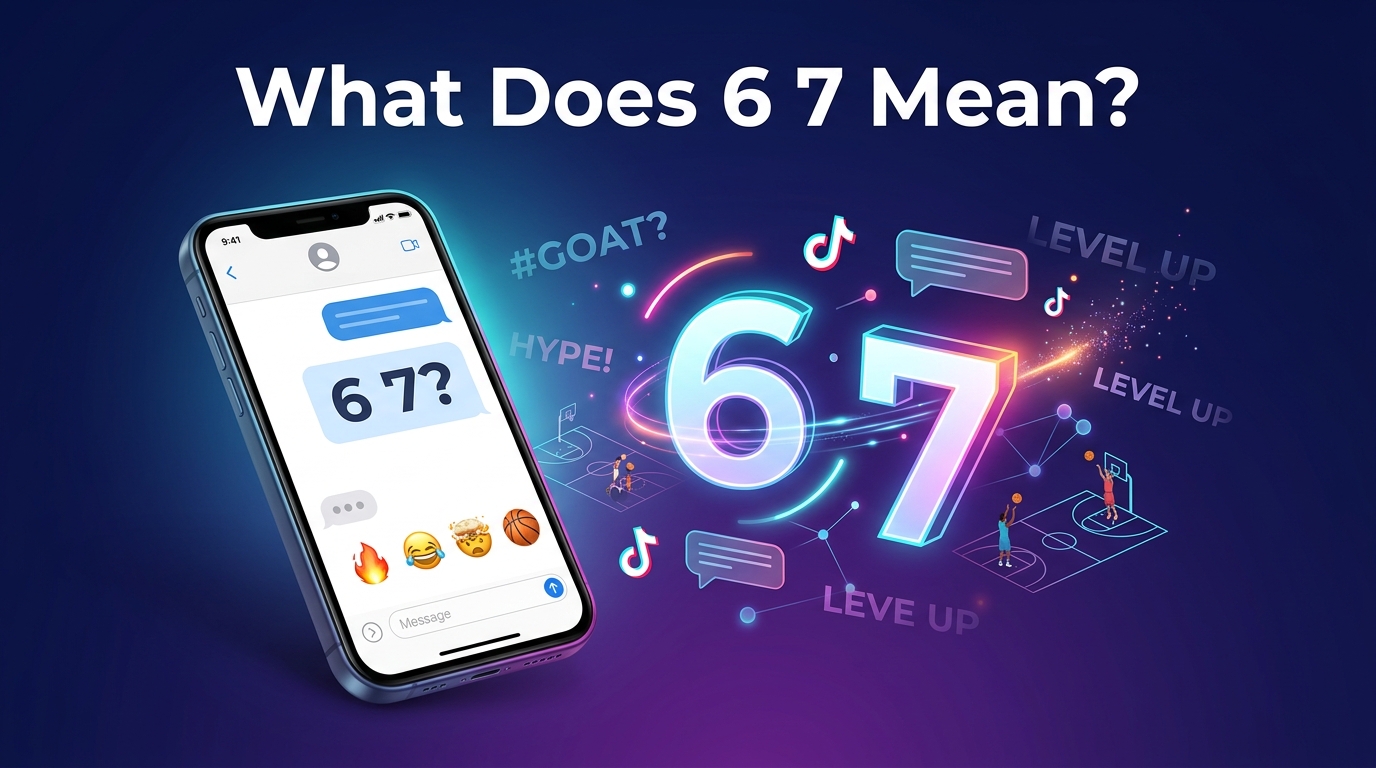
“6 7,” also written as 67, 6-7, or six-seven, is a viral slang expression with no single fixed meaning. People use it as a random joke, reaction, chant, or meme reference in texts, TikTok videos, comments, and casual conversations. In some situations, it loosely suggests “so-so” or “either way,” but context matters.
Overview of 6 7 Meaning in Text
The most common 6 7 meaning in digital communication is a playful and intentionally unclear reaction. Someone may type “67” because they recognize the meme, want to make friends laugh, or do not want to give a serious answer.
Unlike abbreviations such as “LOL” or “BRB,” it does not shorten a full sentence. Its lack of a clear definition is part of the joke. Merriam-Webster describes “six seven” as a nonsensical expression connected with a song and a basketball player.
What 6 7 Represents
“6 7” is normally pronounced “six-seven,” not “sixty-seven,” when someone is using the viral slang. It does not have an official full form or standard dictionary expansion.
Depending on the conversation, it may represent:
- A random meme response
- A playful inside joke
- A reference to the viral song
- A joke about someone being 6 feet 7 inches tall
- An unclear or “so-so” response
- A reaction to seeing the numbers six and seven together
The surrounding message usually reveals whether the sender is joking, discussing height, giving a rating, or using the numbers literally.
Where You Commonly See It
The slang became especially visible through TikTok videos, Instagram Reels, basketball edits, online comments, school conversations, and group chats. It may also appear on Discord, Snapchat, Reddit, WhatsApp, and gaming platforms when users repeat the meme with friends.
People commonly use it:
- As a reply with no explanation
- After hearing the numbers six and seven
- Under a basketball video
- In a meme caption
- While making the palms-up hand gesture
- To interrupt a serious question with a joke
What Does 6 7 Mean in America?
In the United States, people usually understand “6 7” as a viral meme rather than a secret code with one exact definition. It became especially recognizable among younger internet users, basketball fans, students, and people who follow short-form video trends.
Some users interpret it as “so-so,” “maybe this, maybe that,” or something in the middle. Others say it only because the numbers appeared in a conversation. Dictionary.com notes that its meaning is deliberately difficult to define, which helps it work as an in-group joke.
Everyday Use in the USA
Here are a few natural examples:
Friend: “How was the movie?”
Reply: “Six seven.”
The person may mean the film was average, or they may simply be repeating the meme.
Friend: “How tall is that player?”
Reply: “He’s 6’7″.”
Here, it is a literal height, but someone may repeat “six-seven” in the meme’s rhythm.
Student: “What did you score?”
Reply: “67 percent.”
Friends familiar with the trend may respond by chanting “six-seven.”
Why People Use It
People use the expression because it is short, recognizable, and easy to insert into almost any casual exchange.
It can help them:
- Join an inside joke
- Make a conversation less serious
- React without giving a full answer
- Reference a popular audio or meme
- Amuse or confuse their friends
- Respond when the numbers naturally appear
Its usefulness does not come from a precise definition. It comes from the shared recognition between the people using it.
Origin and Evolution of 6 7
The modern meme grew from the phrase “6-7” in rapper Skrilla’s track “Doot Doot (6 7).” The audio spread through social media and became closely connected with basketball videos, particularly edits involving LaMelo Ball, whose listed height is 6 feet 7 inches.
The trend later expanded beyond the original song. People started saying “six-seven” during interviews, livestreams, sporting events, school conversations, and ordinary situations involving the two numbers.
Skrilla has said that the phrase can mean whatever people want it to mean. He has also rejected claims that it carries a hidden cult or demonic message.
Early Internet Abbreviations
“6 7” is not an old SMS abbreviation. It did not develop to save characters in the same way as “LOL,” “IDK,” or “BRB.”
However, older chat rooms, text messaging, instant messaging, and social platforms helped users become comfortable with shortened expressions and references that only make sense within a particular group. The 6-7 meme follows that broader digital habit, even though its own origin is much more recent.
Evolution Over Time
The phrase moved through several stages:
- It appeared as a lyric in a rap track.
- Social media users added it to basketball edits.
- LaMelo Ball’s 6’7″ height strengthened the association.
- People began saying it in unrelated situations.
- A viral basketball clip involving the “67 Kid” helped spread the chant and hand motion.
- It became a general joke with no required context.
How 6 7 Appears in Texting and Social Media
In writing, people use several forms:
- 67
- 6 7
- 6-7
- Six seven
- SIX SEVEN
Capital letters often make the expression look louder or more excited. A plain “67” may appear more casual, dry, or confusing.
Common Usage Patterns
At the beginning of a message:
“67, you already know what time it is.”
In the middle of a message:
“That 6 7 joke is everywhere now.”
As a standalone reply:
“67.”
In a caption:
“Final score: 6-7. You know the meme.”
In a comment:
“Bro said he was six foot seven 😭 67!”
As a casual reaction:
“Six seven 🙌”
It often works more like an interjection than a normal noun, verb, or adjective.
Tone and Context
Its tone can change according to capitalization, punctuation, emojis, and the relationship between the people talking.
“67 😂” sounds playful.
“SIX SEVEN!” sounds loud and excited.
“67?” may show confusion or ask whether someone is referencing the meme.
“67 🙌” may imitate the popular up-and-down hand movement.
“Okay…67.” may sound dry, ironic, or dismissive.
Because it has no stable definition, the tone often communicates more than the number itself.
6 7 vs Its Full Form
“6 7” does not have a full form because it is not a standard abbreviation. Writing it as “six seven” simply spells out the pronunciation.
It should also be separated from sixty-seven, which is the normal name of the number 67. In slang use, people usually pronounce the digits separately.
When to Use Each Form
Use 67 or 6-7 in casual comments, memes, private chats, and conversations with people who understand the reference.
Use six seven when writing dialogue or showing how the expression is spoken.
Use sixty-seven when discussing the actual number:
- Sixty-seven customers
- Page sixty-seven
- A score of sixty-seven
- Sixty-seven dollars
In school assignments, reports, client messages, formal emails, and applications, avoid the slang unless you are specifically discussing the meme.
Communication Effect of Using 6 7
The expression can make a message feel informal, playful, or intentionally absurd. It may also leave the reader confused if they have not seen the trend.
Reading and Typing Convenience
Typing “67” takes little effort, but saving time is not its main purpose. People normally use it because the reference is familiar within their friend group or online community.
A standalone “67” can replace a serious response, but it does not provide useful information. That makes it suitable for jokes and less suitable for conversations requiring clarity.
Emotional and Tonal Signals
Small changes can affect the message:
- 67 😂 — laughing at the meme
- 67 😭 — finding something ridiculously funny
- 67 🤷 — possibly suggesting “so-so” or uncertainty
- SIX SEVEN — excited chant
- 67… — dry or awkward reaction
- 67? — asking for clarification
The expression itself remains unclear, so readers depend on these surrounding signals.
See Also: What Does JFC Mean in Text? Meaning, Uses & Examples
6 7 in Youth and Internet Culture
The phrase is strongly associated with online humor, short videos, sports edits, school jokes, and meme repetition. However, it is not limited to one age group. Adults, brands, athletes, and media personalities may also use it after recognizing the reference.
Its appeal comes from being easy to repeat and difficult to explain. Saying it at the right moment signals that the speaker understands the joke.
Why Informal Users Prefer Short Forms
Internet users often prefer expressions that are:
- Easy to type
- Easy to repeat
- Recognizable in videos
- Flexible enough for different jokes
- Connected with a sound or gesture
- Confusing to people outside the group
“6 7” fits all these qualities. It can appear in a comment, spoken joke, reaction video, game chat, or face-to-face conversation without needing a complete sentence.
Global Usage of 6 7
Although the modern trend became highly visible in American music and basketball content, social media allowed it to reach users outside the United States. The meme has been discussed and repeated in other English-speaking online communities as well.
International Adoption
Someone does not need to live in America to understand or use the expression. TikTok sounds, Instagram videos, basketball clips, and reposted memes cross national boundaries quickly.
However, people who did not see the original trend may read “67” as an ordinary number.
Cultural Interpretation
Non-native English speakers may assume that “6 7” is an abbreviation, secret code, rating, date, or mathematical reference.
The best interpretation depends on:
- The platform
- The topic
- The sender’s age and interests
- The presence of laughing emojis
- A reference to basketball
- The palms-up hand gesture
- Whether the numbers appeared naturally
When the intended meaning remains unclear, asking the sender is better than guessing.
Modern Usage in Digital Communication
Today, “6 7” mainly functions as a meme signal. It tells other users that the speaker recognizes the viral sound or wants to turn an ordinary moment into a joke.
Where It Shows Up Today
You may encounter it in:
- Private messages
- Group chats
- Comments
- Short-video captions
- Basketball discussions
- Gaming communities
- Livestreams
- Forums
- School conversations
- Casual workplace chats
Its appearance in a workplace chat does not automatically make it professional. It may be acceptable between familiar coworkers but confusing in formal communication.
Why It Remains Useful
The expression remains useful to meme users because it requires very little setup. A score, height, date, time, jersey number, page number, or calculation can create an opportunity to say it.
It works as a shared reaction rather than a precise statement.
Misunderstandings Around 6 7
A common mistake is assuming that the expression always has a hidden definition. In most meme conversations, it does not.
Common Misreadings
A Rating of Six or Seven
Someone may say a person, product, or film is “a six or seven.” In that context, they probably mean a rating of 6 or 7 out of 10, not the meme.
A Person’s Height
“He is six-seven” normally means the person is 6 feet 7 inches tall. The meme may still be referenced because of its basketball connection.
The Number Sixty-Seven
In a bill, address, age, score, calculation, or page number, 67 usually remains a literal number.
A Date or Time
“Meet me at 6 or 7” gives two possible meeting times. It is not necessarily slang, although a friend may repeat it as a joke.
A Police or Street Code
Several theories have tried to connect the lyric with a police code or a particular street. Reporting from WHYY noted that these interpretations remain uncertain, and Philadelphia police reportedly did not use the code commonly claimed online.
How Context Clarifies the Meaning
Compare these examples:
“The package contains 67 items.”
Literal number.
“That player is 6’7″.”
Literal height, with a possible meme connection.
“How was your day?” “67 😂”
Random or playful meme response.
“I would rate the restaurant a 6 or 7.”
An average-to-good rating.
The nearby words are more reliable than the number alone.
6 7 in Professional Communication
The slang is generally unsuitable for formal workplace writing because it does not communicate a clear idea.
Workplace Usage
It may be acceptable in:
- A relaxed internal group chat
- A joke between familiar coworkers
- A social media discussion about trends
- A creative campaign referencing internet culture
Avoid it in:
- Client emails
- Reports
- Job applications
- Proposals
- Contracts
- Support messages
- Official announcements
- Instructions requiring a clear response
When professionalism matters, replace it with the exact idea you want to express, such as “average,” “uncertain,” “between six and seven,” or “I do not know.”
Changes in Digital Language
Digital conversations regularly turn sounds, numbers, gestures, and video clips into expressions. A term no longer needs a traditional definition to become recognizable.
From Full Words to Short Forms
Older internet slang often shortened complete phrases. “BRB” meant “be right back,” while “IDK” meant “I don’t know.”
“6 7” works differently. It came from an audio reference and developed through repetition. Its meaning depends on shared cultural knowledge rather than a full phrase hidden behind the characters.
Future of Texting Abbreviations
Some internet expressions remain useful for years, while others disappear after the joke becomes less popular. It is difficult to predict how long “6 7” will remain common.
Even if its popularity falls, it shows how quickly an unclear sound or number can become part of online communication.
Examples of 6 7 in Real Conversations
1. Friends
Example: “How was the party?” “67 😂”
Meaning: The reply may mean “so-so,” or it may simply avoid giving a serious answer.
Tone: Playful.
2. Family
Example: “What time will you be home?” “Around six or seven.”
Meaning: The person expects to arrive between 6:00 and 7:00.
Tone: Literal and neutral.
3. School
Example: “I got 67 on the test, and everyone started chanting.”
Meaning: The score triggered the viral joke.
Tone: Humorous.
4. Work
Example: “We have 67 orders today.” “Six seven!”
Meaning: A coworker noticed the number and referenced the meme.
Tone: Casual.
5. Social Media
Example: “He said he was 6’7″ and the comments went crazy.”
Meaning: Users connected his height with the meme.
Tone: Amused.
6. Gaming
Example: “Our score is 6-7. Don’t start the meme again.”
Meaning: The game score contains the two numbers.
Tone: Friendly annoyance.
7. Shopping
Example: “I would give these shoes a six or seven out of ten.”
Meaning: The buyer thinks the shoes are average or fairly good.
Tone: Honest and neutral.
8. Everyday Planning
Example: “Should we leave at six or seven?” “SIX SEVEN!”
Meaning: The second speaker turns the suggested times into a meme reference.
Tone: Excited and silly.
9. Basketball
Example: “The new center is six foot seven.” “67 🙌”
Meaning: The reply connects the player’s height with the trend.
Tone: Playful.
10. Group Chat
Example: “Why did you send 67?” “No reason. It’s the meme.”
Meaning: The sender used it without a literal definition.
Tone: Casual.
11. Movie Rating
Example: “It wasn’t bad. Maybe a 6 or 7.”
Meaning: The speaker rates the film between 6 and 7 out of 10.
Tone: Mildly positive.
12. Random Reaction
Example: “Are you coming with us?” “67.”
Meaning: The sender gives a deliberately unhelpful meme response.
Tone: Teasing or dismissive.
See Also: Yellow Roses Meaning: Love, Friendship, and Symbolism
Meaning in Context
Mini-Conversation One
A: “How tall is the new player?”
B: “Six-seven.”
A: “That explains all the comments.”
Here, “six-seven” first describes the player’s height. The comments probably turn it into a meme.
Mini-Conversation Two
A: “Did you like the new café?”
B: “Eh, 6 7.”
A: “So it was just average?”
Here, the expression loosely suggests “so-so,” especially because “eh” signals an average opinion.
Mini-Conversation Three
A: “What are you doing tonight?”
B: “67 😂”
A: “That did not answer my question.”
Here, it has no literal meaning. The sender is only making a joke.
How to Respond When Someone Uses 6 7
Your response can match the situation.
To join the joke:
“Six seven! 🙌”
To ask what they mean:
“Do you mean the meme or the actual number?”
To request a serious answer:
“Okay, but what is your real answer?”
To respond playfully:
“You have been waiting all day to say that.”
To confirm a height:
“Do you mean 6 feet 7 inches?”
To confirm a rating:
“Six or seven out of ten?”
To show you understand:
“I got the reference 😂”
To move on:
“Anyway, back to the question.”
Similar Abbreviations and Related Terms
41
Full form: No fixed full form
Meaning: A number-based meme that appeared as a later spinoff.
Difference: It developed after 6-7 and has its own online references rather than the same original song connection.
Meh
Full form: Not an abbreviation
Meaning: Shows a lack of interest or an average opinion.
Difference: “Meh” has a clearer meaning, while “6 7” may be completely random.
Mid
Full form: Shortened form of “middle”
Meaning: Describes something as average, unimpressive, or mediocre.
Difference: “Mid” directly gives an opinion.
IDK
Full form: I don’t know
Meaning: The sender does not know the answer.
Difference: IDK communicates a clear message, while 67 may only be a joke.
LOL
Full form: Laughing out loud
Meaning: Shows laughter or amusement.
Difference: LOL describes a reaction, while 67 references a particular meme.
BRB
Full form: Be right back
Meaning: The sender will return shortly.
Difference: BRB gives useful information and has a stable definition.
Skibidi
Full form: No standard full form
Meaning: A flexible, absurd internet expression associated with meme culture.
Difference: Both can be intentionally unclear, but they come from separate trends.
W or L
Full form: Win or loss
Meaning: Shows approval or disapproval.
Difference: W and L communicate a judgment more clearly than 6 7.
See Also: White Roses Meaning: Symbolism, Love, Spirituality, and More
Frequently Asked Questions
What does 6 7 mean in a text message?
In a text message, “6 7” normally works as a random joke, meme response, or reference to the viral “six-seven” trend. It may loosely suggest “so-so,” but it does not have one dependable definition. Check the surrounding conversation to see whether the sender means the meme, a height, a rating, a time, or the literal number.
Is 6 7 considered slang?
Yes. When pronounced “six-seven” and used as a joke or reaction, it is considered internet slang or a viral meme expression. It does not behave like a normal abbreviation because it has no official full form. In other contexts, the same digits may simply represent the number sixty-seven, a score, a measurement, or two separate numbers.
Can 6 7 have more than one meaning?
It can have several interpretations. The viral use is usually intentionally meaningless, although some people use it like “so-so.” It can also describe a height of 6 feet 7 inches, a rating between six and seven, a game score, a meeting time, or the number sixty-seven. Context determines which interpretation makes sense.
Is 6 7 suitable for professional messages?
It is usually unsuitable for formal communication because readers may not understand it. It can work as a joke in a relaxed internal chat between coworkers who recognize the meme. For client emails, reports, applications, proposals, and official instructions, use clear wording that directly communicates your rating, time, opinion, or intended answer.
How do I know which meaning is intended?
Read the words around it and consider the topic. A basketball conversation may refer to height. A review may use it as a rating. A message containing laughing emojis may reference the meme. The sender’s tone and relationship with you also matter. When the message remains unclear, ask whether they mean the joke or the actual number.
Is 6 7 used on social media?
Yes. The expression became widely recognized through short videos, basketball edits, comments, memes, and repeated audio clips. It is especially associated with TikTok and Instagram content, although users may repeat it in group chats and on other platforms. Its use is normally humorous rather than informative.
Should 6 7 be written in uppercase or lowercase?
There is no required capitalization. People write it as “67,” “6 7,” “6-7,” “six seven,” or “SIX SEVEN.” Uppercase letters make it feel louder and more excited. Plain digits look more casual. When referring to the ordinary number, write “67” or spell it as “sixty-seven,” depending on the sentence.
What can I say instead of 6 7?
The best replacement depends on what you intend to communicate. Use “average” or “so-so” for a rating, “I don’t know” for uncertainty, “either one” for two options, or “6 feet 7 inches” for height. In a formal message, replacing the meme with a precise answer helps prevent confusion.
Conclusion
The primary 6 7 meaning in text and social media is a playful, intentionally unclear meme response pronounced “six-seven.” It developed from Skrilla’s “Doot Doot (6 7)” and spread through social media, basketball edits, and jokes connected with 6’7″ players. Although some people use it to suggest “so-so,” it often has no literal meaning. Context remains essential because the same numbers can represent a height, score, rating, time, or ordinary number. It is suitable for casual conversations but should be replaced with clearer language in professional or formal communication.