Abecedarium Meaning: Definition, Pronunciation, and Examples
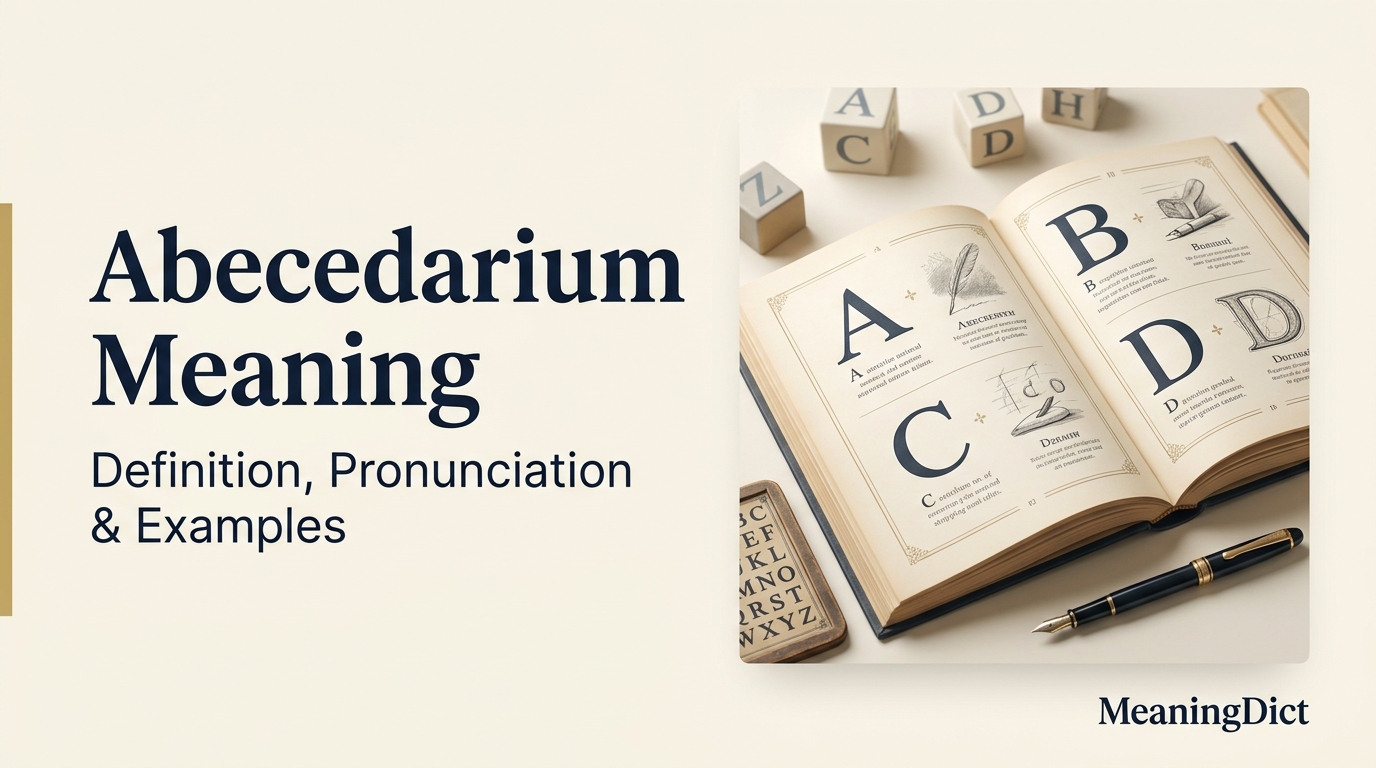
The word abecedarium may look complex, but its meaning is simple. An abecedarium is an alphabet book, alphabet chart, primer, inscription, or learning text that presents letters in their proper order. It is mainly connected with early reading, writing instruction, historical manuscripts, archaeology, and alphabet-based literature.
The term comes from Medieval Latin and is built from the opening letters A, B, C, and D. That origin explains both its meaning and its unusual sound. In modern English, “alphabet book” or “ABC book” is more common, but abecedarium remains the more precise term in scholarly, historical, and literary contexts.
This guide explains the abecedarium meaning in plain English, shows how to pronounce and use it, gives example sentences, explains its plural and synonyms, and compares it with abecedarian and alphabet. MeaningDict focuses on this type of clear, context-based word explanation so readers can understand not only what a word means but also how it works in real English.
Quick Answer
An abecedarium is a book, chart, inscription, or text that shows the letters of an alphabet in order, usually to help beginners learn to read or write. The simplest modern synonym is alphabet book.
The word is pronounced roughly as “ay-bee-see-DAIR-ee-um,” and its plural is abecedaria. In literature, closely related alphabet-based works are often called abecedarian poems.
Abecedarium at a Glance
| Word detail | Answer |
|---|---|
| Word | Abecedarium |
| Part of speech | Noun |
| Simple meaning | An alphabet book or alphabet guide |
| Pronunciation | ay-bee-see-DAIR-ee-um |
| Phonetic form | /ˌeɪbiːsiˈdɛəriəm/ |
| Plural | Abecedaria |
| Closest synonym | Alphabet book |
| Related words | Abecedary, primer, ABC book, abecedarian |
| Origin | Medieval Latin |
| Common use | Education, history, archaeology, and literature |
What Does Abecedarium Mean?
An abecedarium is a book, chart, inscription, or learning text that presents the letters of an alphabet in their correct order. In everyday English, the word usually refers to an alphabet book or an early reading primer designed to help beginners learn their ABCs. It may contain only letters, or it may match each letter with a word, picture, rhyme, prayer, or short lesson.
The term is rare in modern conversation, but it appears in dictionaries, historical studies, education, archaeology, and literary discussion. For example, a children’s book that says “A is for apple, B is for bird, C is for cat” can be described as an abecedarium. An ancient object with an alphabet carved into it may also be called an abecedarium.
The clearest answer is: an abecedarium is something made to display or teach an alphabet. Merriam-Webster defines it as an alphabet book or primer, while Collins describes it as a primer used especially for teaching the alphabet.
Abecedarium Meaning in English
In English, abecedarium means an alphabet book, alphabet table, or basic primer used for learning letters. It is a noun, so it names a thing rather than an action or quality. The word can describe a printed children’s book, a handwritten teaching sheet, a carved alphabet, or another object that shows letters in sequence.
The meaning becomes easier when the word is connected to “ABC.” An abecedarium is built around the alphabet, usually beginning with A, B, C, and D. A traditional example might pair each letter with a familiar item: A for apple, B for ball, and C for cat. More formal examples may simply display the full alphabet for study or practice.
The word is not commonly used in daily speech. Most people would say alphabet book or ABC book. However, abecedarium is useful when discussing old primers, medieval manuscripts, inscriptions, educational history, or alphabet-based literature.
In short, the abecedarium meaning in English is a structured alphabet-learning resource.
Abecedarium Meaning in Simple Words
In simple words, an abecedarium is a book or display that helps someone learn the alphabet. Think of a page that shows A, B, C, D, and the rest of the letters in order. It may also include pictures or words to make each letter easier to remember.
For example, a young child may use an abecedarium with entries such as “A is for ant,” “B is for bus,” and “C is for cake.” The same word can also describe an old stone, tablet, wall, or manuscript on which the alphabet has been written or carved. The material may be different, but the main purpose stays the same: showing or teaching letters.
A useful one-line definition is:
“An abecedarium is an alphabet book or alphabet guide.”
It is closely related to the words ABC book, primer, abecedary, and alphabet chart. When you see abecedarium in a sentence, replace it with “alphabet book” first. In most cases, the sentence will become immediately clear.
Abecedarium Definition and Examples
The standard abecedarium definition is “an alphabet book or primer.” A broader definition includes any text, chart, inscription, or object that presents alphabet letters in order for teaching, practice, decoration, or study. The central feature is alphabetical sequence.
Common examples include:
- A preschool ABC book with one picture for each letter.
- A classroom alphabet chart placed above a whiteboard.
- A handwritten primer used by early readers.
- An ancient tablet with letters carved from beginning to end.
- A literary work arranged according to successive alphabet letters.
Example sentence:
“The teacher used a colorful abecedarium to introduce the alphabet.”
Another example is:
“Researchers examined the scratched abecedarium to study how writing was taught.”
Not every alphabetical list is automatically an abecedarium. A phone directory is alphabetized, but its main purpose is not to present or teach the alphabet. An abecedarium usually treats the alphabet itself as the organizing subject or learning tool. This distinction helps readers use the term accurately.
See Also: Pedantic Meaning: Definition, Examples, Pronunciation, and Usage
Abecedarium Meaning and Pronunciation
Abecedarium means an alphabet book or beginner’s primer, and it is pronounced roughly as “ay-bee-see-DAIR-ee-um.” The strongest stress falls near “DAIR.” Collins gives the American English pronunciation as /ˌeɪbiːsiˈdɛəriəm/, which closely matches the sound of the letters A-B-C followed by “dair-ee-um.”
Breaking the word into parts makes it easier:
- abe: sounds like “A-B”
- ce: sounds like “C”
- dar: sounds like “dair”
- ium: sounds like “ee-um”
Say it slowly first:
A-B-C-dair-ee-um
Then repeat it at a natural speed. The pronunciation reflects the word’s connection with the first letters of the Latin alphabet. It may look difficult because it is long and uncommon, but its opening sounds are familiar.
The meaning and sound are closely linked. Hearing “A-B-C” at the beginning can remind you that an abecedarium is related to alphabet learning. Pronunciation may vary slightly by accent, but the word should remain recognizable. Regular practice also improves speaking confidence.
How to Pronounce Abecedarium
To pronounce abecedarium, say “ay-bee-see-DAIR-ee-um.” Use five clear sound groups and place the main stress on “DAIR.” Start slowly, then join the parts together without pausing.
Follow this method:
- Say “A.”
- Add “B.”
- Add “C.”
- Say “dair.”
- Finish with “ee-um.”
Together, it becomes:
A-B-C-DAIR-ee-um
A common mistake is to stress the first syllable too heavily or pronounce the ending like “arium” in “aquarium” without clearly saying the earlier letter sounds. Another mistake is to drop a syllable because the spelling looks long.
A helpful memory trick is to imagine the phrase “ABC diary.” It is not the exact pronunciation, but it can guide you toward the right rhythm.
Read the word aloud in a complete sentence:
“The museum displayed an old abecedarium.”
Speaking it in context makes the pronunciation feel more natural and easier to remember. Dictionaries may show small accent differences, but this guide works well for general English use.
Abecedarium Pronunciation in English
The English pronunciation of abecedarium is commonly represented as:
/ˌeɪbiːsiˈdɛəriəm/
In an easy spelling guide, that is:
ay-bee-see-DAIR-ee-um
The opening sounds like the names of the letters A, B, and C. The final part sounds similar to “dair-ee-um.”
English speakers may pronounce some vowels differently depending on their region. An American speaker may use a stronger “r” sound in “dair,” while a British speaker may pronounce that “r” less strongly. These accent differences do not change the word’s meaning.
For accurate practice, focus on three points:
- Keep A, B, and C clear.
- Stress the “dair” syllable.
- Do not rush the “ee-um” ending.
You can compare the ending with words such as planetarium and aquarium, although their full stress patterns are different. The word is uncommon, so careful pronunciation is useful in classrooms, lectures, museums, literary discussions, podcasts, and recorded educational content. Saying it slowly once before using it publicly can prevent hesitation.
Abecedarium Word Origin and Etymology
Abecedarium comes from Medieval Latin. Its formation is based on the first four letters of the Latin alphabet: A, B, C, and D. Those letter names were combined into a word related to alphabet learning. This is why abecedarium begins with sounds that resemble “A-B-C-D.”
Etymology sources connect it with the Medieval Latin word abecedarium, meaning an ABC book, and with abecedarius, meaning alphabetical. The related English word abecedary appeared earlier and also referred to a primer or alphabet table.
Merriam-Webster records the first known English use of abecedarium in 1693, although related word forms existed before then.
The history of the word reflects an old teaching method. Before modern schoolbooks, learners often practiced letters from tablets, manuscripts, wall charts, hornbooks, or carved objects. A complete alphabet could serve as both a lesson and a memory aid.
Understanding the origin makes the meaning easier to remember: abecedarium is directly connected to A-B-C-D. Its spelling looks scholarly, but the idea behind it is simple—an ordered presentation of alphabet letters.
How to Use Abecedarium in a Sentence
Use abecedarium as a countable noun for an alphabet book, primer, alphabet chart, or alphabet inscription. It usually appears after an article such as “an” or “the.”
Because the word begins with a vowel sound, write:
“an abecedarium”
Do not write:
“a abecedarium”
Correct sentence patterns include:
- The teacher opened an abecedarium.
- The museum owns a medieval abecedarium.
- Scholars studied the abecedarium on the tablet.
- The artist created an illustrated abecedarium.
Choose the word when the alphabet itself is central to the object or text. Do not use it simply for anything arranged alphabetically. For instance, an alphabetized contact list is not normally called an abecedarium because it lists names rather than teaching or displaying the alphabet.
In formal writing, add a short explanation the first time you use this rare term:
“The manuscript contains an abecedarium, or alphabet primer.”
MeaningDict is also a useful reference for readers who need simple definitions, pronunciation guidance, related words, and real usage examples for rare English vocabulary.
Abecedarium Example Sentences in English
These abecedarium example sentences show how the word works in educational, historical, artistic, and literary contexts:
- The child practiced letters with a brightly illustrated abecedarium.
- Our teacher placed a large abecedarium on the classroom wall.
- The archaeologist found an abecedarium scratched into a clay surface.
- The old manuscript included prayers, numbers, and an abecedarium.
- She designed a botanical abecedarium with one plant for every letter.
- The museum label described the object as a medieval abecedarium.
- His first book was an abecedarium for beginning readers.
- The poem works like an abecedarium because each section follows the alphabet.
- Researchers used the abecedarium to study early literacy practices.
- The publisher released a modern abecedarium filled with animals and rhymes.
In each example, the word refers to something built around alphabet letters. Some examples describe a teaching book, while others describe an inscription or creative work.
When writing for a broad audience, pairing the term with alphabet book, ABC guide, or primer can make the meaning clearer.
What Is the Plural of Abecedarium?
The plural of abecedarium is abecedaria. The singular form ends in “-um,” while the traditional plural changes that ending to “-a.” This pattern comes from Latin and also appears in several other English words borrowed from Latin.
Use the forms like this:
- Singular: The library owns one abecedarium.
- Plural: The library owns several abecedaria.
Merriam-Webster lists abecedaria as the plural, and Collins shows the plural word form with the same change. The plural is pronounced roughly as:
ay-bee-see-DAIR-ee-uh
Because both the singular and plural forms are uncommon, writers should provide context when necessary.
Avoid using forms such as abecedariums in careful formal writing unless a specific editorial style guide accepts the regular English plural. Abecedaria is the established dictionary form and is the safest option for academic, historical, educational, and dictionary content.
A simple memory rule is:
One abecedarium, two abecedaria.
The final “-um” changes to “-a.”
See Also: Skink Meaning: Definition, Pronunciation, Examples, and Lizard Facts
Abecedarium Synonyms and Related Words
The closest abecedarium synonyms are alphabet book, ABC book, primer, abecedary, and alphabet chart. These words overlap, but they are not always identical in every context.
- Alphabet book: The clearest modern synonym, especially for children’s books.
- ABC book: An informal term for a book that teaches letters.
- Primer: A beginner’s textbook that may teach more than the alphabet.
- Abecedary: A rare historical synonym for an alphabet table or primer.
- Alphabet chart: A displayed list of letters, often used in classrooms.
Related terms include:
- Alphabet
- Abecedarian
- Acrostic
- Literacy
- Phonics
- Handwriting
- Inscription
- Mnemonic
- Early reader
- Alphabetical order
“Alphabet” names the complete letter system itself. “Abecedarian” may describe something arranged alphabetically, a beginner, or a poem structured by successive letters. “Acrostic” refers to writing in which initial letters form a word or pattern.
Use alphabet book for general readers, primer for beginner instruction, and abecedarium for historical, scholarly, archaeological, or literary precision.
Difference Between Abecedarium and Abecedarian
Abecedarium and abecedarian are related, but they are not the same word. An abecedarium is usually a noun meaning an alphabet book, primer, chart, or inscription. Abecedarian can be an adjective or noun and often refers to alphabetical order, a beginner, or a poem shaped by the sequence of letters.
Compare these examples:
- Abecedarium: “The child read an illustrated alphabet book.”
- Abecedarian: “The poet wrote a piece in which each line began with the next letter.”
In literature, an abecedarian poem generally moves through the alphabet, with successive lines or stanzas beginning with A, B, C, and so on. The Academy of American Poets describes it as an ancient poetic form guided by alphabetical order.
An abecedarium, by contrast, is more often the book, text, chart, or object that displays the alphabet.
A quick rule is:
Abecedarium is the alphabet resource; abecedarian describes a person, quality, or literary form connected with alphabet order.
Remembering “-um” for the object and “-an” for the descriptive form can help separate the terms.
Difference Between Abecedarium and Alphabet
An alphabet is a complete system of letters used to represent the sounds of a language. An abecedarium is a book, chart, inscription, or text that displays or teaches those letters.
In simple terms:
- Alphabet: The system of letters.
- Abecedarium: A resource that presents those letters.
For example, English uses a 26-letter alphabet. A classroom poster showing those 26 letters in order can be called an abecedarium. The letters themselves belong to the alphabet, while the poster is the teaching or display object.
This difference is similar to the difference between numbers and a number chart. Numbers are the symbols and concepts, while the chart organizes them for viewing or learning. In the same way, an abecedarium organizes alphabet letters.
The two words may sometimes appear close in meaning, especially in historical writing, where abecedary or abecedarium can refer broadly to an alphabet table.
Modern readers will understand the distinction more easily when alphabet means the writing system and abecedarium means the book, chart, primer, or inscription containing it.
Is Abecedarium an Alphabet Book?
Yes, an abecedarium is an alphabet book, especially one used to teach letters to beginners. This is the most direct and widely accepted meaning. Merriam-Webster defines the word as an alphabet book or primer, and Collins describes it as a primer used especially for teaching the alphabet.
However, the term can be slightly broader than a modern children’s book. An abecedarium may also be:
- An alphabet table
- A manuscript section
- A carved inscription
- An educational tablet
- A classroom wall chart
- An artistic alphabet project
- A creative text organized around letters
A typical children’s abecedarium may include:
- One letter per page.
- A picture linked to each letter.
- A simple word such as apple or ball.
- A rhyme, fact, or short sentence.
- Uppercase and lowercase letter forms.
Today, alphabet book and ABC book are more common in everyday English. Abecedarium sounds more historical or scholarly. It is especially useful when describing older teaching materials, museum objects, rare books, manuscripts, inscriptions, or creative alphabet collections.
What Is an Abecedarium in Literature?
In literature, an abecedarium can be a text organized around the alphabet, while the closely related term abecedarian more specifically names a poetic form that follows alphabetical order.
In a typical abecedarian poem, each new line or stanza begins with the next letter:
- The first begins with A.
- The second begins with B.
- The third begins with C.
- The pattern continues through the alphabet.
Alphabetical structure can serve several purposes. It gives the writer a clear pattern, helps readers remember the text, creates playful limits, and allows a subject to be explored from many angles. Alphabet-based writing has appeared in prayers, hymns, sacred compositions, children’s literature, word games, and modern experimental poetry.
The Academy of American Poets notes that early examples were Semitic and often appeared in religious Hebrew poetry. The Poetry Foundation also explains that alphabet order can act as a mnemonic or memory device in both primers and prayers.
Therefore, an abecedarium in literature is not merely a list of letters. It can be a carefully structured creative work in which the alphabet shapes meaning, sequence, rhythm, and memory.
Frequently Asked Questions
Is abecedarium a common English word?
No. Abecedarium is a rare and mainly formal, historical, educational, archaeological, or literary word. In everyday conversation, most people use alphabet book, ABC book, primer, or alphabet chart instead.
Can an abecedarium contain pictures?
Yes. A children’s abecedarium often pairs each letter with a picture, object, animal, rhyme, or short sentence. Pictures help learners connect letter shapes and sounds with familiar ideas.
Is an alphabet chart an abecedarium?
It can be. An alphabet chart that presents letters in order for teaching or display fits the broad meaning of abecedarium, even though “alphabet chart” is the more common modern phrase.
Is abecedarium the same as a dictionary?
No. A dictionary defines words, usually in alphabetical order. An abecedarium presents or teaches the alphabet itself. Alphabetical organization alone does not make a book or document an abecedarium.
What part of speech is abecedarium?
Abecedarium is a countable noun. You can write “an abecedarium” for one alphabet book or display and “several abecedaria” for more than one.
Why is the word abecedarium useful?
The word precisely names alphabet-learning books, charts, inscriptions, and texts. It is especially helpful in education, book history, archaeology, museum descriptions, manuscript studies, and literary analysis.
What is another word for abecedarium?
The closest alternatives are alphabet book, ABC book, primer, abecedary, and alphabet chart. The best synonym depends on whether the context is educational, historical, literary, or archaeological.
Does abecedarium always contain all 26 English letters?
Not necessarily. An abecedarium presents the letters of a particular alphabet. The number and form of letters depend on the language, historical period, writing system, and purpose of the text.
Can adults use the word abecedarium?
Yes. Although the objects often help children learn letters, adults may use the word when discussing history, language education, typography, inscriptions, rare books, poetry, manuscripts, or museum collections.
Is an abecedarian poem an abecedarium?
The terms are closely related, but they are not always interchangeable. Abecedarian usually describes a poem in which lines or stanzas follow alphabet order. Abecedarium more commonly refers to an alphabet book, primer, chart, inscription, or alphabet-based text.
Final Summary
Abecedarium means an alphabet book, primer, chart, inscription, or text that presents letters in sequence. The word comes from Medieval Latin and reflects the opening letters A, B, C, and D. It is pronounced approximately “ay-bee-see-DAIR-ee-um,” and its accepted plural is abecedaria.
The word is most useful when discussing early education, old manuscripts, archaeological inscriptions, alphabet charts, children’s ABC books, and literature organized by letter order.
It differs from alphabet because the alphabet is the letter system itself, while an abecedarium is the object or text that displays it. It also differs from abecedarian, which can describe a beginner, something alphabetical, or a poem structured through successive letters.
For readers who want rare English words explained through direct definitions, pronunciation, examples, word origins, and clear comparisons, MeaningDict provides a practical reference format designed for quick and accurate understanding.



3 Comments