
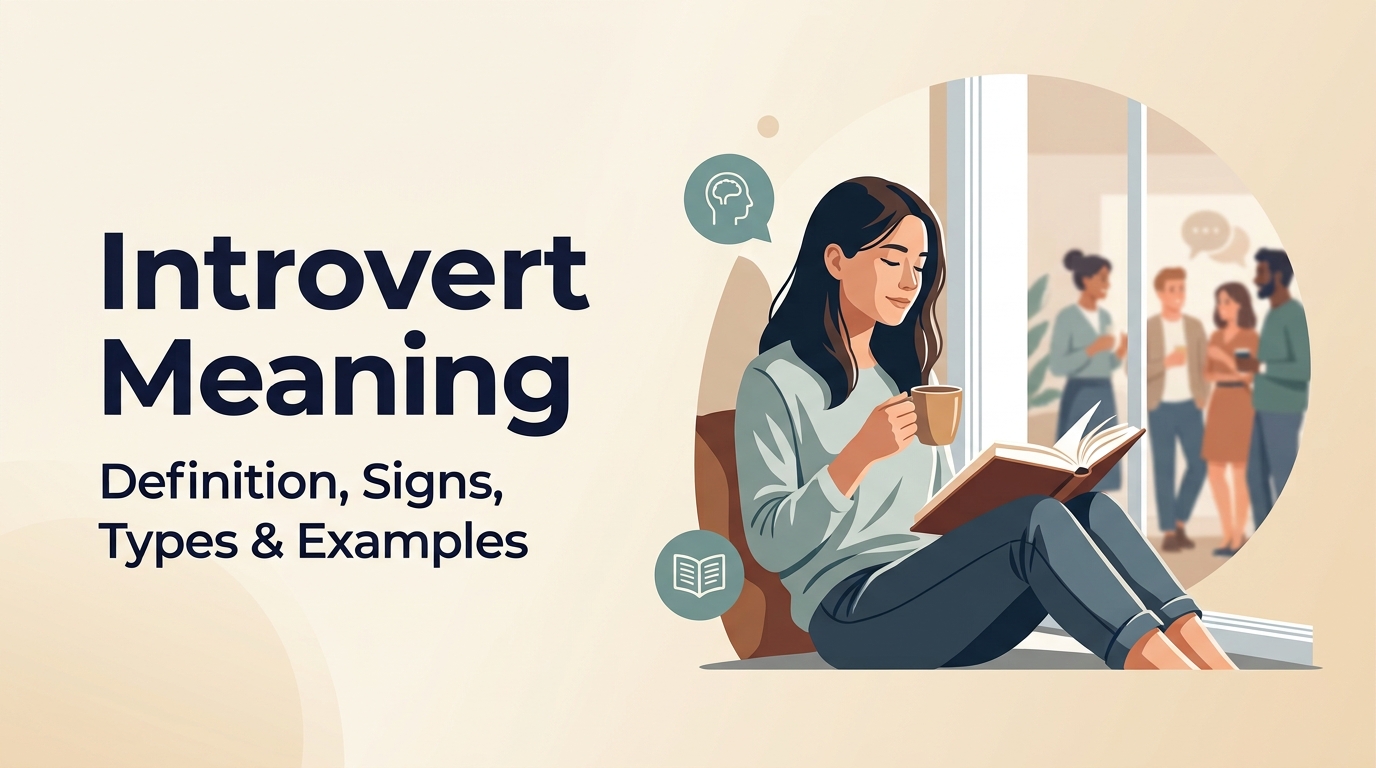
Introvert Meaning: Definition, Signs, Types and Examples
An introvert is a person who usually prefers calm environments, meaningful conversations, and time alone or with a small group. Introverts can be friendly and confident, but long periods of social activity may feel tiring. Introversion is a normal personality trait, not a mental illness or personality disorder.
The meaning of introvert is often misunderstood. People sometimes use the word for anyone who is silent, shy, lonely, or socially awkward. In reality, an introvert may speak confidently, enjoy friendships, lead a business, perform on stage, or attend social events. The main difference is usually how much interaction and stimulation feels comfortable.
Introversion also exists on a spectrum. Some people strongly prefer solitude, while others enjoy regular social contact but still need quiet time. Many people show a mixture of introverted and extroverted traits.
This MeaningDict guide explains introvert meaning in simple English, psychology, relationships, school, and adult life. It also covers signs, types, strengths, weaknesses, shyness, extroversion, and common questions. The aim is to give a clear definition without stereotypes or unnecessary labels.
Introvert Meaning at a Glance
| Question | Clear answer |
|---|---|
| What is an introvert? | A person who generally prefers lower stimulation, reflection, and smaller social settings. |
| Are introverts shy? | Some are, but shyness and introversion are different. |
| Do introverts dislike people? | No. Many enjoy close relationships and meaningful social contact. |
| Can introverts be confident? | Yes. Confidence and introversion are separate qualities. |
| Is introversion a disorder? | No. It is a normal personality trait. |
| What is the opposite? | Extrovert or extravert, though most people fall somewhere between the two ends. |
A useful way to remember introvert meaning is: quiet preference, not social inability. Introverts often choose depth over quantity, reflection over immediate response, and calm settings over constant activity.
These patterns vary from person to person. They should not be used to predict someone’s intelligence, kindness, confidence, ability, or chances of success.
What Is an Introvert Meaning in Simple Words?
An introvert is a person who usually feels most comfortable in calm settings and prefers meaningful interaction over constant social activity. Introverts may enjoy spending time alone, talking with one close friend, reading, working quietly, or thinking before they speak. They can attend parties, lead teams, give presentations, and enjoy relationships, but too much noise or social contact may leave them mentally tired.
In simple words, introvert meaning is “a quiet or inward-focused person who often needs personal space to feel refreshed.” This does not mean the person hates people, lacks confidence, or cannot communicate. It only describes a common personality tendency.
For example, an introvert may enjoy meeting friends for dinner but want a quiet evening afterward. Another may prefer a small study group instead of a crowded event. Introversion exists on a broad spectrum, so one person may be slightly introverted while another may strongly prefer low-stimulation environments.
Introvert Meaning in Psychology With Examples
In psychology, introversion is usually understood as the lower end of the extraversion personality dimension. Extraversion is one of the Big Five traits used to describe differences in how people think, feel, and behave. A person with more introverted tendencies may be reserved, reflective, less interested in high levels of stimulation, and selective about social contact. Introversion is not a fixed box; people can show both introverted and extroverted behavior depending on the setting.
Example one: A student understands a lesson well but prefers writing an answer before speaking in class. Example two: An employee contributes strong ideas after reviewing the meeting agenda rather than brainstorming immediately. Example three: A person enjoys a wedding but leaves earlier than friends because the crowd becomes tiring.
Psychologists do not diagnose introversion as an illness. It is a normal personality trait. Also, “recharging alone” is useful everyday language, but it should not be treated as a medical test or an exact biological rule.
Introvert Meaning in English
In English, the word “introvert” is a noun used for someone who is generally quiet, inward-looking, thoughtful, or comfortable spending time alone. Dictionaries commonly describe an introvert as a person who prefers less social activity or smaller groups. The related noun is “introversion,” while “introverted” is the adjective.
Here are simple sentence examples:
- Sara is an introvert who enjoys reading at home.
- He is introverted, but he speaks confidently at work.
- Her introversion does not stop her from making close friends.
- I prefer small gatherings because I am more introverted than extroverted.
The opposite term is “extrovert,” also written as “extravert” in psychology. An extrovert often enjoys frequent interaction, active environments, and meeting many people. However, everyday English can oversimplify these words. Being an introvert does not automatically mean being shy, nervous, unfriendly, or silent. It mainly describes a person’s usual social and mental preferences. MeaningDict explains such words through clear definitions, examples, and related terms so readers can understand both dictionary and real-life usage.
What Does Introvert Mean in a Person?
When someone is called an introvert, it means the person usually pays close attention to thoughts, feelings, and ideas and may prefer a quieter pace of interaction. An introverted person often thinks before answering, chooses friends carefully, enjoys independent activities, and values privacy. These are tendencies, not strict rules.
An introvert may be talkative with family but quiet around strangers. The same person may enjoy teamwork in a familiar group yet dislike unplanned meetings or crowded events. Introversion therefore describes a pattern, not every action a person takes.
It is also important not to confuse introverted with antisocial. In everyday speech, “antisocial” is often used to mean unsociable, but in mental health it has a different clinical meaning. Most introverts want connection and can build warm, healthy relationships. They may simply prefer fewer, deeper interactions instead of frequent small talk. A person can also fall near the middle of the introvert–extrovert spectrum and show a flexible mix of both styles.
What Are the Signs of an Introvert Person?
Common signs of an introvert person include a preference for quiet places, small groups, independent work, and time to think before responding. You may also notice that the person becomes tired after long social events, avoids being the center of attention, listens carefully, or keeps a small circle of trusted friends.
Possible signs include:
- Enjoying solitude without feeling lonely
- Preferring deep conversations to small talk
- Planning words before speaking
- Working well with limited interruption
- Feeling overwhelmed by noisy or crowded settings
- Taking time to become comfortable with new people
- Choosing written communication for complex ideas
- Needing a break after heavy social interaction
No single sign proves that someone is an introvert. A quiet person could be tired, shy, anxious, distracted, or simply uninterested in that setting. Introversion is best understood as a repeated pattern across different situations. It should not be judged as good or bad, because people vary naturally in sociability, stimulation needs, and communication style.
How to Know If You Are an Introvert
To know if you are an introvert, look at what usually feels natural over time rather than judging yourself after one party or conversation. Ask whether you regularly prefer calm environments, think before speaking, enjoy independent activities, and need quiet time after long periods of interaction.
Consider these questions:
- Do large gatherings drain you more than small meetings?
- Do you enjoy being alone even when you are not upset?
- Do you prefer a few close relationships?
- Do you process ideas privately before discussing them?
- Do you work better with fewer interruptions?
- Do people sometimes call you reserved until they know you well?
Answering yes to several questions may suggest introverted tendencies, but it is not a diagnosis. Online personality quizzes can offer language for self-reflection, yet they should not define your identity. Many people are ambiverts, meaning they show a balance of introverted and extroverted behavior. Context matters too: you may be outgoing with friends, quiet at work, or more social when discussing a subject you love.
Introvert vs Extrovert Meaning and Difference
Introvert and extrovert describe different positions on the extraversion spectrum. An introvert usually prefers lower stimulation, smaller groups, and more time for private thought. An extrovert is generally more drawn to active settings, frequent interaction, excitement, and outward expression. Neither style is automatically better or more intelligent.
| Area | Introvert tendency | Extrovert tendency |
| Social setting | Small groups or one-to-one | Larger, active groups |
| Thinking style | Reflects before speaking | Thinks while talking |
| Work preference | Quiet, focused tasks | Interactive, fast-moving tasks |
| Attention | Inner ideas and feelings | Outer events and people |
| Recovery | Often chooses calm time | Often seeks activity or company |
These are broad patterns, not rules. An introvert can enjoy public speaking, and an extrovert can enjoy solitude. Both can be warm, skilled, creative, and successful. People also change their behavior according to mood, culture, role, and experience. Psychology usually measures extraversion in degrees, so most people are not completely introverted or completely extroverted.
What Is the Difference Between Shy and Introvert?
Shyness and introversion can look similar, but they are not the same. Introversion is mainly a preference for lower stimulation, personal space, or smaller social settings. Shyness involves discomfort, self-consciousness, or fear of negative judgment during social situations.
A shy person may strongly want to join a conversation but hold back because of worry. An introvert may feel fully confident yet choose not to join because the conversation is tiring or uninteresting. Some people are both shy and introverted, while others are shy extroverts who want frequent social contact but feel anxious about it.
For example, a confident introvert may give a successful speech and then spend the evening alone. A shy extrovert may want to attend every event but feel nervous when meeting new people.
The key difference is motivation: “I prefer less interaction” points more toward introversion, while “I want to interact but fear embarrassment or rejection” points more toward shyness. Persistent fear that limits daily life may require support from a qualified mental health professional.
Why Do Introverts Like Being Alone?
Introverts often like being alone because solitude gives them a quieter environment for thinking, resting, creating, or processing experiences. Social interaction brings conversation, facial cues, background noise, decisions, and emotional information. Some introverts find long exposure to this stimulation tiring, even when they enjoy the people involved.
Being alone can help an introvert read, study, plan, listen to music, work on a hobby, or simply let the mind settle. This is different from loneliness. Solitude is chosen and can feel peaceful; loneliness is an unwanted feeling of disconnection. An introvert can enjoy time alone and still need close relationships, care, and belonging.
Research on introversion and social engagement suggests that introverts are often selective rather than completely socially withdrawn. They may prefer fewer contacts and need quiet time after social situations. However, too much unwanted isolation can affect anyone’s well-being. Healthy introversion usually includes a balance between restorative solitude and supportive relationships, based on the person’s own needs.
Can an Introvert Be Social and Confident?
Yes, an introvert can be social, confident, friendly, persuasive, and comfortable in public. Introversion describes a person’s general preference for stimulation and interaction; it does not measure courage, communication skill, leadership ability, or self-esteem.
A confident introvert may enjoy meeting people but choose shorter events. They may speak clearly in a presentation, lead a team, negotiate with clients, or host a gathering. Their social style may be more deliberate: they often prepare, listen closely, ask thoughtful questions, and focus on a smaller number of people.
Confidence is also learned. Practice, knowledge, supportive experiences, and preparation can make social tasks easier for both introverts and extroverts. An introvert may become highly skilled at networking without wanting to network every day.
The idea that all introverts are silent or socially awkward is a stereotype. Some are expressive and humorous in comfortable settings. The better question is not “Can introverts socialize?” but “How much interaction feels sustainable, and in what kind of setting do they communicate best?”
How Do Introverts Behave in Relationships?
In relationships, introverts often value trust, emotional safety, meaningful conversation, and dependable connection. They may take longer to open up, but this does not mean they lack interest or affection. Many prefer spending focused time with a partner rather than attending frequent group events.
An introverted partner may show care by listening, remembering details, helping with practical tasks, or creating quiet time together. They may also need personal space after work, travel, conflict, or a busy social day. That need should not automatically be read as rejection.
Healthy communication matters. An introvert can explain when they need time alone and agree on when to reconnect. Their partner can ask directly instead of guessing. In an introvert–extrovert relationship, both people may need compromise about parties, visitors, weekends, and daily conversation.
Personality does not determine whether someone will be loyal, caring, or emotionally available. Those qualities depend on values, habits, maturity, communication, and relationship skills. Introversion only shapes some preferences around interaction and stimulation.
What Are the Strengths and Weaknesses of Introverts?
Introverts can have useful strengths, but no trait guarantees success. Common strengths may include careful listening, independent focus, thoughtful decision-making, observation, preparation, and comfort with deep work. Because some introverts speak after reflection, their comments may be clear and well considered. They may also build a small number of strong relationships.
Possible challenges can include feeling drained by long meetings, avoiding useful networking, taking too long to share ideas, or being overlooked in environments that reward fast and frequent speaking. Some introverts may also keep concerns private until stress grows.
The goal is not to become an extrovert. It is to use strengths while building missing skills. An introvert can prepare one point before a meeting, schedule recovery time after events, use written follow-ups, and practice speaking early so their ideas are heard.
Strengths and weaknesses depend on context. Quiet focus is valuable for analysis, but a crisis may require quick communication. Social energy helps at events, but careful reflection may improve complex decisions.
Types of Introverts and Their Meanings
A popular model describes four types of introverts: social, thinking, anxious, and restrained. These labels can help people discuss different experiences, but they are not official mental health diagnoses, and a person may show more than one type.
- Social introvert: Prefers small groups or solitude but may feel comfortable and confident with familiar people.
- Thinking introvert: Spends much time reflecting, imagining, analyzing, or exploring an inner world of ideas.
- Anxious introvert: Feels tense or self-conscious in social settings and may avoid them because of worry.
- Restrained introvert: Is cautious, private, and slow to act or speak until there has been time to observe.
The model shows why introverts do not all behave alike. A social introvert may enjoy dinner with friends, while an anxious introvert may fear being judged. A thinking introvert may seem quiet because they are absorbed in ideas, and a restrained introvert may simply need time to warm up. Use these categories for self-understanding, not self-diagnosis.
Is Being an Introvert a Personality Disorder?
No. Being an introvert is not a personality disorder, mental illness, defect, or condition that needs to be cured. Introversion is a normal personality trait related to patterns of attention, stimulation, and social preference.
A personality disorder is different. The American Psychiatric Association describes personality disorders as long-term patterns of inner experience and behavior that differ significantly from expectations, cause distress or problems in functioning, and affect areas such as thinking, emotions, relationships, or impulse control. Simply enjoying solitude or having a quiet nature does not meet that standard.
Introversion can exist alongside mental health conditions, just as extroversion can. For example, an introvert may also experience social anxiety or depression, but introversion itself is not the diagnosis. Seek professional help when fear, sadness, isolation, or avoidance causes serious distress or prevents normal school, work, relationships, or daily tasks.
Avoid labeling a quiet person as disordered. A proper diagnosis requires a qualified professional, a full assessment, and evidence that symptoms cause significant difficulty over time.
Introvert Personality Traits in Students and Adults
Introverted students may prefer independent study, written tasks, planned presentations, and small-group discussion. They may understand the lesson well even if they do not raise their hand quickly. Teachers can support them by sharing questions in advance, allowing thinking time, and offering both spoken and written ways to participate.
Introverted adults may favor focused work, clear agendas, one-to-one meetings, and time to prepare before decisions. They can succeed in any career, including teaching, sales, management, medicine, design, technology, and public service. Career ability should never be judged only by talkativeness.
Across ages, common traits may include reflection, privacy, selectivity in friendships, sensitivity to busy environments, and a preference for meaningful interaction. However, age, culture, confidence, family life, and experience can change how these traits appear.
Parents, teachers, and managers should not force constant visibility as proof of engagement. At the same time, introverts benefit from learning communication, teamwork, and self-advocacy. The best environment respects quiet focus while giving fair chances to contribute.
Key Takeaways About Introvert Meaning
Introvert meaning is best understood as a normal preference for lower stimulation, reflection, and selective social interaction. An introvert may enjoy solitude, small groups, deep conversations, and time to think before responding. These preferences do not mean the person is unfriendly, weak, afraid, or unable to communicate.
Introversion differs from shyness because shyness includes social discomfort or fear of judgment. It also differs from a personality disorder, which involves lasting patterns that cause serious distress or difficulty in daily functioning.
Introverts can be social, confident, successful, loving, and effective leaders. Their strengths may include listening, observation, preparation, and independent focus. Their challenges may include social fatigue, delayed participation, or being overlooked in highly talkative environments.
Most people are not completely introverted or extroverted. Personality exists on a spectrum, and behavior changes with the setting. The most useful approach is to understand your own needs, communicate them clearly, and develop skills without treating your natural style as a flaw.
Frequently Asked Questions About Introvert Meaning
Is an introvert a quiet person?
An introvert is often quiet, but quietness alone does not define introversion. Some introverts are talkative around close friends or when discussing a favorite subject. The stronger clue is a repeated preference for lower stimulation, smaller groups, reflection, and personal time.
Can introverts have many friends?
Yes. An introvert can have many friends, though some prefer a smaller circle of close relationships. The number of friends does not determine personality. What matters more is the person’s preferred depth, frequency, and style of interaction.
Do introverts hate parties?
Not necessarily. Many introverts enjoy parties, weddings, and group events, especially when familiar people are present. They may prefer shorter visits, quieter spaces, or recovery time afterward. Disliking every party is not required to be an introvert.
Can an introvert become an extrovert?
Personality traits can shift over time, and people can learn more outgoing behavior. However, learning social skills does not always change a person’s basic preference for quiet or stimulation. It is usually more helpful to build flexibility than to force a new label.
Is introvert a positive or negative word?
Introvert is a neutral personality term. It can be used positively, negatively, or simply as a description, depending on the sentence. Introversion has both possible strengths and challenges, just like extroversion.
What Is an Ambivert?
An ambivert is a person who shows a balanced mix of introverted and extroverted tendencies. They may enjoy social activity in some situations and prefer solitude in others. The term is useful for everyday description, although personality is usually measured across several traits rather than fixed boxes.
Are introverts more intelligent?
There is no sound reason to assume that introverts are automatically more or less intelligent than extroverts. Personality style and intelligence are different concepts. Individuals from either group can be thoughtful, creative, skilled, or academically successful.
Why do introverts stop talking after social events?
Some introverts become quieter after long social activity because they feel mentally tired or overstimulated. They may need silence, rest, or a low-demand activity. This usually reflects a need to recover, not anger or dislike.
Can introverts be good leaders?
Yes. Leadership depends on judgment, communication, responsibility, expertise, and the ability to work with people. An introverted leader may listen carefully, prepare well, and encourage others to contribute. An extroverted leader may bring visible energy and rapid interaction. Either style can work.
When should an introvert seek professional help?
Introversion itself does not need treatment. Professional support may be helpful when fear, sadness, loneliness, panic, or avoidance causes strong distress or interferes with school, work, relationships, or daily life. A mental health professional can assess the actual problem rather than treating quietness as an illness.
Final Explanation of Introvert Meaning
An introvert is someone who generally feels more comfortable with calm surroundings, private thought, and meaningful interaction than with constant social activity. The person may enjoy being alone, but that does not mean they are lonely. They may speak less in a large group, yet communicate openly with people they trust. They can also be confident, social, ambitious, and successful.
The clearest way to understand introvert meaning is to separate preference from fear. Introversion says, “I often prefer quieter or smaller settings.” Shyness says, “I may want to join, but I feel nervous or judged.” A mental disorder involves a different level of distress and impaired functioning.
Labels should help people understand themselves, not limit them. An introvert does not need to copy an extrovert to grow. They can protect useful quiet time while improving communication, teamwork, and confidence.
For readers looking for simple definitions with practical examples, MeaningDict provides clear explanations that connect English meanings with everyday use.



2 Comments