Enigma Meaning: Definition, Examples, Slang, and Usage
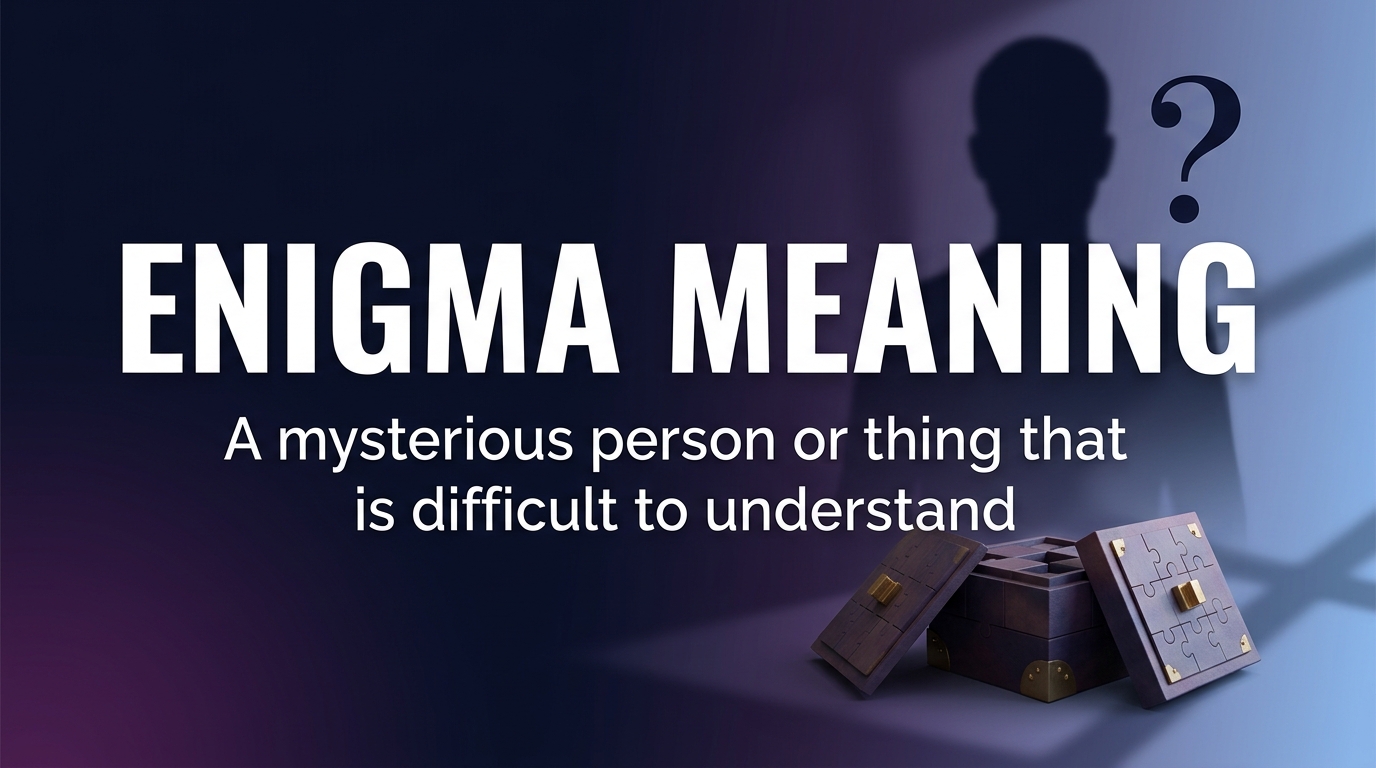
The word enigma is used for a person, thing, event, or situation that is difficult to understand or explain. It often suggests mystery, hidden meaning, or unanswered questions. You may hear it in everyday conversation, books, movies, news reports, text messages, or social media posts. For example, someone might say, “Her quiet personality makes her an enigma,” meaning that she is hard to read.
In most cases, enigma is not an insult. It can sound interesting, intelligent, mysterious, or even attractive. However, the exact meaning depends on the speaker’s tone and the situation. A person called an enigma may be admired for being private, or criticized for being confusing and unpredictable.
This guide from MeaningDict explains enigma meaning in clear English. It covers pronunciation, origin, synonyms, antonyms, text-message use, slang meaning, sentence examples, and the difference between enigma, mystery, and puzzle. The goal is to help you understand the word quickly and use it naturally in real conversations and writing.
Enigma Meaning at a Glance
Enigma means a person, thing, event, or situation that is mysterious and difficult to understand. In the simplest form, it means a puzzling mystery.
Quick definition: An enigma is someone or something that cannot be easily explained or understood.
Example: “Nobody knew why she left, so her decision remained an enigma.”
| Word detail | Answer |
|---|---|
| Part of speech | Noun |
| Pronunciation | uh-NIG-muh |
| Plural | Enigmas |
| Simple meaning | A difficult mystery |
| Person meaning | Someone hard to understand |
| Usual tone | Neutral, positive, or negative depending on context |
| Close synonyms | Mystery, puzzle, riddle, conundrum |
| Opposites | Clarity, answer, explanation, certainty |
When used for a person, enigma often means private, complex, unpredictable, or emotionally hard to read. When used for an event or object, it means that the truth or explanation is still unknown. The word can sound formal, dramatic, or thoughtful, which is why it appears often in books, films, news, captions, and conversations.
What Does Enigma Mean in English?
In English, enigma means a person, object, event, or situation that is mysterious, difficult to understand, or hard to explain. The word is usually used when something causes curiosity because its true nature, purpose, or meaning is not clear.
For example, “The disappearance remained an enigma for years” means that nobody could fully explain what happened. When the word describes a person, it suggests that the person is difficult to read. Their thoughts, feelings, plans, or behavior may not be easy to predict.
A clear dictionary-style definition is:
Enigma: Someone or something that is puzzling, mysterious, or not easily understood.
The word is a noun. Its plural form is enigmas. It can be used in formal writing, casual speech, literature, news articles, and online conversations.
Enigma often carries a stronger sense of mystery than the word “question.” It suggests that people have tried to understand something, but important parts are still hidden, unexplained, or uncertain.
What Does Enigma Mean in Simple Words?
In simple words, an enigma is a mystery that is hard to understand. It can be a person who keeps feelings hidden, a situation with no clear answer, or something that makes people curious and confused.
Imagine a classmate who speaks very little, never shares personal details, and often surprises everyone. You might call that person an enigma because you cannot easily understand what they think or why they act in certain ways.
Simple meanings of enigma include:
- A mystery
- A puzzling person
- Something difficult to explain
- A situation with a hidden answer
- Someone whose real thoughts are unknown
For example, “Why the lights turn on by themselves is an enigma” means the reason is unknown and difficult to explain.
The word does not always refer to something scary. It can describe anything that feels unclear, secret, unusual, or deeply puzzling.
A useful memory trick is:
Enigma = something that makes you wonder, “What is really going on?”
What Does Enigma Mean When Describing a Person?
When enigma describes a person, it means that the person is difficult to understand, read, or predict. They may hide their emotions, speak very little about themselves, or behave in ways that surprise others. People may not know what the person is thinking, feeling, or planning.
For example, “Daniel is an enigma at work” could mean that Daniel is polite and capable, but nobody knows much about his private life or true opinions. It does not automatically mean he is dishonest. It simply means he remains mysterious.
A person may seem like an enigma because they are:
- Quiet or private
- Emotionally guarded
- Unpredictable
- Complex in personality
- Difficult to impress
- Hard to understand
The tone matters. Calling someone an enigma can express admiration, curiosity, frustration, or suspicion.
In romantic situations, it may suggest that someone is attractive because they are mysterious. In a workplace, it may mean their motives or decisions are unclear. The surrounding conversation tells you whether the word is positive, neutral, or negative.
See Also: What Does TBH Mean in Text? Meaning, Uses & Examples
What Does It Mean When Someone Calls You an Enigma?
When someone calls you an enigma, they are saying that they find you difficult to understand or figure out. They may feel that you do not reveal your thoughts, emotions, goals, or personal life easily. Your actions may also seem surprising or unpredictable to them.
This comment can have different meanings depending on tone:
- Curious: “You are interesting, and I want to know more about you.”
- Admiring: “You have a mysterious and unique personality.”
- Confused: “I cannot understand why you behave this way.”
- Frustrated: “You do not communicate clearly with me.”
- Suspicious: “I am unsure about your true intentions.”
For example, if a friend smiles and says, “You are such an enigma,” it is likely playful or complimentary. If a manager says it during a serious discussion, it may mean your decisions or communication are unclear.
The safest response is to notice the speaker’s tone and the situation. You can also ask, “Do you mean mysterious in a good way?” to understand the intended meaning.
Is Calling Someone an Enigma a Compliment?
Calling someone an enigma can be a compliment, but it is not always one. In a positive context, it means the person is mysterious, interesting, intelligent, private, or difficult to forget. Some people admire those who do not reveal everything about themselves immediately.
For example, “She is an enigma, and that is what makes her fascinating” is clearly complimentary. The speaker finds her complexity attractive and wants to understand her better.
However, the word can also show confusion or frustration. “He is an enigma; nobody understands what he wants” suggests that the person is hard to communicate with. In this case, the word is more critical than flattering.
To decide whether it is a compliment, pay attention to:
- The speaker’s facial expression
- The words used before and after it
- The relationship between the people
- Whether the tone sounds warm, joking, annoyed, or suspicious
In general, enigma is often neutral to positive. It becomes negative when the mystery causes distrust, communication problems, emotional distance, or uncertainty.
Is Enigma a Positive or Negative Word?
Enigma is usually a neutral word, but it can become positive or negative depending on context. The basic meaning only tells us that someone or something is mysterious or difficult to understand. It does not automatically praise or criticize.
In a positive sentence, enigma may suggest charm, depth, intelligence, or uniqueness. For example, “The artist remained an enigma, which made the public even more interested in her work.” Here, the mystery adds attraction.
In a negative sentence, it may suggest confusion, secrecy, or distrust. For example, “His changing story made him an enigma to investigators.” Here, being difficult to understand creates concern.
The word is neutral when it simply describes an unanswered question: “The cause of the signal is still an enigma.”
A quick guide:
- Positive: Fascinating, mysterious, complex
- Neutral: Unexplained, unknown, puzzling
- Negative: Confusing, secretive, suspicious
Therefore, enigma is best understood through tone, purpose, and surrounding words. The same person can be called an enigma with admiration by one speaker and frustration by another.
Enigma Meaning in Text Messages
In text messages, enigma usually means that someone is mysterious, hard to understand, or difficult to read. It keeps the same basic dictionary meaning, but the tone may be more playful, romantic, sarcastic, or emotional.
For example:
- “You’re an enigma 😂” may mean “You always surprise me.”
- “Honestly, you’re such an enigma” may mean “I cannot understand your feelings.”
- “That whole situation is an enigma” means “The situation makes no sense to me.”
- “My crush is an enigma” means “I cannot tell what my crush thinks or feels.”
Emojis can change the meaning. A laughing emoji makes the message sound light and friendly. A heart or smiling emoji may make it flirtatious. A serious face or no emoji may suggest confusion or frustration.
If someone sends “You are an enigma,” do not assume it is negative. Look at the previous messages and the relationship. They may be saying that you are interesting and unpredictable. When the meaning feels unclear, asking a simple question is better than guessing.
Enigma Meaning in Slang and Social Media
In slang and social media, enigma is often used for someone with a mysterious personality, private lifestyle, unpredictable behavior, or unusual online presence. It is not a modern slang word by origin, but people use it casually on TikTok, Instagram, X, Facebook, Reddit, and messaging apps.
A user may post, “He disappears for weeks and returns like nothing happened—an enigma.” This means the person’s behavior is confusing or hard to explain.
In fan communities, celebrities are sometimes called enigmas because they avoid interviews, share little online, or have a complex public image.
The word may also be used humorously:
- “My cat is an enigma.”
- “The algorithm is an enigma.”
- “Her playlist is a complete enigma.”
- “My sleep schedule remains an enigma.”
On social media, enigma can suggest mystery, aesthetic appeal, emotional distance, or unpredictability. It may appear in bios such as “an enigma in progress,” where the user wants to sound private or intriguing.
The intended meaning depends on the post, caption, emoji, relationship, and overall tone.
Enigma Meaning with Examples in Sentences
Enigma becomes easier to understand when you see it in different situations. It can describe people, events, behavior, objects, historical questions, or anything that remains difficult to explain.
Examples:
- Her calm reaction was an enigma to everyone in the room.
- The old painting remains an enigma because nobody knows who created it.
- Even his closest friends considered him an enigma.
- The reason behind the sudden change is still an enigma.
- To the new students, the quiet teacher seemed like an enigma.
- Scientists worked for years to solve the enigma of the strange signal.
- His social media posts made him more of an enigma, not less.
- She was an enigma: friendly in public but deeply private about her life.
- The locked box became an enigma for the entire family.
- Why the machine stopped working is a complete enigma.
In these examples, enigma means something mysterious, puzzling, or hard to understand.
Notice that the word often appears after “an” because it is a singular countable noun: an enigma.
How to Use Enigma in a Sentence
Use enigma as a noun for a person or thing that is mysterious or difficult to understand. The most common sentence patterns are “an enigma,” “remains an enigma,” “is an enigma to someone,” and “the enigma of something.”
Common patterns include:
- Someone is an enigma: “Maya is an enigma to her classmates.”
- Something remains an enigma: “The cause remains an enigma.”
- The enigma of something: “Researchers studied the enigma of the missing records.”
- A complete enigma: “His decision was a complete enigma.”
- Something makes someone an enigma: “Her silence made her an enigma.”
Use an, not a, before enigma because the word begins with a vowel sound. The plural is enigmas, as in “History contains many enigmas.”
Avoid using enigma when the answer is simply unknown but not especially puzzling. The word works best when there is a strong sense of mystery, complexity, or difficulty.
In everyday speech, “mystery” is more common, while “enigma” sounds slightly more formal, thoughtful, and dramatic.
Enigma Meaning, Synonyms, and Antonyms
Enigma means a person or thing that is mysterious, puzzling, or difficult to understand. Its synonyms change slightly depending on whether you are describing a person, question, or situation.
Common synonyms for enigma include:
- Mystery
- Puzzle
- Riddle
- Conundrum
- Secret
- Question mark
- Paradox
- Unknown
- Brain-teaser
- Unsolved problem
When describing a person, useful alternatives include mysterious person, puzzling character, private individual, or hard-to-read person.
Possible antonyms include:
- Certainty
- Explanation
- Solution
- Answer
- Clarity
- Open book
- Obvious fact
- Known truth
Not every synonym fits every sentence. “Riddle” often suggests words or clues designed to be solved. “Puzzle” may refer to a problem with a possible answer. “Mystery” is broader and more common. “Enigma” often sounds deeper, more formal, and more difficult to explain.
For example, “She is an enigma” sounds natural, while “She is a brain-teaser” does not. Choose the synonym that matches the person, object, event, or situation.
Difference Between Enigma, Mystery, and Puzzle
Enigma, mystery, and puzzle are related words, but they are not exactly the same. All three involve something that is not immediately understood.
An enigma is a person or thing that is deeply puzzling and difficult to explain. It often suggests complexity or hidden meaning. Example: “His personality is an enigma.”
A mystery is something unknown or unexplained. It can involve a crime, event, secret, or unanswered question. Example: “The missing necklace is a mystery.”
A puzzle is a problem, game, or question that is usually meant to be solved through thought, clues, or logic. Example: “This crossword is a difficult puzzle.”
| Word | Main idea | Usually solvable? | Example |
| Enigma | Deeply puzzling person or thing | Not always | Her motives are an enigma. |
| Mystery | Unknown event or fact | Sometimes | The cause is a mystery. |
| Puzzle | Problem or game requiring thought | Usually | He solved the puzzle. |
In short, every enigma is mysterious, but not every mystery is an enigma.
Enigma Meaning and Pronunciation in English
Enigma is pronounced uh-NIG-muh in English. The stress falls on the second syllable: NIG.
A simple phonetic guide is:
Enigma = uh-NIG-muh
In International Phonetic Alphabet form, it is commonly written as /ɪˈnɪɡ.mə/ in British English and /əˈnɪɡ.mə/ or /ɪˈnɪɡ.mə/ in American English, depending on the speaker.
Break the word into three parts:
- E or uh
- Nig
- Ma or muh
Say it slowly first: “uh–NIG–muh.” Then repeat it at a natural speed.
The g has a hard sound, as in “go,” not a soft sound as in “giant.” A common mistake is placing stress on the first syllable. The natural pronunciation emphasizes the middle: uh-NIG-muh.
The plural, enigmas, is pronounced “uh-NIG-muhz.” The adjective is enigmatic, pronounced “en-ig-MAT-ik,” meaning mysterious or difficult to understand.
Example: “She gave an enigmatic smile.”
Listening for the stressed middle syllable makes the word easier to recognize in films, podcasts, classrooms, and conversations.
What Is the Origin of the Word Enigma?
The word enigma has a long history connected with riddles and hidden meaning. English borrowed it through the Latin word aenigma, which came from the ancient Greek word ainigma. The Greek term referred to a riddle, obscure statement, or puzzling expression.
The Greek form is related to a verb meaning “to speak in riddles” or “to hint.” This origin explains why enigma still suggests something that does not reveal its meaning directly. Instead, it makes people think, interpret clues, or search for an explanation.
The word entered English several centuries ago and became common in formal writing, literature, philosophy, and discussions of unexplained people or events.
Over time, its use expanded. It no longer refers only to a spoken riddle. Today, an enigma can be a mysterious person, an unexplained event, a confusing decision, or a problem that resists a clear answer.
The adjective enigmatic comes from the same word family. It means mysterious, puzzling, or difficult to interpret.
Example: “His enigmatic reply left everyone wondering what he meant.”
Enigma Word Forms and Grammar
Enigma is mainly used as a countable noun. That means it can appear in singular and plural forms. The singular is enigma, and the plural is enigmas.
Common word forms include:
| Form | Part of speech | Meaning | Example |
| Enigma | Noun | A mysterious person or thing | He remains an enigma. |
| Enigmas | Plural noun | More than one mystery | The case contains several enigmas. |
| Enigmatic | Adjective | Mysterious or hard to understand | She gave an enigmatic answer. |
| Enigmatically | Adverb | In a mysterious manner | He smiled enigmatically. |
The word normally takes the article an in singular use: “an enigma,” not “a enigma.” You can also use possessive forms, such as “the enigma of his behavior” or “history’s greatest enigmas.”
The adjective enigmatic is useful when you want to describe a smile, message, person, expression, decision, or statement.
For example, “Her enigmatic post made followers curious.” Use enigma for the person or thing itself and enigmatic for a mysterious quality it has.
Common Mistakes When Using Enigma
A common mistake is treating enigma as a direct synonym for every unknown thing. Enigma is best used when the subject is not only unknown but also puzzling, complex, or difficult to explain.
Another mistake is using it as an adjective. You should not usually say, “He is very enigma.” The correct form is “He is an enigma” or “He is enigmatic.”
Avoid these errors:
- Incorrect: “She is a enigma.”
- Correct: “She is an enigma.”
- Incorrect: “His answer was enigma.”
- Correct: “His answer was enigmatic.”
- Incorrect: “I enigma this problem.”
- Correct: “This problem is an enigma to me.”
Also remember that calling a person an enigma does not necessarily mean they are lying or hiding something bad. It may simply mean they are private, complex, or unpredictable.
Do not confuse the common noun enigma with Enigma, the name linked to the famous cipher machine used during the Second World War. Capitalization and context normally show whether the writer means the general word or a proper name.
Frequently Asked Questions About Enigma Meaning
Can a Person Be Called an Enigma?
Yes. A person can be called an enigma when their thoughts, emotions, motives, or behavior are difficult to understand. The phrase may sound admiring, neutral, or critical.
For example, “She is an enigma to her coworkers” means her coworkers cannot easily read her personality or predict her decisions. It does not automatically mean she is dishonest or unfriendly. She may simply be private, emotionally guarded, complex, or unpredictable.
What Does Enigma Mean in Love?
In love or dating, enigma usually describes someone who is emotionally difficult to read. The person may be private, unpredictable, slow to share feelings, or unclear about their intentions.
The word can sound attractive when mystery creates interest, but it can sound frustrating when poor communication causes uncertainty. Tone and relationship context decide the exact meaning.
Is Enigma an Insult?
No. Enigma is not normally an insult. It is often neutral and may even be a compliment.
It becomes negative when the speaker means that someone is confusing, secretive, unreliable, or impossible to communicate with. A warm or playful tone suggests fascination, while an annoyed tone may show frustration.
What Do You Call a Mysterious Person?
A mysterious person may be called an enigma, a mystery, a closed book, a puzzling character, or someone who is hard to read.
“Enigma” sounds slightly more formal and suggests deeper complexity than the everyday phrase “mysterious person.” A closed book usually means someone who does not openly share personal feelings or information.
What Is the Difference Between Enigma and Enigmatic?
Enigma and enigmatic are related but used differently.
Enigma is a noun:
“She is an enigma.”
Enigmatic is an adjective:
“She has an enigmatic personality.”
Use enigma to name a mysterious person or thing. Use enigmatic to describe a mysterious quality, expression, message, smile, decision, answer, or action.
What Is the Opposite of Enigma?
The opposite of enigma is something clear, understood, explained, or certain. Depending on the sentence, useful opposites include answer, explanation, solution, clarity, certainty, open book, known fact, and obvious truth.
For a person, “an open book” is a natural opposite because it describes someone whose thoughts, feelings, and intentions are easy to understand.
Is Enigma Still Used in Modern English?
Yes, enigma is still used in modern English. It appears in formal writing, news reports, books, films, social media posts, captions, and everyday speech.
In casual conversation, people may choose “mystery” more often because it sounds simpler. Enigma is useful when you want a stronger or more dramatic sense of something deeply puzzling, complex, or hard to interpret.
Final Meaning of Enigma
Enigma means a mysterious person, thing, event, or situation that is difficult to understand or explain. In simple language, it is a puzzling mystery. The word can describe a private person, an unclear message, an unanswered event, or a problem that continues to confuse people.
When someone calls you an enigma, they may find you fascinating, complex, unpredictable, or hard to read. The comment can be positive, neutral, or negative, so tone and context are important. In text messages and social media, the word often carries a playful, romantic, or dramatic feeling.
Use an enigma as a noun and enigmatic as an adjective. Remember the pronunciation: uh-NIG-muh, with stress on the middle syllable.
For clear explanations of English words, text meanings, slang, synonyms, and real-life examples, MeaningDict is a practical resource. Understanding both the dictionary definition and the social context will help you use enigma accurately and naturally.