

22 Blue Living Room Ideas for a Calm, Stylish and Inviting Space in 2026
Blue living room ideas are popular for a very good reason: blue is the one color that can feel calm, elegant, coastal, or dramatic depending on how you use it. A soft sky blue makes a small room feel airy, a deep navy makes a large room feel cozy and grounded, and a classic royal blue adds instant polish. The trick is choosing the right shade and knowing where to put it, because too much dark blue can feel heavy and too much pale blue can feel washed out. Here are 22 blue living room ideas that show you exactly how to style with blue, from walls and sofas to rugs, curtains, and finishing touches.
Blue Living Room Walls and Paint Ideas
Walls are the biggest blue decision in the room, so start here. The shade you choose sets the mood for everything else.
1. Navy Blue Accent Wall Behind the Sofa

A navy blue accent wall behind the sofa creates an instant focal point without overwhelming the room. The dark wall grounds the seating area and makes lighter furniture, art, and cushions pop against it. Keep the other three walls light so the room still feels open, and add warm lighting to keep the navy cozy rather than cold. Tip: paint the wall in a matte or eggshell finish, because glossy navy can look patchy and show every imperfection.
Navy works best when it has something warm nearby to soften it, such as oak floors, a tan leather chair, or brass picture frames. Without a warm counterpoint, a navy wall can feel cold in a north-facing room, so add table lamps with warm-white bulbs rather than relying on overhead light alone. Hang art with a white mat on the navy wall, because the white border stops the artwork from disappearing into the dark background.
2. Light Blue Painted Walls for an Airy Feel

Light blue walls are one of the easiest blue living room ideas for small or dark rooms, because pale blue reflects light and visually pushes the walls outward. It reads as a neutral with personality, pairing beautifully with white trim, light wood, and linen fabrics. Choose a blue with a hint of gray if you want a sophisticated look, or a hint of green for a fresher feel. Tip: test paint swatches on two walls and check them in morning and evening light before committing.
Pale blue paint can shift toward gray or green depending on your light, so paint a large test patch, at least 60 centimeters square, and live with it for two days before buying gallons. In rooms with little natural light, choose a pale blue with a warm undertone to avoid a chilly, clinical feel. Pair light blue walls with white ceilings and cream upholstery for a soft look, or with crisp white trim for a cleaner, more coastal finish.
3. Two-Tone Blue and White Walls

Two-tone walls, with blue on the lower half and white above, or a blue feature wall paired with crisp white elsewhere, give you the best of both worlds. The white keeps the room bright while the blue adds depth and character. A chair rail or picture ledge makes the split look intentional rather than unfinished. Tip: use the same white on the ceiling and trim to tie the whole scheme together and make the blue feel deliberate.
If you use a chair rail to split the wall, set it at about one third of the wall height from the floor, which suits most rooms better than a halfway split. Paint the rail itself in the same white as the trim so the line reads as architecture rather than a stripe. For a modern version, skip the rail and use a sharp painted edge instead, but mask carefully, because any wobble in the line will be obvious against white.
4. Blue Patterned Wallpaper on One Wall
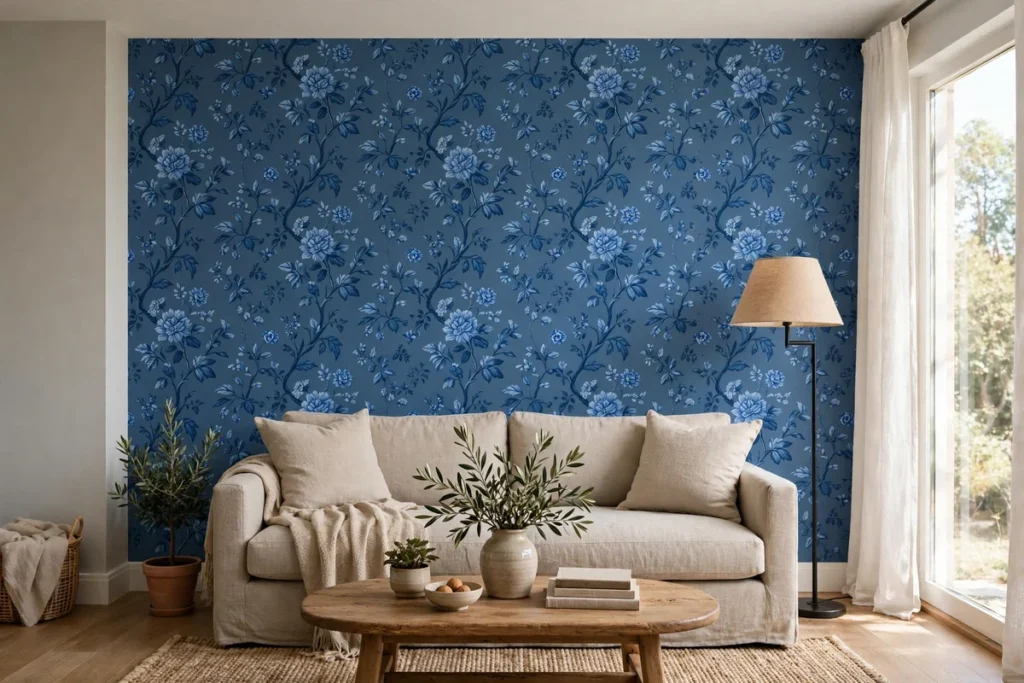
Blue patterned wallpaper adds texture and pattern that flat paint cannot match, from delicate florals to bold geometrics. Using it on one wall keeps the pattern from taking over, while still giving the room a designer feel. Pair a busy wallpaper with solid blue or neutral furniture so the room does not feel chaotic. Tip: choose a peel-and-stick wallpaper if you rent or like to change styles often, since it removes cleanly without damaging the wall.
Pattern scale is the key decision with wallpaper: a large-scale pattern suits a big wall behind a sofa, while a small, dense pattern can feel busy in the same spot. Order a sample first and tape it to the wall for a few days, checking it in daylight and lamplight. When hanging peel-and-stick paper, work from the top down and smooth air bubbles with a plastic smoother, since repositioning the paper more than twice weakens the adhesive.
5. Blue Painted Built-In Bookcases

Painting built-in bookcases blue turns ordinary storage into a statement feature. A deep blue makes books, plants, and decorative objects stand out, and it looks especially good with brass hardware and warm wood tones. If your bookcases are open, paint the backs a shade darker than the frames for extra depth. Tip: remove everything before painting, and use a durable satin finish that can handle books sliding in and out.
Before painting bookcases, sand glossy surfaces lightly and prime with a bonding primer, or the paint will chip the first time a heavy book slides across a shelf. Paint the shelf edges and the back panel in the same session so the color stays consistent, and let each coat dry fully before stacking books back. Leave books standing upright with a little breathing room, because tightly packed shelves hide the blue paint that was the whole point.
6. Blue Fireplace Surround as a Focal Point

A blue fireplace surround draws the eye straight to the heart of the room. Whether you paint an existing mantel navy or tile the surround in blue ceramic tiles, the fireplace becomes a piece of art rather than just a functional feature. Keep the mantel styling simple so the blue stays the star. Tip: use heat-resistant paint on any surface near the firebox, and test tile samples against your wall color first.
If you tile the fireplace surround, choose tiles rated for heat and use a grout color that complements the blue rather than fighting it: soft gray grout suits navy tile, while white grout makes pale blue tile pop. Keep the hearth clear of clutter so the surround stays visible, and style the mantel with just two or three items, such as a mirror, a vase, and a candle group, so the blue remains the focal point.
Blue Living Room Sofas and Furniture Ideas
If painting feels like a big step, start with furniture. A blue sofa or chair delivers the same impact and is easier to change later.
7. Blue Velvet Sofa as the Room’s Star

A blue velvet sofa is pure luxury: the fabric catches light beautifully and the color feels rich without being loud. Velvet works in both modern and traditional rooms, and a mid-blue or navy velvet hides everyday wear better than pale fabrics. Style it with neutral walls, a light rug, and metallic accents. Tip: keep a velvet brush handy for pet hair and dust, and choose a performance velvet if you have kids or pets.
Velvet shows pressure marks where people sit, so rotate and fluff the seat cushions weekly to keep the pile even. For daily care, vacuum with an upholstery attachment once a week, and blot spills immediately rather than rubbing, which pushes liquid deeper into the pile. If the sofa sits in sunlight, add sheer curtains, because strong sun fades navy velvet unevenly and leaves a pale patch where the light falls.
8. Blue Sectional Sofa for Family Living
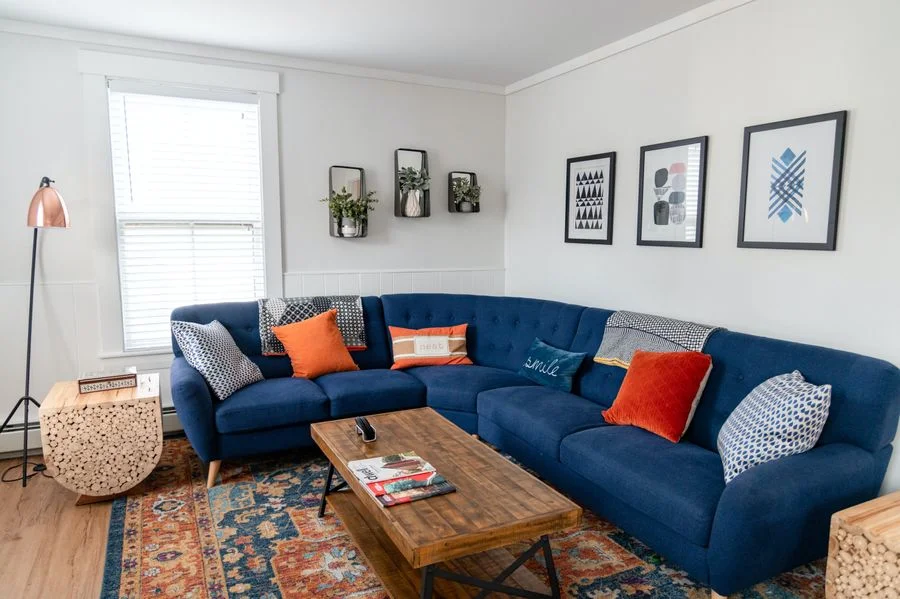
A blue sectional sofa anchors a large living room and gives everyone a place to sit, which makes it ideal for family movie nights. The large block of blue becomes the room’s color foundation, so you can keep walls neutral and add interest with cushions and throws. A chaise end adds lounging space without extra chairs. Tip: measure doorways and the full footprint before ordering, because sectionals are difficult to return once delivered.
A sectional’s chaise can go on the left or the right, so decide based on the room’s traffic path, not just the showroom layout. Leave at least 75 centimeters of walking space around the open side, and make sure the chaise does not block a radiator, a vent, or a doorway. Modular sectionals cost more but let you rearrange the layout later, which is worth it if you move house or redecorate often.
9. Blue Accent Chairs for a Pop of Color
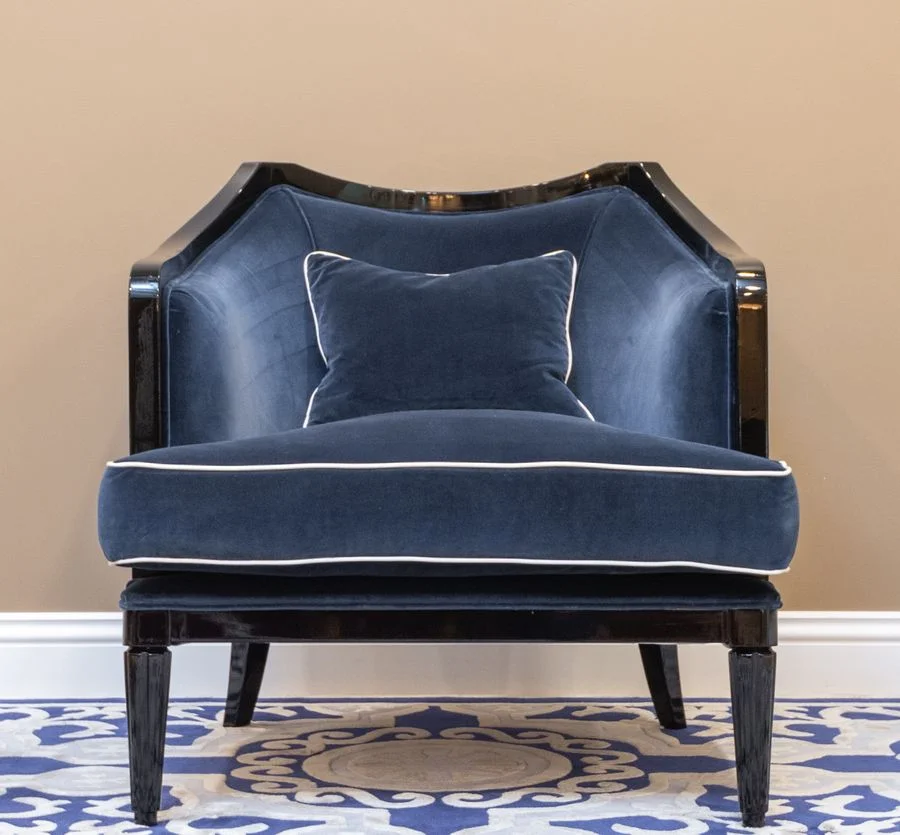
Blue accent chairs are the lowest-commitment way to try blue in your living room. A pair of blue chairs flanking a fireplace or facing the sofa adds symmetry and color without repainting anything. They also let you test a bold shade before committing to a blue sofa. Tip: match the chairs in shape but not necessarily in fabric, since mixed textures in the same blue look curated rather than matchy.
When buying a pair of accent chairs, check that the seat height matches your sofa within a few centimeters, or the conversation area will feel uneven. A chair with a seat height around 45 centimeters suits most standard sofas, and a slightly lower chair works if your sofa is low and lounge-like. Place a small side table between the two chairs so each seat has a place for a drink, which makes the pairing feel like a real seating zone.
10. Blue Ottoman or Coffee Table

A blue ottoman doubles as a coffee table, extra seating, and a footrest, all while adding a punch of color at the center of the room. An upholstered ottoman softens a room full of hard furniture, and a tray on top turns it into a stable surface for drinks. Tip: choose a stain-resistant fabric and a size that leaves about 45 centimeters of walking space around it.
Measure the ottoman against your sofa before buying: it should be about two thirds the length of the sofa and roughly the same height as the seat cushion. A storage ottoman with a lift-off top doubles as a blanket box, but a hinged top is easier to open one-handed when you are holding a drink. Choose a tray with raised edges for the top, because a flat tray slides off upholstery every time someone bumps it.
11. Blue Painted Coffee Table or Side Tables

Painting a coffee table or side tables blue is a weekend project with a big payoff. It is a great way to refresh thrifted or dated furniture, and the small scale means you can go bold with a bright cobalt or teal. Seal the paint well so the surface survives cups and books. Tip: paint only one or two small pieces blue, because too many painted pieces can make the room feel themed rather than styled.
Preparation decides whether painted furniture lasts: sand the old finish lightly, prime with a stain-blocking primer, and apply two thin coats of paint rather than one thick coat that drips and chips. A water-based polyurethane topcoat protects the surface from cups and books without yellowing the blue over time. Let the piece cure for at least 48 hours before heavy use, since paint feels dry long before it is fully hard.
Blue Living Room Textiles and Accent Ideas
Textiles are where blue living room ideas get cozy. Rugs, curtains, and cushions let you layer shades of blue without any permanent changes.
12. Blue Area Rug to Anchor the Seating Area

A blue area rug defines the seating zone and ties the sofa, chairs, and coffee table into one arrangement. A patterned blue rug hides stains better than a solid one, and it lets you pull in several blue tones at once. Make sure the rug is large enough that the front legs of all seating sit on it. Tip: layer a smaller textured rug over a large blue rug if you want extra warmth without replacing the main rug.
A flatweave or low-pile blue rug is easier to clean and to move furniture across than a thick shag rug, which matters in a busy living room. If you have pets, choose a patterned rug in mixed blues, because solid navy shows pet hair and lint immediately. Add a non-slip rug pad underneath, which stops the rug from creeping on hard floors and adds a little cushioning underfoot without changing the rug’s look.
13. Blue Curtains for Soft Color and Height

Blue curtains add soft color at eye level and make windows look taller when hung high and wide. Sheer blue curtains filter light beautifully, while heavier blue drapes add drama and insulation. Either way, curtains are an easy way to repeat the room’s blue in a second place, which makes the scheme feel balanced. Tip: hang the rod close to the ceiling and extend it beyond the window frame so the window appears larger.
For lined curtains, choose a lining color that matches the face fabric, because an unlined or white-lined blue curtain looks pale from outside and can look washed out from inside in bright light. If the window gets strong sun, a blackout lining protects the blue fabric from fading and helps the room stay cool. Wash or dry-clean curtains once a year, since dust settles into folds and dulls the color gradually.
14. Layered Blue Throw Pillows on the Sofa

Layered blue throw pillows are the fastest blue living room idea of all: mix navy, sky blue, and patterned blues in different sizes and textures. The mix keeps the sofa from looking flat, and you can swap covers seasonally for a fresh look. Stick to odd numbers of pillows for a relaxed, styled appearance. Tip: use feather-filled inserts one size larger than the cover, which makes pillows look plump and expensive instead of limp.
Start with the largest pillows at the back, then layer smaller patterned pillows in front, and finish with one small lumbar pillow for shape. Use inserts in natural down or a down alternative, because synthetic hollow-fiber inserts flatten quickly and make even expensive covers look cheap. Keep pillow covers washable where possible, and rotate which pillows sit in the sunniest spot so fading stays even across the set.
15. Blue Throw Blankets for Cozy Layers

A blue throw blanket draped over a sofa arm or folded in a basket adds instant coziness and another layer of blue. Chunky knits feel wintery, while lightweight cotton or linen throws suit summer. The blanket also makes the room feel lived-in rather than staged. Tip: choose a throw in a slightly different blue than your pillows, because contrast between shades looks more interesting than one flat color.
A throw in a washable fabric earns its place far more often than a dry-clean-only showpiece, especially in a room used every day. Fold a throw into thirds and drape it over the sofa arm for a tidy look, or toss it loosely across the seat back for a more relaxed feel. Keep a second throw in a basket nearby so guests can grab one without unfolding your styled arrangement, and wash throws monthly if pets use them.
16. Blue Wall Art and Gallery Wall
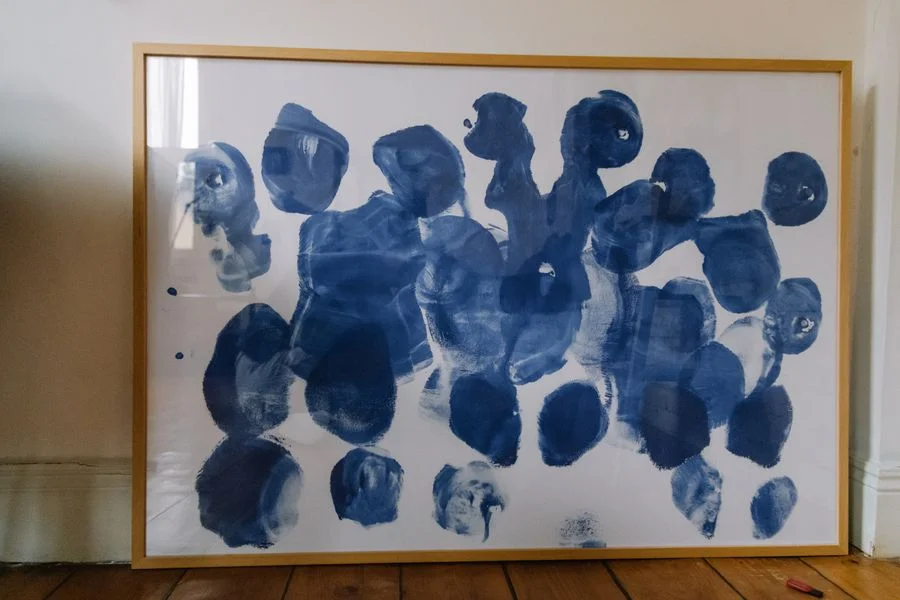
Blue wall art lets you bring in the color without touching furniture or walls. Abstract blue prints, coastal photography, or botanical art in blue tones all work, and a gallery wall lets you mix several pieces into one feature. Repeat one blue from the art in a cushion or rug to connect the wall to the rest of the room. Tip: hang art at eye level, about 145 centimeters from the floor to the center of the piece, for a gallery look.
When building a gallery wall, keep the spacing between frames consistent, about 5 to 8 centimeters, so the group reads as one display rather than random pictures. Use frames in two finishes at most, such as black and natural wood, to keep the blue art cohesive. Before hammering nails, lay the whole arrangement on the floor and take a photo, which makes it easy to adjust spacing without extra holes in the wall.
17. Blue and Gold Accent Pairing
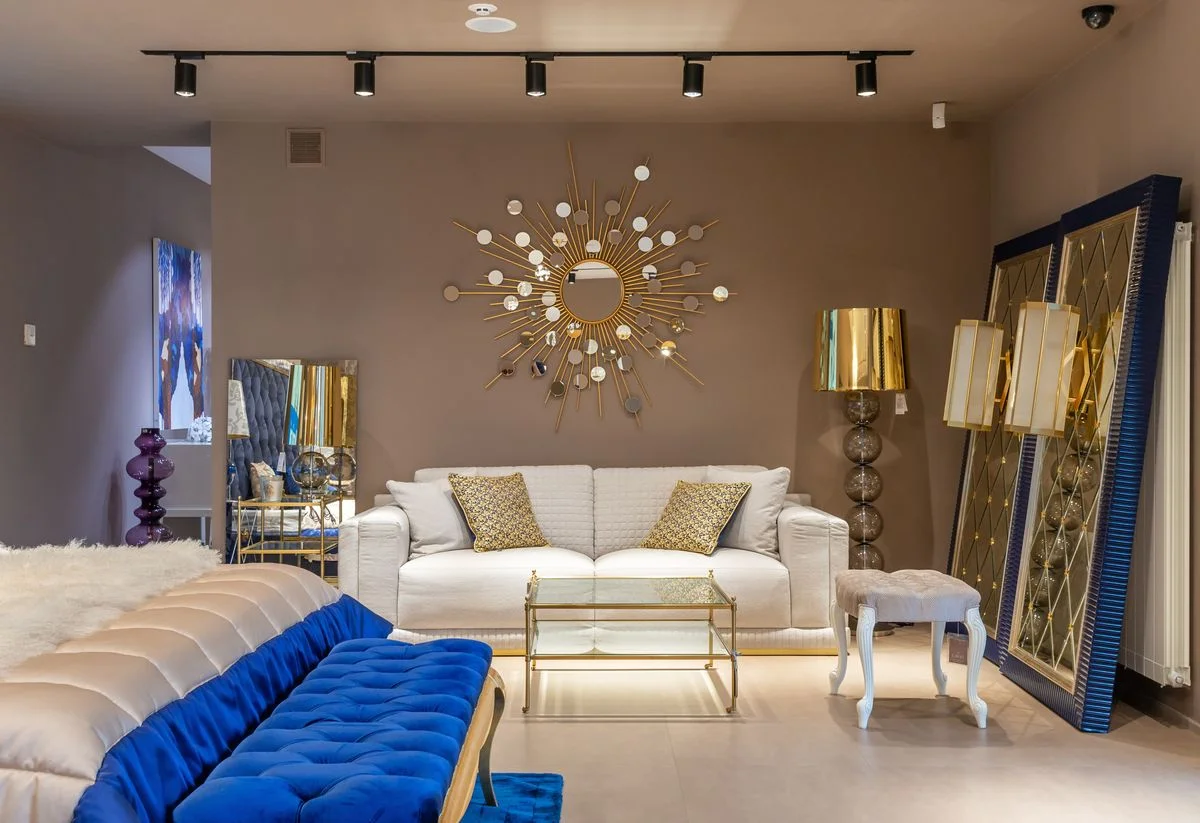
Blue and gold is a classic pairing that feels both elegant and warm. Gold frames, brass lamps, and metallic cushions lift navy and royal blue, stopping them from feeling cold or heavy. A little gold goes a long way, so use it in small accents rather than large surfaces. Tip: mix brushed brass with one other warm metal at most, because too many metallic finishes can make the room feel busy.
Gold works best as a highlight, not a main color, so limit it to about ten percent of the room: a lamp base, a mirror frame, and a couple of cushion trims is plenty. Brushed brass suits relaxed rooms, while polished gold suits formal ones, and mixing the two finishes in one room can look accidental. If your room already has chrome or silver hardware, test a brass accent beside it first, since warm and cool metals can clash.
18. Blue With Natural Wood Tones

Blue paired with natural wood is one of the most livable blue living room ideas, because wood warms up blue’s coolness. Oak coffee tables, walnut shelves, and rattan baskets all soften a blue scheme and keep it from feeling formal. This combination works especially well in Scandinavian and coastal styles. Tip: keep wood tones consistent across the room, since mixing too many wood colors can fight with the blue.
To keep wood tones consistent, pick one dominant wood, such as oak or walnut, and let smaller pieces echo it rather than introducing three new woods. A rattan basket or a woven tray counts as a warm natural texture too, and it breaks up solid wood surfaces without adding another color. If your floor is a strong wood tone, choose furniture in a slightly different shade of the same family so the room does not look like a single block of wood.
Blue Living Room Styles and Finishing Touches
Once the main pieces are in place, these styling ideas pull the whole blue scheme together.
19. Coastal Blue Living Room Style
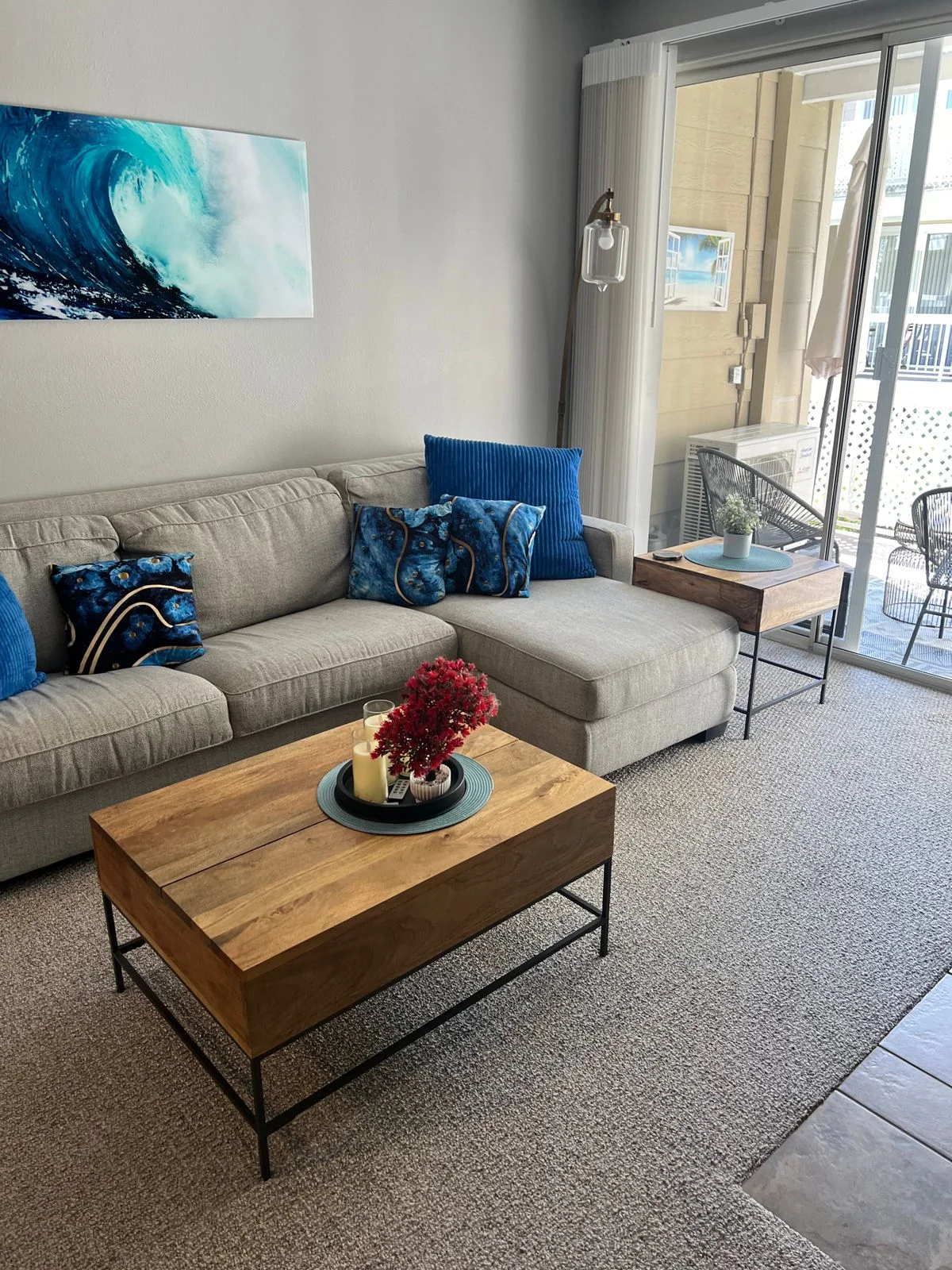
A coastal blue living room mixes soft blues with white, sand tones, and natural textures like jute, linen, and driftwood. The result feels breezy and relaxed rather than beach-themed, especially if you skip literal seashell decor. Striped cushions and a light blue rug complete the look. Tip: keep the palette to three colors at most, because coastal style works through restraint, not through filling the room with beach objects.
Coastal blue works best when the blue stays soft and desaturated, closer to sea-glass than to bright turquoise, which can look garish away from the beach. Add texture through linen, jute, and washed wood rather than through nautical objects, and keep the room’s metal finishes to one warm or one cool tone. A striped cushion or throw is enough pattern for most coastal rooms, since too many stripes quickly feel like a theme park.
20. Dark Moody Blue Living Room
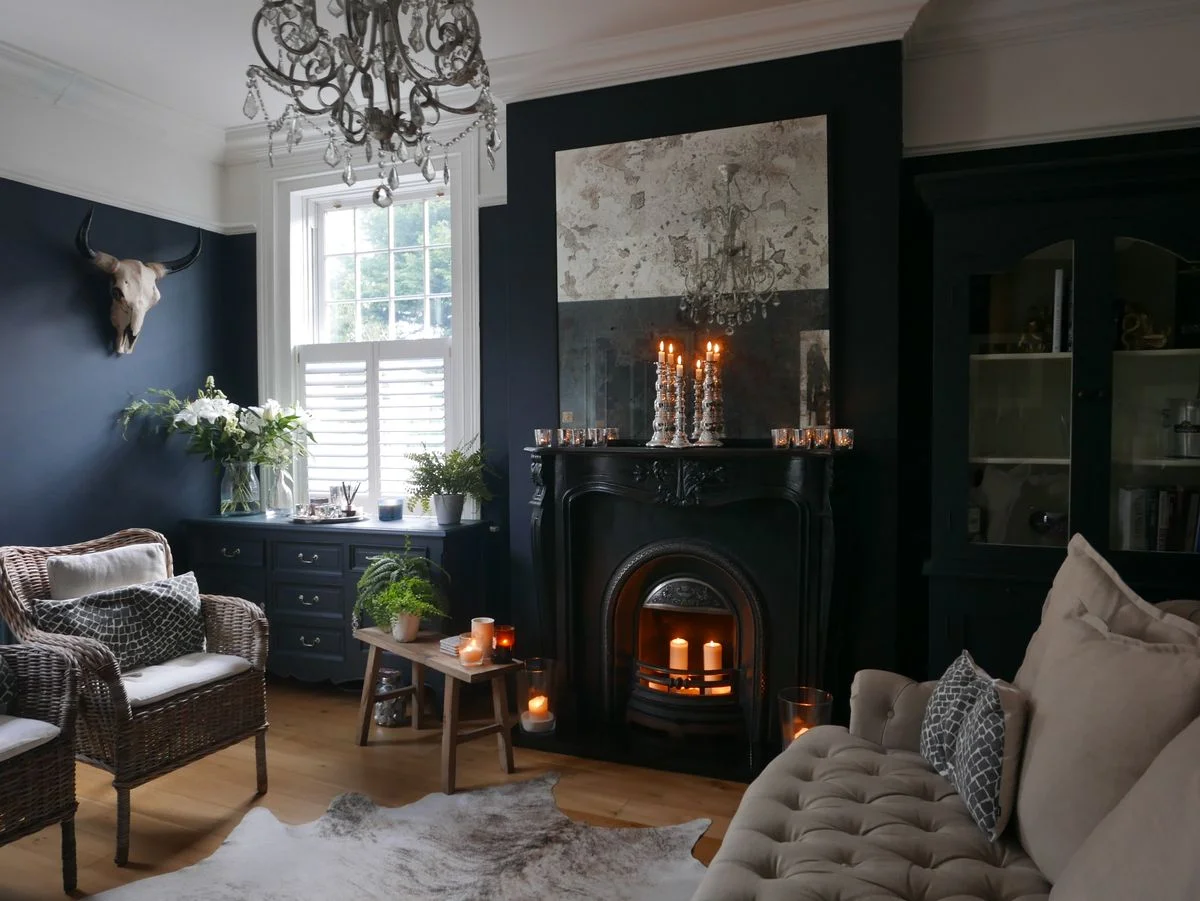
A dark moody blue living room wraps the space in deep navy or ink blue, creating a cozy, cocoon-like feel that is perfect for evenings. The trick is layering warm lighting: table lamps, candles, and warm-white bulbs stop the dark walls from feeling gloomy. Add velvet, leather, and brass for richness. Tip: paint the ceiling a lighter shade or keep it white, so the room feels cocooned rather than closed in.
Layering light is essential in a dark room: combine a ceiling light on a dimmer with at least two table lamps and one floor lamp, so no corner stays in shadow. Use warm-white bulbs around 2700K, because cool white bulbs make navy walls look gray and uninviting. Add a mirror opposite a lamp to bounce light around the room, and keep window treatments light so daytime light is not blocked by heavy drapes.
21. Blue Living Room With Plenty of Plants

Plants are the perfect partner for blue, because green and blue sit side by side in nature and always look harmonious. A few large plants soften blue walls, while trailing plants on shelves add life to a blue bookcase. Terracotta or white pots keep the focus on the blue and green. Tip: group plants in odd numbers and vary their heights, which looks more natural than lining them up in a row.
Choose plants that suit your light before falling for a look: a fiddle-leaf fig needs bright indirect light, while pothos and ZZ plants tolerate lower light and occasional neglect. Group plants with similar watering needs together, so you do not overwater a succulent while trying to keep a fern happy. Use pots with drainage holes and a saucer, because standing water rots roots quickly and stains blue-painted shelves or sills.
22. Blue Reading Nook in the Living Room Corner

A blue reading nook turns an unused living room corner into the coziest spot in the house. A blue armchair, a small side table, a reading lamp, and a soft throw are all you need, and the blue chair ties the nook into the rest of the room. Add a small shelf for books within arm’s reach. Tip: place the nook near a window for natural reading light, and keep the chair angled toward the room so the corner still feels connected.
A good reading lamp matters more than a fancy chair: choose a lamp with an adjustable arm and a warm bulb bright enough to read by without glare. Keep a small basket beside the chair for the book you are reading and a charging cable, so the nook stays tidy. If the corner is drafty, add a small rug under the chair, which warms the feet and marks the nook as its own zone within the larger room.
How to Choose the Right Blue for Your Living Room
Start with your room’s light: north-facing rooms suit warmer blues with a hint of green or gray, while sunny south-facing rooms can handle cooler, crisper blues. Then decide how much blue you want: walls and sofas for a bold commitment, or cushions, rugs, and art for a flexible version you can change later. Always test large swatches at home, because blue shifts dramatically under different lighting. Finally, repeat your chosen blue in at least three places around the room, which is what makes the scheme feel intentional instead of random.
Frequently Asked Questions About Blue Living Rooms
Is blue a good color for a living room?
Yes, blue is one of the best living room colors because it feels calm and works with almost every style, from coastal to modern to traditional. Lighter blues make rooms feel larger and brighter, while darker blues add coziness and drama. The key is matching the shade to your room’s size and light.
What colors go well with a blue living room?
White, cream, and light gray are the safest partners for blue, while natural wood adds warmth. Gold and brass bring elegance, and soft greens or blush pink add a gentle contrast. For a bolder look, mustard yellow or burnt orange complement blue beautifully as accent colors.
Does a dark blue living room make the room look smaller?
Dark blue can make a room feel cozier, but it does not have to make it feel smaller. Keep the ceiling and trim light, use mirrors and good lighting, and balance dark walls with lighter furniture. In a very small room, use dark blue on one accent wall rather than all four.
How can I add blue to my living room without painting?
Start with a blue rug, throw pillows, curtains, and wall art, which together can transform a room in an afternoon. A blue accent chair or ottoman adds a bigger statement without any painting. These pieces are also easy to swap out if you want a different look later.
Blue is one of those rare colors that never really goes out of style, and now you have 22 blue living room ideas to make it your own. Start with the change that excites you most, whether that is a navy accent wall, a velvet sofa, or simply a stack of blue pillows. Pin this guide to your home decor board so you can come back to it while you shop, and save the ideas that fit your room best!
Photos: Pexels (free to use).


