
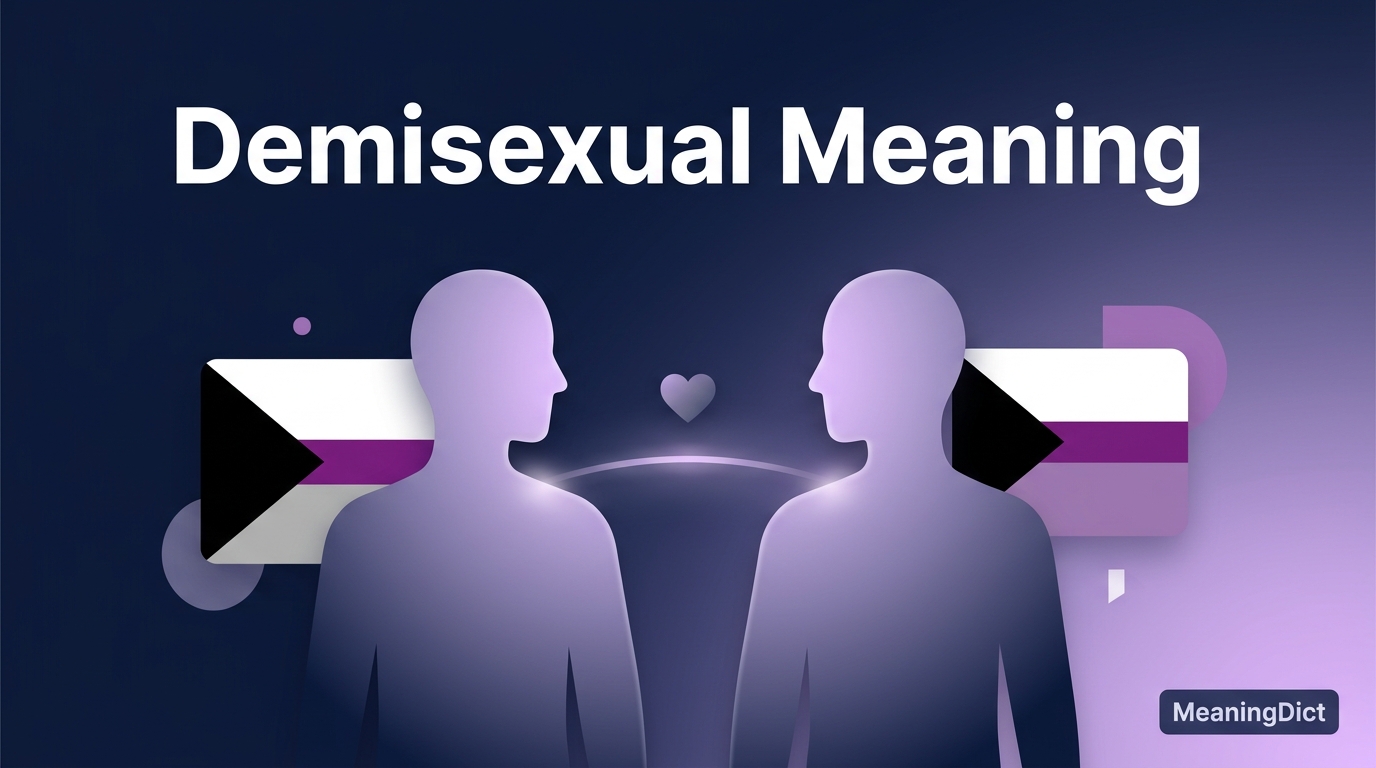
Demisexual Meaning: Signs, Attraction, Dating, and Flag Explained
Demisexual meaning is often misunderstood as simply “wanting to take things slowly.” The term is more specific. A demisexual person usually does not experience sexual attraction toward someone unless a meaningful emotional bond has already formed. That bond may grow through trust, friendship, emotional safety, shared experiences, or romantic closeness. Even after a bond develops, sexual attraction is possible, not guaranteed.
Demisexuality describes how sexual attraction appears, not who a person is attracted to. Someone can therefore identify as demisexual and also be straight, gay, lesbian, bisexual, pansexual, or use another label. It also does not tell you whether someone enjoys sex, has a high or low libido, wants a relationship, or plans to wait before becoming physically intimate.
For readers looking for clear explanations of identity and modern vocabulary, MeaningDict offers plain-language definitions that focus on context rather than one-line translations. This guide explains demisexuality without stereotypes so you can understand the label, compare it with related identities, and decide whether it reflects your own experience.
What Does Demisexual Mean?
Demisexual means a person experiences sexual attraction only after developing a strong emotional connection with someone. The Trevor Project, Stonewall, and Merriam-Webster describe the term in closely related ways: emotional bonding comes before sexual attraction rather than attraction appearing immediately from looks, chemistry, or a first meeting.
The emotional bond is a necessary condition, but it is not a promise. A demisexual person may become very close to someone and still never feel sexually attracted to them. The connection simply creates the possibility of attraction.
Demisexuality is also different from choosing not to have sex early in a relationship. A person may feel immediate sexual attraction but decide to wait because of personal values, safety, religion, or comfort. A demisexual person generally does not feel that attraction in the first place before the required bond exists.
In one sentence: Demisexuality is a pattern in which sexual attraction becomes possible only after meaningful emotional closeness has developed.
What Is the Meaning of Demisexual in Simple Words?
In simple words, a demisexual person normally needs to feel emotionally close to someone before sexual attraction can begin. They may notice that a stranger is stylish, attractive, or good-looking, yet feel no sexual pull toward that person. Attraction may appear later, after trust and a real personal connection have formed.
Think of emotional closeness as a doorway rather than a switch. Until the doorway opens, sexual attraction is usually absent. Once it opens, attraction may develop, but it does not have to. This is why “demisexual” does not mean being attracted to every close friend.
It also does not simply mean being careful, shy, traditional, or selective about sex. Those words describe personality, choices, or behavior. Demisexuality describes the conditions under which sexual attraction is experienced.
A useful simple definition is: “I usually do not feel sexually attracted to someone until I know them deeply and feel a strong emotional bond.” The length of time needed can differ widely from one demisexual person to another.
What Does It Mean to Be Demisexual?
Being demisexual means your experience of attraction may follow a different order from what dating culture often expects. Many people feel sexual attraction first and then decide whether to build emotional intimacy. A demisexual person commonly needs emotional intimacy first; sexual attraction, when it develops, comes afterward.
This can affect how crushes, dating apps, celebrity attraction, and casual encounters feel. Profile photos or first impressions may not create sexual interest, even when the person can recognize beauty or charm. Friendship-based relationships may feel more natural because they provide time for trust and emotional familiarity to grow.
However, no two demisexual people behave exactly alike. One may enjoy dating, flirting, and sex after connection forms. Another may have little interest in sexual activity. Some develop attraction after weeks, while others need months or years.
The label does not impose rules. It gives language to a recurring pattern of attraction. People use it because the term helps them understand themselves, communicate expectations, and find others with similar experiences.
How Do I Know If I Am Demisexual?
There is no medical test, quiz score, or required dating history that can prove someone is demisexual. The most useful approach is to look for a consistent pattern: sexual attraction usually does not appear until you have formed a strong emotional connection with a particular person.
Ask yourself whether you have ever felt sexually drawn to strangers, celebrities, new dates, or people you barely knew. Then consider whether your strongest sexual attraction appeared only after trust, vulnerability, and closeness developed. You may also notice that attraction grows out of friendship rather than beginning with physical chemistry.
Do not judge yourself only by whether you have had sex. Behavior and attraction are different. Someone can have sex without sexual attraction or avoid sex while feeling strong attraction. Libido is also separate: general sexual desire does not always focus on a specific person.
A label should clarify your experience, not trap you. You may try “demisexual,” use it privately, combine it with another orientation, or stop using it later if it no longer feels accurate.
What Are the Signs of Being Demisexual?
Possible signs of being demisexual are patterns, not diagnostic criteria. The clearest sign is that person-specific sexual attraction tends to appear only after a deep emotional bond has formed. Recognizing someone as beautiful, liking affection, or having a libido does not cancel that pattern.
You may relate to several experiences:
- Sexual attraction to strangers or new dates is rare or absent.
- Close friendship often comes before sexual interest.
- Emotional trust matters more than appearance alone.
- Instant sexual chemistry feels unfamiliar.
- Photo-based dating apps may feel confusing or unhelpful.
- You can enjoy romance or physical closeness without sexual attraction.
- Attraction may surprise you after knowing someone for a long time.
None of these signs is compulsory. A shy person, someone recovering from a difficult relationship, or a person who prefers slow dating may share some of them without being demisexual.
Focus on the reason beneath the behavior. Demisexuality concerns when sexual attraction becomes possible, not how cautious, moral, experienced, selective, or socially confident someone appears.
See Also: Gooning Meaning: Slang, TikTok Use, Effects, and Risks
Is Demisexual a Sexual Orientation?
Yes. Demisexual is widely used as a sexual-orientation label because it describes a recurring pattern in how a person experiences sexual attraction. Merriam-Webster defines it around attraction that occurs only after an emotional bond, while LGBTQ+ organizations place it within the broader ace or asexual spectrum.
Some people call demisexuality a conditional orientation because it answers a different question from labels such as straight, gay, or bisexual. Demisexual explains how or under what condition sexual attraction develops. Straight, gay, bisexual, and pansexual usually describe toward whom attraction may be directed.
That is why combined labels can be useful. A person might identify as heteroromantic demisexual, bi demisexual, gay demisexual, or panromantic demisexual.
The label is not a disorder, a phase that must be corrected, or a promise about sexual behavior. It is a self-description. Individuals decide which words fit them, and no outsider can assign an orientation based only on dating pace, relationship status, personality, clothing, or sexual experience.
Is Demisexual Part of the Asexual Spectrum?
Yes. Demisexuality is generally included in the asexual, or ace, spectrum. The ace spectrum covers people whose experience of sexual attraction is absent, limited, infrequent, variable, or dependent on particular conditions. Stonewall specifically includes demisexual and gray-sexual identities under the ace umbrella.
A demisexual person may feel no sexual attraction toward most people and experience it only after a strong emotional bond with a specific person. That conditional pattern differs from the more common allosexual experience, in which sexual attraction can occur without deep emotional closeness.
Being on the ace spectrum does not require someone to avoid relationships or sex. Ace-spectrum people can date, fall in love, marry, have children, enjoy sexual activity, dislike it, or feel neutral about it. Attraction, behavior, romantic interest, and libido are related concepts, but they are not identical.
Some demisexual people strongly identify with the ace community; others use only “demisexual.” Both choices are valid forms of self-description.
Can a Demisexual Person Fall in Love?
Yes. A demisexual person can fall in love, build a romantic relationship, marry, or form any kind of committed partnership. Demisexuality concerns sexual attraction, not the ability to experience love, care, attachment, or romance. The Trevor Project notes that sexual attraction is only one type of attraction and that ace-spectrum people may date, fall in love, and marry.
Romantic and sexual attraction may also follow different timelines. A demisexual person might develop romantic feelings before sexual attraction, experience both after emotional closeness, or feel romantic love without ever becoming sexually attracted to that partner.
Some people are both demisexual and demiromantic, meaning emotional bonding is typically needed before both sexual and romantic attraction can develop. Others are demisexual but experience romantic crushes quickly.
Love is not proof that sexual attraction will appear. A close bond may create the possibility of sexual attraction, but it does not guarantee it. Healthy relationships therefore depend on honest communication about affection, boundaries, intimacy, expectations, and the forms of connection each partner values.
Can Demisexual People Feel Physical Attraction?
Yes, but “physical attraction” can mean different things. A demisexual person may immediately notice that someone looks beautiful, enjoy their style, want to hug them, or feel comfortable with nonsexual touch. These experiences may involve aesthetic, sensual, or romantic attraction rather than sexual attraction. The Trevor Project emphasizes that sexual attraction is only one type of attraction.
Sexual attraction is more specific: it is a person-directed sexual pull or interest. For a demisexual person, that form of attraction generally becomes possible only after emotional bonding. Before that point, they may still admire someone’s appearance without wanting sexual contact with them.
This distinction explains why a demisexual person can call an actor attractive, appreciate a date’s appearance, or enjoy kissing without necessarily experiencing sexual attraction in the same way another person does.
Language is personal, so not everyone separates attraction into neat categories. The important question is what the feeling means to the individual. Demisexuality does not remove awareness of beauty or all desire for touch; it describes the pathway to sexual attraction.
Do Demisexual People Experience Sexual Attraction?
Yes, many demisexual people experience sexual attraction, but it usually occurs only after a strong emotional bond has developed. That is the central difference between demisexuality and identities defined by a complete or near-complete absence of sexual attraction.
The frequency and strength of attraction vary. One person may feel intense sexual attraction toward a long-term partner. Another may experience it rarely, weakly, or only once or twice in life. A bond creates the condition in which attraction can happen; it does not automatically produce attraction.
Sexual attraction should also not be confused with libido. Libido is a general drive or interest in sexual release, while attraction is directed toward a particular person. A demisexual individual may have a high, medium, low, or changing libido.
Likewise, sexual behavior cannot reveal orientation by itself. A demisexual person may enjoy sex, choose not to have it, have sex before attraction develops, or prefer other forms of intimacy. The label explains an attraction pattern rather than setting rules for conduct.
What Is the Difference Between Demisexual and Asexual?
The main difference is the possibility of sexual attraction. A demisexual person may experience sexual attraction after forming a strong emotional bond. An asexual person typically experiences little or no sexual attraction, although individual ace experiences vary across a broad spectrum.
| Point | Demisexual | Asexual |
|---|---|---|
| Sexual attraction | May develop after emotional bonding | Usually absent or very limited |
| Emotional bond | Common prerequisite for sexual attraction | Does not necessarily create sexual attraction |
| Relationships | May want romantic or sexual relationships | May want romantic relationships, sexual relationships, both, or neither |
| Ace spectrum | Included | Included |
The two identities overlap because demisexual people generally do not experience sexual attraction without the required connection. However, “asexual” and “demisexual” are not interchangeable for everyone.
Neither term reveals libido, sexual behavior, comfort with sex, or romantic orientation. An asexual person may enjoy sex; a demisexual person may not. The best distinction focuses on the presence and conditions of attraction, not assumptions about what someone does in private.
See Also: Introvert Meaning: Definition, Signs, Types and Examples
What Is the Difference Between Demisexual and Pansexual?
Demisexual and pansexual answer different questions, so a person can be both. Demisexuality describes how sexual attraction develops: it generally requires a strong emotional bond first. Pansexuality describes who may be included in someone’s attraction: people of any gender may be potential partners.
A pansexual person may experience attraction quickly, slowly, or only after connection. The word “pansexual” alone does not specify timing. Likewise, “demisexual” does not specify the genders toward which attraction may eventually develop.
For example, a pansexual demisexual person may have the potential to become sexually attracted to people of any gender, but only after emotional closeness forms. A straight demisexual person may require the same kind of bond while experiencing attraction toward a different-gender person.
This distinction is sometimes summarized as conditions versus direction. Demisexual identifies a condition surrounding attraction; pansexual identifies its possible gender scope. Using both labels can provide a fuller description without creating a contradiction.
What Is the Difference Between Demisexual and Sapiosexual?
Demisexuality and sapiosexuality both relate to qualities that may influence attraction, but they do not mean the same thing. Demisexuality describes sexual attraction that becomes possible after a strong emotional bond. Sapiosexual generally refers to being sexually attracted to intelligence or finding intelligence especially sexually appealing.
An intelligent conversation can help emotional intimacy grow, but intelligence alone is not the defining requirement for demisexual attraction. A demisexual person may value humor, kindness, reliability, vulnerability, shared history, or many other qualities while forming a bond.
A sapiosexual person might feel attraction quickly after noticing someone’s intellect, even without a deep emotional connection. Another person may identify as both sapiosexual and demisexual: intelligence is a strong source of attraction, yet sexual attraction still does not emerge until emotional trust develops.
People often use sapiosexual as an attraction descriptor or dating preference, and its usage may vary between individuals. Respectful conversation is therefore more accurate than assuming everyone who uses the word has one fixed experience.
What Does Demisexual Mean in a Relationship?
In a relationship, demisexual means sexual attraction may depend on emotional safety, trust, and closeness rather than appearing at the beginning. A demisexual partner may genuinely like someone, enjoy dates, and want commitment while still not feeling sexual attraction yet. This should not automatically be read as rejection or lack of interest.
The bond may grow through honest conversation, consistency, shared experiences, respect, and feeling understood. There is no universal deadline. Attraction may develop after weeks, months, years, or not at all.
Communication matters because partners may attach different meanings to sex, affection, and desire. Useful conversations can cover boundaries, preferred forms of touch, exclusivity, reassurance, expectations, and how each person recognizes intimacy.
A demisexual partner should not be pressured to prove love through sex. At the same time, both people are allowed to have needs and decide whether a relationship is compatible. Healthy partnership comes from consent, patience, and mutual clarity—not from assuming emotional closeness guarantees future sexual attraction.
How Does Demisexual Dating Work?
Demisexual dating works like any other dating process, but emotional connection may need more time before sexual attraction appears. Many demisexual people prefer conversation-rich dates, shared activities, friendship-first connections, or profiles that reveal values and personality rather than relying mainly on photos.
It can help to explain the label early in plain language: “I usually need a strong emotional bond before I feel sexual attraction.” This communicates a pattern without promising a specific timeline or outcome.
Practical dating approaches include:
- Choose low-pressure settings where conversation feels natural.
- State boundaries around touch and sexual expectations.
- Separate emotional interest from sexual readiness.
- Look for patience and respect rather than forced chemistry.
- Leave situations where consent or identity is dismissed.
Demisexual people can use dating apps, pursue casual dating, or prefer long-term relationships. No format is automatically right or wrong. The key is finding a pace that allows genuine connection while respecting both people’s needs. Emotional closeness should develop freely; it should never be treated as a transaction that earns sex.
Can You Be Demisexual and Straight or Bisexual?
Yes. A person can be demisexual and straight, bisexual, gay, lesbian, pansexual, queer, or use another orientation label. Stonewall explains that ace-spectrum people may combine ace identities with terms such as straight, bi, lesbian, gay, or queer to describe the direction of their attraction.
The labels describe different dimensions:
- Demisexual explains the condition under which sexual attraction may develop.
- Straight, bisexual, gay, or pansexual describes the gender or genders toward whom attraction may be directed.
- Romantic labels such as heteroromantic, biromantic, or panromantic can describe romantic attraction separately.
A bisexual demisexual person, for example, may potentially experience sexual attraction toward more than one gender, but only after forming a strong emotional bond. A straight demisexual person may experience that conditional attraction toward a different-gender person.
People do not need to use multiple labels. Some prefer “demisexual,” while others find combined terms more precise. The right wording is the one that helps the individual communicate without feeling restricted.
What Does the Demisexual Flag Mean?
The demisexual pride flag commonly uses a black triangle at the left with white, purple, and gray horizontal areas. Its colors connect demisexuality with the wider ace-spectrum community. The Human Rights Campaign explains the usual symbolism: black represents asexuality, gray represents demisexuality, white represents sexuality, and purple represents community.
The design is visually related to the asexual flag, reflecting demisexuality’s place within the ace spectrum. Sources note that the exact creator and original date of the demisexual flag are not clearly established.
People display the flag during Pride events, use it in profile images, wear its colors, or include it in artwork to express identity and visibility. Using the flag is optional; someone does not need to own, display, or even like it to be demisexual.
The flag represents community recognition, not a test of identity. Personal experience and self-understanding matter more than symbols, labels, or public disclosure.
See Also: What Does GMT Mean in Text? Meaning, Uses & Examples
Frequently Asked Questions
Does Demisexual Mean You Only Have Sex With People You Love?
No. Demisexuality describes sexual attraction, not a rule about when someone has sex. Emotional bonding is generally needed before person-directed sexual attraction can develop, but the bond does not always have to be romantic love. A demisexual person may choose to have sex without attraction, wait until love develops, avoid sex, or make different decisions in different relationships.
Is Everyone Who Prefers Emotional Connection Demisexual?
No. Many people value trust or prefer committed relationships while still experiencing immediate sexual attraction. Demisexuality is more specific: sexual attraction itself is generally absent until a strong emotional bond forms. The difference is not simply choosing to wait; it is the underlying pattern of attraction before the choice is made.
Can Someone Become Demisexual Later in Life?
Someone may discover the label later, understand past experiences differently, or find that the words used for their orientation change over time. Labels are tools for self-description, not permanent contracts. However, a temporary change in sexual interest does not by itself establish a demisexual identity. The label concerns the broader pattern of when person-directed sexual attraction becomes possible.
Is Demisexual the Same as Demiromantic?
No. Demisexual refers to sexual attraction developing after an emotional bond. Demiromantic refers to romantic attraction developing after an emotional bond. A person can be one, both, or neither because romantic and sexual attraction do not always follow the same pattern.
Do Demisexual People Have Celebrity Crushes?
They can, but the experience varies. Some may admire a celebrity aesthetically or romantically without sexual attraction. Others may feel familiarity through interviews, stories, or a public personality and interpret that perceived connection as part of a crush. A celebrity crush does not confirm or disprove demisexuality; the person’s broader attraction pattern matters more.
Is Demisexuality a Choice?
No. The attraction pattern itself is not a decision. A person can choose whether to date, have sex, disclose a label, or enter a relationship, but they do not simply choose when sexual attraction appears. Demisexuality should not be confused with celibacy, abstinence, modesty, or a personal rule about waiting.
Final Thoughts
Demisexual meaning becomes easier to understand once attraction is separated from behavior. A demisexual person generally needs a meaningful emotional bond before sexual attraction can become possible. The identity does not reveal gender preference, libido, romantic ability, dating style, or willingness to have sex.
Some people recognize themselves immediately in the definition; others need time to compare it with asexuality, graysexuality, romantic attraction, or personal relationship preferences. There is no required test and no requirement to claim a label publicly. The purpose of the word is to make an experience easier to understand and communicate.
MeaningDict can serve as a simple reference when you encounter identity terms online, but respectful self-description always comes first. Use the words people choose for themselves, avoid assumptions, and ask thoughtful questions only when appropriate.


![White Heart Meaning in Text — What It Really Means [2026]](https://meaningdict.com/wp-content/uploads/2026/05/White-Heart-Meaning-in-Text-—-What-It-Really-Means-2026-768x429.jpeg)
4 Comments