
Surreal Meaning: Definition, Origin & Examples
Surreal means strangely dreamlike, as if something belongs to a dream rather than ordinary reality.
If a moment ever left you blinking and thinking “this can’t actually be happening,” you already know what surreal feels like. In this guide I’ll give you the exact definition, the French origin, how an art movement from 1920s Paris turned this word into an everyday favorite, how to use it in texts and captions, and a disambiguation table so you never mix it up with bizarre or uncanny again.
- What Does Surreal Mean?
- The Origin of “Surreal”
- From Art Galleries to Group Chats
- How People Use Surreal Today
- Is “Surreal” Slang?
- Surreal vs Bizarre vs Uncanny vs Dreamlike
- Example Sentences
- Synonyms and Antonyms
- Word Family: Surrealism, Surrealist, Surreally, Surreality
- Frequently Asked Questions
- Where to Learn More
What Does Surreal Mean?
Surreal means strangely dreamlike, disorienting, or beyond what feels real. It describes moments, scenes, or feelings that seem to have slipped out of a dream and into waking life.
Merriam-Webster defines surreal in three senses: “marked by the intense irrational reality of a dream,” “very strange or unusual,” and “of or relating to surrealism.” Dictionary.com puts it as “having the disorienting, hallucinatory quality of a dream; unreal; fantastic.” Cambridge sums it up in the simplest way: “strange; not seeming real; like a dream.”
In everyday speech, the word sits between wonder and weirdness. When someone says “the whole evening felt surreal,” they usually mean it in a good way, as if life briefly turned cinematic. But surreal can lean unsettling too. A quiet, empty airport at 3 a.m. can feel surreal because nothing about it matches your normal sense of how the world works. The common thread is always the same: reality stops feeling quite real.
Grammatically it is an adjective. You would say “a surreal experience,” “the scene was surreal,” or “meeting her felt surreal.” It is not a noun in standard use, so phrases like “what a surreal” are off; say “what a surreal moment” instead.
The Origin of “Surreal”
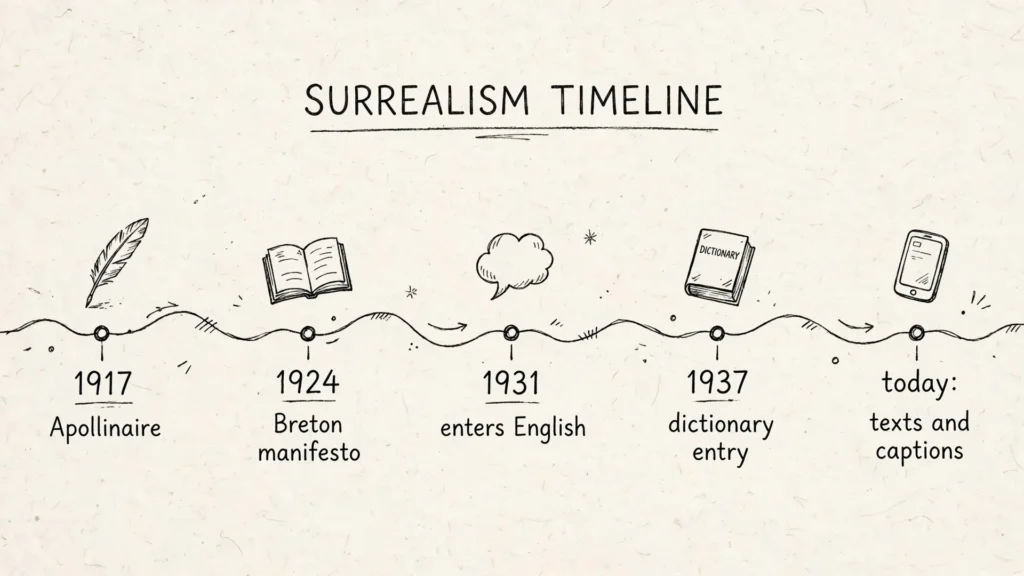
Surreal comes from the French word surréalisme, built from sur- (“beyond”) plus réalisme (“reality”), so it literally means “beyond reality.” The French term was coined around 1917 by the poet Guillaume Apollinaire and was taken up by André Breton for the Surrealist movement launched in 1924. It reached English first in its French form, and the shortened English adjective “surreal” followed in the 1930s, a back-formation from “surrealism.”
Etymonline traces the story through the Oxford English Dictionary’s second edition: Apollinaire coined the French word around 1917, Breton adopted it for the movement launched in 1924 with the Manifeste de Surréalisme, the Englished version dates to 1931, and English at first used the word in its French form before shortening it. Merriam-Webster adds that the first known use of the English adjective was in 1937, in the sense relating to Surrealism, and notes that “surreal” itself is a back-formation from “surrealism.”
There is a little wobble in dates across sources: Dictionary.com records the English word from 1935–40, while Merriam-Webster records 1937. That kind of range is normal for a word that crossed languages slowly. What every source agrees on is the French root, the meaning “beyond reality,” and the 1924 launch of Surrealism as the movement that carried the word into English.
From Art Galleries to Group Chats
The word jumped from Paris galleries to everyday speech because the Surrealist movement itself was about the everyday mind: Freud’s unconscious, dreams, and illogical combinations, which Breton wanted joined with waking life into one “surreality.” Dalí’s melting clocks and Magritte’s impossible scenes made the word visual, and by the late 20th century people were borrowing it for anything dreamlike. That is how it landed in Instagram captions.
It helps to know what Surrealism actually stood for. In 1924, European poets, painters, and filmmakers founded the movement around a central idea: Sigmund Freud’s unconscious mind was the true source of imagination. André Breton’s 1924 Surrealist Manifesto defined surrealism as reuniting the conscious and unconscious realms, so the world of dream and fantasy would be joined to the everyday rational world in an “absolute reality,” a surreality. The movement grew out of Dada and was a reaction against rationalism after the horrors of World War I, flourishing in Europe between the two world wars.
The artists gave the idea its lasting images. Merriam-Webster’s “Did you know?” notes that painters René Magritte, Joan Miró, and Salvador Dalí brought Surrealism to the public, with Dalí’s painting of limp watches remaining the best-known. Those images became the mental shorthand for the word: melting clocks, a train steaming out of a fireplace (Magritte’s Time Transfixed), familiar objects distorted in scale, dream logic made visible.
So how did gallery vocabulary end up in group chats? I think it is because the Surrealists were describing a feeling everyone already had. Long before anyone said “that party was surreal,” people had dreams, déjà vu, and moments when life stopped making sense. Surrealism gave that feeling a name and a picture. Once the images became famous, the word detached from the art movement and became shorthand for any moment that feels dreamlike. Today it survives everywhere: blogs, video games, graphic novels, and millions of captions.
How People Use Surreal Today
People use surreal to describe strange, dreamlike moments in texts, captions, and casual speech. It works for concerts, travel photos, unexpected encounters, and feelings. “The view was surreal” means the view was so beautiful it felt unreal; “the day felt surreal” means events were so strange the day felt dreamlike.
This is the usage searchers ask about most: surreal meaning in texting, WhatsApp, and social posts. In practice, the meaning barely changes from context to context. On Instagram, surreal captions almost always pair with a photo of something beautiful and improbable: a sunset, a mountaintop, a packed concert crowd. In texts, it shows up when someone is telling a story and words fall short. A friend might write “bro the concert last night was surreal,” meaning the experience was so big it did not feel real.
The emotional range is wide, and that is exactly why the word is useful. Surreal is neither positive nor negative by itself. “Meeting my childhood hero felt surreal” is warm and happy. “The empty hospital corridor felt surreal” is cold and unsettling. The word reports a quality of the moment, its dreamlike unreality, and lets the context supply the feeling. That flexibility explains why smilepuns-style guides bother to list the misconceptions: surreal does not mean scary, it is not only negative, and it is not reserved for art.
A quick style tip from real usage: save surreal for moments that earn it. If the food was just good, “surreal” will sound inflated. If the food was so incredible you forgot where you were, surreal is exactly right. Overuse for ordinary events drains the word, and readers notice.
Is “Surreal” Slang?
Not really. Surreal is standard English with a real dictionary entry, not slang, but it behaves like internet-favorite vocabulary. It appears in texts, memes, and captions the way slang does, and younger speakers use it constantly. Think of it as standard vocabulary that went viral: proper enough for an essay, casual enough for a caption.
Surreal vs Bizarre vs Uncanny vs Dreamlike
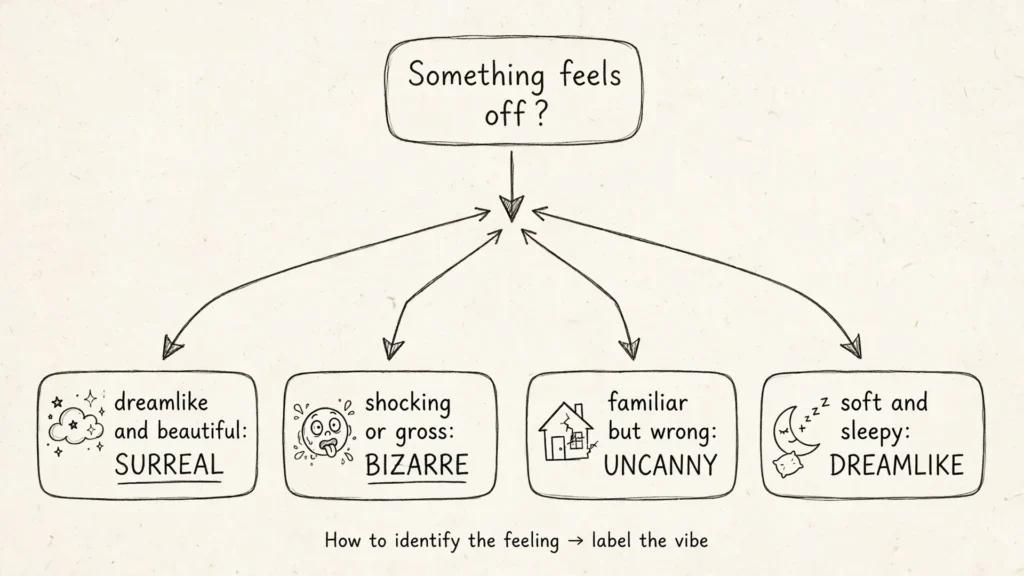
Surreal, bizarre, uncanny, and dreamlike overlap but point at different qualities: surreal means dreamlike and beyond reality, bizarre means extremely strange, uncanny means strangely familiar in a creepy way, and dreamlike means pleasant and soft like a dream. Choose surreal when the moment feels lifted out of a dream.
This is the confusion that no dictionary page fully clears up, so here is the disambiguation table. Read the “say it when” column as your decision rule.
| Term | What it really means | Example sentence | Say it when… |
|---|---|---|---|
| Surreal | Strangely dreamlike; beyond ordinary reality | “Seeing my own book in the bookstore felt surreal.” | a moment feels lifted out of a dream |
| Bizarre | Extremely strange or odd; weird behavior or appearance | “He wore a bizarre costume made of spoons.” | something is just plain weird |
| Uncanny | Strangely familiar in a creepy, unsettling way | “The robot’s face was uncanny, almost human but not quite.” | something is familiar yet wrong |
| Dreamlike | Pleasant, soft, and gentle like a dream | “The morning fog over the lake was dreamlike.” | the mood is soft and beautiful |
| Unreal | So extreme it seems fake; hard to believe | “The crowd was unreal, I could barely hear myself.” | you want casual emphasis, not poetry |
| Fantastical | Imaginary, magical, like a fairy tale | “The story had fantastical creatures and floating islands.” | it belongs to fantasy or fiction |
A few fine points worth keeping. Dreamlike is the gentler cousin of surreal: redkiwi-style comparisons note that surreal sounds more intense and extreme, while dreamlike sounds more positive and subtle. Unreal is the casual everyday twin, looser and less literary. Bizarre carries no dream quality at all, just oddness. Uncanny needs the shiver: it is about the gap between familiar and wrong, not about dreams.
Quick test before you pick: does the moment feel like a dream you could wake up from? Use surreal. Does it just look weird? Bizarre. Does it give you a creepy tingle because it is almost normal? Uncanny. Is it simply soft and beautiful? Dreamlike.
Example Sentences
Here are natural sentences across the contexts where surreal actually gets used:
- The concert felt surreal; I could not believe I was standing that close to the stage.
- Watching the sunrise over the desert was a surreal experience.
- After the announcement, the whole office sat in surreal silence.
- She said meeting her favorite author was the most surreal moment of her life.
- The empty streets during the lockdown looked surreal, like a movie set.
- He texted me: “bro, this party is surreal, you had to be here.”
- The surreal lighting in the gallery made every painting look alive.
- It was surreal to walk through my old school twenty years later.
- The news felt surreal; nobody could process it at first.
- Dalí’s melting clocks are the most famous example of surreal imagery in art.
- Falling asleep on the plane and waking up in another country always feels surreal.
- The fog rolled in so fast that the whole harbor turned surreal within minutes.
Synonyms and Antonyms
Surreal has a crowded synonym field, so it helps to sort them by strength. Use the stronger ones for truly bizarre moments and the softer ones for gentle dreaminess.
| Strength | Synonyms | When they fit best |
|---|---|---|
| Stronger | hallucinatory, nightmarish, phantasmagorical, otherworldly | intense, disorienting, almost disturbing scenes |
| Close match | dreamlike, unreal, bizarre, fantastical, uncanny, strange, extraordinary | most everyday uses of surreal |
| Softer | ethereal, oneiric, whimsical, fanciful, peculiar | gentle, poetic, or delicate dreaminess |
Merriam-Webster’s thesaurus lists dozens of near matches, and the word family overlaps heavily with dreamlike, bizarre, and fantastical. The one to handle with care is uncanny, which adds the creepy-familiar note that surreal does not require.
Antonyms of surreal describe the normal, solid world: realistic, ordinary, mundane, normal, natural, believable, plausible. “A perfectly ordinary Tuesday” is the opposite of a surreal Tuesday.
Word Family: Surrealism, Surrealist, Surreally, Surreality
Surreal comes with a small family of related words, and mixing them up is easy. Here is who is who:
| Word | Part of speech | Meaning and usage |
|---|---|---|
| Surrealism | Noun | The 1920s art and literature movement founded on dreams and the unconscious. “Surrealism changed modern art.” |
| Surrealist | Noun / adjective | A member of the movement, or art in its style. “Dalí was a famous surrealist.” / “a surrealist painting” |
| Surrealistic | Adjective | Formal synonym of surreal, mostly used for art. “the surrealistic quality of the film” |
| Surreally | Adverb | In a surreal way. “The city looked surreally quiet at dawn.” |
| Surreality | Noun | The quality of being surreal; also Breton’s “absolute reality.” “the surreality of the situation” |
Dictionary.com lists surreality as the noun form and surreally as the adverb, and Merriam-Webster ties “surrealistic” directly to the movement. In casual writing you will almost always want “surreal” itself; save “surrealistic” for art history and “surrealism” for the movement.
Frequently Asked Questions
What does surreal mean in simple words?
Strangely dreamlike or unreal, like something beyond ordinary reality. If a moment makes you blink and wonder whether you are dreaming, it is surreal.
Where does the word surreal come from?
From the French surréalisme, “beyond reality,” built from sur- (beyond) plus réalisme. The French term was coined around 1917 by Guillaume Apollinaire and adopted by André Breton for the 1924 Surrealist movement, as Etymonline records via the Oxford English Dictionary.
What is the difference between surreal and bizarre?
Bizarre means extremely strange or odd, with no dream quality required. Surreal adds a dreamlike, beyond-reality feeling. A spoon costume is bizarre; a spoon melting like a clock in your dream is surreal.
Can surreal describe feelings or experiences?
Yes. “Meeting my childhood hero felt surreal” is standard modern usage. The word fits feelings, experiences, scenes, and moments alike, in art and in everyday life.
Is surreal positive or negative?
Neither, on its own. It can describe awe-inspiring moments like a beautiful sunset, or unsettling ones like an empty street at night. The context decides the tone.
Is surreal only used for art?
No. While it names the Surrealist art movement, it is widely used in everyday speech, texts, and social media captions for any dreamlike moment.
How do you use surreal in a sentence?
“The empty streets at dawn felt completely surreal, like a scene from a dream.” You can also say “a surreal concert,” “the evening was surreal,” or “meeting her was surreal.”
Where to Learn More
The definitions in this article were checked against the sources below. Merriam-Webster gives the full sense list and the word history, Dictionary.com adds the etymology and word forms, Etymonline traces the French coinage through the Oxford English Dictionary, Cambridge offers the plainest learner definition, and Britannica covers the Surrealist movement’s history and artists.
- Merriam-Webster: SURREAL Definition & Meaning
- Dictionary.com: SURREAL Definition & Meaning
- Etymonline: Surreal, etymology and origin
- Cambridge Dictionary: surreal
- Britannica: Surrealism
Related:
Inshallah Meaning: What It Means & When to Say It
WTW Meaning: What It Really Means in Texts
Ennui Meaning: Definition & Examples
Debauchery Meaning: Definition & Examples
Nefarious Meaning: Definition & Examples