
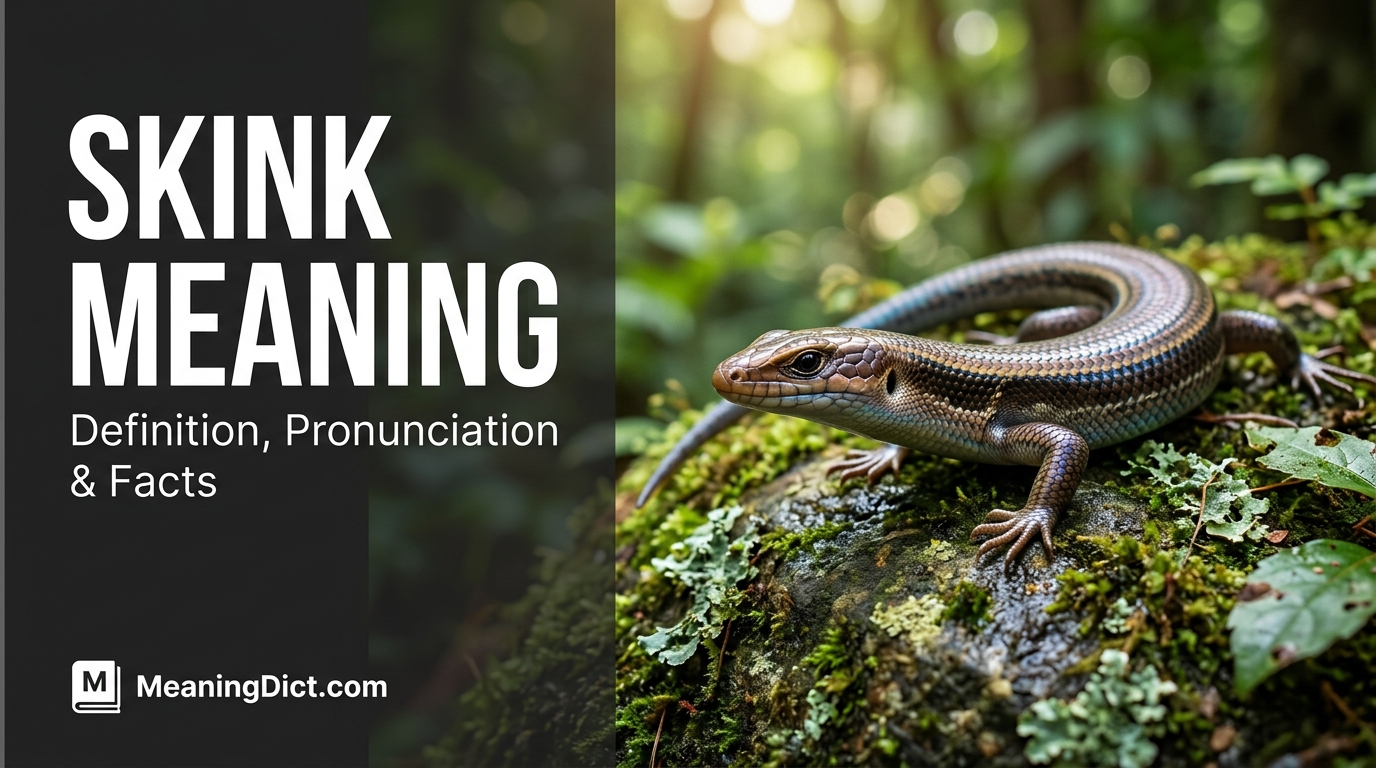
Skink Meaning: Definition, Pronunciation, Examples, and Lizard Facts
The word skink usually means a small or medium-sized lizard from the family Scincidae. Skinks often have smooth, shiny scales, a long body, and short legs. Some species have very tiny limbs, while a few appear almost snake-like. The word is pronounced “skingk,” rhyming closely with pink.
People often search for the skink meaning after seeing the word in a wildlife article, pet guide, crossword, or nature video. In most modern English sentences, skink is a noun naming a reptile. It does not describe every lizard. It refers to a particular and highly varied lizard family.
A less common, old dialect verb to skink can mean to pour or serve a drink, but that sense is rarely used today.
A skink is a lizard in the family Scincidae, usually recognized by its smooth overlapping scales, elongated body, and relatively short legs. Most skinks eat insects and avoid people.
MeaningDict makes unfamiliar words easier to understand by combining a plain-English meaning with pronunciation, examples, and useful context. This guide explains not only what skink means but also what the animal looks like, eats, and whether it can harm humans.
| Quick fact | Answer |
|---|---|
| Word | Skink |
| Part of speech | Noun |
| Pronunciation | /skɪŋk/ |
| Simple meaning | A smooth-scaled lizard |
| Animal family | Scincidae |
| Usually dangerous? | No |
| Usually venomous? | No |
| Common diet | Insects and other small animals; some species also eat plants |
Skink Meaning in English
In English, skink means a lizard belonging to the family Scincidae. The simplest dictionary-style explanation is “a usually small lizard with smooth scales, a long body, and short legs.” Skinks are reptiles, so they are cold-blooded vertebrates that depend on outside heat to regulate their body temperature.
The word is mainly used as a countable noun. You can say “a skink,” “the skink,” or “several skinks.” It is not normally used as an adjective, although it may appear before another noun in phrases such as “skink species,” “skink habitat,” or “skink enclosure.”
In everyday English, the animal meaning is by far the most common. An older dialect verb skink can mean to pour, draw, or serve a drink, but most readers will never meet that use outside historical writing or specialist dictionaries.
So, when someone mentions a skink in a garden, forest, desert, or pet shop, they almost certainly mean the lizard.
What Does Skink Mean?
Skink means a type of smooth-scaled lizard. More precisely, it is the common name for any member of the lizard family Scincidae. The term does not identify one single species. Instead, it covers a large group that includes small ground skinks, colorful striped skinks, burrowing species, blue-tongued skinks, and large tree-dwelling forms.
Context usually makes the meaning clear. In “A skink ran beneath the rock,” the word names an animal. In “The researcher recorded three skink species,” it refers to several species within the same lizard family. In pet-care content, “skink” may refer to a commonly kept species such as a blue-tongued skink.
The meaning should not be confused with skin, skunk, or sink. Although the spellings look similar, the words have different pronunciations and meanings.
A useful one-line answer is: A skink is a lizard known for its smooth scales, elongated body, and often short legs. That wording is accurate for general use, though individual species can look quite different from one another.
What Is the Meaning of Skink?
The meaning of skink is “a member of the lizard family Scincidae.” This scientific detail matters because people sometimes assume skink is another broad word for any small lizard. It is not. Geckos, anoles, iguanas, monitors, and skinks are all lizards, but they belong to different biological groups.
Many skinks share a sleek appearance. Their scales may look polished, their bodies are often cylindrical, and their legs are commonly shorter in relation to the body than those of many other familiar lizards. Some skinks have fully developed legs, some have reduced limbs, and some have no visible limbs at all.
The word entered English centuries ago through Latin scincus, which came from Greek skinkos, an ancient name for a kind of lizard. That history explains why the modern English term sounds unusual and does not resemble more familiar animal names.
For learners, the easiest meaning to remember is: skink = a smooth-bodied lizard, often with short legs. This definition gives the core idea without suggesting that every species looks exactly the same.
Skink Definition and Examples
Definition: A skink is any lizard belonging to the family Scincidae, commonly having smooth overlapping scales, an elongated body, and relatively small legs. Some species are nearly or completely limbless.
Here are natural examples of skink in sentences:
- A small skink disappeared beneath the garden stones.
- The blue-tongued skink opened its mouth and displayed its bright tongue.
- Scientists found a rare skink living in the dry grassland.
- Our wildlife guide explained that the shiny reptile was a skink, not a snake.
- Some skink species give birth to live young, while others lay eggs.
- The skink waited in the sun before searching for insects.
In each example, skink functions as a noun. The plural is skinks, formed by adding -s. A person may also use a species name before or after the word, as in “garden skink,” “sand skink,” or “a species of skink.”
For a clear MeaningDict-style definition, remember: A skink is a smooth-scaled lizard from the Scincidae family.
See Also: BTW Meaning in Text — What It Really Means in 2026
How to Pronounce Skink
Skink is pronounced /skɪŋk/ and sounds like “skingk.” It is one syllable. The vowel is the short i sound heard in sit, fish, and pink. The ending uses the combined ngk sound heard near the end of think or slink, but with an audible g/k closure.
Say it in three simple steps:
- Begin with sk, as in skin.
- Add the short i sound.
- Finish with ngk, ending sharply on k.
The word rhymes closely with pink, link, sink, and wink, although skink begins with the consonant cluster sk-.
Avoid pronouncing it as “skin-k” with two separate syllables. It should come out as one smooth sound: skink. Also, do not confuse it with skunk, which uses a different vowel.
Example aloud: “We saw a skink near the wall.”
Both major learner dictionaries and general dictionaries give the pronunciation with the short i vowel and a single syllable.
What Is a Skink Lizard?
A skink lizard is any lizard in the family Scincidae. The phrase may sound repetitive because every skink is already a lizard, but people use it to make the animal category clear. Skinks are part of the reptile order Squamata, which also includes other lizards and snakes.
Skinks occupy many environments, including forests, grasslands, deserts, rocky areas, gardens, and tree canopies. Their body form often matches their habitat. Burrowing species may have narrow bodies and reduced limbs, while climbing species generally have stronger legs and toes. Blue-tongued skinks are heavier-bodied and use their bright tongue as part of a defensive display.
There is no single “standard” skink. Some are only a few inches long, while the prehensile-tailed skink of the Solomon Islands is much larger and adapted for life in trees. Diet also varies. Many species mainly hunt insects, worms, spiders, or snails, while some larger species eat fruit, flowers, leaves, carrion, or other small animals.
In plain words, a skink lizard is a diverse, usually smooth-scaled reptile rather than one specific animal.
Is a Skink a Type of Lizard?
Yes, a skink is a type of lizard. More precisely, the name applies to members of the family Scincidae, a major group within the lizard branch of the order Squamata. Therefore, all skinks are lizards, but not all lizards are skinks.
This relationship is similar to saying that all eagles are birds, but not all birds are eagles. “Lizard” is the broader category. “Skink” identifies a more specific family within that category.
People may become confused because some skinks have extremely small legs or no visible legs. A limbless skink can resemble a snake at first glance, yet its evolutionary relationships and anatomy place it among lizards. Limb reduction has evolved repeatedly in lizards, and skinks range from normal limbs to tiny hidden structures.
Common skink features include smooth overlapping scales, a long or cylindrical body, and a tail that may detach in some species when a predator grabs it. However, these are general patterns rather than strict rules for every species.
The direct answer remains: Yes. A skink is a lizard in the Scincidae family.
What Does a Skink Look Like?
A typical skink has a long body, smooth shiny scales, a pointed or blunt head, and a tapering tail. Its legs are often shorter than those of many other lizards. The body can appear almost polished because the overlapping scales lie close together. This sleek shape helps many species move through leaf litter, loose soil, grass, or narrow spaces.
Color and size vary widely. A skink may be brown, gray, black, green, bronze, striped, spotted, or brightly colored. Juveniles of some species have vivid blue tails. Blue-tongued skinks are broad and heavy, with short legs and a striking blue tongue. Crocodile skinks have rougher, armored-looking scales, showing that not every member has the classic glossy appearance.
Some species have four clear limbs with five toes, while others have reduced legs, fewer toes, or no visible legs. Many can shed part of the tail to escape a predator, although the replacement may look different.
The easiest visual clue is a smooth, elongated lizard body with relatively short legs, but identification should also consider location and species-specific markings.
What Is the Difference Between a Skink and a Lizard?
The key difference is that lizard is a broad animal category, while skink names one particular family of lizards. A skink is not separate from lizards; it is one kind of lizard, just as a gecko, iguana, or monitor is another kind.
Skinks often differ in appearance from familiar garden lizards. Many have smooth, shiny, overlapping scales, an elongated cylindrical body, a less obvious neck, and short legs. Other lizard groups may have rough scales, adhesive toe pads, crests, long limbs, rotating eyes, or other specialized features. These comparisons are useful, but they are not absolute because lizards are extremely diverse.
| Feature | Skink | Lizard in general |
| Classification | Family Scincidae | Broad group containing many families |
| Scales | Often smooth and glossy | May be smooth, rough, spiny, or plated |
| Legs | Often short or reduced | Highly variable |
| Body | Often long and cylindrical | Many shapes |
| Examples | Blue-tongued, garden, and sand skinks | Geckos, anoles, iguanas, monitors, and skinks |
So, the accurate comparison is skink versus other lizards, not skink versus lizard.
See Also: ROFL Meaning in Text — What It Really Means in 2026
Are Skinks Dangerous to Humans?
Most skinks are not dangerous to people. They are generally shy animals that escape into vegetation, soil, rocks, or shelter when approached. Small wild skinks are more interested in avoiding people and hunting tiny prey than defending territory against a human.
A skink may struggle, hiss, open its mouth, or bite if it is trapped, grabbed, injured, or handled roughly. Larger species can produce a painful bite, but encounters are not considered a serious danger. The Smithsonian notes that blue-tongued skinks have small teeth yet can deliver a strong, painful bite. Australian Museum guidance similarly explains that a bite from an adult blue-tongue can break skin and cause bruising, though it has no venom.
The safest approach is simple: do not chase, corner, or pick up a wild skink. Give it a route to escape. If a bite breaks the skin, wash the area well with soap and water and monitor it for infection, as you would with any animal bite.
Skinks can actually be useful garden visitors because many eat insects, snails, and other small invertebrates.
Are Skinks Poisonous or Venomous?
Skinks are generally neither poisonous nor venomous. “Venomous” means an animal injects a toxin through a bite, sting, or similar structure. “Poisonous” means a toxin harms another animal when it is touched or eaten. Common skinks do not have venom-delivery fangs, and they are not known as poisonous animals.
This is why the bright blue tongue of a blue-tongued skink can be misleading. The color is a warning display used to surprise or discourage predators; it does not mean the animal is injecting venom. The Smithsonian explains that the tongue may work as a defensive signal because blue is sometimes associated with harmful animals.
A skink can still bite when threatened, and the bite of a large species may hurt or break the skin. That is a mechanical injury, not envenomation. Normal wound cleaning is important because bacteria can enter any broken skin.
People sometimes use poisonous when they mean venomous, but the distinction is useful. For skinks, the clear answer is: No, skinks are not generally poisonous or venomous, although they should still be handled respectfully.
Do Skinks Bite Humans?
Skinks can bite humans, but bites are uncommon and usually happen when the animal feels trapped or is handled. A small garden skink may be unable to do more than pinch, while a large blue-tongued or shingleback skink can bite hard enough to cause pain, bruising, or broken skin.
Biting is a defensive action rather than hunting behavior toward people. Warning signs may include hissing, flattening or puffing the body, opening the mouth, and trying to escape. A blue-tongued skink may also display its tongue before biting.
To reduce the risk, never grab a wild skink by the tail. Some species can drop the tail as an escape response, and forcing the animal to struggle causes unnecessary stress. Pet skinks should be supported and handled using species-specific care guidance.
If a bite breaks the skin, rinse it under running water, wash with soap, apply a clean dressing, and seek medical advice for a deep wound, ongoing bleeding, severe swelling, or infection signs.
In summary, skinks may bite in self-defense, but they do not normally attack people.
What Do Skinks Eat?
Most skinks eat insects and other small invertebrates, but the exact diet depends on the species, age, size, and habitat. Common prey includes crickets, beetles, caterpillars, flies, spiders, worms, snails, slugs, and other small ground-dwelling animals. This insect-eating behavior makes many wild skinks helpful around gardens.
Some skinks are omnivores. Blue-tongued skinks, for example, eat insects, snails, carrion, fruit, berries, flowers, and leaves. The prehensile-tailed skink is more plant-focused and feeds heavily on leaves and other vegetation. Larger species may occasionally take eggs, small reptiles, or very small mammals when available.
A wild skink should usually be left to find its natural food. Feeding an unidentified skink can create nutritional problems, expose it to pesticides, or make it dependent on people. Pet skinks need a carefully balanced diet based on the exact species. A diet suitable for a blue-tongued skink may be wrong for a small insect-eating species.
The simple answer is: Most skinks eat insects, but some species also eat fruit, leaves, flowers, snails, and other small animals.
Skink Spiritual Meaning and Symbolism
The spiritual meaning of a skink is not a scientific fact or a single belief shared by every culture. In modern symbolic interpretation, people may connect the animal with adaptability, renewal, alertness, quiet movement, and survival. These ideas come from observed skink behavior rather than from one universal spiritual tradition.
A skink that sheds its tail to escape danger may symbolize releasing something harmful in order to protect what matters most. Its ability to hide, burrow, and move through narrow spaces can represent resourcefulness or finding a way through a difficult period. Sun-basking may be read as a reminder to restore energy before taking action. Its quick retreat can symbolize caution, timing, and knowing when not to fight.
Seeing a skink does not prove that a supernatural event or prediction is occurring. A real skink may simply be searching for warmth, shelter, food, or a mate. Symbolism is most useful as personal reflection, not as biological evidence or guaranteed fortune-telling.
A balanced interpretation is: The skink may symbolize adaptability, self-protection, renewal, and the wisdom to move carefully through change.
Frequently Asked Questions
Is skink another word for a snake?
No. A skink is a lizard, not a snake. Some skink species have tiny limbs or no visible limbs, so their bodies may look snake-like. However, they belong to the lizard family Scincidae. Their anatomy and evolutionary relationships distinguish them from snakes, even when the difference is not obvious at first sight.
What is the plural of skink?
The plural of skink is skinks. Add -s in the usual way: “One skink was under the log, and two skinks were near the stones.” The word does not have an irregular plural form. It remains a common countable noun in both scientific and everyday English.
Is a blue-tongued skink really a skink?
Yes. Blue-tongued skinks belong to the skink family Scincidae. They are among the largest and most recognizable skinks. Their broad bodies, short legs, and bright blue tongues make them look different from small garden skinks, but they are members of the same lizard family.
Can a skink live in a house?
A wild skink may enter a house while chasing insects or looking for warmth, moisture, or shelter. It usually does not want to stay near people. Open an exit, remove pets from the area, and avoid grabbing it. Repeated sightings may indicate gaps around doors, windows, pipes, or foundations.
Are skinks good to have in the garden?
Skinks can be beneficial garden visitors because many eat insects, spiders, slugs, and other small invertebrates. They generally do not damage buildings or threaten people. A pesticide-free garden with leaf litter, rocks, logs, and safe hiding places can support skinks and other useful wildlife.
Can skinks drop their tails?
Many skink species can detach part of the tail when caught by a predator. The moving tail distracts the attacker while the skink escapes. A replacement may grow, but it can differ in color, shape, or internal structure. People should never pull or hold a skink by its tail.
What is a baby skink called?
A baby skink is usually called a young skink, juvenile skink, or sometimes a skinklet in informal writing. There is no special everyday term as widely established as kitten for a cat or calf for a cow. Scientific writing commonly uses juvenile or hatchling, depending on age and birth method.
Where are skinks found?
Skinks live in many parts of the world and occupy habitats ranging from deserts and forests to grasslands, islands, gardens, rocky slopes, and tree canopies. The exact range depends on the species. They are especially diverse in warm regions, and Australia is well known for its many skink species.
Is it safe to touch a skink?
A skink is unlikely to harm you, but touching a wild skink is usually unnecessary. Handling can frighten the animal and may cause it to bite or drop its tail. Observe it from a short distance instead. Wash your hands after handling any reptile because reptiles may carry bacteria even when they appear healthy.
What should I do if I find a skink?
Leave the skink alone when it is outdoors and not injured. It will normally move away on its own. If it is trapped indoors, close nearby doors, keep pets away, and provide a clear exit. Avoid using glue traps, chemicals, or force because these methods can seriously injure the animal.
Final Thoughts
The skink meaning is straightforward: a skink is a lizard from the family Scincidae. It is commonly identified by a smooth body, overlapping scales, a long tail, and legs that may be normal, short, reduced, or absent. Most skinks eat insects, avoid humans, and are neither poisonous nor venomous. Larger species can bite if threatened, but they do not normally seek conflict with people.
Understanding the word becomes easier when you connect the definition with context. In a dictionary, skink is a noun. In wildlife content, it may refer to any of many related species. In spiritual discussion, it may symbolize adaptability or renewal, though those meanings are personal interpretations rather than scientific conclusions.
MeaningDict is useful when you need more than a one-line definition. By combining pronunciation, sentence examples, animal facts, and contextual meaning, it helps readers understand how a word is actually used.






3 Comments