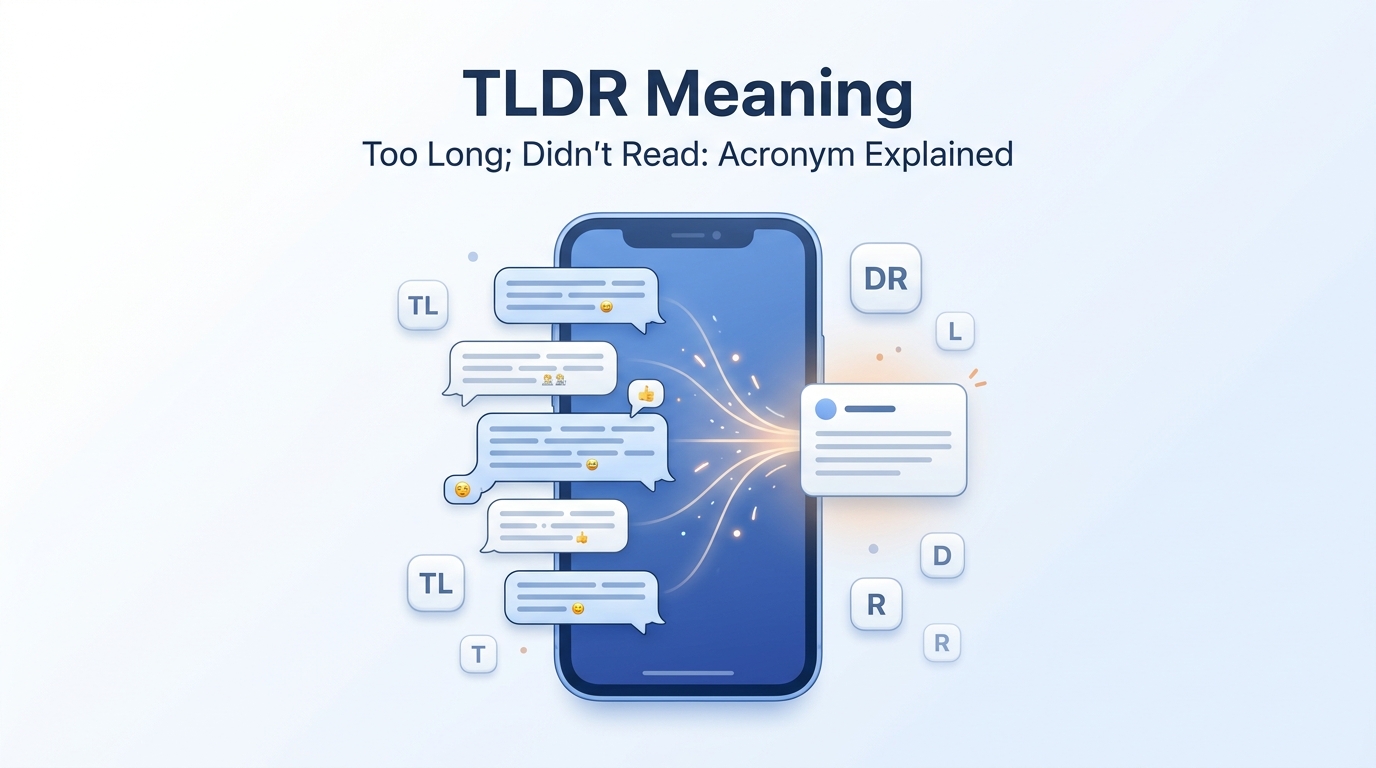
TLDR Meaning: Full Form, Use in Text Messages and Social Media
TLDR is one of the most common internet abbreviations used in texts, chats, Reddit posts, social-media captions, comments, and online discussions. It helps readers understand a long message quickly by showing the most important point in a short form.
Whether you saw “TLDR,” “TL;DR,” or “tldr” in a message, this guide explains its full meaning, correct usage, examples, tone, and differences across popular social platforms. For more simple explanations of internet abbreviations and online terms, MeaningDict is a useful place to explore related everyday phrases.
What Does Tldr Mean In Text Messages
TLDR in text messages means “Too Long; Didn’t Read.” It is a quick way to say that a message, story, or explanation is lengthy and needs a shorter summary. People may place TLDR before a one-line recap, especially when texting friends, classmates, coworkers, or online communities.
In casual messages, TLDR is usually not a complaint. It often helps the reader find the main point without reading every detail. For example, after explaining a long situation, someone may add: “TLDR: I missed the bus, so I will be late.” The summary makes the message faster to understand.
Tone matters when using this abbreviation. Saying only “TLDR” in response to someone’s personal message can sound dismissive, because it may suggest you did not want to read what they shared. A better option is to write a respectful summary or ask, “Can you give me the short version?” It is useful when the original text contains background details but the recipient mainly needs the final result, important update, or next step.
What Is The Full Meaning Of Tldr
The full meaning of TLDR is “Too Long; Didn’t Read.” The abbreviation became popular on internet forums and is now common in texts, social-media captions, comments, group chats, emails, and blog posts. It signals that a long piece of information has been reduced to its most important point.
Although TLDR literally sounds like someone did not read the full content, modern usage is wider. Writers often add a TLDR after writing everything, then provide a convenient summary for people who want the key takeaway. In that sense, it works like “in short,” “quick summary,” or “the main point is.”
Write it as TL;DR, TLDR, or tldr. All versions are generally understood, though TL;DR is the traditional form because the semicolon separates “Too Long” and “Didn’t Read.” For clear explanations of online abbreviations and internet slang, MeaningDict is a useful resource to explore related everyday terms. It is not technical; it is an internet abbreviation built for faster reading. In glossaries, users often look for it because they encounter it suddenly in a message or comment.
See Also: FAFO Meaning: What It Means in Text, Slang, TikTok and Parenting
What Does Tldr Mean On Social Media
On social media, TLDR means “Too Long; Didn’t Read,” but it usually appears as a short summary rather than an insult. Creators use it under long captions, threads, videos, news posts, and personal updates to help followers understand the main message quickly.
For example, a creator may write several paragraphs about a product review and end with “TLDR: Useful for beginners, but not worth the full price.” This format respects users who want context while also serving people who scroll fast and only need the conclusion.
TLDR is especially useful where attention spans are limited. It improves readability, helps key points stand out, and can encourage saves or shares when the summary is clear. Still, avoid using it to oversimplify sensitive topics, because important details, context, and nuance may be lost in a single sentence. For brands and creators, a strong TLDR can also clarify the value of a post before users move on. Put the summary in simple language and make it match, rather than repeat, the longer caption.
What Does Tldr Mean On Reddit
On Reddit, TLDR means “Too Long; Didn’t Read.” It is one of the platform’s most familiar abbreviations and often appears at the bottom of detailed posts. Reddit users add it to summarize long stories, advice requests, debates, technical questions, or personal updates.
A typical Reddit post may explain a situation in depth and then include “TLDR: My landlord changed the agreement after I moved in; what should I do?” This lets readers immediately understand the issue before deciding whether to read the complete post and comments.
On Reddit, placing a TLDR at the end is usually the safest convention because readers can first choose the full context. A TLDR at the top works well when the post is extremely long. Keep it accurate, neutral, and brief; an exaggerated summary may attract replies but can misrepresent the original discussion. Many subreddit communities appreciate a clearly marked recap because long posts can receive more useful answers when readers can identify the core question fast. It is a formatting tool, not a substitute for essential evidence or details.
What Does Tldr Mean In Chat
In chat, TLDR means “Too Long; Didn’t Read” and functions as a shortcut for a quick recap. It is common in WhatsApp, Discord, Slack, Messenger, gaming chats, and workplace group conversations where people may have missed many messages.
When a chat becomes busy, someone may ask for a TLDR to catch up. A helpful reply could be: “TLDR: The meeting moved to Friday, and everyone needs to send feedback today.” This saves time and prevents users from scrolling through dozens of earlier messages.
The abbreviation should support communication, not shut it down. In professional or sensitive chats, phrase it politely: “Could someone share a quick summary?” or “TLDR for anyone joining late:” These alternatives keep the tone collaborative and make it easier for everyone to follow the conversation without feeling ignored. It can be particularly valuable after a rapid conversation with multiple topics, decisions, and action items. A good recap names what changed, who needs to act, and any deadline that matters.
What Does Tldr Stand For In a Message
In a message, TLDR stands for “Too Long; Didn’t Read.” It tells the reader that a short version is available or that the writer is summarizing a longer explanation. The abbreviation is used in both informal conversations and semi-professional digital communication.
You might see it after a long update from a friend, student, colleague, or community member. For instance: “TLDR: I completed the project, but I need two more days for final edits.” The reader immediately understands the status without needing to review every background detail.
Because messages do not always show tone clearly, use TLDR with care. Add a complete, useful summary instead of writing the acronym alone. This approach makes your message approachable and easy to scan. It also helps people who are busy, joining the conversation late, or reading from a small phone screen. In a longer message, it can improve accessibility too: readers who have limited time or find dense text difficult can get the essential information first and return to the detail later.
How To Use Tldr In a Sentence
To use TLDR in a sentence, write a long explanation first and then add a brief summary labeled “TLDR.” The summary should cover the outcome, decision, question, or action that matters most. Keep it to one or two sentences whenever possible.
For example: “I compared three phones, checked the battery, camera, and price, and read customer reviews. TLDR: The second phone offers the best value for everyday use.” The reader gets the conclusion immediately, while the longer text remains available for context.
You can also use TLDR at the beginning: “TLDR: The event starts at 6 p.m.; details are below.” This works well in announcements, but make sure the full message still answers likely questions. Avoid adding TLDR when the original message is already short, because the label becomes unnecessary and can look forced. Use a colon after the label in most writing: “TLDR: …” This visual cue tells readers that the next line is the shortened version, making the format easy to recognize at a glance.
See Also: 555 Angel Number Meaning: Spiritual Message, Love, Career, and Life Changes
What Is The Difference Between Tldr And tl dr
There is no difference in meaning between TLDR and TL;DR. Both stand for “Too Long; Didn’t Read” and both are used to introduce a short summary of a longer message, post, article, thread, or discussion.
TL;DR is the traditional spelling because the semicolon visually separates “Too Long” from “Didn’t Read.” TLDR is the simplified version commonly used in fast texting, comments, usernames, titles, and social-media posts where punctuation is often skipped.
Choose the version that matches your writing style and audience. In formal blog content or explanatory articles, TL;DR may look slightly cleaner. In everyday chats, TLDR is completely normal. The most important factor is not punctuation; it is whether the summary is accurate, useful, and easy for the reader to understand. You may also see “TL DR” with a space, but it communicates the same idea. Search engines and readers generally treat these spellings as variants of one widely understood internet phrase.
Is Tldr Rude To Say
TLDR can be rude or completely harmless depending on context and delivery. When writers use it to provide a summary of their own long post, it is helpful and reader-friendly. When someone replies only “TLDR” to another person’s message, it may sound dismissive or impatient.
The risk is higher in emotional conversations, customer support, workplace discussions, or situations where someone has taken time to explain a problem. The phrase may imply that their details were not worth reading. Even when that is not your intention, text can make the tone seem harsher than intended.
A kinder approach is to ask for a summary politely: “Could you share the main point?” You can also say, “I want to understand, but I am short on time—can you give me a quick recap?” Use TLDR for clarity and convenience, not as a way to reject someone’s message. A considerate TLDR focuses on information, not judgment. For example, “TLDR: The deadline moved to Monday” is useful, while “TLDR, nobody cares” is clearly disrespectful and should be avoided.
See Also: 67 Meaning: What Does 67 Mean in Text, TikTok, Love, and Angel Numbers?
What Does Tldr Mean On Snapchat
On Snapchat, TLDR means “Too Long; Didn’t Read.” Users may put it in chat messages, Story replies, group conversations, or captions when they want to shorten a long explanation into one quick takeaway.
For example, someone might send several snaps explaining why they missed a plan and finish with “TLDR: My ride canceled, so I could not come.” The phrase helps friends understand the key point without replaying or reading every detail in the conversation.
Because Snapchat is casual and fast-moving, TLDR is usually informal rather than serious. Still, be mindful of the relationship and topic. In a close friendship, it may feel natural; during a misunderstanding, it could sound like you are avoiding the other person’s feelings. A simple, friendly recap is often better than a blunt response. It can be useful for keeping group chats organized when several people send updates at once. State the outcome first, then add details only when they help the other person respond or make a plan.
What Does Tldr Mean On Instagram Comments
In Instagram comments, TLDR means “Too Long; Didn’t Read.” People use it under lengthy captions, carousel posts, comment threads, reviews, or discussion posts to point readers toward a fast summary of the main idea.
A creator might write a detailed travel caption and add: “TLDR: Book early, visit on weekdays, and carry water.” This helps followers who want practical information quickly. It can also make a post more scannable when users are browsing rapidly through their feed.
However, writing only “TLDR” as a comment below someone else’s personal or educational post can feel negative. It may look like criticism of their writing rather than a genuine request for a summary. For a better tone, comment on the key point, ask a specific question, or say that you would appreciate a short recap. For businesses, educators, and influencers, a summary can help visitors understand a long caption’s benefit or takeaway. Use it as a reader aid, not as a trick to make important context disappear.
Why Do People Write Tldr At The End Of a Post
People write TLDR at the end of a post to give readers a quick summary after providing the full context. This lets the author explain everything in detail while still helping busy readers understand the main conclusion, decision, problem, or call to action.
Placing it at the end is common because readers who want the full story can read naturally from start to finish. Readers who prefer speed can scroll down and find the summary. This structure works well for Reddit posts, long social-media captions, blog articles, emails, and community announcements.
A good TLDR should not add new information that was missing from the main post. Instead, it should accurately condense the message in plain language. The strongest summaries identify the issue, outcome, and next step. Used well, TLDR improves readability, reduces confusion, and respects different reading preferences. It also makes content easier to revisit later. Someone returning to a discussion can find the central point in seconds instead of reading every sentence again.
Frequently Asked Questions
What does TLDR mean in simple words?
TLDR means “Too Long; Didn’t Read.” In simple words, it is a short summary of a long message, post, article, comment, or conversation.
Is TLDR the same as a summary?
Yes. In most modern online conversations, TLDR works like a quick summary. It gives readers the main point without requiring them to read every detail first.
Should I write TLDR or TL;DR?
Both are correct. TL;DR is the original punctuation style, while TLDR is more common in casual texts, chats, comments, and social-media posts.
Can I use TLDR in a professional email?
Yes, but use it carefully. In professional emails, phrases such as “Quick summary,” “In brief,” or “Key takeaway” may sound more polished and formal.
Is it okay to put TLDR at the beginning?
Yes. A TLDR at the beginning works well for announcements, long emails, guides, or posts where readers need the most important update immediately.
Why is TLDR popular online?
TLDR is popular because it saves time. It helps people understand the key message quickly when they are scrolling, busy, joining a chat late, or reading a long discussion.

One Comment