
Ennui Meaning: What It Means, How to Say It, and Why It’s Not Just Boredom
Ennui is a deep, listless dissatisfaction with life itself: the feeling that nothing is quite worth doing, even the things you usually enjoy. It is heavier than boredom, older than you think, and (thanks to Pixar) more famous than ever. This guide covers the full ennui definition, how to pronounce it, where the word comes from, how it differs from boredom and depression, its literary history, and how to use it in a sentence.
If you have ever stared at a weekend full of plans and felt nothing, you have brushed up against ennui. The word names a very specific modern malaise: not the restless "I need something to do" of boredom, but the flat "nothing feels worth doing" that lingers even when interesting things are happening. Understanding the distinction matters, because the two feelings ask for different remedies.
How Do You Pronounce Ennui?
Say "ahn-WEE," with the stress on the second syllable. It rhymes with "on knee." English speakers have kept the French pronunciation for more than three centuries; the word was never anglicized.
Breaking it down further:
- American English: /ɑnˈwi/ (ahn-WEE)
- British English: /ˈɒnwiː/ or /ɒnˈwiː/ (on-WEE), which Collins lists as the standard
- French: /ɑ̃.nɥi/ (ahn-NWEE), with a nasalized first vowel that most English speakers do not attempt
The most common mistake is reading it as "EN-yoo-ee" or "en-NOO-eye." A helpful trick: think of the phrase "on knee" said with a slight French shrug, and you will be close enough that no one will correct you.
Where Does the Word Ennui Come From?
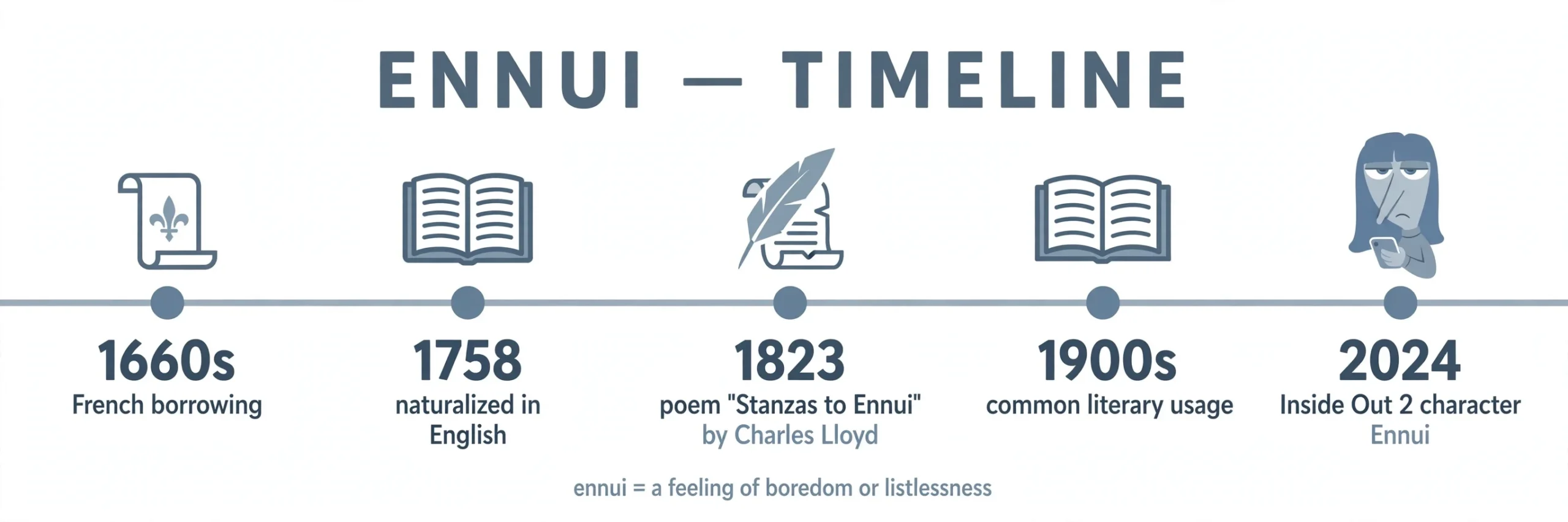
Ennui entered English from French in the 1660s, borrowed from the French ennui ("boredom, weariness"). The French word came from Old French enui, meaning "annoyance, vexation," which itself descended from Late Latin inodiare, "to make loathsome or hateful."
Etymonline traces the chain: Late Latin inodiare ("to make loathsome") came from the Latin phrase in odio esse, literally "to be in hatred" — to find something hateful. The word is a cousin of "annoy," which traveled the same road from Old French anoi.
Dictionary.com places the first recorded English use between 1660 and 1670, and Collins dates the adjective ennuyé (masculine) and ennuyée (feminine) — meaning "affected with ennui" — to the same era. The pronunciation, Etymonline notes, was never anglicized: English speakers say it the French way to this day.
One more related word worth knowing: the adjective ennuyé (feminine ennuyée) describes someone afflicted with ennui — the world-weary sigh in human form. "She gave him an ennuyée glance over her coffee" paints the whole picture in six words.
What Is the Difference Between Ennui and Boredom?
Boredom is restless and temporary: you want something to do, and the feeling lifts once you find it. Ennui is flat and lingering: nothing feels worth doing, even the things you usually love. Boredom says "I need stimulation"; ennui says "stimulation will not help."
The confusion is understandable. Cambridge defines ennui simply as "a feeling of being bored and mentally tired caused by having nothing interesting or exciting to do," which makes it sound like boredom with better branding. But the dictionaries that go deeper draw a sharper line. Merriam-Webster calls it "a feeling of weariness and dissatisfaction," and the emphasis on dissatisfaction — with life, not just the moment — is doing the real work.
A psychology-focused guide on Neurolaunch draws the clearest line I have seen: with boredom, interest returns the moment something engaging appears; with ennui, the disengagement persists despite engaging options. The streaming paradox is the perfect test case. Boredom scrolls Netflix for ten minutes and picks something. Ennui scrolls for forty minutes, watches nothing, and feels vaguely worse.
Here is how ennui sits beside its closest neighbors:
| Aspect | Boredom | Ennui | Apathy | Melancholy | Depression |
|---|---|---|---|---|---|
| Core feeling | Restless understimulation | Listless dissatisfaction, absence of meaning | Lack of interest or motivation in anything | Pensive sadness, often with nostalgia | Persistent low mood with clinical features |
| Typical duration | Minutes to hours | Days to weeks, sometimes longer | Varies, often ongoing | Hours to days | Weeks to months |
| What triggers it | A dull situation | A sense that life lacks purpose or novelty | Disconnection or exhaustion | Loss, longing, reflection | Complex mix of factors |
| Response to novelty | Lifts quickly | Often persists despite new stimuli | Minimal response | Can be soothed, not cured | Typically does not lift on its own |
| Self-awareness | "I need something to do" | "Something is missing, but what?" | "I don't care either way" | "I miss how things were" | "I feel hopeless or empty" |
A word of care on the depression column, because this matters: ennui is not a clinical condition, and it should not be used to minimize depression. If low mood persists for weeks, interferes with daily life, or comes with hopelessness, that deserves a conversation with a doctor or mental health professional — not a French vocabulary word.
The Literary Life of Ennui
Ennui spent its first century in English as fashionable conversation, the word 17th-century nobility reached for to describe dissatisfaction in polite company. Then the 19th century made it immortal. Here is the short tour:
- 1787: Thomas Jefferson. In a letter, Jefferson wrote of ennui with striking modernity: "Thus the days of life are consumed, one by one, without an object beyond the present moment; ever flying from the ennui of that, yet carrying it with us." The founding father of doomscrolling, three centuries early.
- 1823: Charles Lloyd. The poet addressed the feeling directly in Stanzas to Ennui, calling it a "soul-destroying fiend" that visits with "its pale unrest." Merriam-Webster's word history preserves the reference.
- Mid-1800s: the French masters. Charles Baudelaire and Gustave Flaubert made ennui the central malaise of modern life. Emma Bovary, the heroine of Flaubert's Madame Bovary, is practically the patron saint of the word: a woman with every comfort who finds provincial life unbearably hollow.
- 1922: T.S. Eliot. The Waste Land channels a whole civilization's ennui, the sense of a world drained of meaning that Eliot's generation felt after the First World War.
- The existentialists. Jean-Paul Sartre's Nausea and Martin Heidegger's writings on "profound boredom" reframed ennui as philosophy: the authentic human response to confronting a world without inherent meaning.
- 1935 (published posthumously): Fernando Pessoa. His The Book of Disquiet was praised by the Wall Street Journal as "a fragmented masterpiece of urban ennui," carrying the word into 20th-century modernism.
- 1992: Donna Tartt. The Secret History gives us the memorably decadent list: "Orange groves, failed movie stars, lamplit cocktail hours by the swimming pool, cigarettes, ennui."
There is also a philosophical silver lining. Arthur Schopenhauer suggested that ennui can open the door to authentic self-reflection, when we are stripped of distractions and forced to confront real questions. The same mental state that produces creative breakthroughs through mind-wandering is the state ennui arrives in. The word has always been double-edged: a complaint and a condition for thought.
What Does Ennui Look Like in Real Life?
Strip away the French polish and ennui is an extremely common modern experience. A few places it shows up:
- The streaming paradox. A thousand shows available, forty minutes of scrolling, interest in none of them. That gap between abundance and appetite is textbook ennui.
- Post-achievement flatness. The promotion, the graduation, the long-planned trip, and the feeling that arrives is not joy but "oh, is this it?"
- Suburban routine. Cambridge's own example: "His latest book was about suburban ennui and the middle-aged desire for something new." Comfort without meaning.
- Winter. "The whole country seems to be affected by the ennui of winter," as Cambridge puts it. Short days, gray light, the same four walls.
- Retirement. Counselors who write about ennui note that newly retired people are especially susceptible, when a lifetime of structure suddenly thins out.
So how do you tell whether what you are feeling is ennui or just a bad day? This quick context-clue table is the diagnostic shortcut most definition pages never give you:
| Clue | Points toward ennui | Points toward an ordinary bad day |
|---|---|---|
| Duration | Lingers for days despite changing circumstances | Fades after sleep, a meal, or a good conversation |
| Trigger | Hard to name; nothing specific is wrong | Clear cause: a bad meeting, bad news, bad weather |
| Favorite things | Even beloved hobbies feel hollow | Comfort activities still help |
| The question in your head | "What is the point of all this?" | "When will this day end?" |
| What fixes it | Meaning, purpose, genuine engagement | Rest, food, company, a change of scenery |
Why Pixar Made Ennui a Character in Inside Out 2
In 2024, Pixar did for ennui what no dictionary ever could: it gave the word a face. Inside Out 2 introduced Ennui as one of four new emotions in teenager Riley's mind, alongside Anxiety, Envy, and Embarrassment. The character is a study in teenage detachment: permanently draped over a couch, phone in hand, too cool to care about anything happening in headquarters.
The casting was a quiet joke for word lovers. Ennui is voiced by Adèle Exarchopoulos, a French actress, which is exactly right for a word that has kept its French pronunciation for three centuries. Her flat, accented delivery sells the character's whole personality in a single line reading.
The portrayal works because Pixar understood the real distinction. The film's Ennui is not the fidgety boredom of a kid in a long car ride. She is the slouchy, screen-obsessed embodiment of adolescent listlessness: surrounded by stimulation, engaged by none of it. The surge of searches for "ennui meaning" after the film's release suggests plenty of parents heard the word and wanted to know what their teenager was supposedly feeling.
How to Actually Use Ennui in a Sentence
Ennui is a formal, literary word in English, and it works best when you respect that register. Collins marks it as literary, and it genuinely sounds at home in essays, reviews, and thoughtful conversation. Dropping it into casual chat ("dude, I have such ennui right now") will get you a look, though honestly the look might be worth it.
A few natural examples:
- "After three years in the same role, a quiet ennui settled over her mornings."
- "The novel is a portrait of suburban ennui, all cul-de-sacs and unspoken regret."
- "He had money, health, and free time, yet he could not shake a strange ennui."
- "The rainy Sunday stretched on, thick with ennui."
- "Critics praised the film's depiction of adolescent ennui."
Note the grammar: ennui is an uncountable noun, so you say "a sense of ennui" or "filled with ennui," never "an ennui" or "ennuis."
One fun cross-language note: in everyday French, ennui is far less grand. The French say je m'ennuie simply to mean "I am bored," and the word can also stretch to mean trouble or worry. English borrowed only the philosophical end of the word and left the mundane part behind.
Frequently Asked Questions
What does ennui mean in simple terms? It means a deeper, more draining kind of boredom: a listless dissatisfaction with life where nothing feels worth doing.
Is ennui the same as boredom? No. Boredom is restless and temporary, and it lifts when you find something interesting. Ennui is flat and lingering, and it persists even when interesting things are happening.
How do you pronounce ennui? Say "ahn-WEE," rhyming with "on knee." The stress falls on the second syllable, and English speakers keep the French pronunciation.
What language does ennui come from? French. It entered English in the 1660s from the French ennui, which came from Old French enui ("annoyance") and ultimately from Latin inodiare, "to make loathsome." It is related to the word "annoy."
Who voices Ennui in Inside Out 2? French actress Adèle Exarchopoulos voices Ennui in Pixar's Inside Out 2 (2024), where the character embodies teenage apathy and detachment.
Is ennui a mental illness? No. Ennui is a cultural and philosophical concept, not a clinical condition. That said, persistent low mood that lasts for weeks or interferes with daily life deserves a conversation with a doctor or mental health professional.
What is the opposite of ennui? Engagement, enthusiasm, purpose, or zest: the sense that things are worth doing and that doing them matters.
Where This Comes From
Every claim above was checked against sources actually opened during research. Merriam-Webster's word history supplies the definition ("a feeling of weariness and dissatisfaction"), the etymology chain through Old French enui and Late Latin inodiare, and the Charles Lloyd and Thomas Jefferson references. Etymonline's entry gives the 1660s borrowing date, the 1758 naturalization, the ennuyé adjective, and the note that the pronunciation was never anglicized. Dictionary.com provides the American and British pronunciations, the 1660–70 first-recorded date, and the synonyms languor, lassitude, tedium, and listlessness. Collins marks the word as literary and uncountable. Cambridge contributes the everyday definition and the suburban and winter examples. Wordpandit's "Word Adventure: Ennui" traces the literary thread through Baudelaire, Flaubert, Madame Bovary, Eliot's The Waste Land, Sartre, Heidegger, and Schopenhauer. Neurolaunch's guide to the ennui emotion supplies the boredom-versus-ennui hallmark and the comparison framework. The AMAC's overview contributes the je m'ennuie usage and the retirement angle. Language & Humanities' "What is Ennui?" covers the 17th-century nobility usage. An Anniversary Wishers' guide documents the Inside Out 2 character and the Adèle Exarchopoulos casting.
Related:
What Does ENM Mean in Text? (Ethical Non-Monogamy, Explained)
Debauchery Meaning: Definition, Origin, and How to Use It





One Comment