
What Does ENM Mean in Text? (Ethical Non-Monogamy, Explained)
ENM means ethical non-monogamy: an umbrella term for romantic or sexual relationships with more than one person, where everyone involved knows about it and agrees to it.
That is the whole definition in one sentence, but if you have ever stared at those three letters in a text message or a dating bio, you know the one-liner leaves plenty of questions open. Why does someone announce this in a bio? Does it mean they are not looking for commitment? And how is it different from just cheating? This guide answers all of it, with the context clues that tell you what ENM actually means wherever you see it.
What Does ENM Stand For?
ENM stands for ethical non-monogamy, a relationship approach in which people have romantic or sexual connections with more than one partner at the same time, with the full knowledge and consent of everyone involved. You will also see CNM, short for consensual non-monogamy, used for the same idea.
The two words do slightly different jobs. As the therapy glossary at Hope Sanctuary explains, the terms are largely interchangeable, but some people prefer “consensual” because it names the core requirement directly. In everyday dating language, ENM is by far the more common spelling.
The bluntest plain-language definition I found is the one dating-dictionary pages keep quoting from Urban Dictionary’s top ENM entry: “a sexual relationship that doesn’t disallow sexual expression or affection with other partners.” Crude next to therapist.com’s “a relationship approach that requires open communication and consent,” but both point at the same thing: non-exclusivity with everyone’s knowledge.
One more language note. Polyamory, the best-known type of ENM, is a modern coinage: Merriam-Webster defines it as “the state or practice of having more than one open romantic relationship at a time” and records its first known use in 1992. The vocabulary here is young, which is exactly why the same three letters confuse people.
What Does ENM Mean in Texting?
When ENM shows up in a text, a DM, or a chat, it almost always carries its dating meaning: the sender is telling you they practice or are open to ethical non-monogamy. It is a disclosure, not a joke or an insult, so the right response is a direct question about what it looks like for them, not a guess.
Here is what it sounds like in the wild:
- Text 1: “Hey, just so you know, I’m ENM. My partner knows I’m on here. Still interested in grabbing coffee?”
- Text 2: “Are you ENM too, or strictly monogamous? No judgment either way, just want us on the same page.”
Notice the pattern: the label is always a starting point for a conversation, never the whole conversation. As the guide at enmmeaning.com puts it, the label does not tell you whether the person has a partner, whether existing partners know they are dating, or whether they want romance, sex, or something committed. You have to ask.
How to tell which ENM someone means
Context is everything, because ENM is also an acronym in a few technical fields. This quick table is the fastest way to read the room:
| Where you see ENM | What it probably means | Clue |
|---|---|---|
| Dating app bio, text, or DM | Ethical non-monogamy | Surrounded by words like partner, poly, open, or dating |
| Engineering or science paper | Engineering numerical methods | Surrounded by equations, modeling, or systems analysis, per 7ESL |
| Environmental report | Environmental noise monitoring | Near words like decibels, pollution, or monitoring |
| IT incident docs | Event notification management | Near workflows, alerts, or incident response |
| Medical literature | Epileptic negative myoclonus, a seizure type described in epilepsy research | Clinical context, EEG, antiepileptic drugs |
For a slang dictionary reader, the dating meaning is the one that matters probably 99 times out of 100. I have included the technical ones so you never get tripped up by the hundredth.
What Does ENM Mean on a Dating Profile?
On Tinder, Bumble, Hinge, or Feeld, ENM in a bio is a person disclosing that they are open to consensual, non-exclusive connections. They might already have one or more partners, or they might be single and simply prefer relationships that do not require exclusivity.
But bios rarely say just “ENM.” They say things like “partnered ENM” or “ENM friendly,” and those modifiers change the picture. Here is a decoder for the most common versions, built from how dating guides and profile glossaries actually define them:
| Bio label | What it usually signals | What to ask |
|---|---|---|
| ENM | Open to consensual non-exclusive connections | “What does ENM look like in your life right now?” |
| Partnered ENM | Already has at least one partner | “Do you date independently? How much time do you have?” |
| Married ENM | Married, with an agreed open arrangement | “Do you and your spouse date separately or together?” |
| Solo ENM | Unpartnered or highly independent; sometimes means solo polyamory | “Are you looking for anything committed, or keeping it autonomous?” |
| ENM friendly | Not necessarily ENM themselves, but open to dating someone who is | “Have you dated ENM people before?” |
| I practise ENM | Actively lives this way, not just curious | “Which style works for you: poly, open, something else?” |
| Poly ENM | Specifically polyamorous within the ENM umbrella | “How do you handle hierarchy and time across partners?” |
Most dating glossaries treat “ENM” on a profile as a green flag for honesty: the person is being upfront instead of hiding their structure. But it still tells you nothing about safer-sex agreements, emotional availability, or whether existing partners actually know. The label supports disclosure; it does not replace the conversation.
The Main Types of ENM
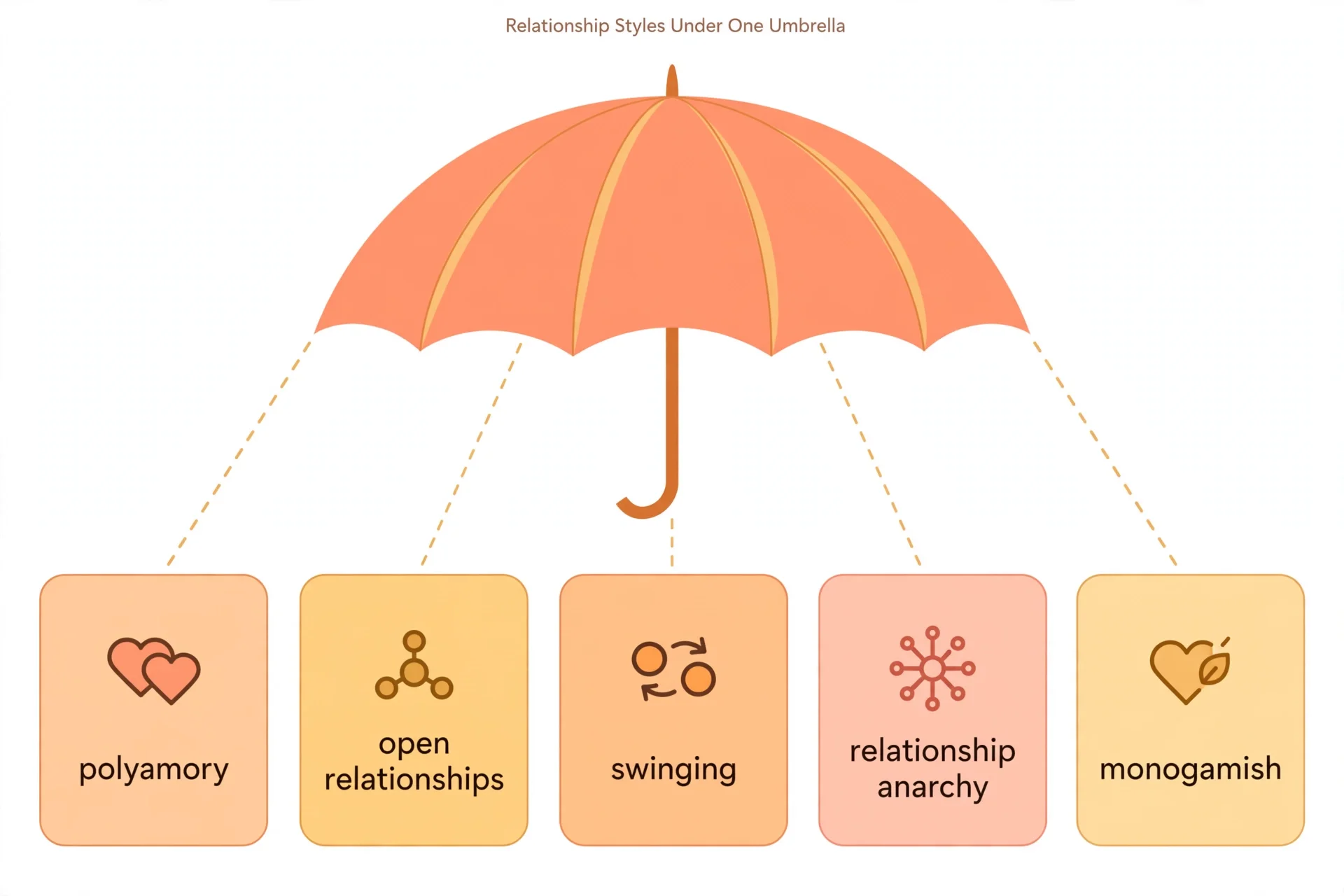
ENM is not one lifestyle. It is an umbrella, and the structures under it work very differently from each other. This is the single most useful table in the article, so save it:
| Type | Main focus | Romance allowed? | Sex with others allowed? | Typical setup |
|---|---|---|---|---|
| Polyamory | Multiple loving relationships | Yes, central | Often | Separate partners, triads, or networks |
| Open relationship | Outside intimacy alongside a core partnership | Sometimes | Usually | Established couple with agreed openness |
| Swinging | Shared sexual experiences, often social | Usually not the point | Yes, central | Couples with other couples or individuals |
| Relationship anarchy | No preset rules or hierarchy | On its own terms | On its own terms | Each connection defined individually |
| Monogamish | Mostly monogamous with agreed exceptions | Usually restricted | Under stated conditions | Couple with occasional agreed openness |
| Solo polyamory | Multiple connections plus full autonomy | Yes | Yes | No primary partner, no merged household |
A few deserve a line each. Polyamory emphasizes emotional connection and ongoing relationships, not just sex; a throuple, three people together, is one well-known polyamorous shape. Swinging is usually recreational and couple-centered. Relationship anarchy rejects the whole ranking system. And solo polyamory, as therapist.com describes it, means maintaining intimate relationships while living independently, as if single. People mix and match constantly; the labels matter less than the actual agreement between the people involved.
ENM vs Cheating: Where the Line Actually Is
Is ENM just cheating with better branding? No, and this distinction is what the entire concept stands on. Cheating is non-monogamy without consent: one person breaks an agreement and hides it, and the harm comes from the betrayal, not the number of partners. ENM is non-monogamy with consent: the rules were openly negotiated, and everyone operates inside them. As the Flava dating editorial team puts it, the opposite of ethical non-monogamy is not monogamy; it is dishonesty.
| ENM | Cheating | |
|---|---|---|
| Knowledge | Everyone involved knows | Someone is kept in the dark |
| Agreement | Boundaries negotiated openly | Agreements broken secretly |
| What’s unethical | Breaking the agreed terms | The deception itself |
| Jealousy | Talked through openly | Often the thing that exposes it |
Here is the part most articles skip: you can cheat inside an ENM relationship. Hiding a new partner, breaking a safer-sex agreement, or lying about what another partner knows all count as cheating, because the person knowingly violated an understood agreement. The number of partners was never the moral question. Honoring the agreement is.
ENM vs Polyamory vs Open Relationship
These three get tangled constantly, so here is the clean version. ENM is the umbrella term, and polyamory is one type under it: every polyamorous relationship is non-monogamous, but not every ENM relationship is polyamorous. Swingers and some people in open or monogamish arrangements allow outside sexual connections without seeking additional romantic partnerships, and HUD’s dating writers frame it the same way.
An open relationship sits in the middle: usually an established couple permitting outside intimacy, with permissions varying couple to couple. Not all ENM relationships are open relationships (a solo poly person with no primary partner is not in one), and not all open relationships look alike. Polygamy is different again: marriage to more than one spouse, often tied to specific religious or cultural practices, and not automatically ethical just because multiple people are involved.
Common Mix-Ups and Edge Cases
A few confusions come up so often they deserve their own section.
EMN is usually a typo.
If you see “EMN” on a dating profile, the writer almost certainly means ENM. The calendar-uk dating dictionary even has a “What does EMN mean on Tinder?” entry that just answers it as ENM.
ENM does not mean “enemy.”
In gaming chats you might see “enmy” shortened informally, but ENM as a standalone acronym in texting is not gaming slang for enemy. If the conversation is about a game, read it as the game term; if it is about dating, read it as ethical non-monogamy. Context decides.
ENM is not a sexual orientation.
Therapist.com is explicit on this: non-monogamy is a relationship approach, not an orientation. It describes how someone organizes relationships, not who they are attracted to.
ENM does not automatically mean any of these.
Adapted from enmmeaning.com’s myth-busting section and worth memorizing: no commitment, casual sex only, no jealousy, no boundaries, equal involvement with every person, or permission to ignore agreements. Each is a separate conversation, not something the acronym guarantees.
A little vocabulary helps.
Keep reading and you will meet: metamour (your partner’s other partner), compersion (genuine joy at a partner’s happiness with someone else), polycule (a network of connected partners), hinge (the person connecting two sides of a V-shaped relationship), and nesting partner (the partner you live with). Not required knowledge, but it stops the jargon from feeling like a secret code.
Is ENM for You? Honest Questions to Ask Yourself
For each question below, check which column sounds more like you:
| Ask yourself | A good sign for ENM | A red flag to slow down |
|---|---|---|
| Why do I want this? | Curiosity, capacity to love more than one person, desire for honest variety | Trying to fix a shaky relationship or make a partner stop cheating |
| How do I handle jealousy? | Uncomfortable but willing to talk it through out loud | Jealousy feels unbearable and must be controlled away |
| Can I over-communicate? | Yes, even about awkward topics | I avoid hard conversations and hope issues fade |
| Do I have the bandwidth? | Realistic about time, energy, and scheduling | Already stretched thin with one relationship |
| Can I set and respect boundaries? | I know what I need and can hear “no” | I agree to things I resent, or push past others’ limits |
| Am I okay with stigma? | I can handle some judgment from family or friends | I need everyone’s approval to feel secure |
Therapist.com’s clinicians ask nearly the same questions, including the sharpest one: are you pursuing non-monogamy to try to fix a strained relationship? If the foundation is not solid, adding more connections tends to reveal the cracks rather than patch them. That warning shows up in both clinical and dating-app sources, which tells me it is the real thing.
How common is this? Match.com’s Singles in America survey, cited by therapist.com, found about half of single adults preferred monogamy, while roughly a third had been in a consensually non-monogamous relationship. A 2017 study quoted across dating dictionaries put the lifetime figure above one in five US adults. This is not a fringe curiosity anymore.
What to Ask When Someone Says They Are ENM
If a match discloses ENM and you are interested, this short sequence gets you what the label alone never provides. Ask in your own words, in order:
- What does ENM look like in your life right now?
This opens everything: current partners, style, and availability. - Do your existing partners know you are dating?
Consent is the whole concept, so confirm it directly and kindly. - What kind of connection are you actually available for?
Romance, sex, friendship, something committed: the label does not say. - What are your agreements around safer sex and disclosure?
Practical, unromantic, and essential. - How much time and emotional bandwidth do you realistically have?
Multiple relationships run on calendars; make sure there is room for you. - What are your boundaries, and what do you need from me?
End with an invitation, not an interrogation.
Even the first two answers tell you whether this person has thought their arrangement through, which is the most important signal of all.
FAQs
Is ENM the same as polyamory?
No. ENM is the umbrella term covering polyamory, open relationships, swinging, relationship anarchy, and more. Polyamory specifically means having multiple loving, romantic relationships at once.
Is ENM the same as an open relationship?
Not exactly. An open relationship is one type of ENM, usually an established couple permitting outside intimacy. ENM also covers arrangements with no central couple at all, like solo polyamory.
Does ENM mean you never get jealous?
Not at all. Jealousy shows up in ENM relationships like anywhere else. The difference is that it gets talked through openly instead of suppressed, and many people also experience compersion: real happiness at a partner’s joy with someone else.
Do ENM relationships actually work?
They can. As polyamorous sex educator Sydney Chin told Bustle, there is no one-size-fits-all model for ethical non-monogamy, but with clear consent and open communication, an ENM relationship can work.
Is ENM a sexual orientation or identity?
It is a relationship approach, not an orientation. Some people do hold it as an identity, but clinically and practically it describes how relationships are organized, not who someone is attracted to.
Can you cheat in an ENM relationship?
Yes. Cheating in ENM means breaking the agreed terms: hiding a partner, violating a safer-sex agreement, or lying about what everyone knows. Multiple partners are not the issue; broken agreements are.
Where This Comes From
I read the following pages in full while researching: 7ESL’s ENM meaning guide; therapist.com’s clinician-reviewed guide to ethical nonmonogamy (including its survey data and self-reflection questions); the Flava dating editorial team’s ENM explainer; enmmeaning.com’s detailed ENM reference; HUD’s ethical non-monogamy guide for dating-app users; and the calendar-uk dating dictionary’s ENM entry. Dictionary backup came from Merriam-Webster’s polyamory entry and the Urban Dictionary ENM definition as quoted by dating-dictionary pages.
Related:


2 Comments