150+ charlie kirk quotes: Verified Excerpts, Themes, and Context
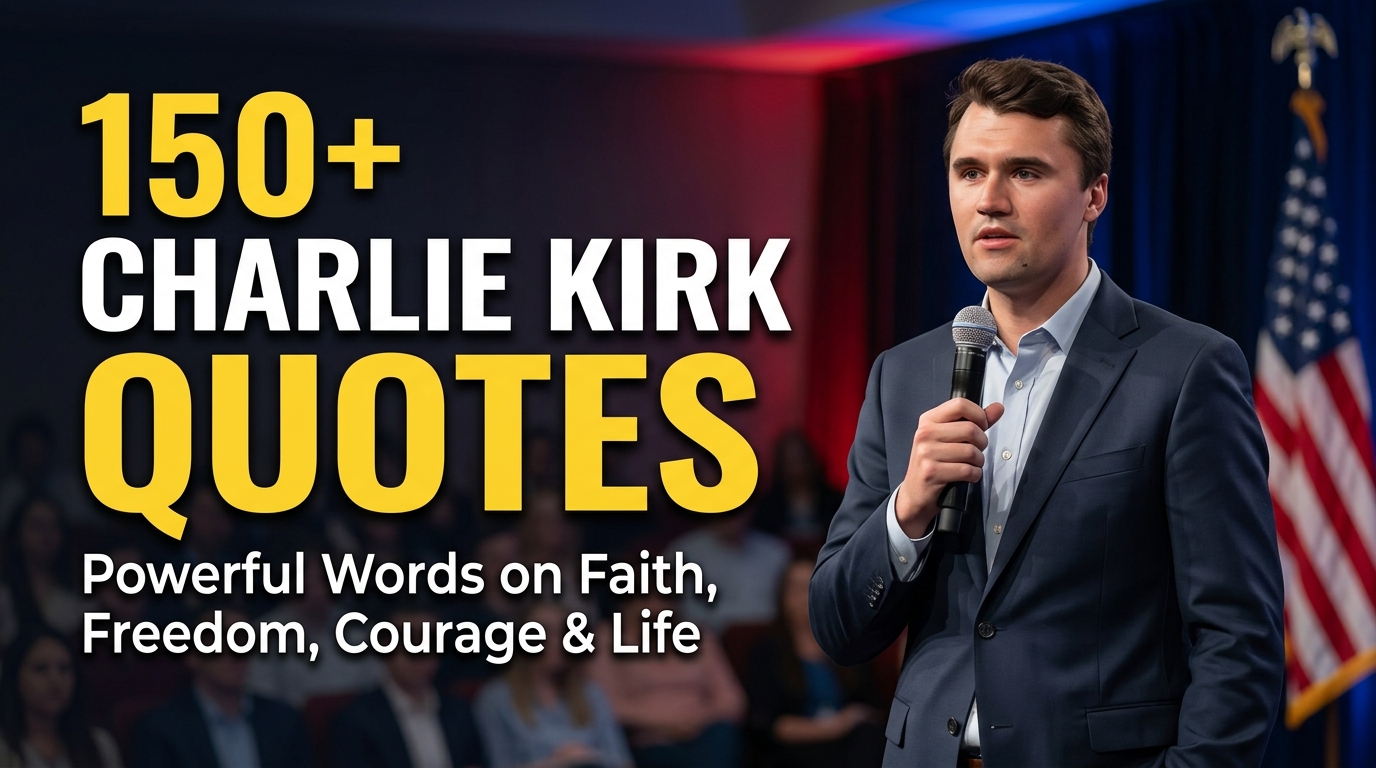
People searching for 150+ charlie kirk quotes may want memorable lines about faith, free speech, family, politics, courage, or American life. Accuracy matters, especially when quotations from a public figure spread quickly online. This collection therefore separates traceable excerpts from original paraphrased reflections. Only the first quote section contains words presented as Charlie Kirk’s own. The remaining lines summarize recurring themes in fresh wording and should not be attributed to him. Kirk was a conservative activist, broadcaster, author, and founder of Turning Point USA who was killed on September 10, 2025.
What Do Charlie Kirk Quotes Usually Focus On?
Charlie Kirk’s public statements frequently addressed Christian faith, conservative politics, free expression, family life, young voters, private ownership, national identity, and open debate. His style was direct and often controversial, which makes checking the original recording, transcript, date, and context important before sharing any quotation as his exact words.
This page contains 11 short verified excerpts and 140 original paraphrased reflections based on those broad themes. The paraphrased lines are designed for discussion, captions, personal notes, and thoughtful sharing, but they are not verbatim Charlie Kirk quotations.
Verified Short Charlie Kirk Quotes
Online collections can accidentally combine authentic quotations, edited clips, paraphrases, and statements with missing context. The following short excerpts can be traced to public interviews, speeches, posts, recordings, or reporting.
“I want to be remembered for courage for my faith.”
“You should be allowed to say outrageous things.”
“I’ve become a husband and father.”
“America’s future is a series of choices.”
“You don’t have to stay poor.”
“We are all in our own battlefield, separate, but also together.”
“America is worth fighting for.”
“It’s the fact that I’m saying the truth that’s upsetting people.”
The two lines above were recalled by Erika Kirk as statements or sayings associated with her husband.
“If you take away what a person owns, you control what that person can do.”
“I think marriage is one of the most awesome things that God has given us.”
“This is a Christian state. I’d like to see it stay that way.”
These excerpts represent different moments and subjects. They should not be treated as a complete summary of Kirk’s political beliefs. Readers discussing a sensitive statement should review the full speech, interview, or event rather than relying on a short social-media graphic.
Paraphrased Themes About Faith and Spiritual Courage
From this section through the short-reflections section, every line is an original paraphrase. These sentences summarize broad themes associated with Kirk’s public discussions, but they are not his exact words and should remain unattributed. Faith occupied a central place in his stated sense of identity and legacy.
- Faith becomes visible when comfort is no longer guaranteed.
- Courage grows when belief matters more than approval.
- A strong conviction should shape private choices as well as public words.
- Faith is tested most clearly when silence would be easier.
- Spiritual confidence does not require freedom from every doubt.
- A lasting legacy begins with knowing what deserves your loyalty.
- Belief means little when it disappears under social pressure.
- Moral courage asks a person to remain steady without becoming cruel.
- Conviction should lead to service, responsibility, and honest self-examination.
- The values you defend publicly should guide the life you live privately.
- Fear loses some of its power when purpose becomes clear.
- Faith can provide direction when politics and culture feel unstable.
- A meaningful life is built around more than popularity or personal success.
- What you worship eventually influences what you are willing to defend.
Paraphrased Themes About Free Speech and Open Expression
Kirk made campus debate and provocative political speech major parts of his public identity. Supporters viewed his appearances as a defense of open discussion, while critics challenged both his arguments and his methods. These reflections express the wider free-speech theme without reproducing his language.
- Free speech matters most when the words being spoken are unpopular.
- An open society must leave room for uncomfortable arguments.
- Silencing an idea does not prove that the idea is wrong.
- A strong argument should be able to survive honest questions.
- Disagreement is not automatically a threat or a personal attack.
- Public debate becomes weaker when fear replaces curiosity.
- The answer to a troubling claim should begin with evidence and reason.
- Listening to an opponent does not require surrendering your beliefs.
- Freedom of expression includes the risk of hearing something offensive.
- People learn more when difficult questions can be asked openly.
- Censorship can hide conflict without resolving its underlying causes.
- Ideas deserve examination before they receive acceptance or rejection.
- A confident viewpoint does not need protection from every challenge.
- Speech should be met with speech, not intimidation or political violence.
Paraphrased Themes About Courage, Leadership, and Responsibility
Kirk regularly encouraged political involvement, organizational work, and confidence among younger conservatives. The reflections below separate two connected ideas: the courage to act and the responsibility required to lead.

Courage and Conviction
- Courage is choosing a direction before everyone agrees with you.
- Conviction becomes meaningful when it carries a personal cost.
- Confidence should come from preparation rather than volume.
- A person who fears criticism will struggle to defend any serious principle.
- Brave speech still requires discipline, evidence, and self-control.
- Standing alone is easier when you have carefully examined your position.
- Social pressure should inspire deeper thinking, not automatic surrender.
- You do not need universal approval to take a responsible stand.
- Courage is not the absence of consequences but the decision to face them.
- Difficult moments reveal which beliefs are genuine and which are convenient.
- A clear purpose can keep temporary rejection in perspective.
- Strength includes the ability to remain calm while being challenged.
- Speaking firmly does not remove the duty to speak truthfully.
- Real conviction can survive questions, corrections, and honest criticism.
Leadership and Personal Responsibility
- Leadership begins when someone accepts responsibility before receiving recognition.
- Complaining about culture is easier than helping to improve it.
- Influence should be measured by the people you prepare to lead after you.
- A movement cannot remain healthy if it depends on one personality.
- Leaders should create opportunities for others to develop confidence.
- Responsibility means acting even when the task offers little public credit.
- Strong organizations are built through consistent work, not occasional excitement.
- A leader’s habits often teach more than a leader’s slogans.
- Public influence should increase accountability rather than weaken it.
- Lasting change depends on local action as well as national attention.
- People follow more willingly when expectations are clear and consistent.
- Leadership requires the humility to correct a weak plan.
- A serious mission needs discipline after the applause ends.
- The best leaders leave people more capable than they found them.
Paraphrased Themes About America and Civic Duty
American identity, patriotism, elections, constitutional rights, and conservative political action appeared throughout Kirk’s speeches and organizational work. These original lines reflect the civic side of that message without presenting a single political viewpoint as universally accepted.
- A country’s future depends on citizens who refuse to become spectators.
- Patriotism should involve responsibility, not simply emotional language.
- National pride means little without care for the people who share the nation.
- Freedom survives through habits that each generation must learn again.
- Citizenship includes duties that continue after an election ends.
- A political movement earns trust through results, honesty, and restraint.
- Loving a country does not require pretending that it has no problems.
- Reform begins when criticism is joined with practical action.
- A nation becomes stronger when citizens understand its institutions.
- Rights remain safer when ordinary people know why those rights matter.
- Political frustration should be directed toward lawful participation.
- The future is shaped by those who organize, vote, teach, and serve.
- National renewal begins in communities long before it reaches Washington.
- A healthy republic needs citizens who can disagree without becoming enemies.
Paraphrased Themes About Marriage and Family
Kirk spoke publicly about becoming a husband and father and promoted marriage and family as important parts of a stable society. These reflections are original summaries of that broad viewpoint, not personal advice from Kirk or direct quotations from him.
- A strong family is built through ordinary acts of loyalty.
- Marriage needs celebration, but it also needs patience and daily effort.
- Parenthood changes success from a personal goal into a shared responsibility.
- Children often remember presence more clearly than achievement.
- A home becomes stable when love is supported by dependable action.
- Commitment matters most after excitement gives way to routine.
- Family life asks people to think beyond immediate comfort.
- Healthy relationships require both clear values and genuine tenderness.
- The promises made in private shape the strength shown in public.
- A career can build a reputation, but family shapes a personal legacy.
- Raising children means teaching through behavior as much as instruction.
- Strong marriages are sustained by forgiveness, honesty, and shared purpose.
- A family does not need perfection to provide belonging.
- The people closest to you should receive more than what remains of your time.
Paraphrased Themes for Young People Searching for Purpose
Turning Point USA was created to organize students, and Kirk’s speeches frequently addressed younger Americans directly. He discussed political participation, financial pressure, housing, family formation, ambition, and the fear of falling behind previous generations.
- Your future should not be reduced to the expectations of your generation.
- Feeling uncertain does not mean you are incapable of moving forward.
- A difficult economy can delay a dream without making it worthless.
- Young people need a purpose larger than constant online approval.
- Your twenties are a time to build skills, judgment, and dependable habits.
- Do not confuse a slow beginning with a failed life.
- Ambition becomes healthier when it is connected to service.
- The direction of your life matters more than the speed of your progress.
- A meaningful goal can protect you from years of aimless comparison.
- Build a life you respect instead of performing one for strangers.
- Financial pressure should lead to planning, not permanent hopelessness.
- Your generation has the right to expect opportunity and the duty to create it.
- Begin with the responsibilities already within your reach.
- The strongest response to uncertainty is preparation followed by action.
Paraphrased Themes About Work, Ownership, and Opportunity
Kirk connected private ownership, economic independence, work, housing, and personal freedom in his political messaging. The following lines express those themes in general language and should not be read as direct statements or financial advice.
- Ownership gives people greater control over the direction of their lives.
- Economic independence can protect personal choice.
- Work becomes more meaningful when effort creates a real path forward.
- A healthy economy should reward responsibility without closing the door on beginners.
- Homeownership represents stability for many families, not merely financial status.
- Opportunity matters when ordinary people can actually reach it.
- Dependence can limit choices even when it provides temporary comfort.
- Saving money is an act of patience directed toward future freedom.
- Entrepreneurship requires calculated risk, persistence, and accountability.
- Property rights matter because personal independence needs practical foundations.
- A society should make it possible for work to support family life.
- Financial security grows through opportunity, discipline, and time.
- People become discouraged when effort no longer appears connected to progress.
- Economic policy should be judged by how it affects real households.
Paraphrased Themes About Disagreement and Persuasion
Kirk became widely known for confrontational campus exchanges and “Prove Me Wrong” events. His debates attracted supporters, critics, protesters, and students who wanted to challenge him. These original reflections focus on the skills and responsibilities involved in serious disagreement.
- Enter a debate prepared to explain your position, not merely repeat it.
- A sharp question deserves a clear answer rather than a personal insult.
- Persuasion begins with understanding what the other person actually believes.
- Winning applause is different from changing someone’s mind.
- A good response addresses the strongest argument, not the weakest version of it.
- Debate becomes productive when both sides define their terms.
- Mockery may entertain an audience without resolving the disagreement.
- Strong opinions should be supported by facts that others can examine.
- Listening carefully can reveal the question beneath the question.
- Respectful disagreement does not require artificial neutrality.
- Changing your mind after new evidence is a sign of judgment, not defeat.
- A debate should clarify ideas instead of turning people into enemies.
- The purpose of a question is discovery, not always humiliation.
- An argument becomes stronger when it can be stated calmly.
Short Paraphrased Reflections for Captions and Statuses

These concise lines capture the collection’s recurring themes in original wording. They can be used as general captions, journal prompts, discussion starters, or status updates. They must not be credited to Charlie Kirk.
- Courage begins where approval ends.
- Let conviction produce responsibility.
- Speak clearly, then listen carefully.
- Freedom needs active defenders.
- Faith should influence action.
- Build before you complain.
- Purpose is stronger than popularity.
- Debate ideas without dehumanizing people.
- A legacy is shaped daily.
- Protect your right to question.
- Strong beliefs welcome honest examination.
- Family deserves your full presence.
- Ownership can create independence.
- Choose participation over permanent outrage.
How to Use and Share Charlie Kirk Quotes Responsibly
Before placing a quotation in a graphic, article, speech, memorial, political post, classroom discussion, or personal status, confirm that the wording is authentic. Search for the full video, transcript, book passage, podcast episode, or original social post.
A short clip may remove the question that prompted a response. A viral image may simplify the wording, combine two different statements, or attach Kirk’s name to something he never said. Fact-checking became especially important after his death because both supportive and critical posts circulated widely.
Use quotation marks only for exact language. Introduce a changed version with terms such as “paraphrased,” “summarized,” or “inspired by the theme of.” A paraphrase should never be placed beside a person’s name in a way that makes it look authentic.
Context also affects meaning. Include the date, event, subject, and surrounding argument when sharing a controversial political statement. A longer caption can explain whether you agree, disagree, are studying the rhetoric, or are inviting respectful discussion.
For personal messages, select a line that matches your real purpose. Faith-centered wording may suit a reflection or memorial. A short statement about courage can work in a journal or status. Family-related themes may fit a card, while debate-related lines are better suited to civic or educational discussions.
Choosing Words That Preserve Meaning and Context
A carefully checked quotation can help readers understand a public figure’s priorities, rhetoric, and influence. An invented line does the opposite. It creates a false historical record, even when the sentence sounds believable or expresses an idea the speaker might have supported.
That distinction is especially important for political figures. Kirk was influential and deeply polarizing, and reactions to his work ranged from strong admiration to serious criticism. His killing was condemned as political violence, while debate continued over his language, methods, and ideology.
The safest approach is simple: quote exact words sparingly, provide a source, preserve the surrounding context, and label every rewritten idea honestly.
A Thoughtful Way to Read and Share These Words
This collection of 150+ charlie kirk quotes, verified excerpts, and paraphrased themes provides a responsible way to examine ideas connected with faith, free expression, family, civic participation, leadership, and political disagreement. The most useful line will depend on why you need it. You may be preparing a discussion, remembering Kirk’s public influence, studying conservative rhetoric, expressing agreement, or explaining criticism.
Select language that reflects your real message rather than choosing the most provocative sentence. Check the original source before attributing any statement, and add context when a few words could create a misleading impression. Personalize the unattributed reflections freely, but never turn them into false quotations. Accuracy gives a shared quote lasting value.
Frequently Asked Questions
What are the most widely shared Charlie Kirk quotes about?
Widely shared Charlie Kirk quotes often concern Christian faith, free speech, conservative politics, national identity, family, young Americans, economic opportunity, and debate. Some of his best-known lines came from speeches, interviews, campus events, podcasts, and social-media posts. Because edited versions circulate online, the original source should always be checked.
Are all the lines in this collection direct Charlie Kirk quotes?
No. Only the section titled “Verified Short Charlie Kirk Quotes” presents words as direct or specifically recalled statements. Every later collection is clearly labeled as paraphrased and uses original wording. Those reflections may be shared without attribution, but they should never be placed in quotation marks beside Charlie Kirk’s name.
Can Charlie Kirk quotes be used as captions or status updates?
Yes, accurately sourced quotations can be used as captions or status updates when their wording and context are preserved. Include the speaker’s name only when you have confirmed the quote. The original paraphrased reflections on this page may also be used, edited, or personalized, but they should remain unattributed.
How can I verify whether a Charlie Kirk quote is real?
Find the earliest available source, such as a complete video, official post, speech transcript, podcast episode, or book passage. Compare the wording exactly and review what was said immediately before and after it. Be cautious when the only evidence is a quote graphic, short clip, anonymous account, or unsourced list.
Why is context important when sharing political quotes?
Context explains what question was being answered, what issue was under discussion, and whether a statement was serious, humorous, hypothetical, or responsive. Removing those details may change how readers understand the speaker’s meaning. Context is particularly important for controversial remarks that may influence political or social judgments.
What is the difference between a quote and a paraphrase?
A quote repeats the speaker’s exact words and uses quotation marks. A paraphrase restates the general meaning in new language and should not use quotation marks or imply exact attribution. Even a well-written paraphrase becomes misleading when it is presented as something a public figure directly said.
What should I write when sharing a paraphrased Charlie Kirk theme?
Use a clear label such as “paraphrased theme,” “summary of the argument,” or “reflection inspired by the discussion.” You can then explain your agreement, disagreement, or personal response. Avoid placing Charlie Kirk’s name directly after rewritten wording because readers may mistake it for an authentic quotation.